Blog Archives
A Common Thread

An Atlas of Ordinary Wonders: Dispatches from the Edge is a beautifully curated collection of photographic essays celebrating the extraordinary stories hidden within ordinary places. What inspired you to gather these twenty photo essays into a single collection?
The idea for An Atlas of Ordinary Wonders: Dispatches from the Edge grew out of a desire to bring together photographs and stories that might otherwise remain scattered across different places and different moments in my travels. The twenty photo essays originally appeared in Edge of Humanity Magazine, and I wanted to give them a second life as a single volume.
What connects these essays is not geography so much as a way of seeing. I have always been drawn to places that reveal something about the human experience—markets, streets, neighborhoods, forgotten landscapes, religious spaces, and communities that may not appear on a conventional tourist itinerary. A livestock market in Kashgar, a historic Chinese settlement in California, a night market in Taiwan, or the stark landscape of Namibia can seem very different on the surface. Still, each contains stories about identity, history, resilience, work, and everyday life.
The title An Atlas of Ordinary Wonders reflects that idea. Travel has taught me that wonder isn’t necessarily found in famous landmarks. Sometimes it is found in an old wall, a stranger’s expression, a crowded market, or a place that most people pass by. I wanted the book to encourage readers to slow down and look more closely at the seemingly ordinary world around them.
Your travels take readers from Kashgar and Haiti to Namibia and South Korea. How did you choose the destinations that appear in the book?
The destinations were chosen less by a checklist of countries than by the stories and visual possibilities I encountered there. Having traveled extensively, I have learned to remain open to places that surprise me. Sometimes I arrive somewhere because I have been fascinated by its history or culture; other times, a location presents itself as an unexpected photographic opportunity.
I am particularly attracted to places where layers of history, culture, and everyday life intersect. Markets are a good example. They are not simply places where people buy and sell things; they are living portraits of a community. Architecture can tell similar stories, as can street art, religious traditions, abandoned places, and ordinary moments of daily life.
I also look for a sense of place that cannot easily be separated from the people who inhabit it. The locations in this collection are geographically diverse, but I hope the photographs reveal a common thread: wherever we live, people create meaning through their surroundings. My goal is not simply to photograph where I have been, but to photograph what those places have to say.
The book includes discussions of lenses, lighting, and composition. Why was it important to share the technical side of the creative process?
Photography is both an art and a craft. I wanted the book to address both sides of that equation. I started including this information with my previous book, Around the World in Eighty Photos. There, it was focused on the thought process and settings for creating a single image, whereas here it is about creating a series of images.
A photograph may appear spontaneous, but there are usually dozens of decisions behind it—where to stand, which lens to use, how to frame the subject, what to include or exclude, how to respond to the available light, and sometimes, most importantly, when to wait. Sharing those considerations gives readers a glimpse into how I approach a scene rather than simply presenting the finished image.
I also wanted the technical discussions to be useful to photographers who are interested in travel photography themselves. You don’t need the most expensive equipment to create a meaningful photograph. Understanding light, composition, perspective, and timing is far more important than having a particular camera or lens.
Ultimately, though, technique is in service of storytelling. I don’t want readers to look at a photograph and think only about the equipment used to make it. I want them to feel something, become curious about the place, and perhaps imagine themselves standing there. The technical choices matter because they help translate an experience into an image.
How has your approach to travel photography changed over the past decade?
Perhaps the biggest change is that I have become more patient. Earlier in my travels, I was often focused on seeing and photographing as much as possible. Over time, I have become more interested in slowing down and allowing a place to reveal itself.
I have also become less interested in making photographs that simply announce, “I was here.” The iconic photograph of a destination has its place, but I’m increasingly drawn to the quieter, less obvious moments—the details, gestures, textures, faces, shadows, and encounters that communicate something deeper about a place.
My approach has also become more intentional. I think more about the story I am trying to tell and how individual photographs relate to one another. A single photograph can be powerful, but a series can create a much richer sense of place.
And, perhaps most importantly, travel photography has taught me to pay greater attention to people. The longer I travel, the more I realize that geography is only part of what makes a place distinctive. Places are ultimately shaped by the people who live in them. My camera has become a way of listening—quietly, visually, and with curiosity. I hope my photographs reflect that sense of connection and respect.
Author Links: GoodReads | Website | Amazon
Blending documentary photography with reflective storytelling, An Atlas of Ordinary Wonders invites readers to slow down and look closer. Each chapter offers an intimate portrait of place, culture, labor, memory, or survival, celebrating the small rituals and human connections that shape life across continents. More than a travel book, it is a meditation on curiosity, empathy, and the quiet wonders waiting at the edge of the familiar.
An Atlas of Ordinary Wonders: Dispatches from the Edge


An Atlas of Ordinary Wonders: Dispatches from the Edge is a generous, visually absorbing collection of twenty photo essays gathered from a decade of travel. Jeremiah A. Gilbert moves from Kashgar’s livestock market and California’s historic town of Locke to Haitian streets, Namibian ruins, South Korean mural villages, and the alleyways of George Town. Arranged chronologically, the book feels like a travel journal refined by hindsight, with each stop adding another point to a map shaped by curiosity.
Gilbert has a sharp eye for places where history remains visible in everyday life. He’s drawn to weathered storefronts, crowded markets, abandoned machinery, handmade memorials, public art, and the people who keep moving among them. The photographs capture both bustle and stillness, often finding their strongest details at the edges of a scene. A tea seller in Kashgar, a cigar worker at his bench, sand filling the rooms of Kolmanskop, and murals brightening an aging hillside neighborhood all receive the same patient attention. Together, these images reveal how communities preserve memory through work, ritual, architecture, and art.
The brief accompanying essays give each portfolio enough historical and cultural grounding to deepen the photographs without competing with them. Gilbert’s conversational notes about lenses, shutter speeds, changing light, and compositional choices add another appealing layer. They let readers see not only what caught his attention, but how he turned an encounter into an image. That makes the book especially rewarding for photographers, though the technical material stays approachable and never interrupts the journey. The progression also traces Gilbert’s evolving interests, particularly his growing fascination with street art as a public record of identity, resilience, and change.
What holds the collection together is Gilbert’s belief that meaningful travel begins with sustained attention. He treats a night market meal, a rusting car, a painted wall, and a deserted room as evidence of lives and histories worth noticing. The result is a book that invites readers to slow down, look closely, and reconsider how much beauty and human feeling can be contained in an overlooked place. An Atlas of Ordinary Wonders turns the overlooked corners of the world into vivid proof that wonder is everywhere we take the time to notice.
Pages: 217 | ASIN : B0H56R9ZHK

Meanwhile, here in Austin


Meanwhile, Here in Austin is a warm and vivid portrait of a life rebuilt in a new city, told through photographs, seasons, small moments, and quiet revelations. The book moves through a year in Austin and folds in memories of storms, wildlife, music, food, community, and family. Author Cetywa Powell shares snapshots that feel intimate and honest. Some pages linger on deer and wildflowers, others settle into the chaos of winter storms or the comfort of neighborhood rituals. The through line is a deep affection for a place that slowly becomes home.
I was pulled in by Powell’s writing style. It feels simple at first, almost gentle, yet underneath it sits a surprising emotional weight. Her images of deer in spring made me smile, and the chapters on thunderstorms made me sit up a little straighter. I felt her worry during Winter Storm Uri and her delight during summer afternoons at swimming holes. The voice feels like someone thinking out loud while watching the world drift by. I enjoyed that. It made the book feel personal. I wished the book had lingered longer on certain ideas, because some scenes flew by quickly, but maybe that fleeting quality is the whole point.
What stayed with me most was how the author tied her family’s everyday life to the bigger personality of Austin. The mix of humor, frustration, awe, and curiosity reminded me of what it feels like to fall into a city and let it shape you. Her thoughts on rising costs, constant change, and the churn of neighbors felt real. I felt her pride when she found slivers of beauty in chaos and her sadness when the bats did not appear one summer night. Some passages felt like private confessions. It is rare for a book of photography and short reflections to leave such a strong impression.
By the end, I felt like I had taken my own quiet tour of Austin, guided by someone who pays close attention to the world around her. I would recommend this book to readers who enjoy reflective writing, newcomers to Austin, longtime Austinites who want to see their city through fresh eyes, and anyone who loves stories built from ordinary days that somehow feel extraordinary. It is a heartfelt and thoughtful read, and a lovely companion for anyone who enjoys watching a place become home.
Pages: 100 | ISBN : 0998892378
Focusing on the Photos
Around the World in Eighty Photos is more than just a photography book; it’s a visual adventure that takes readers across the globe to view the often-overlooked corners of the world through the lens of an experienced traveler. What inspired you to create this pictorial travel book?
My previous book, On to Plan C: A Return to Travel, which documented my return to travel after the pandemic, was the first to include my photography. I really enjoyed the experience of putting it together, even though it required editing both the text and photos. For this book, I knew I wanted to include photography again, but this time make the photos the focus.
There are many books out there showing you photos of famous places around the world, but I wanted to steer the reader toward lesser known locations and give them some insight into how each photo was created—what caught my eye, what challenges I faced, how I dealt with less than ideal lighting in some situations, and so on.
I also wanted to include background information on each location for those less interested in the photography. For those interested, I disclose the settings I used for each photo along with a glossary of photographic terms at the end. So, it can be used as a guide to lesser known locations and/or as a guide to creating better travel photos.
What photo in this collection do you feel has the best “story” surrounding it?
The photo created inside Iglesia El Rosario in San Salvador, El Salvador. From the outside, the church looks like a concrete bunker. In fact, I wasn’t sure it was not abandoned and walked past it without much thought while exploring the area. When our local guide started eventually heading toward it, I was a little unsure of why he was taking my wife and I there.
Turns out, its nondescript concrete exterior conceals an arched roof that sheds a rainbow of natural light that spreads across the altar and bounces off the metal and rock inside. Designed by sculptor Ruben Martinez and completed in 1971, Iglesia El Rosario is radically beautiful and one of the finest churches I have ever visited.
As I don’t travel with a tripod, and it being a church with occasional visitors, made this a very challenging photo to create. I chose settings I felt would let in a good amount of light and used a shutter speed that wouldn’t cause blur being handheld. Situations like this I tend to hold my breath for steadiness and hope for the best.
What advice do you have for aspiring travel photographers?
Study the fundamentals and know your camera well so that you don’t have to hesitate when changing a setting. I have my camera setup so that I can change things like aperture or the type of focusing very quickly. Things can happen fast while on the road and you don’t want to miss them while fiddling around trying to change something.
I’m also a big believer in previsualization. This allows me to determine the lens and general settings before I even start to take photos. For instance, if a situation calls for street photography, then I’m going to use a lens in the 35mm to 50mm range with an aperture around f/8 to keep everything in focus and a minimum shutter speed of 1/250 to of a second to stop motion. This was, I can concentrate more on composition and less on adjusting settings.
What is one thing you hope readers take away from Around the World in Eighty Photos?
There are so many more places in the world than the handful that always seem to be promoted. Yes, Venice is a stunning location filled with canals, but so is Bruges in Belgium or Wuzhen in China. The world is full of surprises. For instance, the Salt Cathedral of Zipaquirá is a remarkable underground cathedral built within the tunnels of a salt mine just north of Bogotá. I hope this book inspires readers to seek out such places and take more inspired photos while there.
Author links: GoodReads | Instagram | Website
This captivating visual odyssey takes readers to the farthest corners of the earth, from bustling cities to serene landscapes, offering a window into the world’s most awe-inspiring sights. Each carefully curated photograph is paired with a short reflection or story, capturing the essence of diverse cultures, iconic landmarks, and hidden gems.
Whether you’re an armchair traveler or a seasoned explorer, Around the World in Eighty Photos is your passport to adventure, offering a unique perspective on the beauty and wonder that unite us all. Prepare to be inspired by the world’s splendor, one photo at a time.
Around the World in Eighty Photos
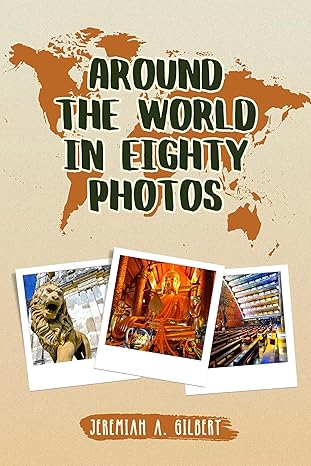
Jeremiah A. Gilbert’s Around the World in Eighty Photos is more than just a photography book; it’s a visual adventure that takes you across the globe through the lens of an experienced traveler. Instead of sticking to well-known landmarks, Gilbert hones in on the often-overlooked corners of the world, giving them the spotlight they deserve. Each photograph is accompanied by a story—sometimes historical, sometimes personal, always engaging. He also shares the technical details behind each shot, making it both an inspiring and educational experience for photographers and travel enthusiasts alike.
As a photographer, I appreciate that Gilbert doesn’t just show beautiful places—he invites us into his thought process. His image of Rano Raraku on Easter Island struck me the most. He describes setting up his shot without people, then serendipitously capturing two figures stepping into the frame, perfectly enhancing the composition. That’s what photography is about—being prepared, yet open to unexpected moments. The book is filled with these little surprises, making it feel like you’re traveling right along with him.
Another highlight is the way Gilbert balances storytelling with technical insight. In his photo of Mexico City’s Basilica de Guadalupe, he explains how he had to ride the moving walkway twice to figure out the best composition. The first trip was for analysis, the second for execution. That’s dedication. And in his shot of Iguazu Falls, he makes a conscious decision to use a fast shutter speed to capture the violent, thundering energy of the water, rather than the dreamy, silky look so many photographers go for. His approach reminds me that technical choices should serve the emotion of the image, not just the aesthetics.
This book is a must for photographers who love to travel, travelers who love photography, and anyone who dreams of seeing the world through fresh eyes. If you want a collection of images that tell stories, that teach you something new, and that make you want to grab your camera and book a flight, Around the World in Eighty Photos is an absolute treat.
Pages: 268 | ASIN : B0DY46TYP3


