Blog Archives
Psychological Layers

In Delphi, a woman struggling to find balance between the past and present embarks on a journey of self-discovery, seeking the wisdom of an oracle. What was the inspiration for the setup of your story?
The seed was planted in the first novel Dancing the Labyrinth when one of the Minoan characters was bitten by serpents and saw her future as establishing the Oracle for Gaea at Delphi (500 years before Apollo). This is interwoven with a contemporary narrative. I wanted to use the main character Cressida as a sounding board for society’s expectations of women to fit patriarchal culture, especially in the entrenched institutions of marriage and finance. I didn’t anticipate deep diving into Cressida’s backstory and work through generational trauma. That evolved through the writing process. It makes sense though, that in making major decisions, we need to know ourselves – what is right for us. Cressida comes from a dysfunctional family and has no confidence in her choices, so she sets off to Delphi to seek the Oracle’s advice because of what is written on the temple of Apollo ‘Know thyself.’ She is unaware she is an integral part of a major plot being played out within a mythological timeframe. Inspiration for this component came from writing in situ. I have a felt-sense of place and when added to my research, compelling stories find their way to my page.
What is it that draws you to mythology?
When I was young, I was drawn to Greek mythology rather than fairy tales. I once read that there are only seven original stories and in all my creative work I have sought the corresponding Greek myth – whether or not I have incorporated it into the narrative. As an adult, I am interested in the psychological layers they offer, but I am also learning other versions of the same myths from archaeological research that do not necessarily confer with the known version, i.e. the voice of the occupier/conqueror. For example, the story of the Minotaur comes from Minoan history, not Greek/Mycenean. There is a stark difference between their accounts.
What was your writing process to ensure you captured the essence of the characters, specifically Cressida?
Because Delphi is a sequel, and Cressida was already my protagonist, she has a definitive voice. Four years on she is older and more confident with life, but she still responds to triggers – her fight/flight tendencies. She is in a process of healing and so to authenticate her life experiences I researched and read about healing from childhood wounds and trauma. I enjoy writing her and getting caught up with her impatience and frustrations. She is deeply flawed but (I think) likable.
I believe everything we create contains personal elements. My characters have specific attributes I recognise that can be explored in the context of plot to express their own nuances and idiosyncrasies, whether subtly or exaggerated. Many of the places, and some of the experiences mirror my own, but from another perspective that enhance my understanding but also adds an honesty to the work.
What is the next book you are working on, and when will it be available?
I am currently working on a travel memoir of when I lived in Crete for a year and wrote Dancing the Labyrinth. As I’d like to get Delphi translated into Greek and do a book tour through Greece next year, I’m planning for the memoir to be ready for release in 2026.
Recently, I released a quirky humorous nonfiction collation of illustrated memes and quotes called The Little Book of Red Flags. I’m planning to follow this up with The Little Book of Apologies (for those who find it so hard to say sorry).
Author Links: GoodReads | Website | Facebook | X (Twitter) | YouTube | Instagram | Threads | Amazon
With a rich tapestry of snakes and prophetic visions, and a captivating heroine in search of her own truth, Delphi offers a spellbinding exploration of the human spirit. Prepare to be swept away by a story that seamlessly weaves the threads of ancient lore with a young woman’s unyielding quest for understanding.
Delphi straddles history and mythology. Sequel to Dancing the Labyrinth, it can be enjoyed as a stand-alone novel. It is the third book in the thematic series Women Unveiled, which blends myth, history and imagination in the telling of (almost true) stories.
An Ancient Matriarchal Society
Dancing the Labyrinth follows a young woman from an abusive background who discovers the veiled history of the Minoans. What was the inspiration for the setup to your story?
The kernel of this idea came from a concern: How, as a mother, can I raise my son to be a decent human being? The unspoken part of this question is – ‘in a patriarchal society.’ Australia has escalating numbers of domestic violence, and because I am contributing to raising the next generation, I feel I have some accountability. As a theatre writer I was surprised the idea came as a novel, so I thought, having planned to live in Crete for a year, I would write it there. At that time I had no idea about the Minoans. So you can imagine my delight to find myself walking the paths of an ancient Matriarchal society. The more I researched, the more the story blossomed. I could never have written it anywhere else. Crete is a very strong land, and is very inspiring. It is full of stories.
Cressida is an intriguing and well developed character. What were some driving ideals behind your character’s development?
To be honest, it was always Cressida’s voice I followed. I have tamed her down a bit – initially she swore like a trooper. In writing, I believe there are aspects of oneself that seep through and I drew on my love of Greek mythology and some of the experiences I had in Crete – like getting sick and being told that “Kriti has me” – which it does. I also drew on my experience of running circus workshops for young women who were survivors. I used their experiences as appropriate. For example, traits such as anxiety, lack of self-worth and distrust. In terms of character development, I am aware of the stages of the ‘hero’s journey,’ and this worked beautifully for Cressida’s growth and development. I also included concepts from psychologists Carl Jung and Erich Newman.
What were some themes that were important for you to explore in this book?
All my creative work tends to explore transitions. I am really interested in those undefined areas between boundaries where something is transitioning from one thing to another. In Dancing the Labyrinth one theme was the movement from matriarchy to patriarchy. The Minoans didn’t have any weapons for war and yet were the most advanced civilization in the Bronze Age. Patriarchy from the north brought violence with it. I also explored transitions in consciousness, where our mind shifted in ways of thinking: from the mystical to magical, introducing rational thinking, and because it was a different way of thinking we were unable to contain both. Vrados exemplifies this shift. This research drew on a great book called The History and Origins of Consciousness.
What can readers expect in the next book in the The Women Unveiled series?
I have just finished the first draft and started my editing process. It is called ‘the Bringer of Happiness.’ My pitch to date is: Imagine if Jesus and Mary Magdalene had a daughter who could time travel. This could be her story.’ I would be very happy with your feedback on this 😊
Sara floats into other people’s bodies. Through her we witness early Christianity – leading up to the Cathar’s massacre at Montsegur. It refers to Greek mythology, especially Persphone and Ariadne, and references the connections between the Eleusinian Mysteries and that of the Mysteries purportedly taught by Mary Magdalene in the South of France – Languedoc region.
My third book in the series will return to Cressida, and follow Ashtar as she leaves the community and establishes Delphi.
Author Links: GoodReads | Twitter | Facebook | Website
Dancing the Labyrinth moves between contemporary and ancient Crete in this tale of a young woman from an abusive background who discovers the veiled history of Europe’s most advanced civilization of the Bronze Age – the Minoans.
PERFECT FOR FANS OF MADELINE MILLER’S CIRCE, PAT BARKER’S THE SILENCE OF THE GIRLS AND KATHLEEN MCGOWAN’S THE EXPECTED ONE
Karen Martin’s spellbinding debut brings women’s history to the fore – relevant in the landscape of the #MeToo movement and #EnoughisEnough
Dancing the Labyrinth
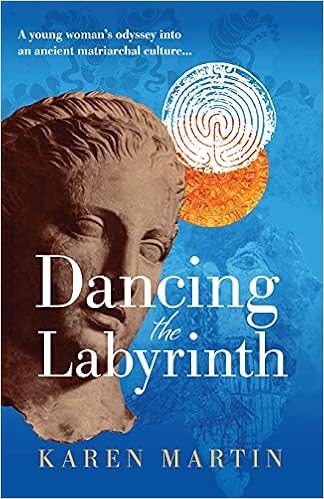

Dancing the Labyrinth by Karen Martin is a story filled with myths, legends, and goddesses. Karen has woven a tale of the past connecting flawlessly with the future by covering the bridge with a vision of the priestess. Dancing the Labyrinth is a story that makes you question your beliefs. I love tales which makes you broaden your horizons and forces you to see and experience something different, something that changes your perspective. Cressida, whose life changed when she arrived in her dream country of Greece, stumbling into a tomb where she experienced the parallels of the world, the past and the future. The experience was divine, yet gruesome.
Author Karen Martin describes the existence of a matriarchal society. Many religions claim it to be true, but Karen captures the essence of it. The transition that shifted society to a patriarchal and violent nature, the story tells this perspective through Pythia, Ashtar and Lydia. The Priestesses, the embodiment of the Mother, the Goddess. It’s a tale of time, conveyed to Cressida through her dreams. But the story doesn’t stop here. Instead, with the help of Angela, Cressida tries to understand and to decipher what happened to the civilization, the existence of the tomb. It is a harrowing story. With the suffering inflicted upon women, to the modern world. Greek mythology is famous all over the world, but the perspective on it in this book is unique and intriguing.
The story continuously switches writing styles. The book starts casually and with contemporary language and then switches to old an older writing style. Along with this we also get switches in point of views. The story is also filled with Greek myth references that will definitely appeal to readers who are familiar with the mythology.
Dancing the Labyrinth was a rewarding experience. I love a story where mythology meets science and the premise was refreshing and made for a riveting read.
Pages: 300 | ASIN: B0985T8VTH




 LITERARY TITAN