Blog Archives
The Weight of 100% Perfection

A Child’s Dream centers around a girl who repeatedly dreams that her Appalachian community builds a silver sled for children and Santa and his elves as they face a mysterious plague. Where did the idea for this story come from?
I was inspired by my own dream while visiting a friend who lives in Niagara Falls, and imagining people with many of their own tools coming together to build a sled.
Why was the theme of second chances an important one to incorporate into your storyline?
Absolutely! As young people can feel fearful about their future and the risks they face, the weight of 100% perfection can be crushing when those plans do not work out as intended. Even when we get the air knocked out of us like a football player, we take our breaks but get back on the field, and that’s our second chance for our Super bowl win.
Where did you get the inspiration for Krystal’s traits and dialogue?
Krystal’s traits are those of that friend we have who loves laughter and pranks, but in a pleasant way, you don’t know what she’ll do next. Shuffling her feet to create static electricity, she’ll probably shock you. Lol. Mixed with some middle child energy.
Can we look forward to more children’s books from you soon? What are you currently working on?
Absolutely, it’s in the works, and it’ll also be focused on action and adventures for young adults and teens, and a mix of silly and serious. After all, hopefully we can all have a lot more silly in life that we all know comes with seriousness.
Author Links: GoodReads | Facebook | Website | Amazon
We need a good laugh…for real with a story having both Action and—Humor!Right Now find out in this Comedic Action and Adventure Story that is
“A Child’s Dream: Santa’s Parking Ticket & an Empty Sled.”
My Dad, My Hero


My Dad, My Hero, by Kacey Hoysted, is a short, rhyming picture book about a kid whose father serves in the army. The child talks about Dad’s “cams and combat boots,” the obstacle courses, the late nights, the gear, and the long stretches apart, then circles back to how much fun they have together and how he is their hero who helps keep them safe. The last pages invite children to write a letter to their own hero parent and add a picture, and there is a heartfelt note from the author, plus a closing “Lest We Forget” spread filled with poppies and a glowing sky.
I really liked how simple the writing is. The rhymes feel natural and light, and they roll off the tongue when I read them out loud. There is no heavy explanation of war or danger, just small kid-sized details like painted faces, staying awake until sunrise, and missing Dad when he goes. It lets the big emotions sit in the gaps between the lines. The repetition of “my dad” and “my hero” gives the book a steady rhythm, like a heartbeat in the background, and it makes the story feel like a little poem a child might actually come up with.
The book treats military life as something real and tough, but also full of love and pride. I felt a tug in my chest when the art switches to silhouettes in the poppy field and again in that final “Lest We Forget” page, because it nods to sacrifice without spelling it out. The activities at the end are a sweet touch. They turn the book into a keepsake, not just a quick bedtime read. Kids can claim their own hero, whether that parent is deployed, training, or working odd hours, and that feels both comforting and empowering.
I would recommend My Dad, My Hero to military families and especially to kids who have a parent in the army or any service role that takes them away from home. Hoysted’s book is idea for classroom discussions about remembrance days or service and sacrifice because it offers a very soft, age-appropriate narrative. It is short, warm, and easy to share, and it opens the door to big conversations without feeling scary.
Pages: 26 | ASIN : B0GKD3542T

It’s Okay to Show Emotions
Captain Smiley: The Adventure of the Bouncy Frisbee follows a young boy who learns to solve his problems with the help of a police officer pal. What first inspired you to create Captain Smiley as a superhero for young readers?
In creating Captain Smiley, I envisioned a small community where the police officer knew everyone in the neighborhood. He knew how to handle easy to difficult situations. He handled these situations by using his words. I felt it was important to create a character who teaches children how to use their words when they feel upset, angry, or frustrated. After sharing my idea with a group of elementary school teachers, I realized the importance of creating an awesome hero like Captain Smiley. He motivates and encourages children to use their voices. Also, to teach them the importance of controlling their emotions while helping them understand that it’s okay to show emotions.
Why do you think it’s important for young readers to name their feelings while learning how to handle their emotions?
Expressing how you feel isn’t easy. Getting a young person to express how they feel can be very difficult. However, I feel it is important to identify the exact emotion to find a solution to the problem. When a person feels frustrated, it is not the same as being angry. Ace was angry about his frisbee. Once Ace expressed his feelings, it made it easier for him to calm down and focus on fixing the problem. It is important to identify the right feelings to help control the emotion being felt at the time. I think it is essential for children to feel free to express their emotions.
What is the most challenging aspect of creating a graphic novel? The most rewarding?
The most challenging is finding an illustrator to bring your vision to life. As a writer, I can visualize the story I would like to tell. Once you find a connection with the right illustrator, it is an amazing feeling to see what they can do. The most rewarding is a combination of telling the story and watching the illustrations tell the story without words. To answer the question, the illustrations are the most challenging and the most rewarding, from my point of view.
Can readers look forward to more adventures featuring Captain Smiley?
Yes! The second book is completed and waiting to be illustrated. I am hopeful it will be released this spring/early summer. . I will be releasing five books in the Captain Smiley’s series. I am super excited to share and introduce Captain Smiley to the world. Go Captain, Go!
Author Links: Website

O Tubarão Que Queria Surfar / The Shark Who Wanted To Surf
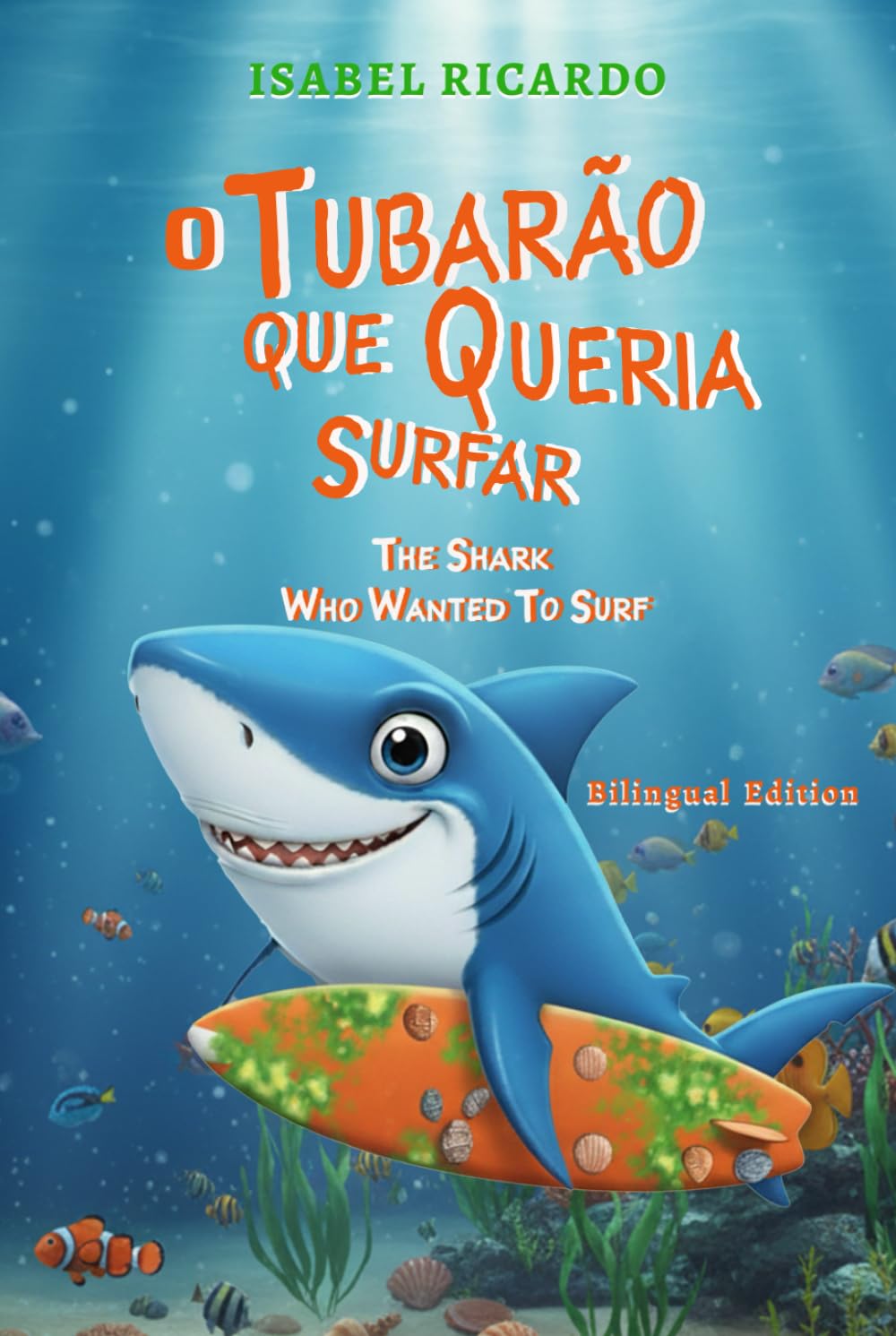
The Shark Who Wanted to Surf by Isabel Ricardo is a fun, fact-filled story about a blue shark named Carmel who dreams of surfing like the “two-legged creatures” on the surface. Each time he swims close enough to learn, the humans panic and flee. Carmel is left disappointed. Still, he refuses to let fear or doubt wash away his goal. That persistence gives the book a heartfelt, encouraging tone.
Ricardo introduces a variety of sea creatures who become part of Carmel’s world. Along the way, readers pick up engaging facts about anatomy and behavior. Those details deepen the underwater setting while also tracking Carmel’s emotional journey. Some animals dismiss his dream as silly. That response may feel familiar to young readers who have ever been discouraged for wanting something different. Others respond with warmth. Fizz the dolphin and Tentaclaude the octopus stand out as steady sources of support. Their kindness shows how far encouragement can go when someone is learning, growing, or trying something new.
A standout feature is that the book is bilingual, which adds an extra layer of value to the reading experience. Seeing the story presented in two languages supports vocabulary growth and language confidence without interrupting the flow. It also invites shared reading between children and adults who may be stronger in one language than the other. In a story centered on reaching across differences and refusing to give up, the bilingual format feels especially fitting. It widens the audience, strengthens comprehension, and makes rereading even more rewarding.
The backgrounds are detailed and adorable. The underwater scenes feel lively and full of personality. The color and small visual touches make the setting welcoming, even when Carmel hits setbacks. The illustrations also strengthen the emotional moments, especially when Carmel feels hopeful and determined because his friends believe in him.
I would recommend The Shark Who Wanted to Surf to young readers who enjoy ocean adventures, and especially to anyone who needs a reminder that dreams are worth chasing. Even when others disagree. It’s a gentle, uplifting story about friendship, courage, and self-belief.
Pages: 109 | ISBN : 978-1962185783
The Prince’s Dress Dilemma

The Prince’s Dress Dilemma, by Sara Madden, follows young Prince Eric, a kid who seems to have it all. He is growing up in a palace with his twin sister, Erica, and their dog, Arthus. His days are full of games and little adventures, and every night he pulls on his favorite nightgown and drifts off to sleep completely content.
One morning, though, everything feels different. Eric wakes up to discover he’s had a growth spurt. Overnight, he’s shot up so much that none of his clothes fit, especially not anything fancy enough for the upcoming royal ball. He’s worried, but his parents aren’t. The king and queen quickly come up with a plan: they’ll send him to the dressmaker to have a royal ballgown made just for him. Once his new outfit is finished, Eric heads to the ball ready to enjoy himself, confident that he looks exactly the way he wants to look.
The Prince’s Dress Dilemma, by Sara Madden, is a short children’s book that feels perfect for young kids, especially as a bedtime read or a cozy rainy-day story. The plot is simple, the language is accessible, and the pictures help carry young listeners through the story without losing their attention.
It’s hard to talk about this book without mentioning the obvious: Eric wears nightgowns to bed and prefers dresses during the day. The book is welcoming to the LGBTQIA+ community, even though those terms never appear in the book, and it tells a supportive story for anyone who may find themselves in Eric’s shoes. Eric’s family accepts his clothing choices without fuss, and that quiet, steady support turns the story into one about exploring and celebrating gender expression that doesn’t always fit traditional expectations. The warm and charming artwork reinforces this, especially scenes from the ball that show same-sex couples dancing together.
Parents who want their children to grow up seeing and valuing diversity are likely to embrace The Prince’s Dress Dilemma. The story itself is gentle and good-natured. It encourages kids to feel comfortable in their own bodies and their own choices. That’s a message many parents can stand behind. And for the children who read this book, there’s a clear and valuable lesson: acceptance and kindness toward people who are different from you are not just important, they’re normal, and they’re good.
Pages: 43 | ASIN : B0C5P1TN2H
Line ‘Em Up!


Line ’Em Up! by Oscar Avery is a heartfelt, motivating children’s book about a classroom many have already written off. After three teachers walk away, a weary group of students, often labeled as misfits, meets a new teacher, Mr. Murant. He refuses to define them by their past. He shares pieces of his own story. Trust forms slowly, then steadily. With small but meaningful lessons, down to something as simple as standing tall in a straight line, Mr. Murant helps his students recognize their worth. Confidence builds. Self-perception shifts. The change feels real, and it lasts.
The story carries a more serious tone than many children’s titles. Even so, it stays warm, hopeful, and deeply encouraging. Oscar Avery handles complex themes with care. Self-doubt appears on the page. So does perseverance. Growth follows, step by step. Young readers are invited to engage without being overwhelmed. The book also raises awareness of CTE and other disabilities, introducing new vocabulary and ideas in a respectful, age-appropriate way. It trusts children to learn and reflect. It does not flinch, and it does not preach. Adults reading alongside them may find themselves learning too, about invisible challenges, and about the lasting impact of a teacher who chooses patience over judgment.
Docker’s illustrations bring the classroom to life on nearly every page. Each character looks distinct. Each expression feels intentional. Frustration shows up clearly. Uncertainty lingers in posture and eyes. Then, gradually, confidence arrives. The artwork captures these emotional turns with warmth and clarity, strengthening the reader’s connection to the students’ journey. For children who lean on visuals to process feeling and change, the illustrations add real accessibility.
What makes this book linger is its quiet reminder that confidence often grows in tiny increments. Mr. Murant never sells instant transformation. He offers belief. He offers structure. He offers time. In doing so, he shows his students they are capable of far more than they have been told. Line ’Em Up! is an inspiring, meaningful read for slightly older children, one that encourages empathy, self-belief, and a deeper understanding of difference, while delivering a story that stays with you long after the final page.
Pages: 45 | ISBN : 978-1-7345743-0-2
Fairness and Equality
Line ‘Em Up! follows a group of students whose world is changed by a new teacher who shows them how to find the greatness inside themselves. What was the inspiration for the setup of your story?
I was incredibly fortunate to have one of my early stories critiqued by the late James Alan McPherson. He once told me that the most powerful stories are often about ordinary people placed in extraordinary situations. That idea stayed with me, but as a special education teacher, I found myself drawn to the reverse: extraordinary individuals navigating what the world considers ordinary.
My students—many of whom have disabilities—work every day to master skills that others take for granted. Something as simple as forming a straight line can be an enormous triumph. That contrast fascinated me. I wanted to explore the dignity, determination, and quiet heroism embedded in those moments.
So I paired these extraordinary children with a teacher who is extraordinary in a very different way—a former professional football player who once seemed invincible, now facing the realities of chronic traumatic encephalopathy. Placing these two worlds side by side allowed me to explore resilience, vulnerability, and the ways people lift one another up.
Ultimately, I hoped to create a story that resonates because we all know someone who appears larger than life, and we all know someone who faces daily challenges due to disability or illness. Line ’Em Up! brings those experiences together in a way that I hope feels both heartfelt and universal.
Is there anything from your own childhood included in the characters in Line ‘Em Up?
Growing up in Massachusetts in the 1970s, I saw how students in special education were often separated from the rest of the school. I didn’t understand it then, but as I grew older and became a special education teacher, I learned that those classrooms held a wide range of students. Some were there because of genuine cognitive disabilities, while others were placed there due to emotional trauma, unstable home lives, or circumstances far beyond their control.
That understanding shaped the way I think about fairness and equality—two ideas I consider very different. Equality means everyone gets the same thing; fairness means everyone gets what they need. That distinction has guided my teaching and deeply influenced Line ’Em Up!
While none of the characters are based on specific individuals, the emotional truth of the story comes from witnessing how children grow when they’re understood, supported, and included.
The artwork in your book is wonderful. Can you share with us a little about your collaboration with illustrator Sarah Jane Docker?
One of the main reasons I reached out to Sarah Jane Docker is simply because she’s an exceptionally talented illustrator. When I looked through her portfolio, I immediately felt she was the right fit for this story. Her characters didn’t look like the typical, polished industry illustrations you see everywhere—there was warmth, honesty, and a lived‑in quality to her work that felt real.
Representation was also incredibly important to me. According to a 2019 study by the Cooperative Children’s Book Center, only about 3.4% of children’s books feature a main character with a disability. When I saw that Sarah naturally included Black, white, Asian, and disabled characters in her illustrations—not as statements, but as part of the world she creates—I knew she understood the heart of this book. That says a lot about an illustrator.
I also want to highlight the tremendous contribution of our layout artist, Anna Lubecka (and her husband Greg), founder of Banana Bear Books. The collaboration between Sarah and Anna elevated the entire visual experience. Without their combined talents—the illustrations and the thoughtful layout—the artwork wouldn’t resonate with readers in the memorable way it does now.
What were some ideas that were important for you to share in this book?
Several ideas were especially important for me to explore in Line ’Em Up! One is the distinction between fairness and equality—a theme that runs through both my teaching and my writing. Equality means everyone gets the same thing; fairness means everyone gets what they need. That difference matters deeply in classrooms and in life.
I also wanted to play with the contrast between the extraordinary and the ordinary—how children who are often overlooked can show remarkable strength in everyday moments, and how something as simple as forming a straight line can become a powerful act of growth and pride.
And finally, the idea of “Champions” versus “Champeons” is woven into the heart of the story. Readers will understand the meaning once they experience the book, but it speaks to the difference between looking like a champion and truly becoming one.
These themes guided me as I wrote, and I hope they resonate with readers of all ages.
Author Links: Instagram | Email
Navigating New Ideas
Surprising Max follows a soccer-loving boy who reluctantly practices piano and discovers, alongside a blooming amaryllis, that patience and care can unlock unexpected confidence and talent. What was the inspiration for the setup of your story?
A retired music professor and piano teacher, I made up Max’s story for Sunday School children, as an introduction to Advent, a season of waiting and preparation that precedes Christmas. A piano teacher enjoys a unique influence in a child’s education, guiding year-by-year growth. And, since music is a performance art, the recitals become the show and tell for performers and parents. Max GETS surprised, at his performance, at the appearance of the high school soccer star, who dazzles at the piano, and by the beauty of the red amaryllis. But, even more than that, Max IS the surprise. He has amazed the audience, his mom, and, of course, himself.
How did you approach writing a story about perseverance without making it feel instructional for young readers?
Max’s thoughts are expressed through his “italicized” questions. We are privy only to what he’s feeling: self pity, bewilderment, amazement, worry, and finally, a proclamation. For most children, navigating new ideas requires an emotional safety net that permits questions that may not have answers.
What role did the illustrations play in shaping Max’s emotional journey as you envisioned it?
Our sons’ favorite book was the great Alexander and the Terrible, Horrible, No Good, Very Bad Day. While my illustrator couldn’t copy that little boy, she came very close to capturing that disheveled awkwardness. Max’s smiles bookend his experiences; he was happy playing soccer AND, eventually, playing the piano.
What do you hope children feel or reflect on after finishing Surprising Max?
A friend told me that, after receiving Surprising Max for Christmas, her grandchildren decided to take piano lessons. Obviously, that was a wonderful reflection on Max! Not every child will become a musician. However, the pursuit of music making is filled with life-enriching and life-enduring lessons. My hope would be that every child feels welcomed in that world.
Author Links: GoodReads | Amazon


