Blog Archives
Romance in Unexpected Places

Remember, It’s Just in Your Head follows a university student navigating grief, anxiety, identity, guilt, and the difficult journey toward choosing to live after the suicide of his close friend. What was the inspiration for the setup of your story?
I am someone who never really acknowledged the mental health of others around me when I was growing up. I realised as I grew older that it’s important to be conscious of everyone who is around you, because their presence can be very beneficial to recovery when you feel low.
Life can take a major turn without any warning, so Reuben personifies how unpredictable these scenarios can be.
Guilt comes because of reflection on decisions that have had consequences that could’ve been avoided. The struggle is that you can’t change the past, and that in itself is a feeling you have to overcome.
How did you balance the novel’s darker themes with its moments of humor, friendship, romance, and hope?
All our emotional responses are built upon interwoven experiences; ruminating on darker themes would make the story too morbid. Reuben as a character’s life still needed to progress even if he was faced with such profound, depressing challenges.
I made Reuben an intuitive character who explored himself as a person and worked out how to tackle his vulnerability by seeking support when he realised he needed it. Humour is a way of relieving stress and anxiety, connecting with people to find positives out of awkward or uncomfortable situations. The story explores this by expanding upon the various personalities you come across in day-to-day life.
Finding romance in unexpected places helps Reuben develop as a character; he learns about his sexuality by exposing himself to people who can relate to it themselves. Nathan is a fundamental character in that plot arc and shows that there are people out there who are going or have gone through similar experiences.
How did you approach writing Reuben’s memories of Ava without reducing her character to her death?
Reuben reflects on several occasions throughout the story when he is faced with objects or situations that give him nostalgia.
Ava has a relationship with him that has lasted many years, and this is depicted by how well they know each other. This is shown in how much they open up to each other and how they promise to be there for each other when they’re struggling. They share sanctuary spaces around town that Reuben feels connected to and comfortable escaping from the harsh community that he is exposed to.
Ava is represented both in life and in death by her Polaroid Camera and how she insists that Reuben takes pictures of “the good stuff.” She shows him how to find beauty in the ordinary and turn something plain into something special.
The story explores art in various forms to show how much someone can connect with their natural passion. Reuben knows by the end of the story that whether Ava is alive or dead is irrelevant to how influential she has been in supporting him mentally in his acceptance of himself.
What did you want readers to understand about queer love within a story that is also centered on grief?
That LGBT+ people are not alone when they’re nervous about coming out. That mental health is a journey that encompasses acceptance regardless of how long it takes.
Sexuality and gender are not something that should define you, in the same way that anxiety shouldn’t. Just be true to yourself and take your time with the hurdles that you come across.
If you love someone, you should make it count, whether they’re the same or opposite sex. Missing opportunities is not something you’d want to dwell on in the future or regret.
Grief is not something that you should have to endure all through life; it shouldn’t trap you. However, all things that are close to our heart take time to heal.
Make sure you value yourself and everything around you because life is never guaranteed to be stable. Make things as easy as possible for yourself to achieve the happiest well-being.
Reuben never chose to be gay, but he learns this from finding solace. Any reader who can relate to this needs to know that life is always about focusing on the “good stuff.”
Author Links: GoodReads | X (Twitter) | Facebook | Website | YouTube | Instagram | TikTok | Amazon
Haunted by what might happen and burdened by his secret, Reuben is trying his hardest to cope. With him sharing sanctuary spaces with his close friend Ava around town, the two have places to relieve stress, where no one can find them.
When Ava’s own pain proves deeper than anyone knew, Reuben is left with grief, guilt, and the impossible question of whether he got caught up in his own spirals too much to notice. Remember, It’s Just In Your Head is a tender contemporary novel about friendship, loss, self-forgiveness, and making sure that anxiety isn’t something that defines you.
“Photography isn’t about capturing perfect moments. It’s about finding beauty in the ordinary, and turning something so plain into something special.”
The Scarecrow’s Secret
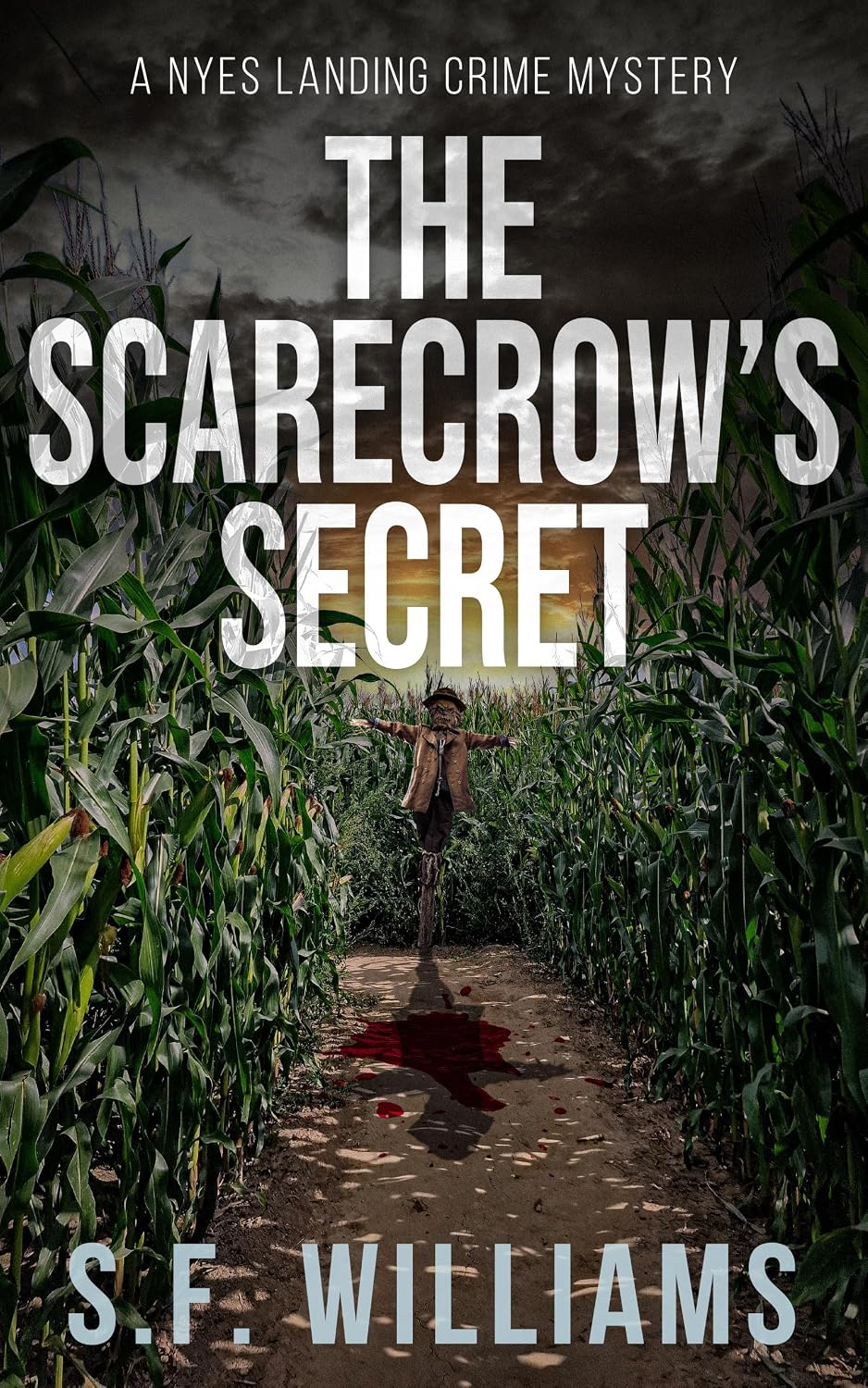

S. F. Williams’s The Scarecrow’s Secret is a character-driven small-town crime mystery that places a murder investigation inside the close, complicated community of Nyes Landing. When migrant worker Blanca Sanchez is found murdered in a corn maze during the town’s harvest festival, Detective Callum “Cal” Nowak is drawn into a case crowded with possible suspects, conflicting accounts, buried family secrets, and local prejudices. Williams makes good use of the festival setting, moving from bonfires, scarecrows, farm animals, and autumn crowds into an increasingly serious investigation. The mystery develops methodically as Cal follows physical evidence, revisits assumptions, and gradually discovers that Blanca’s death is connected to secrets extending well beyond the night of the murder.
Cal gives the novel much of its personality. He’s capable and persistent, but he’s also impulsive, sarcastic, emotionally guarded, and still learning what it means to be both a detective and a dependable partner. His first-person narration allows the procedural elements of the case to sit comfortably beside humor, friendships, family history, and the routines of life in Nyes Landing. Williams also gives substantial attention to Cal’s relationship with Demetrius, particularly as the dangers of police work begin affecting their life together. Demetrius’s admission, “I love you, Cal. I love you, too. But I don’t love your job,” distills one of the book’s strongest personal conflicts: loving someone whose profession repeatedly exposes both partners to consequences neither can fully control.
The novel’s larger concerns deepen the mystery without displacing it. Blanca’s murder unfolds amid racism, hostility toward migrant workers, homophobia, political opportunism, domestic violence, disability, and the unequal ways people are treated according to their status in a community. These issues become part of the investigation because they shape what witnesses notice, whom people suspect, whose testimony receives attention, and what victims are able to say safely. Williams is particularly effective when the case forces Cal to reconsider an apparently simple explanation and continue investigating after others are ready to settle for an easier conclusion. The eventual discoveries involving the O’Leary family give the title real significance and connect the central murder to a longer history of concealment and abuse. The recovery of human remains beneath the barn further reinforces how thoroughly the present crime is rooted in the past.
The Scarecrow’s Secret succeeds as both a murder mystery and another chapter in Cal’s continuing personal story. Williams balances investigative developments with an unusually populated community, giving Nyes Landing the feeling of a place whose residents have histories with one another that extend beyond the immediate crime. That continuity makes the final portion especially effective: solving the case brings consequences rather than simple closure, while Cal’s relationship troubles, his unresolved search for his mother’s killer, and the changing lives around him remain active parts of his story. By the end, the book’s interest in justice has broadened beyond identifying a murderer to include responsibility, protection, prejudice, and the damage people leave behind. It’s an engaging, compassionate crime novel whose mystery matters because the people caught inside it matter.
Pages: 301 | ASIN: B0HBQWCDJH

Stories are Told by the Storyteller

Reel Around the Fountain follows a boy from a working-class family navigating his growing awareness about his own sexuality as he searches for answers about his family’s past. What was the inspiration for the setup of your story?
The core of the book’s genesis wasn’t so much about family history as it was about examining how queer kids are often targeted by predators. Queer kids tend to be good at keeping secrets — at blending into the background, into the walls — and I wanted to explore and expose that. The intersection of queerness and working-class, paycheck-to-paycheck life creates conditions predators can take advantage of. That intersection wasn’t something I saw represented growing up, and it’s still not something I find often, but I wanted to portray it with fairness and affection. It’s a world I know well, and I wanted to honor it.
But I was equally interested in family dynamics, and how those dynamics create room for people like priests to exploit queer kids. As I structured and wrote the book, though, the family itself started to take over. I felt it was important to show that kids from poor backgrounds aren’t exploited because of some lack of love or parenting — it’s that society creates the conditions that marginalize working-class families in the first place, and predators find the cracks in those conditions.
The story captures working-class life with remarkable specificity. How important was it to portray that community with both honesty and affection?
This was extremely important to me. I didn’t want to pander, stereotype, or romanticize working-class life and people. It was key to me to examine how we pull the levers we have access to in this life — and sometimes that may not be many levers at all. In addition to this, I wanted to explore gender roles, and how working-class life is often misunderstood to be rigidly gendered when, in fact, that isn’t always the case. With the grandparents in particular, I wanted to examine masculinity and femininity as a spectrum, not a binary norm. The grandfather and grandmother expose how circumstance often dictates what gender expression in family caregiving actually looks like.
Working-class life also often starts earlier than other facets of life do. White-collar, wealthier kids get a different kind of upbringing — more protected, more cushioned. Working-class kids shoulder different burdens, and shoulder them sooner. Through JP and his family, I wanted to explore that. I also wanted to highlight how the institutions that are supposed to protect people — police, social services, hospitals — often aren’t trustworthy, or aren’t there for people like JP’s family when it counts.
JP slowly learns that every family member remembers the past differently. What does the novel suggest about the relationship between memory and truth?
In any love circle — the one you’re born into or the one you build — stories are told by the storyteller, not recorded by some neutral archivist. As a storyteller myself, I can’t count how many times I’ve sat across from someone I love and found we remember the same event completely differently. I like that. And I know my version isn’t absolute truth. Instead, it’s a form of characterization. So while JP is trying to piece together the story of his birth, that search is also a way for him — and for the reader — to understand each family member through how they tell it. Every version of the story reveals as much about the teller as it does about the event.
I also think it’s important that truth, for the individual, is shaped by survival, not accuracy. What we remember is what we can handle remembering — what lets us survive the day, and the times, we’re living through. JP’s quest for the truth of his birth shows that we can never fully know it. Memory is fluid and fleeting. That’s part of the human condition. I hope that by the end, the reader is still left without the full truth of his birth story — but with the understanding that each storyteller’s memory reveals something about them, not about the events themselves.
What do you hope readers take away about family, forgiveness, and the stories we inherit?
We inherit stories, but since stories are fluid with memory, and truth is subjective, how we choose to shoulder and carry the burden of those stories matters. The truth of a story changes and evolves as we change and evolve as human beings. That’s key to this novel. We inherit family burdens, and those burdens are carried differently as we move through — and change within — this world. I want to be deliberate here with the word change instead of grow. Shouldering the burden of stories isn’t a progressive climb toward growth; it’s up and down, like every other facet of life. Where we are — reacting to outside circumstances — shapes our truth and our memory in that moment.
Forgiveness is a big part of this story, but for me as a writer, what mattered most was that JP needs to forgive himself — for the blame he’s chosen to inherit, both for the weight of his family’s beginning and for the abuse by the priest. If we can’t first forgive ourselves for things — even things that were never our fault, but that we assume blame for anyway — we can’t truly forgive the people closest to us.
Author Links: GoodReads | Instagram | Facebook | Website
Daywalker: Hybrid Vampire

Daywalker: Hybrid Vampire by Len Handeland is a supernatural horror novel that blends vampire fiction, historical horror, queer romance, and paranormal adventure. The story begins in postwar Norway, where Anna Beck becomes involved with Wolfgang Von Pritzker, a former German officer hiding a deadly identity. Their son, Christian, is born a dhampir, half human and half vampire, with a thirst for blood and the rare ability to survive in daylight. By letting Anna, Christian, and Christian’s lover Kjell narrate different parts of the story, Handeland gives the novel the feel of a collection of intimate confessions.
Christian’s journey gives this vampire horror story its emotional center. Abandoned as an infant and adopted as a child, he grows up trying to understand his unusual body, control his bloodlust, and find a place where he belongs. Music becomes both an escape and a clever disguise when Christian fronts a vampire-themed rock band called The Vamps. The irony is fun: the audience sees a theatrical gimmick while Christian is quietly revealing his real nature onstage. His rise through the European rock scene also adds an unexpected show-business angle to the paranormal fiction.
The novel’s relationships are as important as its supernatural confrontations. Christian and Kjell’s romance develops from friendship and attraction into a loyal partnership, while Christian’s reunion with Anna forces both of them to face the pain of his abandonment. Wolfgang brings a colder energy to the family story, representing the predatory side of vampirism that Christian fears inheriting. These connections turn the book into more than a vampire hunter adventure. It’s also a dark family drama about identity, inherited violence, forgiveness, and the choices people make when love and survival pull them in different directions.
Handeland writes in a direct, dramatic style, with plenty of blood, sensuality, emotional declarations, and classic vampire lore. The later chapters move firmly into paranormal action as Christian discovers the full range of his powers and battles the vampires created by his father. Readers who enjoy LGBTQ+ horror, dhampir stories, gothic vampire fiction, supernatural romance, and fast-moving battles between vampires and vampire hunters will find plenty to dig into here. Daywalker: Hybrid Vampire is a bold, personal take on the genre, combining family secrets, rock-and-roll ambition, romance, and monster-hunting in one expansive story.
Pages: 223 | ASIN : B0GXMX8DM6
It Wanted To Become A Novel Instead

Before Closure follows a family whose lives are turned upside down when the matriarch of the family leaves her almost forty-year marriage. What was the inspiration for the setup of your story?
The story has been in various stages of development for more than fifteen years. Frankie’s storyline was originally inspired by my own heartbreak. I drove past the house I had once shared with my ex, saw that it was for sale, and was overwhelmed by the memories it stirred. By the time I got home, the rough outline of the story was already in my head, and the first draft came together remarkably quickly. It began as a screenplay because I wanted to showcase Central Iowa in a way rarely seen on film, building the story around locations I thought deserved to be on screen. I also have an estranged relationship with my own father, so I wanted to write an idealized father figure who was loving without being perfect. During the pandemic, while caring for my mother through the final year of her life, I needed somewhere to escape at the end of difficult days. I pulled the screenplay out of a drawer and discovered it wanted to become a novel instead.
The rotating viewpoints allow readers to understand each character’s private struggles. Why was it important to tell the story through multiple voices?
The rotating viewpoints came about because it started as a screenplay, and I was writing with an ensemble in mind rather than just one main character. When I started working on the novel, I saw this as a way to explore love, fear, pain, family, betrayal, and unexpected connection through a kaleidoscope rather than a single lens.
What did you want readers to understand about the difference between loving someone and being able to let them go?
I wanted readers to understand that love and holding on are not the same thing. We often mistake sacrifice, rescue, or hope for love, when sometimes the most loving act is accepting that another person’s journey belongs to them, not to us. Letting someone go isn’t an act of indifference. It’s often the hardest expression of love because it requires us to surrender the illusion that we can change someone through our own persistence. We can offer compassion, forgiveness, and an open door, but we can’t live another person’s life or make their choices for them. In many ways, Before Closure asks whether closure is something another person gives us, or something we choose for ourselves.
What do you hope readers who have experienced family fractures or unanswered questions take away from the novel?
I’ve often said that I’m a storyteller with one goal: to make people feel less alone. If someone finds themselves in these pages, feels that tingle of recognition, and realizes how weirdly, wonderfully, beautifully complicated life and love can be while also believing, even for a moment, that maybe it’s going to be okay, then I’ve done my job. We don’t always get the answers we’re looking for, but that doesn’t mean the journey isn’t worth it.
Author Links: Amazon | Goodreads
In three days, Clayton is convinced his wife will return. It will be their fortieth wedding anniversary, and he believes she’ll come back to celebrate and rebuild what’s been broken.
Frankie and Jules aren’t so sure. Frankie has gone numb in the wake of his own relationship’s collapse, and Jules is barely holding a fragile marriage together. As one Iowa summer weekend unfolds, each of them must face an invitation to rethink the future they were expecting.
Told with sharp insight and quiet compassion, Before Closure is a tender portrait of love stretched thin, the burden of unspoken truths, and the messy grace of daring to live.
Reel Around the Fountain

Roy Edward Jackson’s Reel Around the Fountain is a coming-of-age novel about JP, a gay boy growing up in a working-class Michigan town amid illness, alcoholism, Catholic guilt, and a family that expresses love through caretaking, teasing, sacrifice, and the occasional hustle. The novel begins with JP learning that his birth coincided with several family upheavals, including the accident after which his father, already living with multiple sclerosis, never walked again. From there, JP tries to assemble the truth from relatives whose stories are shaped by grief, guilt, exaggeration, and self-protection. His questions about the past run alongside his growing awareness of his sexuality and his understanding that, in his world, becoming an adult often means knowing what must remain hidden.
The book’s most striking choice is its second-person narration. Calling JP “you” gives the story the intimacy of someone revisiting a younger self, sometimes compassionately and sometimes with exasperation. It also suits a novel preoccupied with memory. Scenes don’t unfold as a clean historical record but as stories retold, revised, and connected through songs, objects, hospital rooms, bars, Catholic rituals, and family sayings. Records are especially important. Music gives JP and his father a shared language, while scratched vinyl, skipping songs, cassette tapes, and 45 adapters become ways of thinking about damaged memories and lives that keep circling back to the same moments.
Jackson handles painful material with an earthy, observant sense of humor. JP’s attention can land on a dirty carpet, a strange phrase, a record label, or the social rules of a funeral home even when something devastating is happening nearby. That voice keeps the novel grounded in the physical details of working life and poverty. It’s also where the book finds much of its emotional force. JP’s family members are vivid because their care is practical and imperfect. GG manipulates systems, Paw Paw gives up trucking to become a caregiver, Anna turns pain into blunt jokes, and JP learns to work, write obituaries, take photographs, and tell stories. Even after abuse leaves him tangled in shame, the narrative stays attentive to the difference between what was done to him and what he’s been taught to blame himself for.
The novel is episodic and deliberately repetitive, shaped more like an album of connected tracks than a tightly plotted drama. Its recurring phrases and memories occasionally slow the pace, but they also create the feeling of a mind worrying at old wounds until their meaning changes. By the end, JP’s writing, music, and move to Chicago offer him a future built from the people he’s lost rather than an escape from them. The record-adapter tattoo he receives becomes a fitting symbol of that inheritance, something small that connects the music to the person carrying it. I’d recommend Reel Around the Fountain most strongly to readers who appreciate queer coming-of-age fiction, complicated family portraits, working-class settings, and novels in which pop music carries as much emotional history as dialogue does.
Pages: 324 | ISBN : 978-1590218013
Trials of a Legal Junkie


Rich Merritt’s Trials of a Legal Junkie is an ambitious, deeply personal novel about addiction in its many disguises. Rob Marion, a lawyer, author, former Marine, and recovering addict, begins the story riding the publicity rush surrounding his explosive memoir. He believes he’s finally gaining control of his own narrative, especially the painful history he shares with a fundamentalist Christian institution that taught him to fear his sexuality. But attention becomes another intoxicant, and Rob’s hunger for vindication, fame, sex, money, and professional status starts pulling him toward the same destruction he thought he’d escaped. Adapted from real experiences, the novel has the intimate immediacy of a memoir while giving Merritt room to shape a broad, eventful story about a man whose greatest talent is also his most dangerous habit: turning every part of life into a trial he has to win.
Rob is difficult, funny, perceptive, infuriating, and painfully recognizable. His intelligence lets him expose hypocrisy with precision, but it also gives him an endless supply of arguments for ignoring the people trying to help him. Merritt doesn’t flatten that contradiction. He lets Rob be generous one moment and ruthlessly self-involved the next, capable of defending society’s discarded people while treating those closest to him as supporting characters in his personal drama. The result is a protagonist whose gradual collapse feels convincing because it happens through dozens of choices that seem manageable in isolation. Rob’s sharp, frequently profane narration keeps the book conversational even as it moves through grief, relapse, homelessness, criminal courts, rehabilitation, spirituality, and the failures of powerful institutions.
The novel’s large cast gives the story much of its warmth. Friends, sponsors, lawyers, clients, fellow residents, family members, and beloved dogs repeatedly offer Rob forms of connection he’s too restless or wounded to accept. The late Gary, Rob’s Marine friend, becomes a particularly affecting presence, appearing in memory and imagined conversation as both conscience and companion. The legal storyline also grows richer as Rob begins using his training on behalf of people the system has decided are expendable. Courtroom maneuvering, appellate research, recovery meetings, service work, and meditation might seem like separate threads, but Merritt steadily binds them together through the idea of surrender. For Rob, surrender comes to mean neither defeat nor passivity. It means giving up the fantasy that brilliance, outrage, or relentless achievement can substitute for community.
Trials of a Legal Junkie has the generous, unruly scope of a life being reconsidered in full. Its length allows recovery to emerge as an uneven practice rather than a tidy transformation, built through daily work, painful amends, unexpected responsibility, and the willingness to keep loving what can’t be kept forever. Merritt writes candidly about sexuality, religious trauma, substance use, ambition, grief, and justice, but the book’s deepest concern is service: what we owe one another after our defenses have failed and our carefully constructed identities have fallen apart. By the final pages, Rob’s trials have become less about proving his worth than learning how to use his life, his losses, and even his contradictions for someone else. Raw, searching, and fiercely humane, Trials of a Legal Junkie shows that redemption begins when winning matters less than refusing to throw anyone away.
A World Of Possibilities

6060 Vision is centered around a biomechanical Golem who was built soley to observe, record, adapt, and learn, but begins to form connections. What first inspired the idea for 6060 Vision and its far-future Earth?
6060 Vision began with a single idea, playing with the word warehouse during a road trip from Salt Lake City to Anchorage. With so much time to daydream, warehouse became “werehouse,” akin to “werewolf.” The notion spiraled into a living conscious plant structure, that is, Anther’s Root in the story. 6060 felt like a fitting year for such a being to exist, given some imagination, sci-fi potential, and larger plans for the series. A world of possibilities unfolded, where the development of life was accelerated and less bound by time. I created our protagonist, Sam, to explore this land and meet its New People.
The Baast, Sen, Sagoin, Kalak, Mimicats, and Slik all feel distinct. Which species was the most enjoyable to create?
Of all the species and People I created, I absolutely love the Kalak. They’re based off of South America’s Maned Wolves, the real creatures are without peers and they look like they are full of secrets. I actually created the Slik first, the scene with them is one of the first I wrote, but imagining them was far from pleasant.
How did you decide when Sam would stop simply recording events and begin actively shaping them?
I’m not sure I ever knew when Sam would start actively shaping the events around them; my macro plans for the story are distinct and rigid, but, in micro, the writing process itself is haphazard and organic. One could argue that observation is interaction- much of Sam’s journey is similar to a field anthropologist losing objectivity. I knew I wanted Sam to mature, similar to a coming-of-age narrative, so their presence becomes less passive and their actions more decisive with each conflict. I love hearing from readers when they think the pivotal moment is.
What is the next book you are working on, and when will it be available?
6060 Vision is the first novel in a nine book series, a trilogy of trilogies! 6070 Vision is already in the works, set ten years after the first novel, with plans to publish in the Spring of 2027. I have the whole series and each character arc mapped out on a large paper graph. I’m very excited to share more.
Author Links: GoodReads | Instagram


