Blog Archives
The Hunting of the Snark
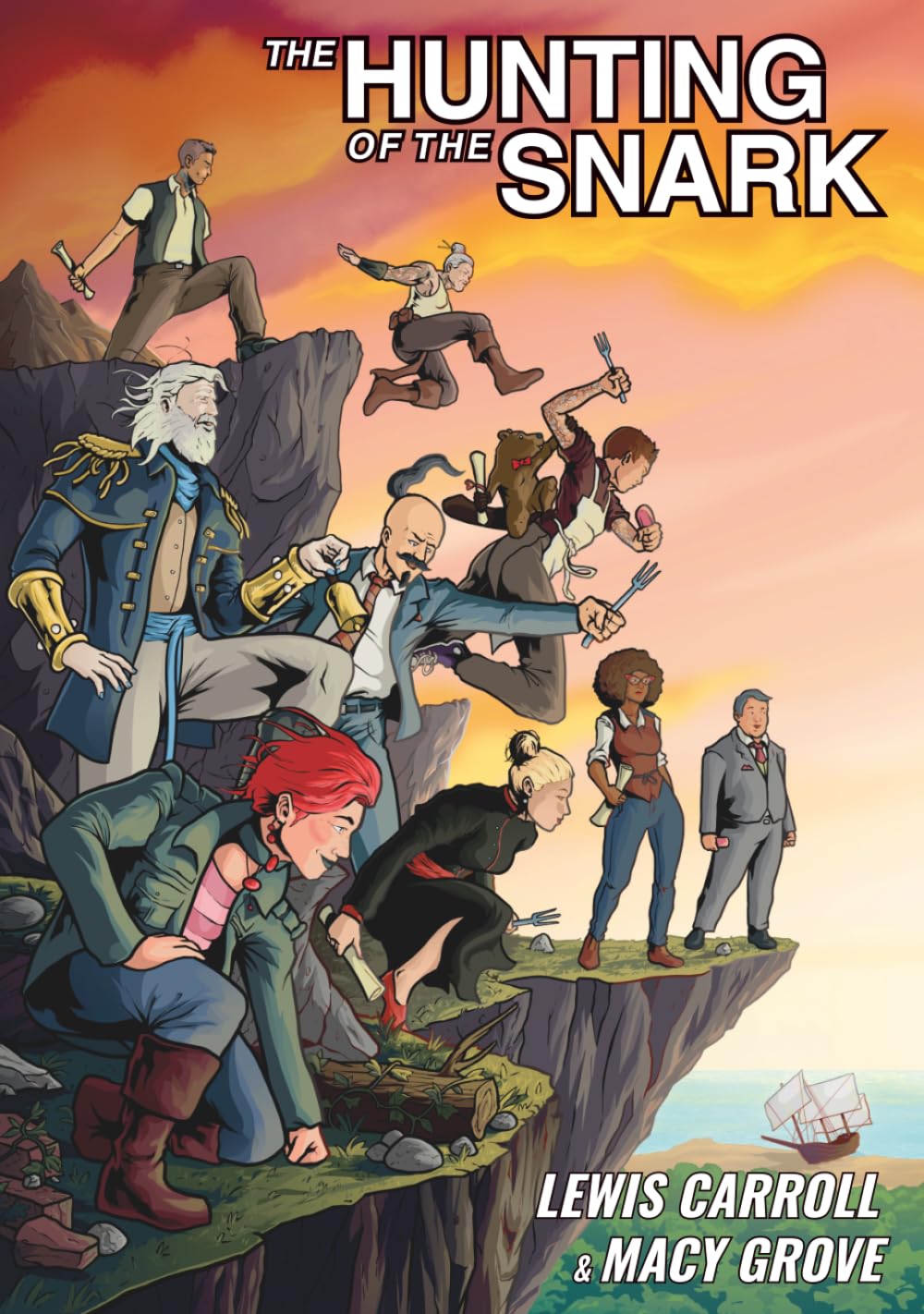

Macy Grove’s The Hunting of the Snark is a vibrant graphic novel adaptation and fantasy adventure built around Lewis Carroll’s famously strange 1876 poem. Grove preserves Carroll’s rhythmic language while giving the expedition a contemporary visual identity, with illustrations credited to Anonymous, Macy Grove, and Nyx Grove. The story follows the Bellman and a wonderfully mismatched crew as they cross an impossible sea, land in a landscape of chasms and crags, and begin searching for a creature they can barely describe. It’s playful from the start, but the silliness always carries a faint sense of danger.
The cast gives this illustrated fantasy poem much of its personality. The crew includes a Baker who has forgotten her name, a lace-making Beaver, a Butcher who can kill only beavers, a Barrister, a Banker, a Broker, and several other specialists whose talents are either oddly specific or completely useless. Grove updates the hunters into a broader, more varied group while making that choice part of the book’s own mischievous mythology. The character designs help turn Carroll’s list of occupations into an ensemble you can recognize, follow, and care about, especially as the Beaver and Butcher move from mutual fear to genuine friendship.
What makes the book especially enjoyable is the way its surreal comedy and comic book storytelling work together. Carroll’s absurd logic remains intact: the Bellman navigates with a blank map, treats repetition as proof, and instructs the crew to hunt with thimbles, forks, railway shares, smiles, and soap. The art gives those jokes physical shape, but it also deepens the mood when the Jubjub, Bandersnatch, and Boojum enter the story. Scenes that sound ridiculous on the page can suddenly feel lonely, eerie, or threatening when placed against dark valleys, jagged cliffs, and an approaching night.
The final part lands with more emotional force than the book’s comic setup might suggest. The Baker appears to find the Snark, calls out in triumph, and then vanishes when the creature proves to be a Boojum. That ending gives this dark fantasy graphic novel a haunting aftertaste, turning the hunt into a story about ambition, fear, friendship, and the things people chase without fully understanding them. Grove’s adaptation feels lively, affectionate, and visually generous, making it an inviting way to experience Carroll’s poem while also giving longtime readers plenty of new details to notice.
Pages: 99 | ASIN : B0FP54JXFZ

Essentials Vol. 2

Essentials, Volume Two picks up Harris Pax’s journey through a universe where reality has become unmoored from objective rules and increasingly responsive to consciousness, memory, and desire. Harris and Buttons travel between failing stations and self-contained worlds, trying to establish a safe zone before existence fragments beyond repair. Along the way, Harris confronts the people he couldn’t save, the family he neglected, and the suspicion that his heroic mission may be another expression of his need for control. Buttons’s presence gives the story warmth and momentum. She’s both his companion and an interdimensional consciousness living inside a borrowed body, which makes their growing intimacy inseparable from the knowledge that her physical life is temporary.
The book is especially interested in the difference between saving people and truly sharing a life with them. Harris can cross realities, solve impossible problems, and glimpse other minds, yet ordinary emotional openness remains difficult for him. That conflict becomes literal when he and Buttons enter a collective consciousness, a visually abstract space where thoughts form bodies and private fears become part of the landscape. Their connection offers Harris the complete understanding he’s always wanted, but it also asks whether intimacy requires surrendering individuality. The sequence is strange, tender, and unusually honest about the appeal of disappearing into another person. Their decision to return to separate lives carries real weight because they choose unfinished responsibility over permanent escape.
This volume reminded me of Neil Gaiman’s The Sandman, particularly in the way each new realm has its own visual language and philosophical argument. One section becomes a whimsical airborne adventure starring a teenage captain and her robot companion. Another resembles an illustrated religious fable filled with angels, gods, and acts of creation. Later chapters dissolve conventional panels into typography, symbols, negative space, and overlapping voices. The changing artists make those transitions feel purposeful. Like Gaiman, Luke Arnold and Chris “Doc” Wyatt use fantasy worlds to externalize private conflicts, but Essentials brings a more openly science-fictional vocabulary to questions about grief, loneliness, identity, and belief. Even its playful realities are connected to the central question of whether an imagined world has meaning when it’s built only for its creator.
The conflict with Angel brings those ideas together especially well. Angel can create elaborate realities within realities, but Buttons challenges the value of a paradise that treats other lives as disposable or unreal. Their argument turns world-building into an ethical responsibility. The volume occasionally moves so quickly between genres and perspectives that some supporting stories feel compressed, yet that abundance is also part of its personality. Essentials, Volume Two is an emotionally ambitious graphic novel about people learning that connection involves risk, limits, and the willingness to return when escape would be easier. It expands the series’ cosmology while giving Harris a more personal reason to keep fighting, and its closing movement leaves the story poised between fragile hope and the danger of turning belief into certainty.
Pages: 184 | ISBN : 978-1964226217
Mad Dog Morgan

Mad Dog Morgan is a supernatural horror graphic novel that blends occult horror, haunted-house fiction, and the bruising spectacle of professional wrestling. Mitch “Mad Dog” Morgan is a washed-up wrestler carrying years of addiction, humiliation, and regret when he enters a house that feeds on wounded people. Watching from nearby is Hilda, a sharp, wheelchair-using young woman who can see the house and hear the souls trapped inside it. Their stories gradually converge, turning the book from a grim character study into a dark fantasy wrestling graphic novel with a surprisingly heartfelt partnership at its center.
Morgan is compelling because his physical strength exists alongside a deep belief that he’s already wasted his life. His history in the ring, his abusive childhood, and his dependence on alcohol all shape the choices he makes without reducing him to a collection of problems. Hilda brings a different kind of toughness. She’s observant, strategic, funny, and willing to confront Morgan when he starts slipping into self-pity. Their growing trust gives the supernatural violence emotional weight, especially as Morgan begins to recognize that the house’s monsters are people whose suffering has been twisted against them.
Maxi Dallo’s artwork gives the horror comics storytelling a filthy, restless energy. Heavy shadows and scratchy lines make rooms feel damp, unstable, and faintly alive, while Patricio Delpeche’s purples, greens, oranges, and violent reds push the imagery toward fever-dream territory. Wrestling moves are staged with satisfying force, but the most memorable sequences often involve warped bodies, staring eyes, living shadows, and layouts that fracture as Morgan’s sense of reality collapses. The house feels less like a setting and more like a patient predator, which suits the book’s mix of psychological horror and body horror.
Mad Dog Morgan is about what happens when pain becomes an identity, and what it takes to loosen its grip. It’s raw, profane, grotesque, and often funny, with tenderness arriving through practical acts of loyalty. Readers who enjoy supernatural horror graphic novels, dark fantasy comics, wrestling drama, and stories about damaged people choosing to help one another will find plenty to dig into here. The book hits hard, but its real strength comes from the empathy behind every blow.
Pages: 184 | ISBN : 978-1964226224
Vidal

Danila Botha’s Vidal is a vivid historical fiction graphic novel inspired by her family’s history. It follows Vidal Ben Soussan from a lively Sephardic Jewish childhood in Tiberias to the freedom and glamour of Paris, then into the terror of the Holocaust. The first-person narration makes Vidal feel immediate and complicated. He’s charming, impulsive, affectionate, vain, creative, and sometimes painfully selfish. That complexity gives this graphic novel its energy. Rather than presenting history as a sequence of dates, Botha builds a life out of family rituals, multilingual conversations, food, flirtation, artistic ambition, and the small decisions that become devastatingly consequential.
The early chapters are especially rich in sensory detail. Tiberias smells of jasmine, coriander, garlic, mint tea, and Vidal’s mother’s Moroccan cooking, while Paris offers lace, pastries, cafés, studios, and the excitement of becoming an artist. These pleasures matter because they establish exactly what war destroys. As this Jewish historical fiction story moves into occupation, antisemitic restrictions, the Vel d’Hiv roundup, resistance work, and Auschwitz, the tone tightens without flattening Vidal into a symbol. His decision to hide his daughters, even against his wife Sylvie’s wishes, becomes the emotional center of the book. It saves their lives, but it also leaves a wound that survival can’t simply close.
The artwork is central to the storytelling. Botha uses thick black lines, distorted faces, layered blocks of saturated color, handwritten text, and collage-like page designs that resemble journals, family albums, street posters, and painted memories. In the Tiberias and Paris sections, pinks, oranges, blues, and greens crowd the pages with warmth and movement. As the book enters its Holocaust passages, the palette grows harsher and more claustrophobic, with barred windows, crowded figures, repeated uniforms, identification papers, and cramped architectural shapes. The images don’t aim for photographic realism. They capture how memory feels: bright in places, fragmented in others, and sometimes almost unbearable to look at.
What stayed with me most was the book’s insistence that survival includes contradiction. Vidal lives because he’s adaptable, persuasive, talented, reckless, and lucky, yet those same qualities complicate his relationships long after the war. The ending, in which he reunites with daughters who barely remember him, is moving because it allows love, estrangement, grief, and relief to occupy the same space. Vidal works as a Holocaust memoir-inspired graphic novel, a family saga, and a portrait of an artist whose hunger for life persists through catastrophe. It’s an intimate, visually distinctive book about memory and inheritance, told with color, tenderness, and a clear understanding that being remembered means being remembered whole.
Pages: 120 | ISBN: 1998779920
It’s Okay to Show Emotions

Captain Smiley: The Adventure of the Bouncy Frisbee follows a young boy who learns to solve his problems with the help of a police officer pal. What first inspired you to create Captain Smiley as a superhero for young readers?
In creating Captain Smiley, I envisioned a small community where the police officer knew everyone in the neighborhood. He knew how to handle easy to difficult situations. He handled these situations by using his words. I felt it was important to create a character who teaches children how to use their words when they feel upset, angry, or frustrated. After sharing my idea with a group of elementary school teachers, I realized the importance of creating an awesome hero like Captain Smiley. He motivates and encourages children to use their voices. Also, to teach them the importance of controlling their emotions while helping them understand that it’s okay to show emotions.
Why do you think it’s important for young readers to name their feelings while learning how to handle their emotions?
Expressing how you feel isn’t easy. Getting a young person to express how they feel can be very difficult. However, I feel it is important to identify the exact emotion to find a solution to the problem. When a person feels frustrated, it is not the same as being angry. Ace was angry about his frisbee. Once Ace expressed his feelings, it made it easier for him to calm down and focus on fixing the problem. It is important to identify the right feelings to help control the emotion being felt at the time. I think it is essential for children to feel free to express their emotions.
What is the most challenging aspect of creating a graphic novel? The most rewarding?
The most challenging is finding an illustrator to bring your vision to life. As a writer, I can visualize the story I would like to tell. Once you find a connection with the right illustrator, it is an amazing feeling to see what they can do. The most rewarding is a combination of telling the story and watching the illustrations tell the story without words. To answer the question, the illustrations are the most challenging and the most rewarding, from my point of view.
Can readers look forward to more adventures featuring Captain Smiley?
Yes! The second book is completed and waiting to be illustrated. I am hopeful it will be released this spring/early summer. . I will be releasing five books in the Captain Smiley’s series. I am super excited to share and introduce Captain Smiley to the world. Go Captain, Go!
Author Links: Website

Captain Smiley: The Adventure of the Bouncy Frisbee

Kerry Phillips’ Captain Smiley: The Adventure of the Bouncing Frisbee reads like a warm nod to the superhero comics many of us grew up with. It delivers that bold, comic-book rush. At the same time, it carries a fresh, modern spark that fits comfortably with today’s young readers. The themes feel thoughtful. The representation feels timely. Nothing comes across as dated.
The story begins with a small problem that feels enormous in a child’s world: Ace’s favorite frisbee is lodged at the very top of a tree. A simple playground mishap turns into a real adventure once the kids call on Captain Smiley. He doesn’t arrive with instant fixes or flashy shortcuts. He listens first. He invites ideas. He helps the children work through the challenge together. The rescue is lively and fun, capped by an even more exciting bouncing frisbee, yet the real highlight is the way the journey unfolds.
Under the action sits a steady emotional message. Ace is upset, and that frustration is taken seriously. It isn’t brushed aside. Captain Smiley nudges the children toward naming what they feel, using their words, and supporting one another while they think it through. For young readers learning how to manage big feelings in small bodies, that approach matters.
The artwork lifts the entire book. The illustrations are vibrant, expressive, and full of joy. They capture the comic-book spirit with ease. Every character feels distinct and animated, which keeps the pages visually engaging from start to finish. The representation also lands with real significance. Seeing a superhero who reflects children of color will mean a great deal to many readers. It feels natural and empowering, woven into the story instead of presented as a separate lesson.
The final pages add extra value with activities like word searches and reflection questions, extending the experience beyond the last scene. That makes the book a strong fit for classrooms, family read-alouds, or independent reading time.
Overall, it blends humor, heart, and meaningful representation in a way that stays accessible and genuinely engaging. Captain Smiley is the kind of hero kids will want to return to. Families will appreciate the positive messages tucked neatly inside the adventure.
Open the Mind of Some Poor “Nitwit”
Revolutionary Women A Little Left of Center, weaves together your personal history with your artistic, and ideological journey, starting with your early life in Toronto to your awakening as a gay artist and the experiences that shaped your identity and worldview. Why was this an important book for you to write?
“The book, Revolutionary Women, a Little Left of Center, is meant to be a work of revolution and revolt. Rejecting stale outdated notions and inspire people to think and see things differently.”
“The old dysfunctional thinking wasn’t working and needed to be laid bare. I wanted to create humorous imagery for all people, who were craving “phycological relief” and “counter-balance,” to the endless outpouring of “agony” and “hate” from the “extreme right.” I wanted to lift up the “left” and show it too, was an important human ingredient.”
“Women, more often than not, embody the left; more subtle in tone, soft, gentle, caring, uncanny intuition, creative and intelligent. These are the same characteristics shared by artists, musicians, gay people and any intelligent free-thinking person. What’s needed is real acceptance by society at large of people who are different. The standing order from idiotic religious & xenophobic ideologies is…. “You’re different and our leaders are telling us who to hate & to join-in their agenda of taking power by suppression and annihilation of others.”
“Let’s look at it from a gay women’s point of view and learn to lean a little to the “left.”
Your book expertly blends memoir with satire, offering readers a dash of humor alongside serious topics that impact modern day women. What is one thing that you hope readers take away from your story?
“What’s happening in the United States right now, sickens and horrifies me. It is my heart felt wish to connect and ease the hearts that ache for the planet and all its living creatures.”
“The “Left” is often attacked, and certainly regarded as less important than the ideas associated with extreme masculine notions of the “Right.” The extreme right rigid binary people are stuck in their own conflict of what is right and what is wrong. Unfortunately, they’ve been misinformed.”
“So, let’s laugh in the face of the ridiculous societal norms. Lay bare the faulty logic in religious beliefs and open the mind of some poor “nitwit” saturated in bigotry and speak out for those who cannot!”
What part of the book did you have the most fun illustrating? Was there one particularly hard section?
“I had the most fun actually drawing all the illustrations. The first four illustrations really set the tone. Firstly, imagine a fantasy of women cleaning up a war scene in WOMEN DO ETHNIC CLEANSING. Or next, envision a 3,000-year-old scene, at the ancient monument STONEHENGE, where women are included in the construction and joke about a huge fear known to all mankind.”
“Thirdly, a reenactment of the famous first moon landing, with women astronauts in MOONWALK. And fourthly, I introduce the character of Mother Nature in the illustration called GOD AND MOTHER NATURE DO THE REVIEW.”
“I suppose THE PHOBE FAMILY was a particularly hard section to finish, as it took me 10 years to resolve the problem presented in THE PHOBE FAMILY and answer it in WHY MAKE IT LEGAL? In the “Phobe Family,” I wanted to hi-light the fear, isolation & denial families go through, when it turns out they have a Gay child. It’s funny but hints of dark undercurrents.”
What is the next book that you are working on, and when can your fans expect it to be out?
Work in progress.
Step into a world where sharp wit meets unapologetic truth. A collection of full color illustrations/cartoons delivers a fierce and funny feminist punch, from the absurdity of gender roles to the hypocrisy of historical myths. With a clever commentary of edgy humor, and a wink into gay culture. These pages don’t just make you laugh; they make you think. Whether poking holes in patriarchy, challenging religious relics or spotlighting modern day madness, these cartoons are radical in the best way. Some are satirical, some are heart felt and sincere. All of them are drawn with a love for justice a questioning spirit and a mischievous pen. Perfect for anyone who’s ever rolled their eyes at the status quo or laughed in its face..
Laura M. Duthie was born in Toronto. Attended the Ontario College of Art from 1976 to 1980. Studied Fine Art. Worked in Real Estate Graphics, Woodworking and Carpentry. Also worked in property management and Security. Recently retired to become a full-time artist.
About the Author:Laura M. Duthie was born in Toronto and studied Fine Art at the Ontario College of Art (1976–1980). Her diverse background spans real estate graphics, woodworking, carpentry, security, and property management. Now retired, she has returned to her true passion as a full-time artist—using her art to speak truth with humor and heart.


