Blog Archives
Your Path of Happiness: The Credit Union Playbook for a Successful Retirement
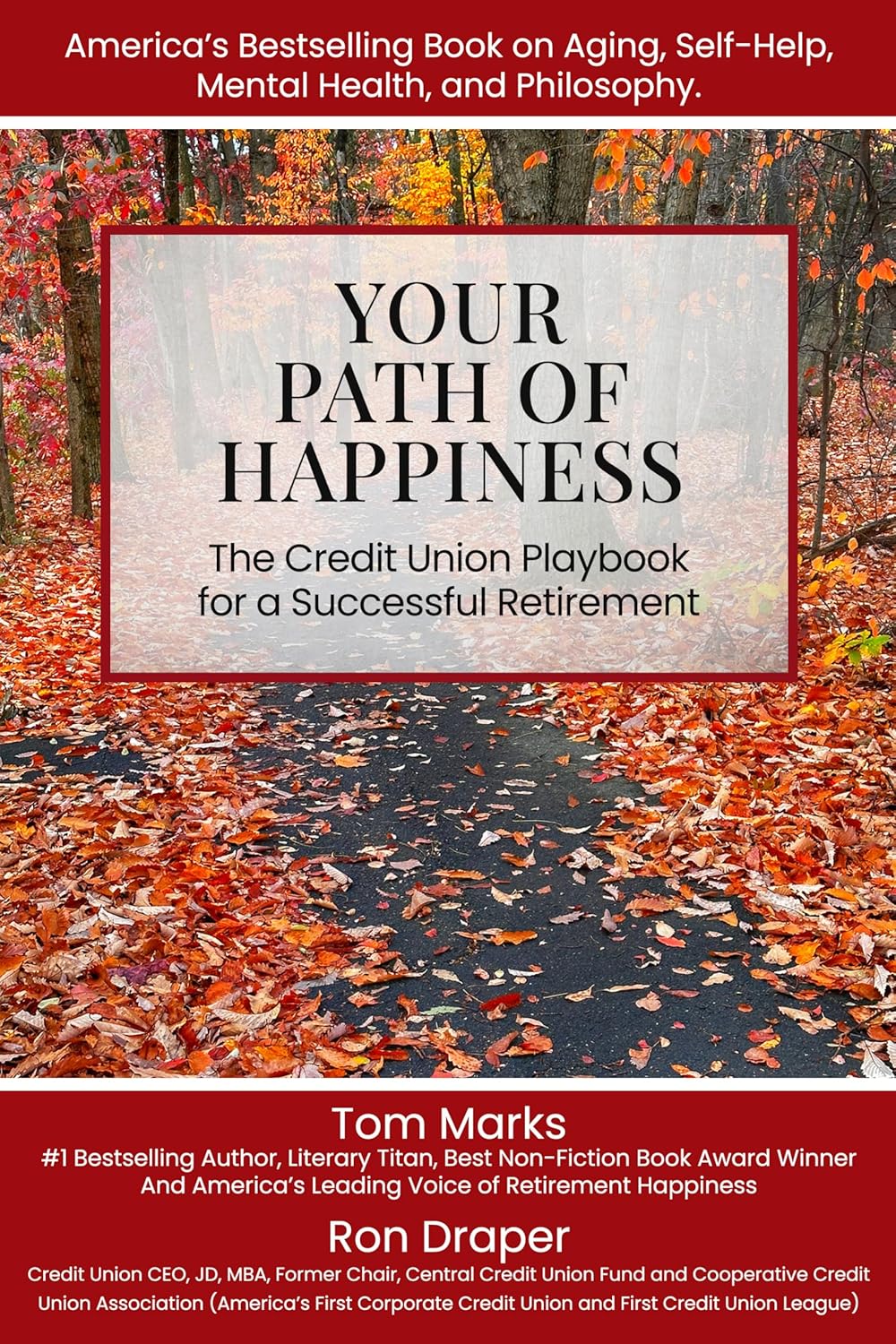

Your Path of Happiness by Tom Marks and Ron Draper is a thoughtful and expansive guide to retirement that argues financial readiness is only the beginning of a well-lived later life. The book moves between history, philosophy, personal reflection, credit union advocacy, and practical emotional counsel, tracing a line from Ninomiya Sontoku’s Gojoukou and the idea of hōtoku, or repayment of virtue, to modern credit unions and their responsibility to older members. At its heart, though, this is less a manual about money than a meditation on identity, gratitude, simplicity, self-empathy, creativity, and the difficult question of who we become when work no longer tells us who we are.
Marks and Draper write with a looseness that can be funny, tender, and unexpectedly piercing, especially when they talk about the emotional disorientation of retirement. Tom’s struggle with lists, schedules, and the hollow ache of losing professional purpose felt honest in a way many retirement books avoid. I also admired the book’s insistence that happiness isn’t something retirees arrive at after checking off a bucket list, but something practiced daily through smaller, humbler gestures. The gratitude lists, with their hummingbirds, mountain views, family names, and ordinary domestic comforts, gave the ideas texture. So did the recurring stories of credit unions as places of continuity, whether through Ron’s childhood memory of root beer lollipops or the book’s broader reverence for institutions that remember people across decades rather than transactions.
I liked that the authors aren’t afraid of odd angles, such as the “hamster wheel” of retirement busyness, the danger of possessions becoming a second career, or the beautifully eccentric Rule of Two Trees from the Samuel Jurkovič Peasant Cooperative. Those moments give the book a moral imagination beyond standard retirement advice. Another strength of the book is its generosity of perspective. Marks and Draper don’t treat retirement as a private puzzle to be solved alone, but as a shared human passage shaped by family, community, memory, and service. I appreciated how the book widens the frame beyond individual planning and asks institutions, especially credit unions, to see retirees not as a declining demographic but as people still rich with purpose, wisdom, and belonging. That sense of social responsibility gives the book a deeper moral weight, making its advice feel less like self-improvement and more like an invitation to care better for one another.
I came away from Your Path of Happiness feeling that its real subject is dignity. Retirement, in this book, isn’t a retreat from usefulness but a chance to recover a truer rhythm, one shaped by gratitude, creativity, generosity, and a less punishing relationship with the self. The book succeeds because it treats happiness not as a slogan, but as a discipline of attention. I’d recommend it to retirees, people approaching retirement, credit union leaders, and anyone trying to understand the emotional weather of later life with more patience and grace.
Pages: 335 | ASIN : B0H2WQ7WSG

The Architecture of Excellence: Habits, Virtue, and the Making of a Life Worth Judging

The Architecture of Excellence, by Craig Wright, treats a human life like a building project. Not a mood, not a vibe, a structure. The author lays out an “architecture of excellence” that ties together old-school virtue, modern habit research, and a central tool he calls the Ledger, a daily scorecard for character and conduct. Each chapter follows a clear rhythm: a vivid scene that shows drift or discipline in action, a tight explanation of the idea, a breakdown of common self-sabotage, and then concrete practices and exercises. By the end, the argument feels simple on purpose. A life you can respect comes from small, repeatable behaviours, tracked honestly, across work, health, relationships, and moral courage.
I found the writing to be sharp and controlled. The voice is firm and at times downright severe, yet it stays clear and readable. I liked the way the author weaves in Aristotle, Jordan Peterson, and Ayn Rand without slipping into academic fog or online ranting. The prose carries a lot of punchy lines and tight images, and that gave the book a steady energy that kept pulling me forward. At the same time, the intensity barely drops. The book keeps its foot on the gas, and I felt that in my body.
The structure works well. I appreciated the repeating pattern of “concept, traps, methods, exercises” because it makes the book easy to navigate and revisit. The Ledger idea is the strongest element for me. A simple grid of virtues and behaviours, filled in every day, used as a mirror for who you actually are, not who you say you are. I felt a mix of dread and excitement as I read those sections. Dread, because I could see exactly how my own patterns would look in those boxes. Excitement, because the system is practical and does not rely on hype or motivation. Some arguments get repeated in a slightly different dress. But I understand why, as repetition helps the message stick.
The book lands hard on personal responsibility, honest self-audit, and the danger of drift. That part resonated with me. I liked the claim that your “real self” is the moving average of your behaviour over time, not your feelings on a good day. The blend of virtue ethics and simple behavioural tools works better than I expected. It gives the book both weight and usability. The moral stance can be demanding. The author acknowledges hardship, but the spotlight always swings back to individual agency. The Ledger can be a strong tool for growth, and it can also become a strict inner judge if someone leans that way already.
I see this as a serious and well-built book for readers who want discipline, not comfort. I would recommend it to ambitious professionals, students standing at a crossroads, and anyone who feels stuck in vague self-improvement loops and wants something more concrete than “believe in yourself.” It will also fit people who already enjoy thinkers like Aristotle, Jordan Peterson, or Ayn Rand and want a more applied, day-to-day framework. If you want someone to look you in the eye and say, “Here is what a life of excellence would actually require from you,” The Architecture of Excellence will be worth your time.
Pages: 86 | ASIN : B0GDQS5SJ5


