Blog Archives
Your Retirement Routine

Your Path of Happiness presents the notion that financial readiness is only the beginning of a well-lived life in retirement. Why was this an important book for you to write?
First, and this is discussed throughout the book, any book is important for me to write because the creative arts are a significant part of any successful retirement; research has shown that conclusively. The creative arts for me is more focused on writing than it is on painting, performance, or music — although I love music very much — but the fact remains that imbedding the creative arts into your retirement routine will lead to a happier and more successful retirement. It’s indisputable.
Second, the aging demographic is a market that needs to be communicated with. Unfortunately, most of the communication is financially-focused, and much of that is writing and promotion that’s really a money-grab. There are 70 million Americans over the age of 50, there are almost 11,000 people turning 65 every day, the senior segment owns 70% of everything in the US, and controls more than 50% of the disposable income, yet we have been stereotyped, marginalized, and put in a box for more than 50 years. The subject of retirement is hot right now and I didn’t want to be left-out in the cold (I’ve been writing and speaking about it for several years now, ahead of many who are just discovering us).
Third, my publishers tell me that between 90-95% of retirement books are written about finances and investing; yes, it’s important, but those books lack the other part of the equation that needs to equal a happy retirement. And that’s what I focus on because 95% of the authors and researchers do not. For people transitioning into retirement, or retirees who might not feel that retirement was all that it was cracked-up to be, I’m the voice of truth, and the person who coined the phrase “Who are we when we are no longer who we were.” I feel a need to constantly provide answers to that question in hopes that the retirement mistakes I made can spare a few people from the unsuccessful retirement that I had for the first few years.
Lastly, I’m regularly asked on podcasts, at book signings, and at speeches what are my non-financial recommendations for a happy retirement so I decided to write my 10-step plan so, at the very least, it was documented.
The “hamster wheel” of retirement busyness is one of the book’s most memorable ideas. What inspired that concept?
Well, being on it, for starters. The hamster wheel, also more clinically referred to as Hedonic Adaptation, or the Hedonic Treadmill Syndrome is this notion where we’re spinning in busyness without purpose or intention. We’re keeping a busy retirement schedule most often times because we’re trying to keep up with the Joneses, comparing ourselves to others, or most dangerously, playing the role of retirement in someone else’s’ movie.
Retirement needs to be about individualism, but the forces of grouping seniors together and stereotyping them as feeble, lonely, sad, technologically incompetent, wrinkled, and the beat goes on, works in direct conflict with the entire concept of individualism. We need to do whatever the hell we want to do and not be bound by the hamster wheel of staying active every hour of the day.
The entire concept of retirement happiness can be found in the Buddhist lesson “There is no path to happiness. Happiness is the path.” It sounds simple but it’s not. Retirees need to understand that the destination isn’t happiness, the odyssey, or the path is where happiness is derived. My research has actually shown that what makes us happy, most likely day in and day out, is something that made us happy when we were younger, like playing an instrument, teaching, mentoring, or in my case, writing. We have the time to do what we might not have had the time doing long ago. But this Buddhist lesson also speaks to the concepts of staying in the present, slowing down and enjoying the smaller things, which invariably lead to larger things, and not waking-up with the broken pieces of yesterday (in Buddhism every day is a new beginning, yesterday is gone, tomorrow hasn’t arrived yet); I’m not a Buddhist and my knowledge is fundamental at the very most, but much of the lessons sound so good because they sound so right.
You emphasize self-empathy alongside discipline and purpose. Why is self-compassion particularly important during major life transitions?
You cannot be an empathetic person unless you’re empathetic to yourself. The world needs more empathetic people, that’s irrefutable, but the funny thing is older people tend to be more empathetic than any other demographic group and because of that they have the ability to be happier. Research has proven that. So, in my 10 steps to retirement happiness, I include the practice of self-empathy because it’s a direct path to happiness. I’m just giving the readers a little nudge in that direction so they can understand the importance of it as they transition into retirement.
But I write a lot about the childhood song “Dem Bones” where so much is physiologically connected. But most emotional constructs are interconnected, too. So with self-empathy, you’ll also be connected to gratitude, a greater understanding of people, the dangers of comparing yourself to others, the pitfalls of leading a life based on the accumulation of possessions, of being all-consumed with bucket lists, and making list after list only to find yourself unable to manage the expectations because of all the list making that retirees have a tendency to do. In other words, if there was ever time to be kind to yourself, time to do yourself a solid, time for self-compassion, it’s in retirement.
What is one thing you hope readers take away from Your Path of Happiness?
It would certainly be understanding the path itself. Once you’ve found what truly makes you happy, without the encumberments and influences of others, you will find happiness, but it’s a bit of an exploration. It didn’t come easy for me because this wasn’t a known retirement consideration before I started writing about it, but now, others should be able to find this more accessible than it was for me.
In addition to that, the primary takeaway would certainly be the actual 10 steps to retirement happiness: those are (1) managing your expectations; (2)reducing all your list-making tendencies; (3) practicing gratitude; (4) rethinking a life of possessions; (5)resisting the hamster wheel; (6) choosing your path of happiness, not a path to happiness; (7)understanding that mistakes will happen, but you get do-overs; (8) practicing self-empathy; (9) knowing that individualism is critical; and (10) believing that everything in retirement happiness is connected.
Of course this is chapter without the verse, so it’s important to dive into each chapter to fully embrace the takeaways.
Author Links: Website | LinkedIn
In less than one day, this book became the #1 bestselling book in America on Aging, Self-Help, Mental Health, and Philosophy. Winner of the prestigious best Non-Fiction Book Award by the Non-Fiction Authors Association of America, the International Impact Book Award, the Literary Titan Award, the Book Fest Award, the Readers’ Favorite Award, and the Book Excellence Award, Your Path of Happiness: The Credit Union Playbook for a Successful Retirement has been described as a “Masterpiece,” “A Triumph of Wisdom,” “Heartwarming,” “An Instant Classic,” and “Life Changing.”
Don’t let the title fool you. This book isn’t just for the 150 million credit union members and employees in the US or the 450 million credit union members throughout the world, it’s essential reading for anyone thinking about or transitioning into retirement, already in retirement, but not finding this life-stage as satisfying as anticipated, the 70 million Americans over the age of 50+, or friends and families of people who are entering the retirement world.
Written by famed bestselling author, many times over, Tom Marks, who is also known to be America’s leading voice on retirement happiness, and his collaborator, Ron Draper, a renowned credit union CEO with a law degree and an MBA who has been omnipresent in the credit union industry for more than 40 years, Your Path of Happiness: The Credit Union Playbook for a Successful Retirement should be on every bookshelf in every home in the US and is required reading for anyone over the age of 50.
You can learn more about the book, about Tom and Ron, and what the top book reviewers in the US are saying about Your Path of Happiness: The Credit Union Playbook for a Successful Retirement here: yourpathofhappiness.com.
Your Path of Happiness: The Credit Union Playbook for a Successful Retirement
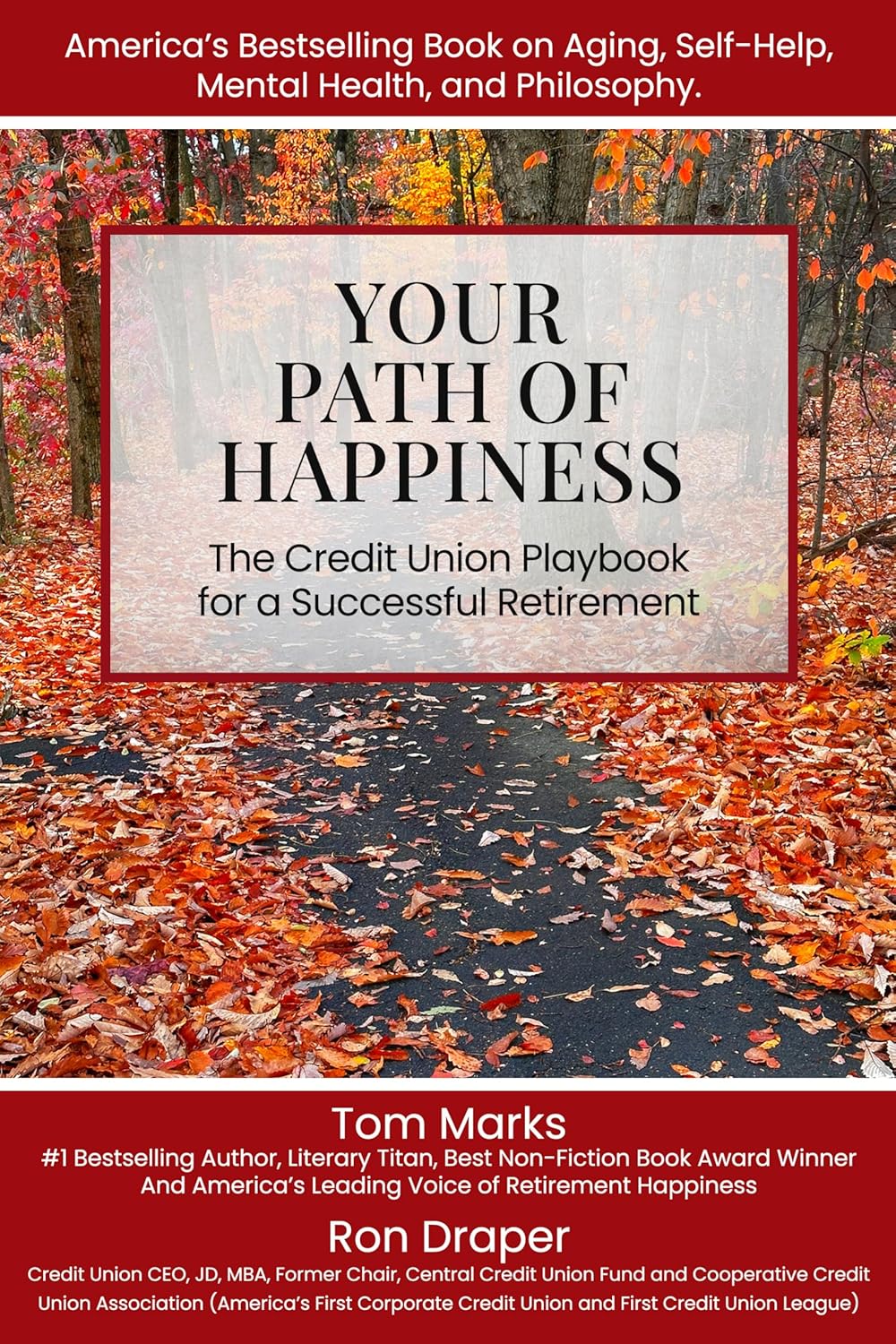

Your Path of Happiness by Tom Marks and Ron Draper is a thoughtful and expansive guide to retirement that argues financial readiness is only the beginning of a well-lived later life. The book moves between history, philosophy, personal reflection, credit union advocacy, and practical emotional counsel, tracing a line from Ninomiya Sontoku’s Gojoukou and the idea of hōtoku, or repayment of virtue, to modern credit unions and their responsibility to older members. At its heart, though, this is less a manual about money than a meditation on identity, gratitude, simplicity, self-empathy, creativity, and the difficult question of who we become when work no longer tells us who we are.
Marks and Draper write with a looseness that can be funny, tender, and unexpectedly piercing, especially when they talk about the emotional disorientation of retirement. Tom’s struggle with lists, schedules, and the hollow ache of losing professional purpose felt honest in a way many retirement books avoid. I also admired the book’s insistence that happiness isn’t something retirees arrive at after checking off a bucket list, but something practiced daily through smaller, humbler gestures. The gratitude lists, with their hummingbirds, mountain views, family names, and ordinary domestic comforts, gave the ideas texture. So did the recurring stories of credit unions as places of continuity, whether through Ron’s childhood memory of root beer lollipops or the book’s broader reverence for institutions that remember people across decades rather than transactions.
I liked that the authors aren’t afraid of odd angles, such as the “hamster wheel” of retirement busyness, the danger of possessions becoming a second career, or the beautifully eccentric Rule of Two Trees from the Samuel Jurkovič Peasant Cooperative. Those moments give the book a moral imagination beyond standard retirement advice. Another strength of the book is its generosity of perspective. Marks and Draper don’t treat retirement as a private puzzle to be solved alone, but as a shared human passage shaped by family, community, memory, and service. I appreciated how the book widens the frame beyond individual planning and asks institutions, especially credit unions, to see retirees not as a declining demographic but as people still rich with purpose, wisdom, and belonging. That sense of social responsibility gives the book a deeper moral weight, making its advice feel less like self-improvement and more like an invitation to care better for one another.
I came away from Your Path of Happiness feeling that its real subject is dignity. Retirement, in this book, isn’t a retreat from usefulness but a chance to recover a truer rhythm, one shaped by gratitude, creativity, generosity, and a less punishing relationship with the self. The book succeeds because it treats happiness not as a slogan, but as a discipline of attention. I’d recommend it to retirees, people approaching retirement, credit union leaders, and anyone trying to understand the emotional weather of later life with more patience and grace.
Pages: 335 | ASIN : B0H2WQ7WSG

Irony is Overwhelming

Coming of Age in Retirement is a funny, thoughtful, and eye-opening memoir-meets-social-commentary about stepping away from a high-powered advertising career and fumbling through the uncertain terrain of retirement. Why was this an important book for you to write?
I was at the point in my life where I was trying to understand the intricacies of life in general and retirement life in particular. The more I thought about my existence, the less about it I understood. I was lost without my nearly 50-year career, my work-friends, the national TV commercials I wrote and directed, the production shoots that I executive produced, and my packed schedule that included more than 180,000 hours of work I had amassed. It wasn’t replaceable, and certainly not in an instant.
I took to heart the words of the Buddha, who said, “There is no path to happiness. Happiness is the path.” And that clicked with me. From that clickage came my new book, which is my path of revelation and enlightenment. I had heard time and again that the transition into retirement, for many, wasn’t as simple as it appears to be, so it was important for me to share my struggles, fumbles, and missteps in hopes that others might learn from my ineptitude.
What is one of the biggest misconceptions that social media and advertising try to convince people about retirement, and what is the fallout when the truth is revealed?
The misconceptions are so prolific, I barely know where to begin. But the takeaway for anyone, regardless of their age, is that the perceptions about retirement, in many shapes and sizes, are dictated to us — both positively and negatively — by advertising agencies and their employees, who, in many cases, are 25-year-olds. The irony is overwhelming that the impressions created about retirement are messages developed by juniors who know nothing about seniors. It’s sorrowful, but also damaging and damning. In my book, I prove this beyond any doubt.
So, what we have are either perceptions of retirement bliss, mostly in an effort to sell retirees something, either a product or a service, or retirement angst, also in an attempt to sell us something, but by way of fear of losing everything. There’s no effort to empower retirees, only a well-established effort to devour us.
There is prolific research that shows purposeful advertising impressions of seniors and the elderly to be incompetent, technologically incapable, lonely and sad, without purpose, and to be physically wrinkled, dotted with age spots, and even imagery of us drooling. This couldn’t be further from the truth. My retired friends, and I have hundreds of them, are probably in better shape than people I know who are half their age.
What were some ideas that were important for you to share in this book?
It’s difficult to whittle it down, but I think your Editor-in-Chief, Thomas Anderson, did an insightful job when he reviewed my book and wrote, “This isn’t a how-to. It’s not about finances and hobbies. It’s about getting honest with yourself. About reckoning with who you’ve been, who you might become, and what matters in the time you have left. For me, it was both a reality check and a relief.” I think that’s right.
And I also think we owe it to ourselves to be ourselves and not what we are supposed to be because of these myths and stigmas that surround seniors and the notion of what retirement is supposed to look like, which, incidentally, we think of as so American. In fact, most of what we know retirement to be is almost completely shaped by what retirement is in other countries and continents. I would also add that it’s important to find your path, not someone else’s, or some guidebook on how to retire happy. There’s no formula, no concoctions, and certainly no elixir that guarantees some sort of happiness spritzer.
What advice do you have for individuals approaching retirement or who have recently entered it?
Of course, the advice I’ve always given to people, whether it’s business advice, retirement advice, or matters of the heart, has always been, “Don’t take my advice!” That said, I will tell you that I’ve heard from dozens of people and reviewers who have received the ARC (Advanced Reader Copy) of the book that they wished they had read the book before they retired. I do remind them that it’s never too late.
Aside from the fact that this sounds swollen-headed, and I’m typically not that way, I would say read the book; there’s literally never been any book written about retirement the way this manuscript is written, and certainly nothing has ever been written about the history of retirement from the perspective of an ad man, the unblemished truth, supported by one fact after another, how our perceptions of retirement are not our own, and the notion of failure in retirement transitioning, my own, in such a raw and honest style.
Author Links: LinkedIn | Website

Coming of Age in Retirement: An Advertising Executive’s Story of Revelation and Enlightenment


Tom Marks’s Coming of Age in Retirement is a funny, thoughtful, and eye-opening memoir-meets-social-commentary about stepping away from a high-powered advertising career and fumbling through the uncertain terrain of retirement. In the first half, Marks digs into the historical and cultural origins of retirement, exposing how our modern view of “the golden years” was shaped more by ad campaigns, policy quirks, and economic conditions than by personal reflection or purpose. The second half is deeply personal, as he recounts his own missteps and lessons while transitioning from agency life into something more grounded, honest, and, eventually, peaceful. What starts as a search for what to do in retirement becomes a much deeper look into how to be.
Reading this book felt like sitting across from a sharp, funny, slightly grumpy friend at a diner who’s finally telling you what’s really going on. The writing flows like conversation, sometimes punchy, sometimes tender, often bouncing between sarcasm and sincerity. I liked that Marks wasn’t trying to be a guru. He admits he got it wrong. He planned financially but never thought about the emotional tailspin that can come from losing your title, your schedule, your identity. He makes fun of his own cluelessness while unpacking how the advertising industry (his industry) has long sold seniors a glossy, unrealistic dream. He doesn’t offer rules or routines; instead, he gives raw, reflective stories. And honestly, I felt seen in them.
What stood out most was Marks’s willingness to be messy. He doesn’t tie things up in a bow. He talks about therapy. About shame. About trying too hard and letting go. And while some parts wandered a bit, especially in the sections about industry history, they always led back to something meaningful. His writing style zigzags, like a curious mind darting between memories, jokes, and gut-punch insights. I appreciated that. It made it feel real. Like a person actually figuring life out, not just repackaging answers.
If you’re near retirement, newly retired, or even just burned out and wondering what’s next, this book will resonate with you. I’d especially recommend it to overachievers, late-career professionals, and anyone secretly dreading what happens after the job ends. This isn’t a how-to. It’s not about finances or hobbies. It’s about getting honest with yourself. About reckoning with who you’ve been, who you might become, and what really matters in the time you have left. For me, it was both a reality check and a relief.
Pages: 264 | ISBN : 979-8-992506-6-8
We Need More Thought Leaders

The Second-Best Business Book Ever Written: The Pursuit of Thought Leadership in Sales, Marketing, and Life encourages readers to rethink the principles of leadership and focus on what truly matters: knowledge, authenticity, and the pursuit of a better world. Why was this an important book for you to write?
It was important for several reasons. I was dismayed at the quality of business books that have flooded the market in recent years (as many as 350,000 per year). Nearly all business books are written to capture more business for the author, secure speaking gigs, or raise the author’s hourly rates. I write about that in my book, and there’s little doubt that writing a business book is a terrific lead generation strategy. However, it makes the book less authentic, somewhat suspect in it’s purpose and mission, and more about an alternative motive than the true motive of a book, which is to educate, create curiosity, and drive increased thoughtfulness.
Second, I was the only person in the country teaching thought leadership as part of the disciplines of market leaders all through the lens of the great Greek scholars. It just wasn’t right for me to take this information to my grave. That would have been overtly selfish, and that wasn’t the thinking behind Socrates, his ace student, Plato, and Plato’s top student, Aristotle. Those three philosophers had a great love and respect for education. It was my time to share the doctrines as well.
And finally, we need to begin to align the positive factors that businesses who are thought leaders can have outside the business world. Businesses get a bad rap on their impact on society, and in many cases it’s well-deserved. But thought leaders really do have a worldview beyond the business construct. I think it’s important to show how thought leadership can make people better humans.
What were some ideas that were important for you to share in this book?
By far and away it’s the notion of Eudaimonia. In part, it’s the Greek notion of happiness, but it doesn’t translate exactly to our happiness because being happy is fleeting. Thought leaders possess Eudaimonia, more aptly defined as a total and constant spirit of well-being. In addition to that, it was important for me to teach how to conduct Voice-of-Customer research (VOC), and how to sell your thought leadership and wisdom through my proprietary Critical Insight Selling technique.
What is one piece of advice you wish someone had given you when you were younger?
Well, for starters, it would have been to stop giving me so much advice. But in the end, I wish someone would have told me to keep a keen eye on the dirty ways of the world. I went into business blinded by so many half-truths. Frankly, around every corner there’s always going to be someone who is trying to game the system, who is more attentive to a money-grab than a grab for goodness, and those pursue shortcuts rather than cutting through the nonsense and doing it right.
What do you hope is one thing readers take away from your book?
We need more thought leaders in business as well as businesses who embrace the discipline of thought leadership. It’s an actionable business practice that is available to any size company in any industry. So, it’s my sincere hope that people who read this book see the benefits and advantages of pursuing thought leadership. If that happens, we’ll have better business, better business people, and a better world.
Author Links: Facebook | Website
Honesty, in its purest form, is a key characteristic of all thought leaders, so I’m going to hit you with the truth. Many business books today are written for the purpose of winning more business for an author, or acquiring new speaking gigs, and anyone who fits into that camp is A-OK with me. It’s a smart move. But after more than four decades in sales and marketing, I’m beyond those goals. Frankly, it feels great that I’m not anchored to those intentions anymore. I have only one intent in The Second-Best Business Book Ever Written, and that’s to teach the ins and outs of thought leadership to as many people as possible because that’s how corporations, and the individuals who run them, succeed.
There’s a process to becoming a thought leader; it’s methodical, detailed, and rewarding. After all, where’s the amusement in being a price-chopper? Or even a technology leader where the tenure is as short as my nephew’s attention span? The greatest thought leaders started sharing their thinking 2,500 years ago through the teachings of my four favorites: Socrates, Plato, Aristotle, and Aspasia.
I’m going to travel with you down the thought leadership road, known as the Via Egnatia, from the foothills that rise above Athens to the skyscrapers that tower above Madison Avenue. And along the way, I’m going to show you how I did it for Fortune 500 companies, and for small and midsize businesses, with a few wild detours along the way.
By all accounts, the Green Bay Packers future Hall of Fame quarterback Aaron Rodgers was born with a rock-solid throwing arm and an annoying chip on his shoulder. I’m no Rodgers fan; after all, I was born and raised in inner-city Chicago and have been a Bears fan since birth, but I recognize greatness, and Aaron Rodgers is a great football player. Some of his other qualities? Not so much.
But these aren’t lessons about tackle football. They’re insights about leadership; about what happens off the football field, and on a more important playing field; about greatness in sales, marketing, and business; and about thought leadership, the single most important differentiator in the business playbook.
Or, as Plato not so recently said, obviously unaware of Aaron Rodgers’s famous retreat into darkness, “We can easily forgive a child who is afraid of the dark; the real tragedy of life is when men are afraid of the light.”
I’d like to shed some light on what’s required in business, but frequently misunderstood. What every salesperson needs to know, but doesn’t always know how to achieve it. And what every marketing expert wishes they had in their bag of tricks. To simply say that thought leadership is an essential part of the disciplines of market leaders is like saying a stick is an essential part of a Popsicle. Well, it is, assuming you’re not interested in taste, color, packaging, name, price, quality, and the beat goes on.
Tom Marks survived forty-seven years in the advertising business and has lived to write about it. He’s the founder of TMA+Peritus, one of the leading marketing, thought leadership, and corporate ethics firms in North America and has won more than sixty-five American Advertising Awards for his writing. He spent many years on the professional speakers circuit and survived that, too. His thought leadership workshops for Fortune 500 companies have brought him national acclaim and has made him a favorite among the nation’s CEOs.
The Second-Best Business Book Ever Written: The Pursuit of Thought Leadership in Sales, Marketing, and Life

The Second-Best Business Book Ever Written: The Pursuit of Thought Leadership in Sales, Marketing, and Life presents a refreshing and incisive critique of modern business theories and practices, boldly challenging the conventional wisdom that often dominates the corporate world. Author Tom Marks encourages readers to rethink the principles of thought leadership, a concept he argues has endured since the days of Socrates, Plato, Aristotle, and Aspasia. According to the author, thought leadership remains timeless, yet many contemporary experts fail to keep pace with the ever-evolving economic landscape, leaving readers without the guidance they need to navigate current challenges.
The author’s perspective on thought leadership is particularly compelling, as he argues that it is not about the size or resources of a company but rather about the adaptability and relevance of its ideas. This approach feels especially pertinent in today’s dynamic business environment. Marks’ book is both insightful and comprehensive, capturing business leadership as an organic, fluid entity that grows and evolves over time. His detailed exploration of his perspective is balanced and open-minded, acknowledging differing opinions while making a strong case for his own views. Marks emphasizes the importance of recognizing and learning from these smaller organizations, which frequently implement innovative practices and philosophies that, while not always in the spotlight, have a significant impact. This point is especially relevant for small business owners, who may find validation and inspiration in Marks’ focus on the value of their experiences. In a commendable display of impartiality and courage, Marks also critiques the pitfalls of modern business strategies, such as the fleeting nature of trends and the hollow promises of so-called thought leaders more interested in self-promotion than genuine innovation. His ability to tie these critiques into the broader theme of the book is a testament to his writing skills and deep passion for the subject. His use of relatable and realistic scenarios helps readers grasp why this is a crucial conversation to have in today’s business world. The book is rich with real-world examples drawn from Marks’ extensive experience working with both large corporations and smaller enterprises. His writing is enlivened by these examples and peppered with sharp quips, making for an engaging and memorable read.
From the moment you encounter the title, it’s clear that The Second-Best Business Book Ever Written is something special. Marks maintains a simplicity and relatability throughout the book that ensures it resonates with a wide audience. This is a thought-provoking read that challenges readers to look beyond the noise of current business trends and focus on what truly matters: knowledge, authenticity, and the pursuit of a better world. Marks’ insights are sure to inspire and resonate with readers, regardless of their background or reasons for picking up the book. This is the kind of book that not only inspires but also drives meaningful impact.
Pages: 296 | ASIN : B0D96MXPY4


