Blog Archives
IYSH


IYSH is a historical fiction novel that begins in 1940 Germany with Leo Butlion, a Jewish medical student whose worst fears about Nazi violence become real with terrifying speed. From there, the story widens into a long wartime and postwar saga that follows Leo and Ivy through persecution, separation, survival, reunion, family life, and careers that eventually carry them far beyond Europe, into Israel and South Africa. It’s a big novel in every sense, built around endurance, faith, identity, love, and the stubborn will to keep moving when history tries to crush ordinary people.
Author Greg Price doesn’t write with a lot of polish for polish’s sake. He writes to tell the story clearly, and that plainness actually gives many scenes more force. When Leo’s family is broken apart, or when people are pushed from homes and into rail cars, the book does not feel interested in cleverness. It wants the pain to land cleanly. At times, the dialogue has a straightforward quality, and the novel leans into earnestness rather than subtlety, which gives it a sincerity that feels true to its character.
This is not just a Holocaust novel. It grows into a sweeping historical saga with romance, faith, Zionism, displacement, medicine, and even heart transplant research in the later sections. That reach is ambitious. As if several novels have been stitched into one long one. But there is something moving about that ambition, too. Price seems determined to show that survival is not the end of a story. Life keeps unfolding. People love, work, argue, build families, chase callings, and carry old grief into new countries. That idea felt authentic to me. Trauma is not wrapped up neatly here. It echoes. It travels. It changes shape.
In its sweeping historical reach and focus on ordinary lives shaped by war, IYSH may remind readers of The Nightingale by Kristin Hannah. But where Hannah’s novel is more polished and lyrical, Greg Price’s book feels more direct and openly earnest, with the pull of a family saga told from the heart.
I came away from IYSH feeling that it is more about witness, memory, and moral conviction. I would recommend it most to readers who appreciate historical fiction with a strong emotional core, especially those who do not mind a long, wide-ranging narrative that blends wartime suffering with romance, family resilience, and medical drama. Readers who want a heartfelt, old-fashioned historical novel that wears its sincerity in full view will find a lot to value here.
Pages: 1025 | ASIN : B0F5ZCFHC5

A Love Letter

Ancilla centers around a bisexual woman in the 80s and 90s in Ohio as she finds herself unraveling her own Catholic upbringing when she enters into a relationship with a magus who becomes her mentor, dom, and soulmate. What was the inspiration for the setup of your story?
I took my inspiration from a number of different sources.
Some of it came from my own memories of growing up. I, too, was raised in Ohio, at roughly the same time my protagonist grew up. People have asked me just how autobiographical the book is, to which I would have to say, not much, except for the protagonist’s sexual orientation (I, too, am bi/pan and kinked – more on this later) and the book’s setting.
Putting the story in the time I remembered, in places where I had lived, allowed me to do my background descriptions more or less on autopilot so that I could focus on other things. I didn’t want to think too hard about whether or not I was describing a college campus, or downtown library, or city park accurately. It felt like a distraction. I wanted to use familiar material when writing. I prefer to pour my energy into other things: word choice, sentence structure, philosophy, foreshadowing, character development, and style.
Some of it came from a desire to fill a void – to fill multiple voids, actually. Bisexual people, for instance, are rare in literature. They’re rare in general. When we are portrayed, it’s usually in a villainous context (we’re depraved! Remember Basic Instinct?) or a pitiable one (just Google “hot mess bisexual” and “disaster bisexual” and see what you get – it’s an unfortunate trope). When we manage to be the main characters rather than just side characters, we’re still usually villains or “messy.” Or we’re hypersexualized! The bisexual literature category, commercially, is well-stocked with smut. This is not necessarily a bad thing if you are looking for validation or for one-handed reading material, but I think we deserve something serious, as well.
So I wrote something that was sort of like The Bell Jar, only its protagonist is a young bisexual woman. (Also, it takes the historical figures of Heloise and Abelard as its inspiration, and the main characters are vampires who can bend elements when adequately fed or otherwise sufficiently powered, because magical realism. I assume my readers are bright enough to figure that one out for themselves).
I worked in depictions of BDSM that centered informed, enthusiastic consent, because there’s a lot of material out there that romanticizes captivity, “dubious consent” with or without “betraying body syndrome” (news flash: “blurred lines” are just rape), and other abusive dynamics, and that’s not what BDSM is all about. Let’s have some good representation.
And I created characters who were different from what might be otherwise expected in more mainstream love stories. How often have you encountered a story about a couple of academic nerd types falling head over heels in love with each other, despite what was originally meant to be a purely tutorial relationship? And how often have those nerds been obviously neurodivergent? Although I don’t say so explicitly (there’s not a lot I say explicitly in Ancilla, ironically enough for a novel that is explicit enough when it comes to matters of sexuality) I coded “ancilla” and “Magister” as autistic. I am on the spectrum, so this is another way in which Ancilla is own-voice literature written for a demographic that, at least from what I have seen, seldom gets good representation. The autistic characters I’ve seen in books are often caricatures, or at least, our autism is treated as our entire personality, rather than as just part of what makes us who we are and ought to be taken for granted as such. Normalized.
I especially thought about breaking convention when crafting “Magister,” because I wanted to create a male character who didn’t fit at all into the “man box,” but who was nevertheless unquestionably masculine. Whereas most men in romance novels are alphas, even when they aren’t alphaholes, “Magister” is shy and reserved, and he is more than content to let other people take the lead when BDSM is not involved. He’s not a billionaire CEO or sports figure or firefighter or cowboy or spy or in some other hyper-masculinized, unrealistically romanticized line of work – he’s a librarian. He’s middle class, and that only barely. Hobbies? He cooks and bakes, listens to opera, reads, and plays tabletop role-playing games. Is he “ripped?” No, he’s actually rather slender, and his muscles are not prominent (although he is strong enough to carry “ancilla” in his arms without struggling – let the readers assume what they like about whether or not vampiric power factored into that one). He’s comfortable with showing his feelings and being vulnerable, too, although introvert that he is, he’s usually rather subtle about it… He is masculine, though. Very obviously. You wouldn’t have accused people like Bob Ross and Fred Rogers of not being men just because they didn’t fit into the prescribed masculine mold when they were alive, and I don’t think anybody could accuse “Magister” of not being a man, either. He is a wrecking ball to toxic masculinity.
I put these people into a setting I knew, and knew intimately, so that I could focus on them rather than on the setting. I wanted them to shine.
On another level, Ancilla is a love letter. The people I wrote it for know who they are. They might not see themselves in the characters – in fact, I sincerely hope they don’t, because my characters are distinct people in their own right, and were never meant to be based closely on anybody in particular, even in instances where I ransacked my memories, took things out of context that I thought would read well if fictionalized, and embroidered like mad – but they know who they are.
One of them was my first beta reader. She lost internet access soon after I completed the rough draft and sent her the final chapter in its raw form, and I hope she finds the final product on Amazon or in a library somewhere, reads it, and approves of it. And if she ever sees this interview, I hope she reads far enough to see that I say I miss her.
What drew you to frame your narrative in this particular setting?
Why northeast Ohio in the early 1990s, of all times?
Partly because, again, I wanted to rely on memory for descriptions of the setting. Nearly all the places described in the book are real, whether I’m describing a mansion in Cincinnati within walking distance of a posh private school, a small college on the edge of northeast Ohio’s Amish country, Severance Hall, or the neighborhoods and metroparks of Akron and Cleveland. The only made-up place in the entire book is “Magister’s” apartment, which I nevertheless set at the end of a real street. I didn’t want to interrupt my creative processes by researching locales. I just wanted to write my story and let the setting more or less take care of itself. I trusted my memory when thinking about how to describe places.
I also decided on northeast Ohio because it was generic. A colourful setting – say, Manhattan – would have become almost a character in itself. I wanted a setting that felt real, but not one that would steal the focus from my characters and from the book’s esoteric themes.
If I’d set the story too early, it would have been historical fiction, which would have required extra research. If I’d set it later, it would eventually become science fiction, because this is going to be part of a trilogy, and the third book covers “ancilla’s” later years. She’s writing her memoirs, and at the time of her writing, she’s either a centenarian or a late nonagenarian. That’s still going to put the final chapters of the last book in the future, but not very far. I don’t want the focus to pivot to science fiction scenarios… So the time is set where it is.
The eighties and nineties were not a good time to be queer in any way, unless you were maybe living in a haven like San Francisco. While I didn’t want to make that hostility to sexual divergence the most central part of the plot, it is nevertheless part of the background. It was all too common for kids to get disowned by their parents after coming out, or to be packed off to “deprogramming.” Coming out was terrifying if you lived in a conservative part of the country, which was most of the country at the time.
It was also difficult to be kinked back then. There wasn’t much support for it unless, again, you had the good fortune to live in a large city where there was an active subculture. Today, “ancilla” and “Magister” could have booked sessions with a kink-friendly, polyamory-friendly couples counselor to work on the challenges they faced (okay, that I set up for them). That option did not exist for them in their time and place.
The chapters are structured around the Tree of Life and its sephiroth, turning the novel into a kind of spiritual ladder. Why did you decide to organize the book this way?
It came to me.
It demanded to be written that way.
I still don’t know if I was up to the task that seemed to have been set before me. Only time will tell.
What do you hope readers ultimately take away from your protagonist’s journey through belief, identity, and desire?
Enlightenment.
Failing that, I hope I created something so beautiful that it felt like a dream, and so immersive that it felt like a pleasant form of drowning.
And for the readers on the margins of our heteronormative, neurotypical society, I hope they see themselves represented and know that they are not alone, and that they are valid.
We exist. We have a right to exist. We have a right to be visible.
Author Links: Reedsy Discovery | BookBub | GoodReads | Bluesky | Facebook | Instagram | Pinterest | YouTube | Website | Amazon
Avenue for an Assassin


Avenue for an Assassin is a political thriller set in the tense years after World War II. It follows Jonas Shaw, an ex-detective and former protector of Winston Churchill, as he is pulled into a shadowy plot that begins with a mysterious shooting on a rural French road. From that moment, the story widens into a web of money couriers, Soviet operatives, Resistance veterans, and a looming operation that threatens to destabilize nations. The book blends espionage, murder, and international maneuvering, and it moves with all the confidence of a classic suspense novel.
Author Steve Haberman writes with a steady hand. His pacing is unhurried in a way that works well because the world he builds is thick with history and personal ghosts. Jonas, especially, carries that weight. I found myself liking him for his rough honesty and the way he constantly wrestles with past mistakes. Sometimes the plot dips into long explanations, but I didn’t mind because it is intriguing and immersive from the first few chapters.
What struck me most was the author’s choice to weave major historical power players into a thriller that still feels intimate. The Soviet angle, the old Resistance networks, the sense that Europe is still picking up its broken pieces, these textures give the book more depth than I first expected. Natasha, the operative driven by the shadow of her father, is unsettling and fascinating all at once. Haberman doesn’t romanticize espionage; he shows it as shabby apartments, bad meals, coded newspaper ads, and people who are just trying to survive the next move on a dangerous chessboard. Sometimes the scenes feel almost cinematic; other times they feel like the quiet hum of a city at midnight, when the wrong knock on the door can derail everything.
By the end, I felt Avenue for an Assassin more than delivered everything a good thriller should: tension, atmosphere, flawed people trying their best, and a mystery that slowly sharpens into something frighteningly believable. If you enjoy historical thrillers, Cold War setups, or stories where everyday streets hide dangerous secrets, this one will be right up your alley. It’s a great pick for readers who like their suspense grounded and their characters complicated, and who don’t mind taking the long way around as the story unfolds.
Pages: 221 | ASIN : B0GF9C3454
The Chip
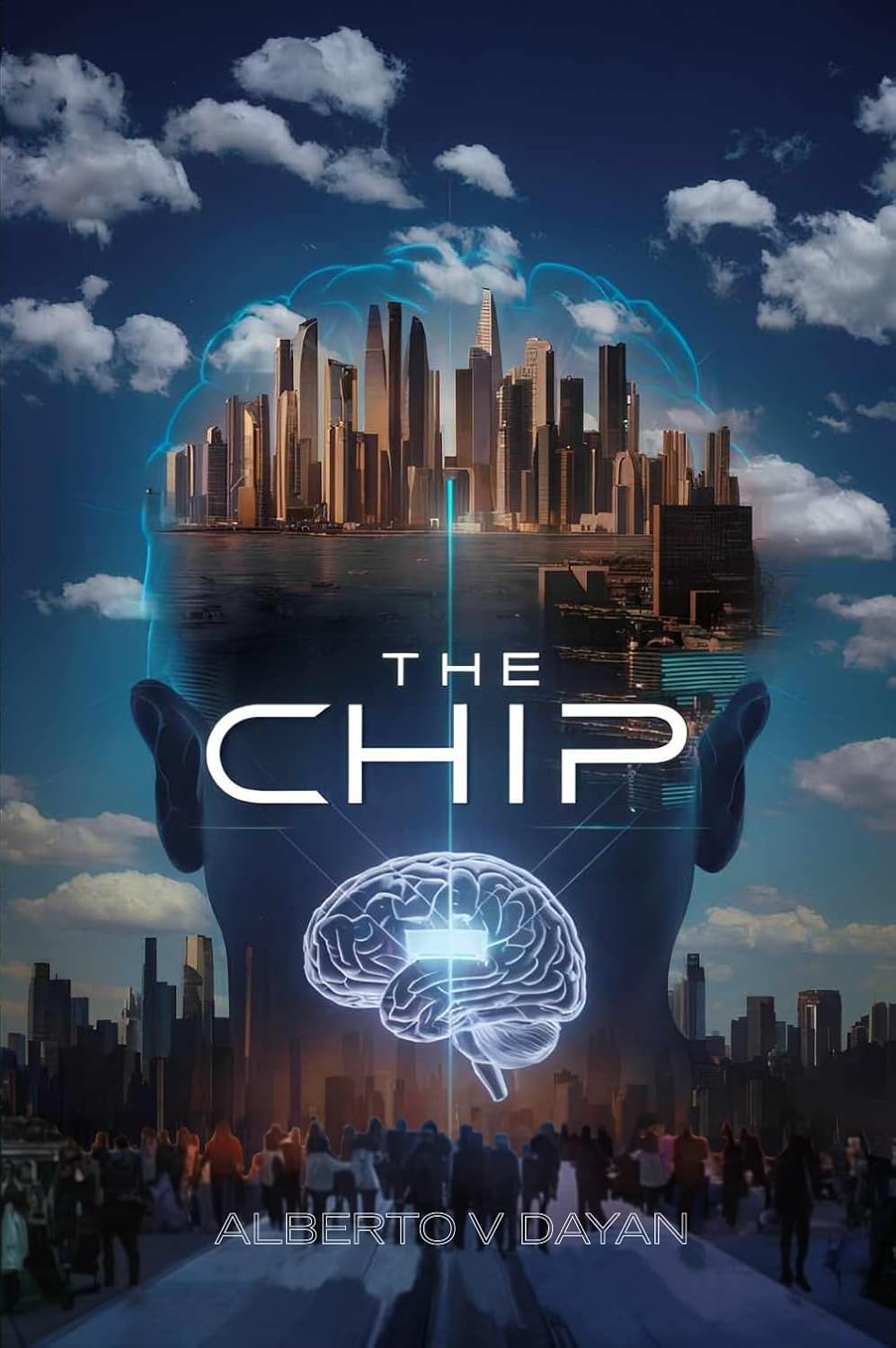
The Chip follows Phillip Novak, a brilliant and driven CEO who secretly implants an advanced A.I. microchip into his brain. The surgery turns him into a kind of superhuman thinker, and the world quickly bends around his newfound power. Governments scramble, cultures fracture, and everyday people start asking whether they should become “enhanced” too. It begins as a story about invention and ambition, then widens into a global clash over identity, freedom, and who we become when we let technology crawl into our minds.
The writing often moves at a quick clip, and I liked that. It gave the story a sense of momentum, almost like the world itself was speeding up the moment Phillip woke from surgery. Some scenes felt larger than life. His fleets of look-alikes, his secret mountain compound, his perfect confidence. I kept thinking how bold it was to paint a character with so much certainty. I would have liked more space to breathe with Phillip and understand him as a man rather than a symbol. Even so, I enjoyed how the book made big ideas feel close and personal. I kept turning pages because I wanted to see how far this technology would push him.
The book plays with power in a way that made me uncomfortable in the best sense. Watching governments rush to control the Chip felt scarily real. The split between “Enhanced Persons” and everyone else gave me a knot in my stomach. I caught myself thinking about how easily people trade freedom for convenience and how quickly leaders twist “safety” into something else entirely. Some of the social changes came fast, but the emotional weight landed. I found myself wondering what I would do. Would I let someone drill a device into my skull if it promised to make me brilliant? The book never answers that for you. It just sits with you and pokes at your thoughts.
The Chip is a cautionary tale, a thriller, and a tech fantasy all at once. I think this book is a strong fit for readers who enjoy fast pacing, high-concept ideas, and stories that make them question where our world is heading. If you like fiction that blends science with moral tension and if you enjoy thinking about the consequences of our inventions long after you close the book, then The Chip will be right up your alley.
Pages: 171 | ASIN : B0DJMJHRC4
Journey With Grief and Healing

Invisible Sun follows a man grappling with painful memories as he reels from grief following his brother’s suicide. What was the inspiration for the setup of your story?
I lost a brother to suicide many years ago and was intrigued by the way everyone, including myself, who was impacted by his death, managed the incident differently. Often, it’s only when we are confronted with death that we stop to consider life. Invisible Sun is a conversation about the perspective of what life is and less about death.
I enjoyed the depth of the main character, Ian. What was your process to bring that character to life?
While this story is NOT autobiographical, I did reach into my own history for inspiration. I needed Ian to be a flawed but curious human who digs deep to ask difficult questions about his existence. I jokingly told a friend that Ian was my whipping boy. I constructed a dark, heavy, almost impossible world with extreme situations for him to explore in this novel. I asked him to make hard decisions and choices that were the opposite of what I would choose in my life. In the process of writing Invisible Sun, I learned a lot about my own journey with grief and healing.
Are there any emotions or memories from your own life that you put into your characters’ lives?
Vulnerability. While this is not an emotion per se, it is a state of emotional exposure that involves a willingness to accept the risk that comes from being open and willing to give and accept love.
What is one thing you hope readers can take away from Invisible Sun?
In the novel, a homeless man on the bike tells Ian, “Don’t waste your life! It’s a gift.” Life is not complete without its ups and downs, but learning to find contentment in this life is the most important thing we can do.
Author Links: GoodReads | Twitter | Facebook | Website | Amazon
In Invisible Sun, Andrew H. Housley probes mental illness and the painful consequences of choice. He questions brotherly bonds, belief systems, and interconnectedness with profound intricacy, immersing readers in a world where reality blurs. Housley’s storytelling peels back the human psyche, exposing raw emotions. This haunting tale captivates as a broken soul seeks solace and understanding, diving deep into a reflection on resilience and choices.
Will Ian find the truth he seeks, or will he be consumed by the shadows that threaten to swallow him whole?
Be Your Own Hero
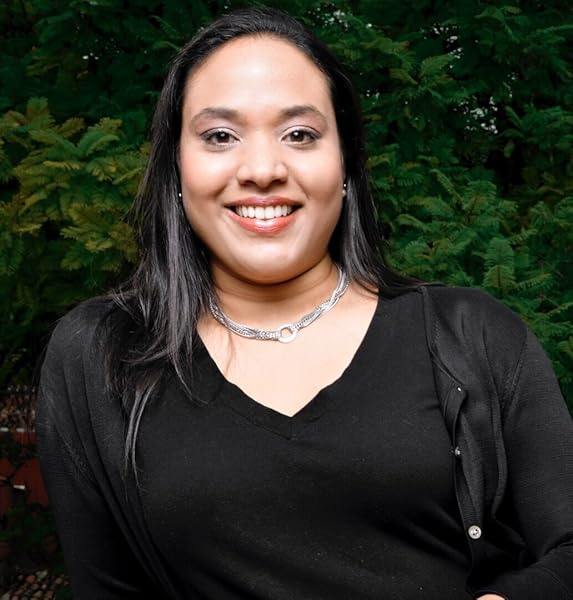
Can You Be follows a woman living a self-imposed, sheltered life who, after receiving a mysterious box, starts to open up and discover who she is and starts to heal from her past. What was the inspiration for the setup of your story?
I like to write stories of self-development and self-discovery, focusing on the pivotal moments of a character’s life. This is what I did with Naina in Can You Be, and was the inspiration for this novel. Naina is about to turn thirty and receiving the box sets her on a path where she chooses to face herself, her fears and insecurities, and explore who she wants to be. Naina is an underdog and learns to become her own hero. I want to showcase that anyone can change their life and bring their dreams to reality. It can be as simple as making a choice, which Naina did. She chose to be different, heal, forgive, take a chance, and go on a life-changing trip. She learns and grows tremendously through the course of the book.
What was one scene in the novel that you felt captured the morals and message you were trying to deliver to readers?
The best scene to capture the morals of the story is one towards the end where Naina and Holy Man are sitting on a towel at the beach on Sullivan’s Island. The location is special to Naina, and she regularly goes there when she needs solace, but she usually does it alone. This time, Holy Man joins her. She has already grown a great deal through the journey she’s been on but needs a final push, if you can call it that, to get out of her own way. The conversation she has with Holy Man helps her.
What were some themes that were important for you to explore in this book?
I have already shared the theme of self-discovery and self-development, which are tied into the topic of exploring who we can be. There is the theme of “being” in discovering who Naina is as a person, but also not having the pressure to “do,” which comes up for her a lot, and rather to “be,” which she struggles with. Food and travel are featured in the book as an avenue to showcase diversity and multicultural elements. Naina is born in America but of Indian descent, Raiya is Indian, and there are other characters from other countries. Naina travels to Stockholm, the Baltics, and Helsinki, yet most of the book takes place in Charleston, South Carolina. I also explore spirituality in a grounded way through crystals, mindfulness and meditation, Angel Oak, and a mysterious Holy Man. All of them help Naina on her journey.
What is the next book that you are working on, and when will it be available?
I have a few projects I am working on. I have a daily reflections deck of cards that I am collaborating on with Jess Fowler, an artist based in Australia. It will be a deck of 77 cards that encourage daily self-reflection. I also am working on another poetry collection called “Journeys.” It’s a collection of books that explores journeys through various facets of life such as travel, health, relationships, love, faith, and so much more. The cards and the first book of poetry in the Journeys collection should be available in 2024. I am also working on my third novel, which is a story about a woman who leaves everything behind to become a tarot card reader. It follows her struggles and how she overcomes them to evolve into taking on her dream career. This should be available in 2025.
Author Links: GoodReads | Twitter | Facebook | Instagram | Website
Everything begins to change after the arrival of the box, and Naina is presented with a chance to change her life and explore compassion, forgiveness, and believing in herself. She struggles to understand the power of connections and the potential of expanding her horizons. Naina’s journey is mystical and, in portions, it takes her through Stockholm, Helsinki, and the Baltics. Will this quest lead her to discover who she can be?
Can You Be

Navigating the subtle threshold between solitude and self-imposed isolation, Can You Be by Sonee Singh explores the theme of self-reflection through the lens of a young woman’s life. The narrative delves into the starkness that can arise from an over-simplified existence, probing the depths of the void left by routine’s meager offerings. The protagonist, Naina, finds herself at a pivotal point when an enigmatic parcel triggers a cascade of incremental shifts, suggesting that embracing minor alterations can pave the way for monumental growth.
In this contemporary fiction piece, Singh crafts a tale that threads through the intricate tapestry of Naina’s reclusive existence, marred by childhood wounds, an emotionally distant caregiver, and the resulting social invisibility. Her retreat into the realms of fantasy is a poignant coping mechanism for her solitude. The arrival of a cryptic stone becomes the fulcrum upon which she begins to reassess her life. Naina’s physical and metaphorical odyssey unfolds at the intersection of the mystical and the tangible, leading her toward self-realization, healing, and a transformative personal evolution.
The prose is articulate and captivating, ideal for mature audiences who are drawn to narratives that unravel the complexities of a character’s history and aspirations. The novel touches on historical and socio-political topics as part of Naina’s exploration into who she is. These sections enhance her journey, tying it to the real world and giving readers an inclination for rich, contextual backdrops that touch upon broader societal themes; these forays add a layer of depth to the narrative.
Can You Be is crafted to inspire readers to venture beyond the confines of their comfort zones, reclaiming the reins of their destinies from the clutches of their past. This thought-provoking and accessible work poses a dual proposition: it is both a challenge and a solution, resonating with those who seek a narrative of authentic and relatable metamorphosis.
Pages: 325 | ASIN : B0CG8ZBFXH
Death Spoon
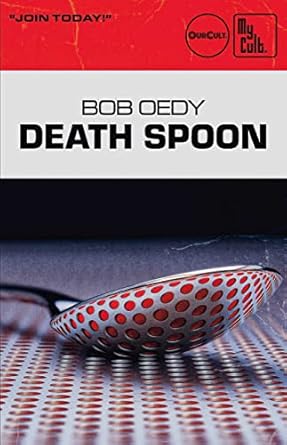
In the atmospheric realm of suspense and enigma, Death Spoon, by Bob Oedy, ensnares readers into the tumultuous life of Ted, forever changed by calamitous events linked to a clandestine cult named MyCult. Ted’s ensuing struggle with guilt and sorrow intertwines with the malevolent presence of the ‘Death Spoon’—a foreboding emblem of a concealed truth. Loyalties waver, allegiances evolve, and the characters find themselves ensnared amidst ominous forces, with the relentless murmur of the ocean bearing witness to their dilemmas.
Oedy crafts a narrative oscillating between the shadows of menace and poignant emotionality, providing readers with a riveting literary journey. His prose is richly evocative, delineating both the lavish and the lugubrious with finesse. The dialogue, marked by its authenticity, propels the narrative with earnest exchanges. The emblematic ‘Death Spoon’ anchors the narrative, drawing readers into its swirling vortex of mystery.
While Oedy offers a promising foundation, there are moments when I feel the pacing falters. Some sequences are opulently detailed, momentarily stalling the story’s momentum. While the novel teases various mysteries tied to MyCult and other clandestine organizations, it occasionally leaves the reader yearning for answers, craving a more definitive resolution.
In their complexity and imperfection, the characters evoke a spectrum of emotions, from empathy to intrigue. While Ted and the primary characters are meticulously sculpted, a few supporting roles beckon for deeper exploration.
Death Spoon is a labyrinthine narrative that immerses readers in a realm rife with secrecy, cult dynamics, and profound ethical quandaries. Despite its minor imperfections, the novel shines in its nuanced portrayal of cult organizations and the shadowy depths they conceal, culminating in a climax that provokes contemplation about the essence of faith and sacrifice.
Pages: 206 | ASIN : B0C5G4FJ19


