Blog Archives
Knowing Winning Material

Multiverses of Entertainment explores how Hollywood, technology, finance, and filmmaking can converge into a new entertainment ecosystem without sacrificing the human creativity that gives stories their power. What motivated you to write this book?
The greatest motivation came from pure love for the cinematic arts. Working in so many of the filmmaking arenas gave me arguably the most diverse experiences. The love for this industry grew like a garden growing a dozen exotic flowers, each one beautiful in its design and complexity. Work – from being an extra, to a stunt double, actor, screenwriter, Producer, Director, technology innovator, and mentor, to running a Mini-Major studio – gave me multiple perspectives I refer to in my books as Parallax View. The vision in 2016 that Hollywood, in its role to deliver the Power of Story, Hero’s Journey, and great performances in motivating films, would be burned to the ground motivated me to sacrifice ten years to deliver a separate Multiverse for the highest quality films and series. The books are the foundation, the tech innovation is the ROI for investors, the products are over 100 of the most valuable screenplays, and the payoff for Talent, crew, and audiences is symbolized in the Imagii Avatar. This does more than save Hollywood – Hollywood saves humanity.
The book combines material written around 2016 with your 2026 perspective. Which assumptions about Hollywood, China, streaming, and entertainment investment from that earlier period turned out to be most right, or most wrong?
Great question. Simple answer: learn from the past. First, let’s tackle the question as it relates to the past and why so many chapters feature China’s rise, which was happening at the same time Hollywood began its death spiral. Crystal-clear success and disaster examples were in motion from 2008-2018, when China was not only the biggest investor for Hollywood films but also the biggest investor in the world. At the same time, it was learning to improve filmmaking as an art. Hollywood would have starved for money without China’s tens of billions in investment and box office – yet the Industry was screwing over Chinese investors at an unprecedented level. My book began as tutorials on the sins and dire future of Hollywood and became a book. Barry London, who just left Paramount and was mentoring me so we could open our own Mini-Major using my formulas for success, gave me a lot of insight into what nobody is supposed to know about major Studio good practices and also their worst mistakes. Every one of my predictions came true. The most useful half of my book is the first half that presents the concept of the film Multiverse I created; however, the second half spells out what was leading to the collapse I saw as inescapable. So how do we go forward? We can’t assume anything we read is true today due to the skewing of news and information by technology. Most of Hollywood is too young to know what a great film requires. 90% of agents and entertainment lawyers have never spent one full day on a set. Not one of them could survive a day of decision-making. The veteran lawyers and agents have surrendered to the idea that the Earth of filmmaking revolves around the Sun of Streaming. That gravity keeps them in an orbit that only intersects what the Streaming Giants allow, and this includes AI replacing film artists. There is a place for that in the world of eyeball time, but not in the world of great filmmaking. The two cannot coexist in the same universe, so a Multiverse is formed. It obeys the laws of the greatest era of filmmaking. The gatekeepers to powerful execs are usually under 25, and they rely on AI to make decisions. It’s laughable. Here is an example from the past that shows how few graduates can handle production pressure to be excellent at a job, your position determined as a meritocracy: If I needed 4 Production Assistants when I was Producer-Director, I would hire 6 and fire all but one or two. Then go through the cycle again until I got my four. Today, I’d have to go through 50 wannabe filmmakers to find 4.
You argue that better movies require a business structure that works for both investors and artists. What is the biggest change Hollywood could make today to give filmmakers more creative freedom while still making projects financially sustainable?
Even in the best era, every production wanted more time and money. But they could justify it with who starred in the film and their foreign pre-sale value. There is no guarantee any film will hit a theater anymore because Streaming Giants lie to top talent like Gal Gadot and Jake in Road House about guaranteeing a theatrical release. Hollywood Studios cooked the books, faked costs for production and advertising, to screw investors out of a big profit. The big test to this, of course, for any veteran of the 80s, was Coming to America, based on the story pitch by Art Buchwald. Paramount first claimed it wasn’t, and then lied to say it never made a profit. Paramount lost and paid a huge settlement. Films were commonly thought of as a bad investment, but this was not due to revenue; it was mostly due to every system in the Industry agreeing to screw investors who don’t know enough. This was the Nash Equilibrium then. The only way to get longer shooting schedules to ensure fine cinematic moves is to guarantee a new revenue stream far greater than box office and tied merchandise. This is where the patented tech innovation and ability to tap into the next generation of social Apps, and Gamer and Influencer revenue and fanbase comes in. The deals and IP Event Horizon presents investors will hold pages of unimaginable legal language developed by me to guarantee Actors, Writers, and Directors get a share of Multiverse revenue, exactly like how Death Row offered pennies of every sale to rappers and made them worth $200 million in a year. New legal also includes massive revenue streams for each Mini-Major investor from the Next Gen Apps, which returns revenue even before a film or series is released. This makes the stock of the investor skyrocket more than how much they committed to spend on production. This is the future. This is how to get a shooting schedule long enough to honor the greatest Actors in Hollywood. And there must be enough IP to last 3 years so Actors cannot be blacklisted by Streaming and law firms, which they are now if they do not bend the knee to Streaming’s shitty pay and schedules that would turn the best performance of anyone into mediocrity (ask Affleck and Damon the weird changes forced on them in scenes for The Rip.). Every Mini-Major is a group of one television series that can get on air within 8 months and Apps with them so ROI begins within two quarters for the investor. And being on the first Multiverse guarantees billions. If they go for an IPO the investor makes several billion before the big payouts begin for production. This is the perfect investment model for entertainment for the next 5 years. It’ll take that long for any tech competitor to copy the model.
After decades around filmmakers, producers, actors, agents, and executives, what have you learned about the qualities that make a story powerful enough to endure across changing technologies and platforms?
So much of knowing winning material is a gut feeling – an ability to feel chemistry brewing, an ability to know original concepts that will win. A good example is Speed. This movie was the first to not follow the formula for action films where there were low points of action, for the audience to calm down like in Die Hard. Speed was nonstop action and tension. Romance was thrown in. Next major change was Apatow’s formula for breaking a film into 12 sets of scenes that can stand alone so they could be binge-watched by teens on phones. You had to be around then to “feel in your gut” what High Concept requires. At the same time, the power of the story to win over audiences had to tickle your senses with surprises, like in the unpredictable humor of The Hangover. The new generation of assistants, readers, law school grads, production execs, casting people – their gut was never trained, never forced into the field, never went through test by fire, never had a genius like Ron Howard and Brian Grazer to mentor them. And none of them understand the concept that films are often “made great in editing.” If you do not have the coverage, two shots, dolly shots, that great films need, it cripples editors. My Multiverse film financing and production requirements ensure we have the angles and sounds needed to deliver a scene that hits the audience on the three levels of great filmmaking: voyeuristically, vicariously, and viscerally. Great films have most scenes delivering two of those V’s. And then have at least 2-3 scenes that deliver all three at once. THAT is when a film story becomes its most powerful, successful, and impactful enough to improve people and society. It makes the fan believe in being his own hero, waiting for the right love, being the parent that protects, and saving someone for the sake of Integrity or Virtues. The technology and platforms are there in new forms simply because the audience for Influencers, Gamers, and Social Media is evolving and likes using these in Apps. The methods for outstanding filmmaking and stories they seek remain the same: devotion to “the film always comes first.”
Author Links: GoodReads | X (Twitter) | Instagram | TikTok | Website | Amazon
Connections and Patterns
Accelerating Intelligence explores how sharper observation, greater adaptability, creativity, and moral responsibility can help humanity remain fully human in an age of rapidly advancing technology. Why was this an important book for you to write?
The two things motivating me were a) to preserve the role of art and the human ability to increase its advancement of the gifts given us by our creator, and b) I knew I was the only person in the world that could write this and connect it to filmmaking so it remains superior to anything AI tempts us to allows as limitations that make us nothing more than its commodity.
Your formula for intelligence links observation skills with adaptation speed. How did you arrive at that definition, and how has it changed the way you understand intelligence in your own life?
I knew since I was 12 that I saw connections and patterns in the world in a deeper way than other people. This drove me to be creative in multiple arenas, first as a chef. My years solo camping in National Parks provided the influx of natural wisdom to fuel this mindset. The film industry was the first arena that challenged all my mind could create and deliver, and I love it for that. I saw the Power of Story and the art of filmmaking as one of the greatest motivators of mankind. Because a great film requires adaptation speed and observation skills, it magnified this message. Humanity has always been uplifted by the various eras of grand art, like the Renaissance. The more films I wrote and directed the more it honed my skills. Driven to write this book released all the wisdom and higher forms of elegance in me, and like a movie, made it something to share with audiences. In this, I hope to fuel the rise of human intelligence to counterbalance AI and the increasing limitations it will put on each mind as it turns us into data.
Your recovery from a serious brain injury gives the book’s ideas about neuroplasticity, perception, and creativity a deeply personal dimension. How much did that experience shape your philosophy?
Throughout modern science, some of the greatest minds and innovations seemed to be channeled into the famed innovator. I honestly must say I did not know the extent of my knowledge of how Physics interacts with the solutions to limitations of the mind until I began writing the books – which was days after the brain injury. It seems to have been my chance to leave the world a better place. I had always been an optimist, always been curious about other cultures and art, but this injury made me think of how lucky I am to have the ability to interpret more than usual and wanted to share it in its higher form that came to me in recovery.
Film, literature, science, religion, personal memory, and popular culture all interact throughout the book. What does moving between such different fields allow you to discover that a more traditional philosophical approach might miss?
Comedy, tragedy, heroism, and love chemistry often prove their value due to juxtaposition with another relatable and sometimes polar human experience. I knew I had to make this high science and philosophy relatable and realized references to films and even comical juxtapositions connected more neural connections and emotions in the readers. My most common compliment is that this style made it fun to read, a page-turner, and easy to understand. Most philosophical reports or books are very linear and build off of what is widely known already. The writer might be able to think deeply about a philosophy but lacks the storytelling style of a film screenplay writer or sitcom writer. In this book and my others, I hope the readers get inspired but also get amused. This makes them accept the “hero within them” that will accelerate their intelligence and create a living philosophy of morals to counterbalance AI turning us into nothing but data.
Readers can purchase Accelerating Intelligence at a discounted price through my website, Event Horizon Studio.
Author Links: GoodReads | X (Twitter) | Instagram | TikTok | Website | Amazon
Confusion to Confidence

AI for Beginners Demystified turns artificial intelligence from a confusing buzzword into a practical tool, guiding everyday readers through how AI works, where it shows up in daily life, and how to use it with confidence. Who did you imagine as the ideal reader when you started writing?
When I started writing AI for Beginners Demystified, I had a very clear reader in mind: the curious person who keeps hearing about artificial intelligence but feels slightly overwhelmed by it. It might be a business owner, a professional trying to stay relevant in a rapidly changing workplace, or simply someone who sees AI mentioned in the news every day and wonders, “What exactly is this, and should I be paying attention?”
I’ve met many people like this through my work in digital marketing. When my company began implementing AI tools, I noticed that many business owners were hesitant to adopt them. They weren’t uninterested. They were intimidated. The technology sounded complicated, and they worried they might not understand it. That reaction became one of the motivations for writing the book.
The ideal reader I imagined was someone intelligent and curious, but not technical. They don’t want a textbook filled with jargon. Instead, they want clear explanations, relatable examples, and maybe even a little humor along the way — like sitting down with a knowledgeable friend who explains it in plain English.
Ultimately, I wrote the book for people who want to move from confusion to confidence. Once readers start exploring AI tools, they often discover something surprising: AI isn’t just about technology. It’s about creativity, productivity, and finding smarter ways to solve everyday problems. My reviews strongly indicate I’ve reached that audience.
Why do you think so many people feel intimidated by artificial intelligence?
First, AI as we know it is still in its infancy. Before 2022, AI was powerful but mostly invisible to everyday people — living inside search engines, industry, and back-end software. That changed in November 2022 when OpenAI released ChatGPT. As of this writing, it’s not even four years old. It’s barely old enough to tie its own shoes! (Its exact birthdate is November 22, 2022 — feel free to add that to your trivia book.)
Beyond novelty, many people feel intimidated because AI is often presented as something extremely technical and mysterious. When people hear terms like machine learning, neural networks, or generative AI, it can sound like a foreign language. There’s also fear of the unknown: AI is advancing rapidly, and headlines tend to amplify that by focusing on dramatic possibilities rather than practical realities.
Then there’s Hollywood. For decades, AI has been portrayed as a world-conquering machine. Those stories are entertaining, but they shape how people think about AI in real life — which is far more practical: voice assistants, recommendation systems, tools that help us work more efficiently.
The intimidation usually fades once people simply start using AI. That realization was a big reason I wrote the book: to remove the technical barriers so readers can shift from feeling intimidated to becoming genuinely curious about how AI can improve their lives.
What do you think people misunderstand most about AI and jobs?
The biggest misunderstanding is that AI will simply replace people across the board. History tells a different story. When computers entered the workplace, similar fears arose — and what happened was that computers automated certain tasks while creating entirely new industries and career paths. The internet followed the same pattern. AI is likely to do the same. Rather than replacing humans, it will enhance human abilities — handling repetitive tasks, analyzing large datasets, and automating routine work so people can focus on creativity, strategy, and relationship building. The key advantage will go to those who learn to work with AI rather than fearing it. I believe the future of work will be defined less by humans versus machines and more by humans who understand AI working alongside those who don’t. That’s the central message of the book: AI isn’t something that replaces you — it’s a tool that can make you more capable and competitive.
Which AI applications do you think will have the biggest impact on business in the next decade, and how should professionals prepare?
Three areas stand out. First, AI-powered data analysis and predictive analytics. Businesses generate enormous amounts of data, but making sense of it is difficult. AI can identify patterns, spot trends, and help companies make faster, more informed decisions — predicting customer needs, streamlining operations, and sharpening strategic planning.
Second, AI-driven automation. Scheduling, customer service, report generation, and administrative work can increasingly be handled by AI. This frees people to focus on higher-value work like problem-solving and relationship building. Think of it as a digital assistant that handles the grunt work.
Third, Generative AI. Tools that create written content, marketing materials, images, and software code are already transforming industries like marketing, media, and design. A related evolution is Agentic AI — AI that doesn’t just answer questions but gets things done. Ask it to plan a dinner party, and instead of prompting you step by step, it looks up recipes, makes a grocery list, orders the groceries, and sets cooking reminders. You give it a goal; it figures out the rest. That’s the future.
As for preparation: you don’t need to become an AI engineer, but you should understand the basics and develop a mindset of continuous learning. Professionals who stay curious, experiment with tools, and develop AI literacy will be well-positioned for the decade ahead.
Author Links: GoodReads | Facebook | Rick Samara | Website | Amazon
Instead of presenting artificial intelligence as a confusing or intimidating subject, this book makes AI accessible, practical, and relevant to everyday life. From virtual assistants (Siri, Alexa, Copilot, Grok, Perplexity) to smart home devices, photo editing apps, and personalized online shopping, you’ll discover how AI already powers the technology you use every day.
Inside this engaging guide, you’ll learn:
What AI really is and why it’s more of a helpful partner than a threat.
Machine Learning explained through fun, relatable analogies that actually make sense.
Generative AI tools that create text, images, and even music, and how you can use them.
Chatbots and conversational AI like ChatGPT, Gemini, and Copilot, and how they’re shaping communication.
How AI is transforming the job market and why it creates new opportunities instead of just taking jobs.
With witty commentary, personal anecdotes, and straightforward explanations, this book takes the fear out of AI and turns it into something exciting to explore. Whether you’re a student, professional, entrepreneur, or simply curious, you’ll finish this book with a clear understanding of artificial intelligence, machine learning, and generative AI plus the confidence to use these tools in your own life.
If you want to understand AI without the jargon, laugh while learning, and gain practical knowledge of the future of technology, this is the book for you.
AI for Beginners Demystified
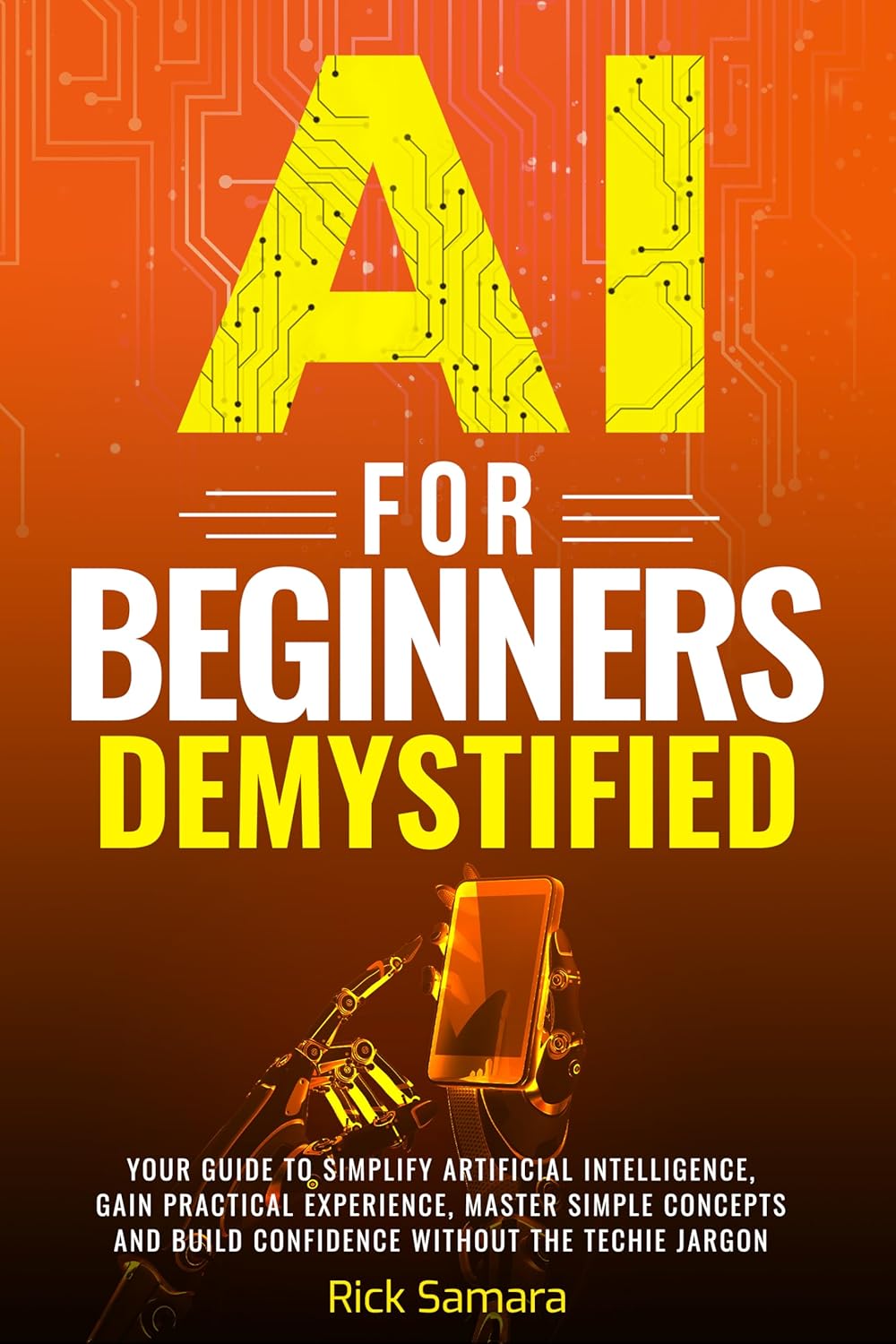

AI for Beginners Demystified by Rick Samara is an introductory guide to artificial intelligence that walks the reader from basic concepts to real-world uses in business and everyday life. It starts with the fear and confusion around AI, then explains core ideas like machine learning, neural networks, deep learning, and generative AI in plain language. From there, it tours familiar spaces such as smartphones, smart homes, social media, transportation, healthcare, finance, and education, then moves into ethics, bias, misinformation, and finally, practical next steps like courses, Facebook groups, and an addendum on using AI in business. The book aims to turn AI from a hazy buzzword into something a non-technical reader can talk about and actually use.
The tone stayed warm, reassuring, and a little chatty, which fit the target audience. He uses a lot of personal stories from the Air Force, from his marketing work, and from family life, and those stories kept me engaged. I liked the way he came back again and again to the idea of making the complex simple and actually stuck to that promise. The explanations of AI versus machine learning versus neural networks versus deep learning felt clear and grounded, and the nesting doll image for those layers worked for me.
I liked how practical the book felt. The sections on everyday AI, like smartphones, smart homes, shopping, and banking, pulled AI out of the clouds and into real life with examples that almost anyone can recognize. The “easy and fun exercise” pieces sprinkled throughout were a nice touch. They nudged me to pause and connect the material to my own habits. The ethics chapter and the parts on surveillance, bias, and job loss anxiety added a needed sense of seriousness. When the author talks about balancing innovation and responsibility, and about collaboration between companies, governments, and the public, the tone stays accessible instead of academic, which I found refreshing.
I actually liked the structure and depth of the book. It feels like a friendly guided tour, inviting me to wander through different ideas. The way the focus moves from one domain to another, then loops back to themes like job security and lifelong learning, gives the book a conversational rhythm. Beginners will benefit from the upbeat tone and clear enthusiasm. The business addendum works well as a starter checklist and offers a broad, accessible foundation that leaves room for readers to seek out their own case studies and frameworks later. Since the goal is to build comfort and confidence rather than teach a technical course, the approach feels right. When I picture someone who feels intimidated by AI opening this book, the welcoming tone and relaxed pacing seem perfectly chosen.
I would recommend this book to readers who feel uneasy or left behind when people talk about AI, especially adults who do not see themselves as “tech people” but still want to understand what is happening and how to keep up. I think it suits small business owners, teachers, parents, and older professionals who need a gentle on-ramp rather than dense theory or code. For someone at the true beginner level who wants a calm voice, real-life examples, and a path to keep learning, this book is a solid and encouraging read.
Pages: 138 | ASIN : B0FLW34RKW

Share and Accept Feedback

The Magic of Imperfection uses stories from real people to show that embracing imperfection helps people make more progress, take smarter risks, and actually enjoy their work without overthinking. How much research did you undertake for this book, and how much time did it take to put it all together?
The Magic of Imperfection is a summary of my work philosophy and approach I’ve honed over three decades – it didn’t require outside research – as my work has been the driver for the book. The act of writing the book was fairly quick, given it was information I’ve used for years – from start to finish it, was a 6-month project.
What is the 3/4 baked philosophy, and how does it help improve people’s quality of work?
The idea is that people hold onto their work too long, and many great ideas don’t get out in the world as a result. The 3/4 baked philosophy asks people to find a sweet spot to share and get feedback from others, precisely when the work isn’t yet perfect – but has enough form and clarity that your intentions are clear – not half baked – and not fully baked…. But 3/4 baked.
Over time, when we are willing to share and accept feedback (good or bad) sooner and more rapidly, we develop tools and an inner compass that makes our work stronger over time. We learn the most from failure – and a willingness to test ideas as widely as possible.
What is one thing that you hope readers take away from The Magic of Imperfection?
Stop trying to be perfect with what you do – and magically – by using the 3/4 baked approaches in the book – your work will get more perfect over time…. But with less effort, stress, and drama – giving you more time to spend on things you love and people you care for – or just getting a lot more shit done!
Author Links: GoodReads | Amazon
Break free from perfectionism and finish your creative projects. This unconventional guide shows you how to overcome creative blocks and finally complete your work through strategic imperfection.
The world is full of creative people. So why do some get their ideas out in the world while others don’t? Why are some incredibly prolific while others struggle with deadlines or can’t complete projects? In this book, Jason F. McLennan-a master in “getting stuff done”-shares secrets to boosting productivity, innovation, and personal success. By adopting his “¾ baked” philosophy and the key lessons that surround it, readers will be able to dramatically increase their output while also keeping their creative juices flowing.
McLennan’s recipe for creative success includes the following ideas:
• Look forward to failure
• Discover the power of feedback
• Learn to become a “trim tab”
• Harness the power of momentum to drive creativity
We’ve all heard the phrase “the perfect is the enemy of the good.” Perfection is often what holds so many people back. Trying to reach it means that nothing much can get completed, and inspiration itself is often blocked as people either procrastinate or endlessly self-edit. By chasing perfection, it remains elusively further away.
The world is full of half-baked ideas-but almost no perfect ones. With The Magic of Imperfection, readers will learn how to seriously amp up what they do, how fast they do it, and simultaneously how well it gets done.
The Magic of Imperfection
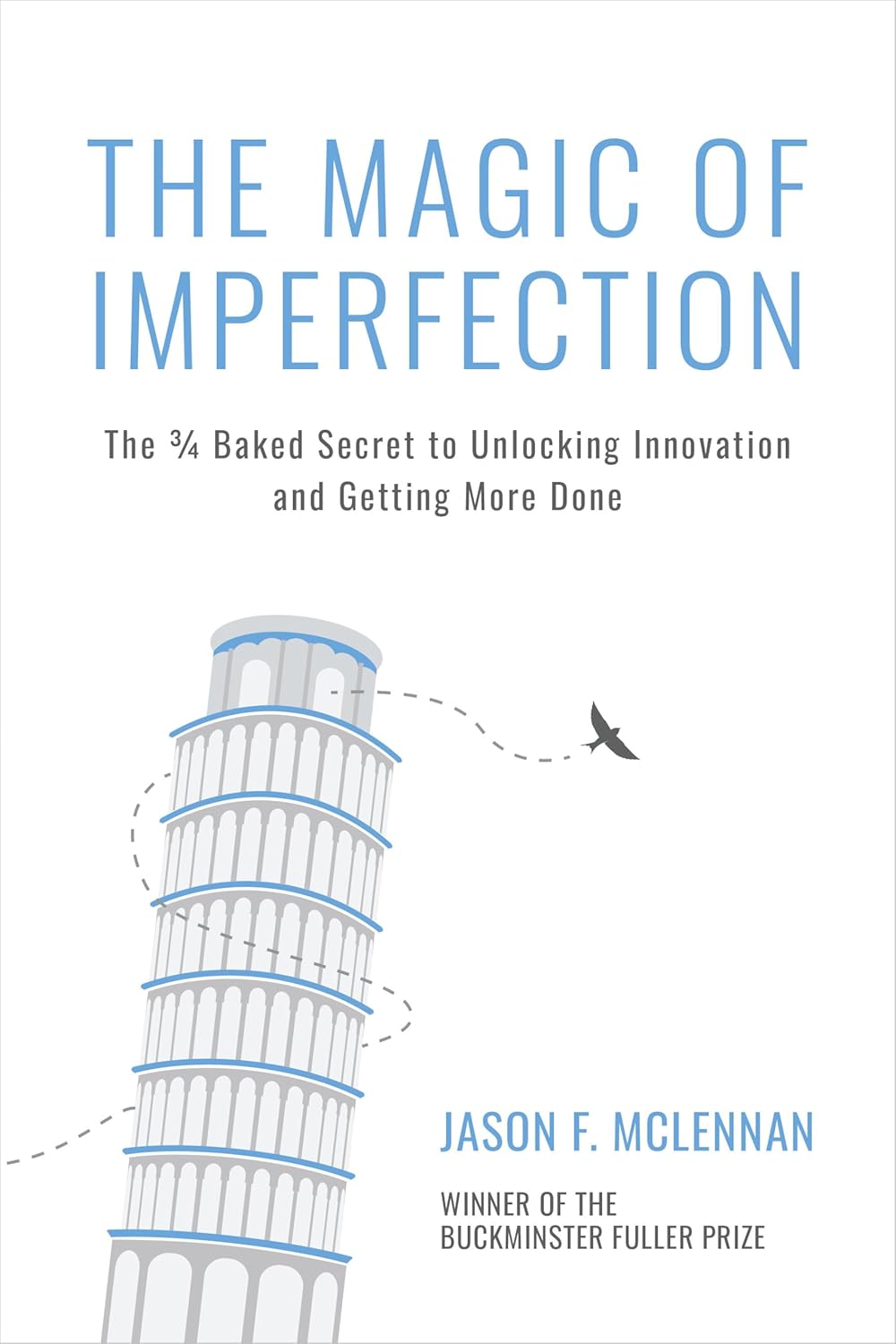
The Magic of Imperfection surprised me with how quickly it got to the heart of its message. Author Jason McLennan argues that most great work reaches a sweet spot long before perfection. He calls this the ¾ baked moment, the point where an idea is clear enough to stand yet rough enough to grow. He shows how this mindset speeds up creativity, opens the door to real innovation, and breaks the grip of fear and overthinking. Using stories from architecture, mentorship, cooking, leadership, and even childhood, he makes the case that embracing imperfection helps people make more progress, take smarter risks, and actually enjoy their work.
Reading this book, I found myself nodding, smiling, and sometimes groaning because the truth hit a little too close. McLennan’s tone is warm and grounded, and he mixes personal stories with quick lessons that feel almost like friendly nudges. I liked how he ties big ideas to everyday moments, like pulling cookies out of the oven before they look done or watching asparagus cook just a little too long. These simple images stuck with me more than some productivity books stuffed with charts or buzzwords. Sometimes the message was repeated, but I didn’t really mind because each angle gave it a fresh spark.
I especially loved the honesty around failure. His stories about projects that collapsed, ideas that bombed, and designs that broke apart mid-demonstration made the book feel relatable. And his point about people who cling too tightly to perfection really landed with me. I’ve watched talented friends freeze themselves in place, and I’ve done it too. The way he talks about letting the universe finish what you start made me laugh at myself a little. The writing isn’t fancy. It’s straightforward and warm. Sometimes it feels like someone thinking out loud. I liked that looseness because it matched the whole philosophy.
Anyone who feels stuck, overwhelmed, or afraid to put their work out into the world would get a lot from The Magic of Imperfection. It’s great for creatives, leaders, students, and anyone who carries too much pressure on their back. If you enjoy books that teach through stories instead of strict rules, this one will fit you well.
Pages: 192 | ASIN : B0FGPLMPKG
Must: Becoming the Person You Are Meant to Be
Stephen Rue’s Must: Becoming the Person You Are Meant to Be is a powerful self-development guide that blends memoir, psychology, and motivation into one steady climb toward self-discovery. The book unfolds in three parts, Exploration, Implementation, and Integration, walking readers from personal reflection to purposeful action. Rue doesn’t just talk theory. He builds each idea from his life: the trauma of losing his stepfather, the pain of abandonment, the struggle of self-worth, and his long road to forgiveness. His “Must Mindset” is the core concept, the inner conviction that becoming your best self isn’t optional; it’s necessary. Rue mixes practical strategies with deeply human storytelling, making his lessons feel lived-in and real.
I admired how Rue handled pain without drama. His voice is calm and steady, but it carries weight. I found myself pausing often, thinking about my own limiting beliefs. The simplicity of his writing keeps the ideas grounded. He pulls in research from thinkers like Carol Dweck and Brené Brown but never lets it turn academic. I liked how he invites you to ask questions about your life, right there on the page, as if you’re part of a workshop. At times, the reflection prompts felt heavy, but in a good way; they make you stop scrolling through your day and actually think.
Emotionally, the book hit me hardest when Rue described forgiving his father. That scene, holding his father’s ashes and realizing he could no longer be angry, stuck with me. It’s rare to see that level of vulnerability in a self-help book. Rue’s writing sometimes drifts toward the inspirational-speech style, but it’s balanced by sincerity. I didn’t feel like he was selling me motivation; he was sharing hard-earned peace. The pacing allowed me to sit with his thoughts instead of rushing to the next “tip.”
Must isn’t just about becoming successful; it’s about becoming whole. I’d recommend this book to anyone standing at a crossroads, especially those who’ve felt broken or stuck for too long. It’s for people who want practical tools but also crave meaning behind them. If you’re willing to be honest with yourself and do the work, Rue’s words will meet you where you are and nudge you toward who you could be.
Pages: 564 | ASIN : B0FN993723

Get Your Mind Right

Kenneth Wyche’s Get Your Mind Right is part life manual, part personal manifesto, and part spiritual pep talk. It’s a deep-dive into mindset, self-worth, manifestation, and personal growth, told with the energy of someone who’s lived through hard lessons and came out the other side with clarity and purpose. Structured in 31 chapters, it mixes practical advice with spiritual insight, touching on everything from privilege to resilience, from frustration to faith. Wyche’s central message is this: your mind is the driver of your reality—so get it in gear.
Wyche writes with the conviction of someone who’s both been broken and rebuilt himself with intention. He’s not afraid to say things like, “Life wants to happen for you not to you,” or that pain “isn’t meant to be solved, it’s meant to be endured.” That’s raw, but it’s real. There’s a rhythm to his writing that feels almost sermonic, like spoken word—very fluid, very now. It might not be polished in the classic literary sense, but that’s part of the charm. It feels like a conversation with your wise, slightly intense older brother who’s done the work and just wants you to level up too.
What stood out the most was how Wyche links personal evolution to mindset shifts, particularly in the chapters on manifestation and belief. His breakdown of “The Law of Attraction” and “The Law of Vibration” is surprisingly accessible—none of the overcomplicated spiritual fluff that often clouds those concepts. He’s upfront about his own struggles during the pandemic and how he turned his life around not by magic but by changing his thoughts and actions. The story about going from jobless to focused because of a mental shift was the kind of gritty honesty I appreciate.
Wyche has this tendency to go philosophical for stretches—like in Chapter 6 where he dives into the origins of privilege, hierarchy, and human development. It’s smart, for sure, but these moments made me pause and wonder if the average reader would stay with him through those detours. Still, there’s real value in those explorations—especially when he links them back to the self. His reminder that “you don’t need to work harder; you need to relocate” was a standout—practical and profound. It’s a reminder that sometimes the grind isn’t broken—it’s just misaligned.
Chapter 29, The Value in Adding Value, really struck a chord with me. Wyche flips the usual success narrative by asking not what you can get, but what you can give—and how that giving defines your worth. He challenges you to think deeply about your personal ROI not just in money but in energy, purpose, and impact.
Get Your Mind Right is a mindset in book form. Wyche doesn’t just preach improvement; he outlines how to live with intention, even when life’s messy, painful, and unfair. It’s not a soft read—it asks things of you. It’s for people who are tired of surface-level inspiration and are ready to actually do the work. If you’re in a life rut, if you’re trying to build your confidence, or if you’ve got big dreams and no roadmap, this is for you.
Pages: 163 | ASIN : B0D9WT95PG


