Blog Archives
The Objectivist’s Guide to the Galaxy: Answers to the Ultimate Questions of Life, the Universe, and Everything
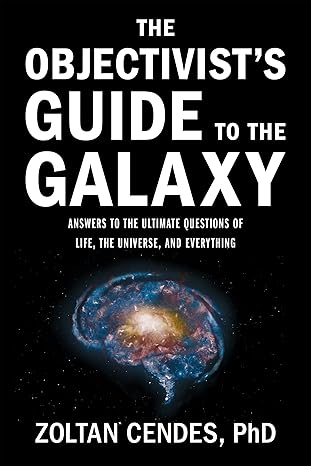

After reading The Objectivist’s Guide to the Galaxy, by Zoltan Cendes, I found myself both challenged and provoked. The book is a philosophical and scientific expedition through 42 “Ultimate Questions” about life, the universe, and the human mind. Cendes sets out to finish the job that Douglas Adams left as a joke in The Hitchhiker’s Guide to the Galaxy by giving serious answers to the deepest questions about existence. From the nature of consciousness and knowledge to the structure of space-time and the metaphysics of mathematics, the book moves briskly guided by Ayn Rand’s objectivist philosophy and modern science. It’s ambitious and unrelenting, written with the intent to convince rather than merely explore.
I found the writing incredibly confident. Cendes writes with the conviction of someone who believes they’ve genuinely cracked the code of the universe, and in some ways, that’s thrilling. There’s a sharpness and clarity to how he argues for the “primacy of existence” and the role of volitional consciousness in shaping reality. I admired how he didn’t water down big ideas. It is worth noting that at times, the tone veers somewhat toward dismissive, and the reasoning is sometimes presented with an air of finality.
Still, I enjoyed how wide the scope was. One minute you’re reading about ancient cave art and the roots of concept formation, and the next you’re knee-deep in a breakdown of quantum mechanics and AI consciousness. Some chapters had me nodding along, and even in disagreement, I appreciated the effort to bring philosophy and science into one tight framework. His take on language, consciousness, and mathematics had real weight. I liked that he stuck to his guns and built a full worldview rather than just skimming topics.
The Objectivist’s Guide to the Galaxy is best for readers who enjoy having their assumptions pushed, especially if they have a taste for philosophy and don’t mind some sharp edges. Fans of Ayn Rand will love it. Fans of Richard Dawkins or Sam Harris might find common ground, too. It left me stimulated, and I recommend it to anyone who prefers to be left still turning over bigger ideas when the reading is done.
Pages: 392 | ASIN : B0F8J74GZS

Love, Light & Other Beautiful Lies: A Poetic Memoir of Spiritual Materialism

Sean Russell’s Love, Light & Other Beautiful Lies is a poetic memoir that gently unravels a decade-long spiritual journey with raw honesty, lyrical introspection, and a good dose of humility. It’s a collection of reflections, poems, and emotional snapshots that chart the evolution of a seeker from the bright-eyed idealism of early awakening to the weary, tender wisdom of a man who’s stared down his own illusions and kept walking. The book moves in reverse chronology, starting with recent revelations and working its way back through the darkest nights and earliest stirrings of transformation.
What I loved most is how deeply human this book is. It doesn’t put enlightenment on a pedestal or try to sell transcendence as a shiny object. In “new age,” Russell pokes fun at his own spiritual ego, saying, “an all-loving divine form of a human, blessing the world with a radiant and unique light you were so proud to hold.” I’ve definitely been there, thinking I’m above the mess when I’m just knee-deep in a more glittery version of it. The humility with which he revisits his younger self made me feel less alone in my own mess.
The writing is honest, graceful, and gut-punching when it wants to be. It’s not showy. It’s not trying to be clever. It just is. “Everything becomes a crust,” he writes in “where we meet,” talking about how even the most sacred routines can become cages. There’s something really beautiful about how he holds space for contradiction. You can feel his former self trying so hard to be perfect, and current him just… breathing through the cracks. That contrast is where the magic lives. Poems like “growing up” and “written in blood” pulled me in with their clarity and they didn’t try to dress up the pain, but they didn’t wallow in it either. They just told the truth.
And then there are these moments, scattered all over, where he really opens the door and lets you into the most awkward, neurotic, precious parts of the journey. Like in “cheeseburger with a side of epiphany,” where he watches people grilling meat and realizes his judgment is really just loneliness in disguise. This one felt really relatable. These aren’t poems trying to impress you. They’re more like conversations you have at 3 a.m. when no one’s pretending anymore.
Love, Light & Other Beautiful Lies isn’t just about spirituality. It’s about being alive. Messy, contradictory, beautiful life. I’d recommend this to anyone who’s ever gotten lost in their own reflection, anyone who’s tried to meditate their way out of being human, or anyone who’s looking for a reminder that awakening is not a straight line, it’s a spiral, a stumble, a dance.
Pages: 166 | ASIN : B0DWJZJCV5
The Power of Choice

Finding Yoyu is more than a self-help guide; it explores the seven aspects of Yoyu. Through engaging stories and practical exercises, you guide readers on a journey to reclaim balance and abundance. Why was this an important book for you to write?
Writing Finding Yoyu was both a personal necessity and a calling. When I first started, I thought I was simply telling the story of how I became my father-in-law’s caregiver while also supporting my husband through cancer treatment. But as I wrote, I realized the real story was about how I navigated those challenges without losing myself. I wanted to share the concept of yoyu because it became my compass, helping me create space—emotionally, mentally, and physically—when life felt overwhelming. I knew that if yoyu could help me, it could help others, too. So many of us, especially caregivers and busy professionals, feel stretched too thin. I wanted this book to be a conversation, a companion, and a guide to help readers recognize their own reserves and find more yoyu in their lives.
What were some ideas that were important for you to share in this book?
One of the key ideas I wanted to share is that yoyu isn’t about having unlimited resources—it’s about recognizing, cultivating, and replenishing the reserves you do have. It’s easy to think that balance and abundance are things we either have or don’t, but I’ve learned that they ebb and flow.
I also wanted to emphasize that small shifts make a big difference. We often think we need a huge lifestyle change to feel more at ease, but even micro-moments—like taking five seconds to breathe or stepping outside for fresh air—can restore a sense of yoyu.
Finally, I wanted to highlight the power of choice. In Finding Yoyu, I share how choosing to shift my perspective on financial abundance, for example, helped me move from feeling constrained to recognizing the wealth of non-monetary resources available to me. I hope readers walk away feeling empowered to make similar shifts in their own lives.
However, most importantly, I wanted readers to understand that yoyu isn’t some secret tool or an ancient hidden concept. It’s a normal, everyday word used by Japanese people in daily life, whether they’re conscious of it or not. By bringing awareness to this concept, we can start recognizing and cultivating yoyu in our own lives with more intention.
What is one thing that people point out after reading your book that surprises you?
Many readers have told me that they hadn’t realized how much yoyu—or the lack of it—was influencing their daily lives until they read the book. They’ll say, “I didn’t know there was a word for this!” or “Now I see how much I talk about yoyu without realizing it.” It surprises me how quickly people start incorporating yoyu into their vocabulary and self-awareness.
Another unexpected response has been how much the stories about my father-in-law and husband resonate with people who aren’t caregivers. I initially thought the book would primarily speak to those in caregiving roles, but readers from all walks of life have connected with the lessons in different ways—whether it’s about setting boundaries, creating space for themselves, or simply recognizing when they need a break.
What has also surprised me is how many Japanese readers have said they were unaware of how important yoyu is until they found the book. Even though they use the word frequently in daily life, it hadn’t occurred to them just how significant the concept is. Now, they tell me that the word jumps out at them whenever they hear it used casually in conversation, making them more mindful of their own reserves and balance.
What is one thing that you hope readers take away from Finding Yoyu?
I hope readers walk away with a deeper awareness of their own yoyu and the permission to prioritize it. Too often, we push ourselves to the brink before recognizing we need rest, support, or a shift in perspective. I want Finding Yoyu to serve as a gentle reminder that taking care of ourselves isn’t selfish—it’s essential.
Ultimately, I want people to feel encouraged that even in overwhelming times, they have more power than they realize to create space, cultivate abundance, and navigate life with greater ease. Yoyu isn’t about achieving a perfect balance; it’s about learning to flow with the natural rhythms of life and knowing that there are always ways to restore and replenish ourselves.
Author Links: GoodReads | Facebook | Website | Instagram | Substack | Amazon
Struggling to find enough time, energy, or resources to pursue your dreams?
YOU NEED YOYU!
Get ready for a fresh perspective on managing life’s challenges through the lens of yoyu—a Japanese concept expressing bandwidth, capacity, or oomph. Yoyu is the essence of having enough (or more than enough) time, money, energy, or other resources.
Drawing from her experiences living in Japan for 30+ years and caring for her Japanese father-in-law, Marci explores seven essential aspects of yoyu, including time, energy, money, and spirituality. Through engaging stories and practical exercises, she guides readers on a journey to reclaim balance and abundance.
Finding Yoyu is for you if:
Balancing family and work feels like an uphill battle and you want to learn how to leverage small pockets of time and focus on what truly matters.
Despite efforts to plan ahead, you face a persistent lack of energy and need energy-boosting strategies for everyday life and those emergencies when you accidentally hit exhaustion.
Helping family is a priority, but you’re feeling financially constrained, struggling to see the positives, and need a way to recognize and leverage other forms of abundance.
Family members don’t understand or respect your personal space needs, and the absence of dedicated space calls for ingenious solutions for communicating those needs and how you use shared spaces.
Avoiding issues is no longer an option, and you need to feel empowered and centered so that you can initiate difficult conversations with your loved ones.
Fatigue and stress from daily life lead to overreactions and inappropriate emotional outbursts that inadvertently hurt your loved ones and you need a way to intercept these outbursts before they occur.
Taking care of everyone and everything leaves you feeling tired, lonely, and disengaged and you need a way to tap into the interconnectedness of all things and find joy again.
Targeted at women navigating the complexities of midlife, Finding Yoyu offers a unique blend of cultural insight, personal narrative, and actionable advice. Whether you’re dreaming of starting a new career or nurturing your creative passions and instead feel the weight of caring for loved ones with nothing left over for yourself, this book will empower you to embrace abundance and live with purpose.
Marci Kobayashi is a seasoned writer, teacher, and entrepreneur based in Hiroshima. With over three decades of experience living and working in Japan, she brings a wealth of cultural wisdom to her writing. Finding Yoyu is her latest endeavor, born from her journey of caregiving, spiritual exploration, and personal growth.



 LITERARY TITAN