Blog Archives
Speed With Soul

The MACH-10 Leader is a practical leadership guide for organizations centered around the idea that timing is part of quality. What prompted you to write this guide?
I wrote The MACH-10 Leader because I kept seeing organizations treat speed and quality as opposites. Leaders were being told to move quickly, but the systems around them still rewarded delay, excessive consensus, and the illusion that more analysis always produces a better decision.
AI raises the stakes because it dramatically increases how quickly organizations can generate information, automate work, and act at scale. But faster technology does not automatically create faster or better leadership. In many cases, it simply exposes the friction that was already there.
The central idea of the book is that timing is part of quality. A technically excellent decision made after the opportunity has passed is not an excellent decision. At the same time, speed without judgment or ownership creates a different kind of failure. I wanted to give leaders a practical model for balancing all three: speed, judgment, and responsibility.
Your concept of “Speed with Soul” is one of the book’s defining ideas. How did that philosophy develop?
“Speed with Soul” began with a concern I had while writing The MACH-10 PM. Most conversations about AI and speed focus on efficiency: doing more work, reducing headcount, accelerating output, or automating decisions. Those outcomes can matter, but they are incomplete.
Organizations are still human systems. Decisions affect employees, customers, partners, and communities. Moving faster should not mean becoming careless, mechanical, or indifferent to consequences.
To me, Speed with Soul means using AI to remove friction while preserving the distinctly human responsibilities of leadership: judgment, empathy, context, ethics, and accountability. AI can help us see patterns, test possibilities, and act with greater confidence. It should not become an excuse for leaders to surrender ownership of what happens next.
The book argues that AI should strengthen human judgment rather than replace it. Where do you think leaders misunderstand AI’s role today?
The biggest misunderstanding is treating AI as either an all-knowing decision-maker or simply another productivity tool. Both views are too narrow.
AI is exceptionally good at expanding the field of view. It can synthesize information, identify patterns, expose inconsistencies, model scenarios, and dramatically shorten the time between a question and a useful answer. But it does not possess the full context, values, or accountability required to make many consequential leadership decisions.
The leader’s role is not to compete with AI at processing information. It is to ask better questions, understand where the technology is reliable, recognize where uncertainty remains, and own the outcome.
The danger is not only that AI may get something wrong. It is that a small mistake can be repeated across an organization before anyone understands what happened. I call that the Godzilla Effect. Leaders need to design systems that take advantage of AI’s speed without allowing automation to scale errors, weak assumptions, or misplaced confidence.
If you were writing a second edition in five years, what new topic do you think would need its own chapter?
I suspect a second edition would need a full chapter on delegated agency: not just using AI to recommend actions, but allowing autonomous systems to initiate decisions, coordinate with other systems, spend resources, and act on behalf of an organization.
The important leadership question will no longer be, “Should we use AI for this task?” It will be, “How much authority should this system have, under what conditions, and who owns the consequences when its actions move beyond what anyone explicitly anticipated?”
That will require a more sophisticated approach to trust, escalation, auditability, and reversible decision-making. Organizations will need to define where autonomous action is appropriate, where human approval remains essential, and how authority can be withdrawn quickly when conditions change.
Author Links: GoodReads | X (Twitter) | Facebook | Website | Amazon
AI is compressing the distance between signal, decision, action, and consequence. The gap between leaders who can operate at this speed and leaders still waiting for alignment is widening.
Are you shaping the system, or reacting after the moment has already passed?
The MACH-10 Leader is the practical leadership playbook for the AI-compressed era. From multi-award-winning author Jason M. Riggs, creator of The MACH-10 PM, this book shows leaders how to make better decisions faster, build accountable systems, and lead with judgment when speed alone is no longer enough.
WHO THIS BOOK IS FOR
This book is for executives, founders, product leaders, operators, managers, consultants, and transformation leaders working where AI is changing how fast decisions get made, work gets done, and consequences arrive.
It is not a beginner introduction to AI. It is a practical system for leading through compressed time, decision latency, automation risk, organizational slowdown, and human judgment.
STOP WAITING FOR THE SYSTEM TO SLOW DOWN. START LEADING AT THE SPEED IT ALREADY MOVES.
Jason M. Riggs introduces the MACH-10 Leadership Model: a framework for leading when AI accelerates execution, decision windows collapse, and traditional leadership habits create delay instead of control.
You will learn how to separate productive speed from performative motion, reduce decision latency, strengthen ownership, prevent automation from scaling the wrong work, and protect the human edge that determines what matters.
WHAT YOU WILL BE ABLE TO DO
By the end of this book, you will know how to lead at MACH-10:
THE DECISION VALUE LAW
Understand why decision quality, timing, and ownership must work together before a decision can create value.
SPEED WITH SOUL
Move fast enough to matter without surrendering judgment, context, or accountability.
DECISION LATENCY
Identify where decisions lose value while the organization is still aligning, validating, or waiting for permission.
THE GODZILLA EFFECT
Prevent small AI-driven errors from scaling into organizational damage before anyone understands what happened.
THE AUTOMATION TRAP
Recognize when automation moves friction, rework, and accountability somewhere else.
LEARNING VELOCITY
Build faster feedback loops so teams learn from reality before slower organizations finish debating theory.
THE HUMAN EDGE
Use AI for leverage without letting judgment, taste, ownership, and responsibility go soft.
INSIDE THE BOOK, YOU WILL FIND:
A leadership model for AI-compressed organizations
Frameworks for faster decisions, clearer ownership, and accountable speed
Field-tested patterns from product, strategy, restaurant technology, and AI automation
Chapter-end diagnostics, tools, and leadership moves you can apply immediately
An operating philosophy for leading with Speed with Soul
THE SEPARATION IS HAPPENING NOW
Slow leadership is no longer neutral. Alignment can become delay. Automation can create motion without judgment. Speed can amplify confusion as easily as advantage.
The leaders who win the AI era will know where speed belongs, where judgment matters, and when the system needs ownership before it needs another meeting.
Whether you are leading a team, scaling a company, or trying to keep pace with AI-driven change, The MACH-10 Leader gives you the operating model for leading when the future will not wait.
The Kindle Edition puts this operating model in your hands wherever decisions, teams, and AI-driven change are moving fastest.
The MACH-10 Leader: AI-Native Leadership at Decision Speed


Jason M. Riggs’s The MACH-10 Leader: AI-Native Leadership at Decision Speed is a practical leadership guide for organizations operating in an environment where AI has compressed the time between information, action, and consequence. Riggs argues that many companies aren’t struggling because their people lack intelligence or effort. Their decision-making systems were built for a slower era. Meetings, approval chains, stakeholder alignment, and extended analysis can produce thoughtful decisions, but those decisions lose value when they arrive after the opportunity has shifted. The book’s central insight is captured in one of its sharpest lines: “Timing is part of quality.”
Riggs develops this idea through a series of connected concepts, including decision latency, decision velocity, targeted speed, accountable ownership, trust calibration, and faster learning loops. His “Speed with Soul” approach is especially useful because it keeps the book from becoming a simple demand to move faster. Speed represents action and momentum, while soul represents judgment, context, restraint, and responsibility. Reversible, low-risk decisions should move quickly, while decisions involving safety, law, ethics, customer trust, or lasting consequences need stronger controls. That distinction gives leaders a sensible way to increase pace without treating every situation like an emergency.
The book is at its best when it turns broad leadership concerns into things a team can examine immediately. Chapters end with mindset shifts, practical tools, short exercises, key takeaways, and specific MACH-10 leadership moves. Readers are asked to track a decision from signal to action, identify where ownership became unclear, remove approval steps that add comfort rather than value, and locate the point where additional refinement becomes delay. Riggs keeps returning to a straightforward operating principle: “If everyone owns it, no one does.” That emphasis on naming a human owner gives the framework weight, particularly in the chapters on automation and trust, where AI can easily make responsibility feel abstract.
Riggs writes with the voice of an experienced operator rather than a distant theorist. His examples from product strategy, enterprise software, restaurant technology, pricing, automation, and customer-facing workflows make the argument feel grounded in actual organizational pressure. The prose is direct, conversational, and occasionally funny, which helps a management book built around decision systems stay readable. Several ideas recur across the chapters, especially the dangers of excessive alignment and late decisions. That repetition reinforces the model and makes the terminology memorable, though some readers may feel the core argument has landed well before the final chapters.
The MACH-10 Leader is a focused and highly usable book about leading when work moves faster than traditional management processes can comfortably handle. Its real subject isn’t AI software so much as organizational responsiveness: how signals become decisions, how decisions become action, how feedback changes the next move, and who remains accountable throughout the cycle. Riggs offers leaders a framework for making speed disciplined rather than frantic and for using AI to strengthen human judgment rather than avoid it. The result is a timely operating manual for leaders who need their organizations to learn, decide, and adjust while the opportunity still matters.
Pages: 332 | ASIN : B0H7PZFLRR

Brand Constellations: A Framework and Guide for Creating a Brand that Shines


Brand Constellations by Steven Silverman lays out a bold new map for branding, showing readers how brands are really complex networks of meanings, what he calls “constellations” in the minds of consumers. The book introduces eight key elements (like Product, Placement, Pricing, Promotion, Category, Competitors, Company, and Customer) that together form this mental constellation. It’s not just theory, though. Steven breaks it all down into a practical framework that includes strategy advice, real-world examples (Coca-Cola, Tesla, Patagonia, to name a few), and even a hands-on workbook to help you apply the lessons to your own brand.
I loved the way the book starts with the idea of a brand as a mental “object,” similar to how we recognize a mug or a constellation in the sky. It’s such a simple but powerful metaphor that makes branding feel more human and less like some cold corporate exercise. As I read, I found myself reflecting on how accurately this metaphor captures the way brands like Nike or Starbucks form lasting impressions. Silverman’s connection to neuroscience and Gestalt psychology adds depth and credibility to his argument without making it feel overly academic. His exploration of the emotional and largely unconscious ways we engage with brands made me significantly more interested in understanding what allows certain brands to truly embed themselves in consumers’ minds.
While the historical overview of branding, from ancient artisans to the digital revolution, covers an impressively broad scope, it occasionally felt more expansive than necessary given the book’s primary focus. That said, the context it provides enriches the reader’s understanding of how branding has evolved over time. Silverman’s real strength shines when he transitions to contemporary, practical examples, such as his analyses of Netflix and Starbucks. These modern case studies bring the framework vividly to life and make the core ideas feel especially relevant and actionable.
One of my favorite sections was on the “interconnectivity of the stars.” Steven points out how no part of a brand exists in isolation, how, say, your Pricing strategy needs to reflect your Product’s position and your Company’s values, and vice versa. This holistic view clicked for me. It’s easy to fall into the trap of thinking about each piece separately, product development over here, marketing over there, but Steven shows you why that’s a mistake. And I loved how he used examples like Apple’s sleek retail stores or Patagonia’s environmental activism to show what it looks like when everything is aligned. It honestly made me want to audit the brands I follow and see where they’re nailing it or missing the mark.
Brand Constellations is a thoughtful and practical guide well-suited for anyone engaged in building, managing, or studying brands. It is detailed without being overwhelming, optimistic without becoming superficial, and insightful without becoming overly theoretical. Whether you are a brand strategist, marketer, business owner, or student seeking a deeper understanding of contemporary branding, this book offers significant value. It left me feeling energized, challenged in the best possible way, and, most importantly, far more confident in approaching brands not simply as logos, but as dynamic, living narratives within the minds of consumers.
Pages: 345 | ASIN : B0DD7R7GG9

Valuepreneurs
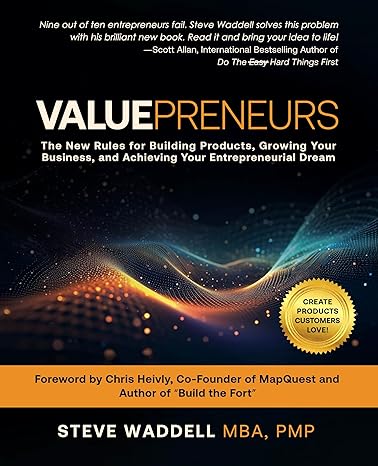
In Valuepreneurs, the author provides aspiring entrepreneurs with a clear, step-by-step roadmap to transform product ideas into successful ventures. Waddell’s writing is deeply rooted in practicality, drawing from his extensive experience covering crucial aspects of entrepreneurship, including idea validation, leveraging freelancers for team expansion, protecting intellectual property, and the importance of ongoing learning.
The systematic approach to product development is a central theme, illustrating how this process is foundational to creating value. The author highlights the importance of identifying and overcoming potential obstacles, offering readers a comprehensive framework for navigating these challenges. This is further enriched by in-depth discussions on topics such as non-disclosure agreements and assessing market viability, providing valuable insights into protecting ideas and achieving commercial success. One of the book’s strengths lies in its use of real-world examples and case studies. These enrich the learning experience and contextualize key concepts, ranging from the success stories of renowned companies like Dyson and GoPro to the journeys of lesser-known startups. These narratives offer readers a tangible understanding of value-driven entrepreneurship.
Valuepreneurs is a comprehensive and indispensable resource for anyone interested in entrepreneurship and product development. Its textbook-like format, with clear chapter delineations and outlines, makes it accessible to both novices and seasoned professionals. In an era when entrepreneurs often grapple with self-doubt and imposter syndrome, this book emerges as a valuable tool to bolster confidence in one’s abilities and ideas. Its timely insights and practical advice make it a crucial addition to the entrepreneur’s toolkit.
Pages: 279 | ASIN : B0CLT7ZGBX


