Blog Archives
The Emergent Leader: A Guide to Brand Building, Leadership, and Self-Mastery


Don Gregori’s The Emergent Leader is a practical leadership guide built around brand building, business judgment, innovation, operational focus, career development, and mental readiness. The book is organized into sixty short chapters across six themed sections, which gives it the feel of a field manual rather than a long lecture. Gregori writes for founders, managers, first-time bosses, and ambitious professionals who want to lead with more clarity and less guesswork.
One of the book’s strongest ideas is that leadership starts with purpose. Gregori puts it simply: “The mission is our journey. Purpose is our reason why.” That line captures the book’s larger approach: define what matters, align people around it, then build habits that support it. His chapters on brand and culture are especially useful because he treats a company as something alive, shaped by values, behavior, employees, customers, and trust.
The book also spends a lot of time on the human side of business. Gregori doesn’t frame leadership as charisma or control. He frames it as listening, empathy, transparency, and the discipline to make better decisions repeatedly. “There is no business without people. There is no team without togetherness,” he writes, and that belief runs through the book. He’s at his best when connecting business performance to the everyday choices leaders make in how they communicate, delegate, hire, and respond under pressure.
What makes The Emergent Leader approachable is its structure. Each chapter is brief, direct, and ends with a takeaway and an action step, so readers aren’t left with abstract advice. Gregori pulls from business cases, cultural references, research, and personal observation, but the tone stays grounded. The book talks about risk, creativity, focus, sleep, stress, ambition, and self-mastery in a way that feels designed for real workdays, not idealized conference-room scenarios.
The Emergent Leader is a thoughtful and usable guide for people who want to become steadier, sharper leaders. It’s about building something durable: a brand with purpose, a team with trust, a career with direction, and a mindset that can handle pressure without losing perspective. Gregori’s message is clear and practical: before leaders can guide others well, they’ve got to understand their own habits, limits, blind spots, and responsibilities.
Pages: 316 | ASIN : B0GXC6P1JK

Mind The Gap: Scaling Businesses Across Cultures
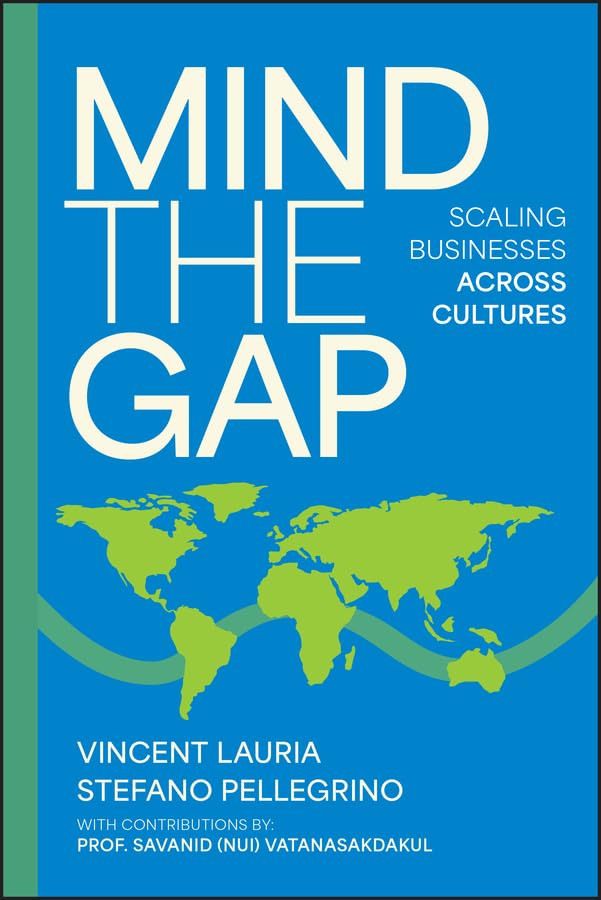
Mind the Gap, by Vincent Lauria and Stefano Pellegrino, is a thoughtful, experience-rich guide to the human complexity of global expansion. Drawing on venture capital, law, entrepreneurship, and lived cross-cultural experience, the book explores what happens when companies try to grow across borders and discover that contracts, products, hiring plans, leadership habits, and even the meaning of “yes” don’t travel as cleanly as expected. From the failed Vietnamese deal over a last-minute $20,000 request to the lessons of Golden Gate Ventures, Carro, MoneySmart, Tata and Docomo, livestreamed commerce in Asia, and the dangers of an overbroad “Africa strategy,” the book argues that scaling internationally is never just a market-entry problem. It’s a test of humility, presence, adaptation, trust, and cultural imagination.
What I enjoyed most was the book’s insistence that business is not abstract. Deals are human, the authors remind us, and I felt that idea gathering emotional weight as the chapters moved from strategy into listening, code-switching, hiring, team management, and social responsibility. The early story in Hanoi could have been treated as a simple cautionary tale about trust, but the book does something more interesting with it. It lets the discomfort linger. That moment of bafflement becomes a doorway into a larger truth: what looks irrational from one cultural vantage point may be operating by a different logic entirely. I found that both sobering and oddly hopeful. The book doesn’t romanticize cultural difference, nor does it flatten it into tidy business-school categories. Instead, it asks the reader to become more observant, more patient, and less intoxicated by their own assumptions.
The writing is clear, practical, and at its best when it lets stories carry the weight of the lesson. I especially appreciated the chapters on transcreation and cultural code-switching because they move beyond the thin idea of “localization” into something more alive. A product cannot simply be translated into another market. It may need to be reimagined through local habits, values, infrastructure, and desires. That distinction feels vital. The book is strongest when it blends framework and anecdote, as in its discussion of why remote launches can mislead companies, why an on-the-ground presence reveals truths no spreadsheet can, or why the phrase “yes” might signal acknowledgment, hesitation, politeness, or refusal depending on context. The steadiness of the advice gives the book its usefulness, while the stories keep it from becoming sterile.
I came away from Mind the Gap with the sense that global business, done well, requires a rare combination of ambition and reverence. The authors believe in expansion, but not in conquest. They believe in growth, but not in arrogance. That balance gives the book its quiet authority. It’s a smart, generous, and unusually grounded read for founders, investors, executives, operators, and anyone preparing to build across cultures, especially those who already know that success abroad will demand more than confidence and capital. I’d recommend it to readers who want a practical business book with a human pulse, one that treats cross-border growth not as a formula to master, but as a discipline of attention.
Pages: 310 | ISBN : 978-1394381487
How to Succeed in Your Professional Service Business


Larry Easto’s How to Succeed in Your Professional Service Business is a practical and reflective guide for self-employed professionals who are skilled at serving clients but less comfortable with the business of finding them. Moving from mindset to marketing, Easto argues that sustainable success begins with the professional’s inner life: passion, purpose, beliefs, values, calm decision-making, and authenticity. From there, he turns toward the visible work of building relationships, clarifying an ideal client, developing a personal brand, networking, creating compelling offers, using online tools, and sustaining trust through credible authority and continuous improvement.
What I appreciated most is the book’s insistence that marketing professional services doesn’t have to feel like a costume. Easto’s best idea is that the provider and the business are deeply intertwined, which makes authenticity not a decorative virtue, but a practical necessity. I found that especially persuasive in moments like his story of setting up a law office around a pine dining table rather than an intimidating desk. That image stayed with me. It quietly expresses the whole book’s philosophy: clients are not abstractions to be captured, but people to be met with clarity, usefulness, and care. The recurring “Life Lessons” also give the book warmth. Marg’s second thought before buying a troubled business, Ben’s shift from financial planning to life coaching, and Eva’s discovery of purpose through music and seniors’ care all make the advice feel lived rather than merely assembled.
The writing has an easy, mentoring cadence. Easto can be conversational, even folksy, and that makes the material accessible without draining it of seriousness. I liked the way he folds in memorable images, from the Field of Dreams opening to the lodgepole pine after a wildfire, because those metaphors give the business advice an emotional weight. I found the stronger current to be pragmatic. Easto keeps returning to action: SWOT analysis, relationship-building, a 30-, 60-, and 90-day plan, added value, communication, and trust. The ideas are at their best when they join hope to responsibility.
I came away from the book feeling that Easto is less interested in teaching professionals how to sell themselves than in helping them become more fully themselves in the marketplace. This is a thoughtful guide for consultants, coaches, advisors, trainers, solo practitioners, and small professional service providers who want practical marketing direction without sacrificing their integrity, personality, or sense of purpose. It would be especially useful for professionals in transition, people who know they’re good at their work but need a steadier, more authentic way to invite the right clients toward it.
Pages: 262 | ASIN : B0DGNK4PXC
The Emergent Leader: A Guide to Brand Building, Leadership, and Self-Mastery

Don Gregori’s The Emergent Leader is a broad, practical meditation on what it takes to build a durable company and become the sort of person capable of leading one. Moving through brand identity, culture, risk, innovation, operational discipline, career growth, and mental resilience, Gregori argues that leadership begins with self-mastery and then radiates outward into teams, customers, products, and purpose. I found the book most compelling when it tied lofty ideas to lived business texture, such as the distinction between mission and purpose through the Everest metaphor, Patagonia’s moral clarity, Harley-Davidson’s almost tribal customer loyalty, Shackleton’s grim honesty aboard the Endurance, and Fitbit’s decision to be candid with customers when production delays threatened early trust.
What I liked most was the book’s insistence that leadership isn’t a performance of certainty. Gregori returns again and again to humility, empathy, transparency, and the courage to act before conditions are perfect. I appreciated that emotional intelligence isn’t treated as decorative softness but as an operating principle, especially in the discussion of Google’s Project Aristotle and the idea that high-performing teams depend less on raw talent than on psychological safety, curiosity, and the ability to listen. The pregnancy simulation example in the chapter on empathy struck me as especially memorable because it shows how imagination can become disciplined, almost physical. The best leaders, in Gregori’s framing, don’t merely think about customers and employees. They submit themselves to the discomfort of trying to feel what others feel.
The writing is brisk and confident, and at its best, it carries the energy of a seasoned operator speaking from scar tissue rather than theory. I liked the rhythm of the short chapters, the “Take Away” and “Take Action” structure, and the way the book moves from brand building to sleep, vacation, stress, and ambition without treating those later subjects as lesser concerns. The voice remains assured and engaged throughout, with enough candor and momentum to keep the reading experience warm rather than prescriptive.
By the end, I felt that The Emergent Leader is less a single argument than a leadership field manual with a conscience, one that asks readers to build companies with purpose while also protecting the human beings who make those companies possible. Its strongest idea is that external leadership cannot outrun internal disorder, and that point lands with quiet force in the final sections on stress, expectations, limits, and release. I’d recommend this book to first-time managers, founders, ambitious intrapreneurs, and experienced leaders who want a practical reset without surrendering the reflective, human side of their work. It’s a thoughtful guide for anyone trying to lead with sharper judgment, steadier nerves, and a deeper sense of responsibility.
Pages: 304 | ISBN : 978-1611537246
ULTIMATE LAW OF SUCCESS: Provide Solutions, Solve People’s Problems, Meet Others’ Needs, Get Paid for Your Products and Services, and Attain Wealth

Ultimate Law of Success, by Peter James Kpolovie, is an expansive self-improvement and wealth-building book built around one insistent premise: lasting success comes from solving other people’s problems through useful products, services, inventions, and disciplined action. Across chapters on time, breakthroughs, skill acquisition, business websites, memory, enthusiasm, and going the extra mile, Kpolovie returns again and again to the same moral and economic equation: serve real needs, create value, and wealth will follow. He illustrates this through figures such as Willem Kolff, Steve Jobs, Thomas Edison, Stanley Mason, and everyday inventions like toothpaste tubes, razors, microwave ovens, and disposable diapers, using them as proof that human progress is often born from someone refusing to accept a persistent inconvenience as permanent.
The book is most compelling when it treats success not as personal accumulation, but as usefulness made visible. There’s a humane spark inside the argument, even when the language is intensely commercial. Kpolovie’s repeated insistence that egocentrism repels wealth and that time should be guarded for service gives the book a straightforward quality. I respected the moral pressure behind the author’s ideas. The book made me reconsider productivity less as busyness and more as contribution. The example of Kolff’s dialysis machine stayed with me because it gives the book’s philosophy a heartbeat: invention isn’t merely profitable, it can stand between suffering and survival.
The book’s confidence is energizing. The writing is passionate, repetitive, and forceful. Kpolovie favors declaration, and the book revisits principles to ensure they stick. The author writes with the certainty of someone preaching from long conviction rather than casually offering advice. I appreciated the breadth of examples, from Apple’s products to print-on-demand publishing and Stanley Mason’s small, practical inventions, because they grounded the grand ideas in recognizable things people actually use.
I came away seeing Ultimate Law of Success as a fervent, ambitious, and earnest manifesto about service, invention, and wealth creation. It has a clear purpose: to make something useful, help people meaningfully, and refuse to live passively. I’d recommend it to entrepreneurs, aspiring inventors, coaches, students of personal development, and readers who respond well to motivational writing with a strong moral charge and a practical business emphasis. For someone looking for a warm but uncompromising push toward disciplined value creation, this book offers a vigorous and memorable call to become useful in the world.
Pages: 396 : ASIN : B0G2JXDWBH
PS. Some Things Really Are Easy

The Passive Income Power Plan isn’t about getting rich quickly; it is a guide to help readers build income streams that give them more breathing room. What is the biggest barrier to wealth, practical or emotional?
To me, our mindset is our biggest barrier, as any belief starts in our minds. As Henry Ford said, “Whether you believe you can or you believe you can’t, you’re right.” That belief system will lie to you and tell you that you’re too old or you don’t have the right education or your partner won’t support you or it’s too expensive to get started (I could go on… and on).
Even the shift from active to passive income begins in your mind. Do you believe you can only exchange hours for dollars? Might it be possible for you to earn income that was tied to something physical, like a house rental or someone purchasing a product that you had created? Once you set up these systems, they exist without much or any involvement from you. For many, it’s a matter of exchanging a belief of what financial freedom really looks like.
You frame passive income as “sovereignty” rather than hustle. What does financial freedom actually look like in lived, everyday terms?
I get asked this question when I speak. And the question is, what does it look like for you? For someone it might be the ability to build a tiny home and live off the land. For someone else it might mean $100 million. we’re almost everyone I’ve spoken with, it means time freedom: I can do with my day what I desire. And money freedom — I don’t have to worry about my bills. Where are you fall on that spectrum is up to you. Consciously focusing on what this would look like — creating images of it in your head and then going and living inside of those images — can help create a safe space for you where this is actually possible in real life.
The book ends with a simple directive: pick one idea and act. Why is that so difficult for people to do?
I love this question so much! We tend to overcomplicate things. Many people have a belief that simple and easy are the same thing. But they’re not. We will tell ourselves “That’s too easy! It won’t work.” What we are really saying here is that it’s too simple and therefore, I don’t believe that it will work. Quite a difference. Coaching can help shift your mindset here – even the bumper sticker coaching, I included in the book can be quite transformational. Yet many people won’t even try, because they want a 15 step system. PS. Some things really are easy.
What are the biggest financial mistakes beginners make when chasing passive income?
The first one is going where they think the money is as opposed to creating the stream they really care about. I believe that alignment is everything. You have to choose the thing that you’re going to want to stick with when there are bumps in the road.
I also see people making basic business mistakes because they haven’t bothered with business basics. If you started making income, put a portion aside for taxes. Simple, right? So much of this can be learned online right now.
Not doing basic market research before starting their passive stream. Are you in an industry where the kind of product that you want to create is already done trending? Do you want to open a laundromat but there are already four in your local area? Using AI tools, market research that used to take days or weeks can now be done in minutes.
The biggest financial mistake I see is people not getting started because they’re afraid they don’t have the money. I think something like half of the passive income streams mentioned in the Passive Income Power Plan can be started with less than $500! Some can be started for free, using just your brain and your computer. This bring us back to your mindset. Are you willing to believe in yourself and to know that the desire you seek is also seeking you?
Author Website
If you’ve ever thought, There’s got to be more than this — you’re right. The Passive Income Power Plan is your starting line.
In this powerful guide, transformational wealth coach and business strategist Halle Eavelyn delivers 108 proven ways to earn income while you sleep—no hype, no fluff, just practical ideas that work. Whether you’re stuck in a 9-to-5, running a business that owns you, or finally ready to make your money work harder than you do, this is your roadmap to financial freedom.
Inside, you’ll discover:
108 income ideas—from simple side hustles to scalable digital assets
How to turn what you already know (or own) into recurring cash flow
Mindset shifts to stop stalling and start building
Practical tools to grow wealth without grinding 24/7
You don’t need an MBA. You don’t need a six-figure budget.
You just need to take the first step.
Because freedom isn’t luck. It’s leverage. And this book shows you exactly how to build it.
The Passive Income Power Plan: 108 Ways to Make Money While You Sleep

What I found in The Passive Income Power Plan is less a strict investing manual than a wide-ranging, motivational field guide to financial diversification. Author Halle Eavelyn opens with a personal argument against trading your life for a paycheck, frames passive income as a form of sovereignty rather than a hustle fantasy, and then moves through 108 possibilities that range from dividend stocks, REITs, and lease-to-own agreements to tiny home rentals, niche job boards, online courses, blogging, podcasting, membership sites, and domain flipping. Along the way, she threads in short mindset refrains she calls “Bumper Sticker Coaching,” and the book ends not by complicating the plan, but by stripping it down to a blunt imperative: pick one idea, act on it, and build from there.
Eavelyn writes like a coach who has sat across from too many exhausted people and decided she’s no longer interested in speaking softly about their resignation. When she recalls the client who cried every day for twenty years on the way to a job he hated, or her own experience of watching one industry collapse and then another until she was down to minus ten dollars, the book acquires real pulse. That urgency gives the project its moral center. I also liked the odd, revealing mix of practicality and personal belief. A line like “Yes, please, more and thank you” could have felt airy in another book, but here it sits beside discussions of management fees, separate bank accounts, and the need to vet borrowers, which creates an interesting texture. It’s earnest, sometimes almost disarmingly so. I found that warmth appealing, even when the language veers into the glossy, high-vibration register of contemporary coaching.
The book’s great virtue is range. Many of the 108 entries are more like invitations than analyses, and the line between truly passive income and simply different kinds of work can get blurry. A reader moving from dividend stocks to ATMs, from vacation homes in Augusta to smart lockers for laundry pickup, and then into online courses, audiobooks, YouTube, and SaaS will absolutely come away with options, but not always with enough detail. That said, I admired the book’s candor in places. She admits some markets are saturated, notes that some ideas require real upfront capital, and repeatedly insists on doing your own research. I also appreciated the way her examples reveal her sensibility: she doesn’t just like scalable things, she likes overlooked things, slightly eccentric things, things with texture. Mailbox rentals, equipment libraries, and vending machines stocked for “mind, body, and soul” are not the usual boilerplate examples, and that gives the book personality.
I read this book as a persuasive nudge out of passivity. Its writing is vivid, repetitive by design, and its central idea is compassionate: freedom is built by creating assets, systems, and choices before desperation makes your decisions for you. I would recommend it to readers who feel financially stuck, intimidated, or overidentified with the paycheck-to-paycheck script and need a warm, forceful, idea-rich push into possibility. It’s best for the person who doesn’t need another theory of money so much as a reason to believe they can begin.
Pages: 148 | ASIN : B0FP6TGSY1

Exceptional Leadership

In The Exception Code, you share a framework for leadership that results in customer loyalty and profitability. Why was this an important book for you to write?
Because I’ve seen how organisations lose trust long before they lose revenue. Culture doesn’t collapse with a bang. It erodes quietly, in the meetings we tolerate, the standards we lower, and the good people we exhaust until they leave. Customer loyalty follows that same pattern. It doesn’t disappear overnight. It drifts.
I wrote The Exception Code because leaders deserve more than inspiration. They need an operating system. Something they can use when the pressure is real, when the targets are tight, when the team is tired, and the customer is one poor experience away from walking. This book is my answer to the question I kept hearing, even from strong leaders: “What do I do next, in a way that actually holds?”
Why Courageous Mindset first? Is courage the gateway trait to the other three pillars?
Yes. Courage is the gateway because it’s the first thing pressure tries to steal. Without courage, leaders manage appearances. They avoid the hard conversation, protect comfort, and call it “stability.” But stability built on silence is just delayed damage.
Courageous Mindset comes first because it gives you permission to face reality and act on it. It’s what makes an Original Approach possible, because you stop borrowing safe answers. It’s what makes Driven Impact sustainable, because you stop chasing wins that cost you people. And it’s what makes Enduring Legacy real, because you stop building cultures that collapse the moment you step away.
What is one meeting habit you believe most organizations get fundamentally wrong?
They use meetings to share information instead of making decisions. They confuse activity with progress. The calendar fills, the slides get sharper, and everyone leaves with the same unresolved issues they walked in with, just more tired.
A meeting should earn its time. It should produce clarity, decisions, and ownership. If it doesn’t, it becomes a slow leak in culture. People learn that truth is optional, accountability is negotiable, and momentum is something we talk about instead of creating. One of the fastest ways to change a culture is to change what your meetings reward.
What is one thing you hope readers take away from The Exception Code?
That exceptional leadership is not a label. It’s a discipline. And it’s available to any leader willing to stop leading by default.
If readers walk away with one thing, I want it to be this: you can build a culture that performs without burning people out, retains talent without begging, and earns customer loyalty without gimmicks. But it requires a code, not charisma. The book gives you that code, and it gives you a way to apply it immediately, starting with the next decision you make and the next standard you refuse to lower.
Author Links: GoodReads | Facebook | Website | Amazon
It’s failing because too many are leading by default.
Caught between quarterly pressures, cultural fatigue, and constant change, capable leaders are doing everything “right” while still watching engagement, innovation, and loyalty slip through their fingers.
So,The Exception Code is written for leaders who know there’s more to leadership than metrics, titles, and optics. It’s for CEOs, founders, and purpose-driven teams who want to build cultures that perform because they are principled, and keep performing even when the leader isn’t in the room.
Johnathan Johannes writes from the front lines of real change. He led one of the Caribbean’s oldest banks through pandemic disruption, a major transformation agenda, and a landmark acquisition in the Eastern Caribbean.
The lesson was clear: culture, retention, and customer loyalty aren’t “soft stuff.” They are the levers of sustainable profit.
This book gives you the clarity, conviction, and tools to lead that way.
No fluff. No jargon. No performative inspiration.
At its core, The Exception Code is not a collection of leadership hacks. It’s an operating system for leaders who want to build organizations worth believing in.
This book doesn’t offer easy answers. It offers a mirror, a method, and a movement for leaders willing to trade convention for conviction, and short-term wins for lasting influence.
If you’re ready to stop performing and start being the exception in your organization, this book is for you.


