Blog Archives
Embrace the Challenge

In Surviving the Stroke, you share your journey to recovery following a hemorrhagic stroke as well as actionable advice for those coping with the daily challenges of rehabilitation. Why was this an important book for you to share?
There is a saying ‘knowledge is power.’ While I was in the ICU for that first week and the rehabilitation hospital for three weeks, there was a lot of knowledge passed on, however, most of that knowledge was not about predicting the future as it related to recovery and rehabilitation. While I’m sure the information was available, but at the time I thought it would have been nice to have some of that information. After the rehab hospital, I was in outpatient therapy for 10 months. I met other stroke victims during that time and it was there that I decided to write the book because we all had shared experiences and agreed that there was not a good supply of resources to prepare us for the day-to-day future in being prepared for, and what to expect during recovery, rehabilitation, and later.
I appreciated the candid nature with which you told your story. What was the hardest thing for you to write about?
This is a good question and in hindsight, I think the hardest part was probably in the beginning when I discussed the actual stroke experience and my conversation with God. I think that was because in the moment of the stroke occurring, there was uncertainty of what was happening and if I was dying, or what was happening, therefore I think that was probably the most difficult.
What is one misconception you believe many people may have about recovering from a stroke?
During interactions with other stroke victims at outpatient therapy, we discussed this subject and there are some misconceptions relating to the severity of a stroke. The term mini-stroke is used a lot and I think when people hear the word, stroke, they automatically associate it with mini-strokes and celebrities like Hailey Bieber who appeared to be fine afterward and returned to their activities. Although, there are other celebrities like Randy Travis who have severe strokes, paralysis, and other challenges, and they fade away from the public eye.
In outpatient therapy, there was a woman in her first week and she was similar to me in the severity of the stroke. Her employer called her twice in the previous week asking when she was returning to work, which was upsetting to her and demonstrated to us a lack of empathy, a lack of understanding, and the reality of what a stroke really is.
What is one thing you hope readers take away from your experience?
There is a section in the book “I Quit,” that discusses quitting and dying. My hope is that when a stroke happens, it is not the end of the world. A positive attitude coupled with occasional humor can overcome life’s challenges. Do not give up, do not quit, and embrace the challenge ahead.
Author Links: GoodReads | X (Twitter) | Facebook | Website | Surviving the Stroke | Amazon
Surviving the Stroke: A Minute with God: A Recovery and Rehabilitation Guide
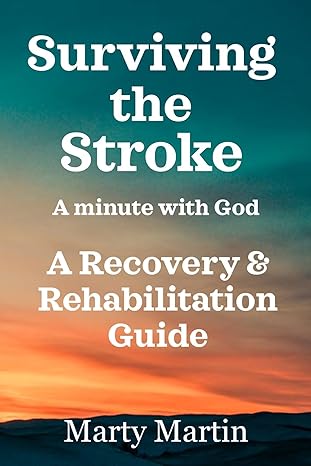

Marty Martin’s Surviving the Stroke: A Minute with God is both a recovery memoir and a practical guide for those navigating the turbulent aftermath of a stroke. The book chronicles Martin’s harrowing experience with a hemorrhagic stroke and his extensive rehabilitation journey, weaving personal anecdotes with actionable advice. From the initial trauma to the daily realities of therapy and family dynamics, Martin lays bare his vulnerabilities, offering hope and camaraderie to readers facing similar struggles.
What struck me most was Martin’s ability to blend raw honesty with humor. Early in the book, his description of the initial moments of his stroke—his leg buckling and his puppy, Izzie, licking his hand as he struggled to reach his phone—is both heart-wrenching and oddly endearing. This balance of gravity and levity continues throughout, making the narrative compelling and relatable. Martin’s conversational tone, especially when recounting his struggles with spasticity and the quirks of therapy, makes you feel like you’re sitting across from a friend who’s baring their soul.
One of the standout sections is Martin’s emphasis on attitude as a critical factor in recovery. He doesn’t shy away from admitting his initial struggles with self-pity but quickly pivots to the importance of embracing his new reality. The book shines in its actionable advice for stroke survivors and caregivers. From navigating hospital protocols to understanding the “toddler effect” of relearning to walk, Martin’s insights are grounded in lived experience. I found his tips on overcoming spasticity and the benefits of speech-to-text technology particularly useful.
Surviving the Stroke is more than a memoir; it’s a lifeline for those grappling with the aftermath of a stroke. Martin’s candid storytelling, bolstered by his unwavering determination and faith, makes this book a valuable resource. I recommend this book to stroke survivors, caregivers, and even medical professionals seeking to understand the human side of recovery. If you’re looking for a guide that mixes practical advice with heartfelt storytelling, Marty Martin’s journey will leave you inspired and better prepared to face life’s toughest challenges.
Pages: 111 | ASIN : B0DQHT2658

Knowledge Is Power

The Power of Your Spine: How Back Strength and Posture Pilots the Entire Body explains to readers the vital function of back muscles and the spine and how to care for this important area of the body. Why was this an important book for you to write?
One reason this book was important for me to write, which is the core of all my books, is to help educate people to help them heal, support, maintain, and exercise their bodies safely. I often say, “Knowledge is power.” I wanted to teach the power of this spine.
What were some ideas that were important for you to share in this book?
In this book I share illustrations of muscles that we all have. In order for me to teach the “Power” of the spine, readers need the visuals in these illustrations for better learning and understanding.
What is a common misconception you feel people have about back pain?
I find a big misconception about back care and muscles is the “cliche” of what the core muscles are. In social media we often see posts and videos with strong titles like “3 best exercises for your core” or “number one exercise everyone should do for their core” etc. The “core” also includes the many deep muscles in the spine.
These deeper muscles play essential roles in walking, standing, posture, balance, stabilization, and movement. If they are weak and/or ignored the larger muscles try to do the smaller muscles jobs and this causes malfunction, injury, and pain.
What is one thing you hope readers take away from your book?
A gain of knowledge. Once the knowledge shared in this book is known, this can help the reader find a knowledgeable trainer, chiropractor, physical therapist, and more. If professionals helping me heal or in therapy do not know the purpose of all the muscles and how they work together as a team, they cannot help to the extent most people need. For example, if someone is going to a personal trainer, physical therapist, or massage therapist for back care (posture, pain, strengthening, etc.), these professionals should know all the muscles in this book.
Also, many professionals hand a patient/client a piece of paper with exercises to go home and do. Well, the paper is usually the same for every person with back pain. Its usually not based on the individual’s personal situation. This leaves people unable to heal or get more injured.
Author Links: GoodReads | Twitter | Facebook | Website | Instagram
Tracy L. Markley details the vital function of back muscles and bones as key powerhouses to your physical wellness. While back pain is a common complaint among people for various reasons, you don’t need to suffer chronic distress.
Learn how different body parts work together and, if not cared for, work against each other to nourish or diminish your quality of life. You’ll also discover the importance of taking care of your core—how to do it effectively—and discover comprehensive ways to better your posture and promote spinal stabilization so that issues like sciatica are controlled for good.
Whether you’re healthy, suffering from an injury, or seeking to ease the impacts of aging and lifestyle on your body, this dual anatomy and reference resource literally has your back.
The Power of Your Spine book is available it two paperback editions. One is in a colored edition and one is a black and white edition. The kindle edition is always in color.
The Power of Your Spine: How Back Strength and Posture Pilots the Entire Body
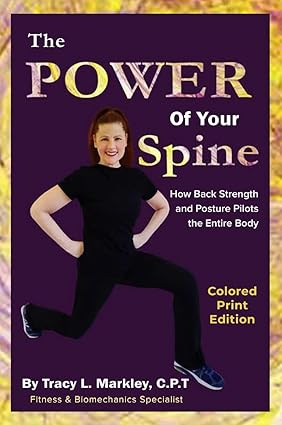
The Power of Your Spine: How Back Strength and Posture Pilots the Entire Body by Tracy L. Markley is an exceptionally enlightening and valuable book that takes readers on a profound exploration of our physical beings. Tracy’s motivation to write this book stems from her interactions with individuals, aiming to foster an understanding of our bodies’ fundamental composition: bones and muscles. She emphasizes that comprehending the intricate workings of each muscle, both independently and in synergy with others, holds the key to cultivating a healthy and pain-free physique. By prioritizing good posture, exercise, and providing our bodies with proper care, we can significantly enhance our physical well-being, thus elevating our overall quality of life.
The book’s composition showcases Tracy’s masterful craftsmanship, characterized by an amiable yet highly informative tone that resonates with readers of all backgrounds. One notable example is Tracy’s inclusion of anatomical terms. The author thoughtfully incorporates illustrations throughout the book, facilitating clear comprehension of muscle identification and function. Consequently, readers can grasp the knowledge imparted by the book and overcome the challenges associated with anatomical terminology.
While the author acknowledges the relevance of the book to individuals in recovery or older age groups, I firmly believe that its usefulness extends to people of all demographics. In our contemporary society, where rapid-paced living and technological advancements dominate, many of us find ourselves bound to chairs or computer screens for prolonged periods. Moreover, poor posture, although an individual concern, affects a substantial portion of the population. Understanding the root causes of bodily discomfort and equipping ourselves with the knowledge to alleviate such pain becomes imperative for leading a pain-free existence.
The Power of Your Spine: How Back Strength and Posture Pilots the Entire Body by Tracy L. Markley is a book that should be embraced by everyone, as it empowers individuals to alleviate existing pain and prevent future discomfort. Personally, I intend to return to this invaluable resource repeatedly, employing it as an essential tool to guide my exercise routines and self-care practices.
Pages: 114 | ASIN : B07XDC3FMR



 LITERARY TITAN