Blog Archives
Ripple Effect

Heather’s Journey follows a 19-year-old girl living in a small town in Illinois during the 1930s who dreams of leaving, but tragedy strikes, changing everything about the course of her life. What was the inspiration for the setup of your story?
The year 1930 amazes me. For most of the year, everyone thought the stock market crash would breeze over and they could keep dancing like they did in the Roaring Twenties. They were so vulnerable, and our early Americans have grabbed my heart. Along with this, there was Prohibition, and racism that was considered normal. They were still recovering from World War I and the Titanic sinking. (Similarly, we’re still recovering from 9/11, which was over 20 years ago. Healing takes time.) Heather was a mirror of her father’s dreams in his younger days. He moved north; she wants to go south where the dreams started, but racism, like I said, was normal. I pondered on how unfair that had to have been for a young woman with enough issues to deal with. Racism had such a ripple effect on Heather’s entire life. It really umbrellaed her whole “journey.”
Were you able to achieve everything you wanted with the characters in the novel?
I took 18 months to write the novel. I fell in love with all my characters. I even have some compassion for Sylvia. It took time to develop her character. I withheld good qualities from her. I also discovered a struggle in creating Mae — a comical character who isn’t too annoying. Renato’s character was fun — I built him from younger photos of Marc Anthony. I picture Heather to look like Dorothy Danridge in her younger years. Hugh is a soft version of Denzel Washington. 🙂 I have gazed over the marsh in Savannah and thought, this is what the end of a happy story looks like. And so, . . . So, yes, I achieved everything I wanted to.
What were some themes that were important for you to explore in this book?
One important theme is conflict with independence and family — when are we being selfish, and how much of ourselves should we feel guilty about if we don’t give away? Sylvia suffered this conflict. So did Heather and Mae. Renato keeps the reader in conflict with this. He held back going to his family who could keep him safe to take care of Heather and Mae.
Chasing a dream that seems impossible is another theme. Must we have the skills and resources to walk towards where we want to be in life? Renato had a rough past, but he dreamed of respect.
The power of the ripple effect of racism is embedded before page 1.
What is the next book that you are working on and when can your fans expect it to be out?
I am working on another book set in 1930. The setting is a Chicago hotel. Once again, the protagonist is an unadmirable character in the American eye — an Irishman named Percival Dooley. I am hoping to be done with the story by the end of June of this year.
Author Links: GoodReads | X (Twitter) | Website | Amazon
Nineteen-year-old Heather Randolph longs to escape her small-town life in Sterling, Illinois, and uncover her family’s roots in Savannah, Georgia. But when tragedy strikes, she’s thrust into a world of danger, deception, and forbidden romance.
Caught between a charming Puerto Rican bootlegger, her sharp-tongued 12-year-old sister, and a mother whose cruelty knows no bounds, Heather must navigate the turbulent era of Prohibition, the shadows of World War I, and the harsh realities of racism and lawlessness. With the law closing in and her dreams slipping away, will she find the freedom she craves—or be trapped by the past she’s desperate to escape?
A gripping historical fiction novel set in 1930s America, perfect for fans of sweeping family sagas, unforgettable heroines, and forbidden love.
Heather’s Journey: Historical Romance of 1930
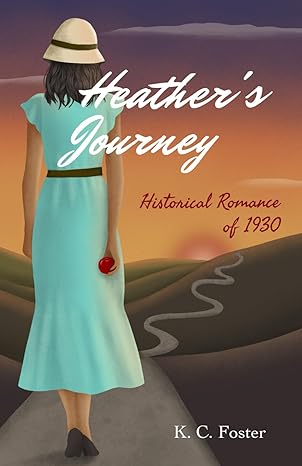

Heather’s Journey by K.C. Foster is an emotional, immersive novel that pulls the reader into a deeply atmospheric world of family struggles, love, loss, and the quest for identity. Set in the 1930s, the book follows Heather as she navigates a life tangled with mystery, survival, and self-discovery. From the first few pages, we are drawn into Heather’s tense reality, witnessing a secretive late-night burial in Chapter 1 that sets the tone for the book’s brooding undercurrents. As the story unfolds, we meet a complex cast of characters, each carrying their own burdens, yet all woven into Heather’s path toward understanding herself and the world around her.
Foster’s writing is rich and evocative, making every setting feel alive, from the small town of Sterling, Illinois, to the shadowed corners of Dodge Grocers. There’s a poetic rhythm to the prose, particularly in descriptions of the world Heather inhabits, whether it’s the wind whispering secrets across the fields or the hushed tension in a dimly lit kitchen. One of the book’s strongest points is its ability to create mood. In the opening scene, Heather is watching shadows move in the night while whispers of danger hang in the air, which immediately sets up an eerie intrigue. The dialogue, too, is crisp and filled with subtext, particularly in interactions between Heather and the enigmatic Renato, whose presence in her life is as steady as it is uncertain.
The heart of the book, though, is in its characters. Heather’s father, Hugh, is a quietly dignified figure, a man of resilience, whose fate is one of the novel’s most devastating blows. When tragedy strikes, Foster doesn’t hold back in letting us feel the rawness of Heather’s grief. The way she stumbles through her pain, desperately seeking solace in routine, in small moments, in the presence of Renato, it’s heartbreakingly real. And then there’s Sylvia, Heather’s absent mother, whose arrival is both anticipated and dreaded. When she finally steps onto the page, she’s not the warm, comforting figure Heather might have hoped for. Instead, she’s a force of vanity and detachment, more concerned with reclaiming control over the family store than reconnecting with her daughters. Foster masterfully builds Sylvia as a character we want to understand, yet can’t fully trust.
There are moments in this book that feel so intimate, they almost hurt to read. One of the most striking is when Heather, caught between grief and longing, kisses an unconscious Renato, a moment filled with quiet yearning, desperation, and a kind of naive hope. It’s these personal, human moments that make Heather’s Journey so compelling. The novel isn’t just about external struggles, it’s about the battles within, about the weight of choices, and about how even love can be tangled in regret and hesitation.
By the time I reached the final chapters, I was left with an ache in my chest. Heather’s Journey is not just a coming-of-age story; it’s a reckoning with past and present, with what we want and what we are forced to accept. It’s a book for those who love deeply drawn characters, slow-burning tension, and writing that lingers long after the last page is turned. If you enjoy historical fiction with a raw emotional core, this book is absolutely worth the journey.
Pages: 207 | ASIN : B0CWB5QRNX

The Whims of the Natural World

An Empty House Doesn’t Sneeze follows a 15-year-old boy navigating the challenges of adolescence while the world around him is engulfed in chaos. What was the inspiration for the setup of your story?
Because my father was killed in WWII, the war has always been an interest. At some point, the idea of somebody lighting fires during the mandatory blackouts in Seattle captured my imagination. As a former sixth-grade teacher, I understand how inadequate we are at teaching civics and history, especially to young people, hence teenage readers became my target audience.
Was there anything from your own life that you put into the characters in your novel?
The novel is set in my Seattle neighborhood, which by the way, still looks almost exactly like it did in 1943. Much of the story reflects my own lived experiences, though slightly updated to the nineteen fifties. I grew up near the “wilds” of Ravenna Park – in terrain that shaped my mind as much as my appreciation of nature. This experience cultivated my habits of listening, observing, and yielding to the whims of the natural world.
What were some themes that were important for you to explore in this book?
The central idea of An Empty House Doesn’t Sneeze cried out to become a mystery. It was also a vehicle to portray the homefront in a way most young readers had not been exposed to. I merely hope readers enjoy An Empty House Doesn’t Sneeze and learn a little history along the way.
What is the next book that you are working on, and when will it be available?
The children’s stories I noodled around with years ago are brewing on the back burner, and I’m waiting to see if they spark my interest. An Empty House Doesn’t Sneeze follows my debut novel (published in September 2023) – River’s Reach: Coming of Age Amid the Fish War – a coming-of-age adventure (for “kids” of all ages) that highlights the tensions between the Washington State Game Department and the Nisqually Indians over tribal fishing rights in the Nisqually Valley. With River’s Reach, I hoped to open minds, encouraging people to question beliefs and prejudices that might otherwise settle in for a lifetime.
Author Links: GoodReads | Facebook | Website | Amazon
Into this fragile balance a neighborhood threat emerges: Someone is lighting fires during the mandatory blackouts. Scotty, whose father is an air raid warden, is soon caught up in the firebug mystery and tries to smoke the arsonist out. When the local bully throws suspicion on Scotty’s draft-age brother, and when even his best friend’s actions don’t seem to add up, Scotty must navigate a moral and ethical thicket while treading a path toward maturity. Even as scarcity slips into every nook and cranny, An Empty House Doesn’t Sneeze celebrates a youthful spirit and hearkens to simple pleasures, where free time and family abound.
David Scott Richardson’s An Empty House Doesn’t Sneeze is a work of historical fiction set in 1943 in the Pacific Northwest. A heartwarming and playful coming-of-age adventure, this novel is suitable for MG/YA and the young at heart. It contains no gratuitous language, but there are a few slurs that are true to the historical setting and swear words-in keeping with the characters and story.



 LITERARY TITAN