Blog Archives
The Phoenix CODEX: 138 Palindromic Mirror Edition Complete Phoenix Chronicles: Complete Phoenix Chronicles: A Trilogy of Trilogies


The Phoenix Codex: 138 Palindromic Mirror Edition is a speculative science-fiction thriller with strong elements of conspiracy fiction, metaphysical fantasy, horror, and mythic adventure. At its center is Dr. Natori Saira Evren, a synesthetic researcher drawn into a hidden pattern of Phoenix cycles, ancient Egyptian consciousness technology, alien hunters, simulation theory, and recurring resets every 138 years. The book presents itself not just as a story, but as a codex, a puzzle box, and a ritual object, with its mirrored structure, sacred numbers, and recurring symbols shaping the reading experience as much as the plot itself.
The book is committed to its own mythology. It doesn’t ease the reader in gently. It opens with pain, blood, classified files, impossible geometry, and a heroine who is already half legend before we really know her. That choice gives the novel a charged, feverish energy. Sometimes it works beautifully. The world feels huge, dangerous, and strangely magnetic, like every room has a hidden door and every number is whispering. The book wants to explain its patterns, prove them, dramatize them, and make the reader feel implicated in them all at once. That’s ambitious, but it can also be overwhelming at times.
The writing is at its best when it trusts atmosphere and image. Copper, burnt cinnamon, cold concrete, humming frequencies, jungle silence, blood on leaves: those details make the strange ideas feel physical. I could feel the book trying to turn paranoia into texture. The author’s biggest choice, though, is structural. The palindromic design, the 138-year cycle, the ascending and descending arcs, and the central mirror are not decorative. They’re the book’s engine. Even when I questioned some of the repeated exposition, I could see the purpose behind it. This is genre fiction that wants the form to become part of the spell. It’s a story about recursion.
I would recommend The Phoenix Codex most to readers who enjoy big, strange, high-concept speculative fiction, especially people drawn to ancient mysteries, secret histories, simulation ideas, cosmic horror, and books that blur the line between novel, artifact, and prophecy. Readers who like genre fiction that swings hard, builds its own symbolic language, and treats conspiracy, myth, and science fiction as parts of the same burning machine, this book has a fierce pull.
Pages: 501 | ASIN : B0GBVLRVXP

The Phoenix CODEX: 138 Palindromic Mirror Edition Complete Phoenix Chronicles: Complete Phoenix Chronicles: A Trilogy of Trilogies
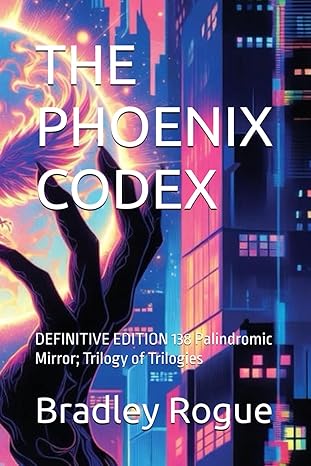
The Phoenix Codex is a theatrical metaphysical thriller that treats structure as part of the story, not just a container for it. Bradley Rogue builds the book as a “palindromic mirror” with ascending and descending arcs wrapped around a central point, and that design gives the whole thing a ritualized, incantatory feel rather than a straightforward adventure-novel rhythm. The opening makes its intentions clear right away: “It’s also a novel. Also a seed. Also a key.” That line captures the book’s whole personality. It wants to be read as fiction, transmission, puzzle box, and initiation text all at once.
At the center of it all is Dr. Natori Saira Evren, who isn’t just a protagonist so much as the book’s tuning fork. Her synesthesia, her academic outsider status, and her role as a traveler through patterns of recurrence make her the ideal guide for a world built on hidden frequencies, ancient architectures, and repeating catastrophes. The book follows her through interrogations, prequels, secret histories, temporal jumps, and revelations about the Phoenix cycle, and it does so with total conviction. Rogue writes like someone fully committed to the reality of his invented cosmology, and that commitment gives the novel its distinctive heat.
The book wants myth, conspiracy, sacred geometry, speculative archaeology, simulation theory, apocalypse, and spiritual transformation all in the same breath. Sometimes that makes the prose feel deliberately overwhelming, but that excess is also part of the reading experience. This is a book that likes pressure, repetition, symbols, and declarations. It keeps returning to numbers, mirrors, cycles, names, and encoded meanings until the language starts to feel ceremonial. Even the narrative instructions invite readers to treat the novel as an object with multiple valid pathways, which is a pretty revealing choice. The Phoenix Codex isn’t shy about asking the reader to participate in its pattern-making.
The most interesting thing about the novel is how openly it explains its own method. In the author’s note, Rogue says, “The Phoenix Chronicles make no claims to historical accuracy. They are mythology—but mythology that is aware of its own mythological status.” That self-description is useful because it points to what the book is really doing. It isn’t just telling a story about a hidden truth. It’s dramatizing the human urge to arrange history, fear, destiny, and transcendence into one giant meaningful design. That gives the novel a strange double quality. It’s earnest and self-conscious at the same time, immersive but also always nudging readers to notice the architecture holding it together.
The Phoenix Codex is less a conventional novel than a designed experience, and that’s what makes it memorable. It reads like a fusion of esoteric manifesto, sci-fi myth cycle, and visionary character saga, all organized around symmetry and recurrence. Readers who click with its wavelength will probably admire the sheer audacity of the construction and the intensity of its voice. Even when it gets wild, it knows exactly what it’s trying to summon: a story where reading becomes a form of initiation, and where narrative structure itself becomes part of the spell.
Pages: 550 | ASIN : B0GF7YTNQ8



