Blog Archives
The Need to Take Risks

In Harm’s Way follows a Colonial sea captain returning home after a year-long voyage only to have his ship confiscated by the British Royal Navy and find more tragedy at home who outfits his own private ship-of-war to seek out enemy merchant ships to oppose their tyranny. What was the inspiration for the setup of your story?
The inspiration was the many times I came home myself from six-month deployments aboard Navy ships. I then coupled it with the history of the Norfolk area, where I was at the time stationed. It was always heartwarming to see the new fathers meeting their children for the first time, and heart-wrenching to occasionally see a young sailor coming home after the death of a close relative. I knew I wanted to write a historically accurate novel set during the Revolution, and it was natural to begin it with a homecoming that turned sorrowful. It sets the mood for the story. The Revolution was not clean, it was not easy, nor was it a fight between “good” and “bad” guys.
What are some things that you find interesting about the human condition that you think make for great fiction?
The struggle each of us has to rise above the events that shape our current circumstances. We can either sink under the weight of what’s happened or happening, or adapt and change. But we must choose; even deciding to do nothing is a choice. Every day, folks around us choose to rise above. Even if they fail, they try and often try again. We should honor that.
What were some themes that were important for you to explore in this book?
Loss, and dealing with it, and the need to take risks in life. Playing it safe is rarely, if ever, successful. Finally, that in every conflict, a person must choose a side, based on their values and principles. Neutrality only works for Switzerland, and only because they can defend themselves.
Where does the story go in the next book, and where do you see it going in the future?
Jonas will return to sea in the next book, this time accompanied by his son, and with vengeance in his heart. But he’ll find that revenge is an insufficient reason to fight, and obtaining it is both unsatisfying and damaging. In the third book, he will again return to the fight, this time with a commission in the Continental Navy.
Author Links: GoodReads | X (Twitter) | Facebook | Website | Amazon
Colonial sea captain Jonas Hawke returns home to Norfolk after a year-long voyage only to have his ship and its valuable cargoseized by the British Royal Navy. As the royal governor further tightens the noose on trade, Jonas is thrust into the chaos of a growing rebellion. Desperate to support his family, he sets out to find work. When he is denied a commission with the newly formed Continental Navy, he outfits his own vessel as a private ship-of-war and voyages to the Caribbean in search of enemy merchant ships he can capture and friends he can trust.
But dangers multiply on the unforgiving sea. The Royal Navy reacts mercilessly to the threat posed by privateers like Jonas. How will Jonas fare now that he has boldly defied the king of Britain to preserve his family? And what will happen to his loved ones while he is away, engulfed in a war to oppose tyranny in the name of freedom?
In Harm’s Way
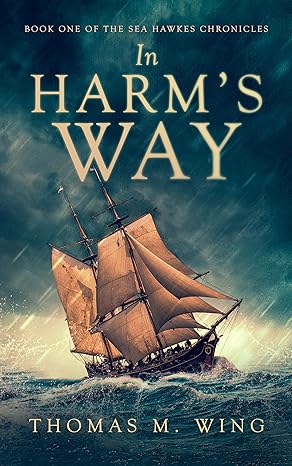

Thomas M. Wing’s In Harm’s Way is a gripping historical novel set during the American Revolution, centering on Captain Jonas Hawke, a privateer navigating the turbulent waters of war and personal loss. When his ship, the Elizabeth, is seized by the British Royal Navy under dubious pretenses, he and his crew are thrust into a battle not just for their freedom but for justice. As Hawke returns home to Norfolk, he finds not only a changed political landscape but also devastating personal tragedy. Wing blends historical accuracy with compelling storytelling, making the reader feel the weight of revolution on ordinary men.
What struck me most was Wing’s ability to bring history to life through vivid and authentic detail. His background as a retired Naval officer shines in the way he captures the rhythm of ship life—sails creaking, the smell of tar and hemp, and the ever-present danger on the high seas. The opening scene, where British forces storm a printing press to suppress rebellious voices, is tense and sets the tone for the book’s theme of resistance against oppression. He delivers a story that feels raw and real, making the reader feel every injustice and triumph.
Jonas Hawke is a protagonist who carries the novel with quiet strength and deep emotion. His return home to find that his infant twins have died is a gut punch that lingers. Wing makes us feel the grief through Mary, Hawke’s wife, whose simmering resentment toward his long absences cuts deep. Their exchange—her quiet fury, his helpless sorrow—was one of the most emotionally impactful moments in the book. The revolution is personal, fracturing families and reshaping lives. Hawke’s struggles reflect the larger battle for independence, making his journey all the more compelling.
The pacing of the novel balances naval battles with quieter moments of introspection. The scenes aboard the Otter, where Hawke and his men are treated as criminals rather than citizens, are particularly enraging. The arrogance of the British officers, especially Captain Squire, is infuriating yet believable, reinforcing the stark divide between colonists and their so-called rulers. The way Wing builds tension, especially during the naval confrontations, had me holding my breath. The book immerses you in history, making the reader experience the frustration, fear, and determination of those who fought against British rule. At times, the historical details, while fascinating, slow the pacing just a bit, especially for readers less familiar with naval terminology or Revolutionary War politics.
In Harm’s Way is an outstanding read for anyone who enjoys historical fiction, particularly those fascinated by naval warfare and the Revolutionary War. Fans of Patrick O’Brian’s Master and Commander series or Bernard Cornwell’s Revolutionary War books will find much to love here. Wing’s storytelling is rich, emotional, and historically grounded, making this book both educational and deeply engaging.
ASIN : B0F1W6GTC4

Modern Naval Warfare Novel
Against All Enemies follows a Naval Commander whose crew is cut off from leadership after a devastating attack on the US. What inspired the setup of your story?
I wrote the first draft between Feb. and Nov. of 2016. Tensions were fairly high with China, again. I worked at the Navy lab where the Prologue is set and often lunched at the cafeteria that features. One day in late 2015, I wondered what it would look like if a cruise missile attack streamed in from the sea. That gave me the opening. A few months later, I listened to the various debates and positions taken by presidential candidates across the spectrum. I took what I felt were the least well-considered positions vis a vis our relationships with China, Russia, and NATO, and combined them all into my president. He was not patterned after any one candidate. I’d always wanted to write a modern naval warfare novel, and the rest of the characters were born as amalgamations of officers and enlisted I served with through my 32-year career. Though I must admit, my Seventh Fleet commander, Vice Admiral Simpson, was influenced by David Weber’s Honor Harrington character! The Russia-NATO war came as a natural consequence of a break with NATO. I am not prescient by any stretch of the imagination, but I did have to make some changes and edits over the next five years. It also required a full year and a half to get the manuscript through the Navy Operational Security review process.
Newly appointed Commander Bill Wilkins is a fascinating character who is thrown into a complex situation. What scene was the most interesting to write for that character?
There were several, but the scene that sprung fully developed without any conscious thought was when he is reporting in with Rear Admiral Gupta at the end, just before Bill and Nicholas are ordered home. The possibility that Bill would reject an augment to his crew after suffering such losses definitely didn’t come from me! Bill had his own ideas by this point, and he made it clear he didn’t need any help. The real-life USS Franklin analogy is much more nuanced than portrayed here, but Bill was clear about why he wanted his crew to take Nicholas home themselves. The second most interesting, and difficult, scene to write with him was the one (SPOILER!) in which his Navigator dies. I didn’t want her to die, but the story needed it, and it led to the theme, which hadn’t yet revealed itself to me: risk and the need to embrace it.
I felt that the action scenes were expertly crafted. I find that this is an area that can be overdone in novels. How did you approach this subject to make sure it flowed evenly?
I have a wonderful editor, Laura Taylor, who runs a Read and Critique workshop at the Southern California Writers Conference. She’d seen several of the action sequences and encouraged me to keep writing them short and to the point. She doesn’t believe in overdone action scenes, either! I avoided them because I’ve experienced combat at sea myself and want to be true to the way it plays out. Especially today with supersonic missiles, but even as far back as World War II (particularly during the Guadalcanal campaign), sea combat moves quickly. If I were to have characters over-reacting, or inject unnecessary drama, I’m no longer being authentic. Authenticity is very important to me. I want Navy veterans to read this and say, “Yep, that’s how it was.” People do their jobs amidst chaos. There’s no time to let anything else in, even if the ship is taking hits. That was true 249 years ago and has proven true again as recently as last month in the Red Sea.
Will there be a follow-up novel to this story? If so, what aspects of the story will the next book cover?
I’ve been asked that quite a bit. When I finished this book, I didn’t have any plans for these characters, and I will definitely never try writing a story too close related to real-world events again! That said, I’ve played with some possible future scenarios, perhaps where Bill is now a Destroyer Squadron commander. Iran and Korea are obvious possibilities for adversaries, but again, I am leery of writing anything that might be overcome by events by the time it comes to print. I think China is done for this generation, based on where I’ve left it, and I don’t want to stretch the bounds of reasonable to create another conflict with them just to get the characters back into another book. I’m working on a trilogy set during the American Revolution right now, and a World War II novel loosely based on my father’s and two of my uncles’ service. But I’m not ruling out Bill’s eventual return. I wish Barrister were alive, as I think she’d be an interesting character for a future story, but alas, it’s not to be.
Author Links: GoodReads | Website | Amazon
When the People’s Republic of China unleashes a devastating attack on the United States, newly appointed Navy Commander Bill Wilkins and his crew are suddenly alone, deep in the enemy’s backyard, and unable to communicate with naval or national leadership.
At home in Washington, the president is detached from reality. Survivors of his cabinet contend with military leadership for control, some to save the nation they serve, others in pursuit of personal power.As America becomes alienated from her allies, Russia begins a campaign that creates heightened fears of nuclear annihilation.
Bill must navigate a political minefield to find friends among China’s neighbors while undertaking a role that demands he take unimaginable risks and wrestle with the question, What losses are acceptable in order to win?
Against All Enemies
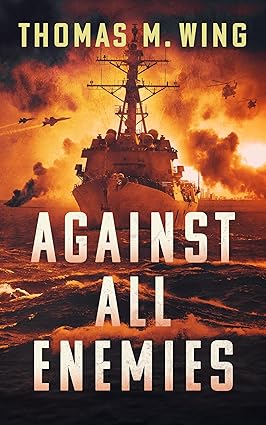

Against All Enemies plunges its readers into a high-stakes military scenario led by the adept and seasoned Commander Bill Wilkins. The novel thrusts Wilkins and his crew into the heart of a conflict sparked by an audacious attack from the People’s Republic of China against the United States. Navigating these treacherous waters, the story unfolds in enemy territory, while political turmoil back home adds layers of complexity. Washington is in disarray, with a President depicted as out of touch and government officials pursuing personal agendas, leaving the nation’s unity and direction in jeopardy. Simultaneously, Russia seizes the opportunity to sow further discord among U.S. allies.
Drawing comparisons to the suspenseful narratives of Tom Clancy, the book presents Wilkins as a character reminiscent of the renowned Jack Ryan. Wilkins’ intellectual and strategic acumen are central to the plot as he endeavors to lead his crew to safety amid escalating tensions. The narrative does not shy away from the gritty realities of such a dire situation, portraying the challenges and the resilience of Wilkins and his crew in vivid detail. An underlying theme explores the concept of patriotism in a modern context. Wilkins’ love for his country is evident and unwavering, yet the portrayal of a fractured and self-serving American leadership raises poignant questions about the nature of this devotion. The novel invites readers to ponder what it means to fight for one’s country when the very essence of that country seems undermined by its leaders. It subtly hints at a disconnect between Wilkins’ clear sense of duty and the broader, more nuanced realities of national and international politics.
Against All Enemies offers more than just a military thriller; it is a reflective journey into the complexities of loyalty, leadership, and the often-blurred lines between ideals and reality. The narrative challenges readers to consider the true meaning of patriotism in a world where political motivations can be as convoluted as they are compelling.
Pages: 461 | ASIN : B0CHXLMFDD


