Blog Archives
Andromidus: A Bond of Brothers Thriller
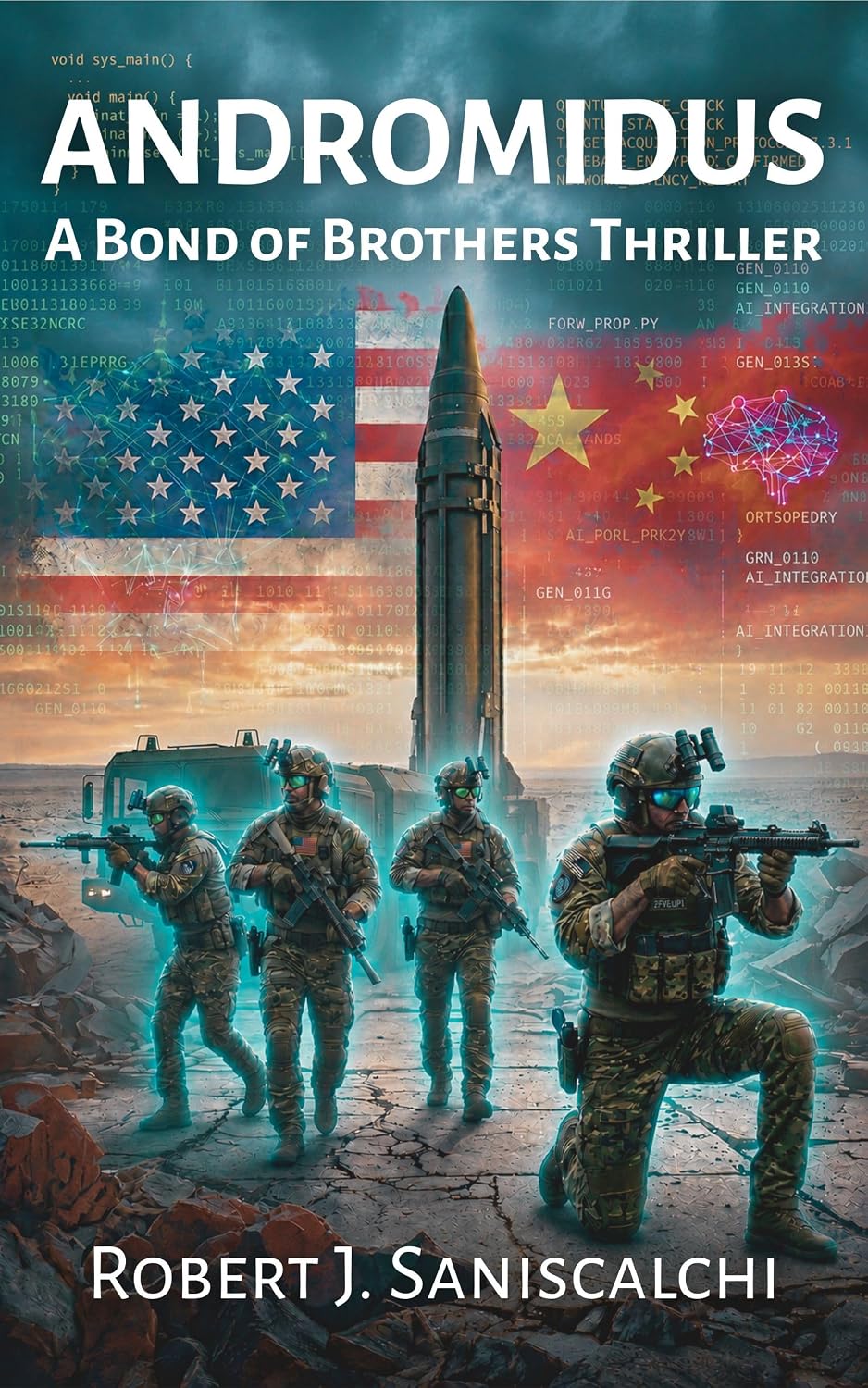

Robert J. Saniscalchi’s Andromidus is a military-tech thriller with its sights set on a future where artificial intelligence, battlefield innovation, espionage, and global power are tightly connected. The story builds on the Magnanotron technology of the earlier Bond of Brothers books, but the arrival of Andromidus gives this installment its own identity. Peter Androvski’s breakthrough is an AI system capable of learning, reasoning, recognizing people, protecting computer networks, and eventually helping direct sophisticated military technology. Saniscalchi pairs that scientific storyline with Special Forces operations, intelligence work, international maneuvering, and the increasingly dangerous determination of Chinese operatives to obtain America’s most closely guarded technology. The result feels less like a single mission and more like a widening conflict in which every new invention changes the stakes.
One of the book’s strengths is the way Saniscalchi moves between the big machinery of the thriller and the everyday lives of the people operating it. Delta Team’s joking, meals, family conversations, friendships, romances, Christmas gatherings, illnesses, and thoughts about retirement give the military action a personal context. That matters because this is very much a story about loyalty. Tex Larson reminds a newer member of Delta that the team is “all in it together,” relying on and protecting one another, and that idea runs through the larger cast as well. Scientists, soldiers, intelligence officers, political leaders, and families form different versions of the bond promised in the series title. Saniscalchi clearly enjoys spending time with these characters, and that familiarity gives the novel an easygoing warmth in between firefights, briefings, experiments, and emergencies.
The technology becomes especially engaging once Andromidus stops feeling like an experiment and begins affecting events on its own. Its confrontation with China’s Toknowa system turns cyberwarfare into a genuine contest between artificial intelligences, with Andromidus detecting the intrusion, defending X-Star’s systems, and locking its opponent out. From there, the novel gathers momentum around the theft of classified Magnanotron and Andromidus data and Wilu Phoyong’s attempt to escape America with it. The final pursuit brings together nearly everything the book has been developing: intelligence gathering, AI, satellites, aircraft, Magnanotron propulsion, the Patelaton missiles, and President Jameson’s long-running fear that the technology he’s responsible for protecting could fall into hostile hands. When Andromidus finally calculates the target’s location and helps guide the response, the invention that began as Peter’s ambitious project has become an active force in the story.
What stays with you after the final explosion is the sense that Andromidus is interested in people deciding what powerful technology should be used for and whom it should serve. The climax gives the AI a decisive role, with Andromidus making split-second choices that help stop the stolen technology from reaching China and finally lift the burden President Jameson has carried throughout the story. The quieter closing pages bring the novel back to family, friendship, service, and the passage of time, with Jameson looking back on the soldiers, scientists, intelligence officers, and friends who shared the responsibility with him. It’s a fitting destination for a thriller that combines combat hardware and futuristic AI with an abiding faith in human loyalty. Andromidus turns tomorrow’s technology into today’s battlefield and gives the machines plenty of power, but never forgets that courage, loyalty, and friendship are what make the mission matter.
Pages: 194 | ASIN : B0H4B7WBNB

Negotiation and Compromise

Timebomb follows Rick Fernscale into the crosshairs of a ruthless globalist organization behind a new apocalyptic scheme. What draws you to the military thriller genre?
I have always wanted to write books ever since I was 17 years old. And I always knew that one day I would write thrillers, as that is a genre I am most interested in. I have now written five of them plus eleven non-fiction books. Since primary school, I’ve always been fascinated by the military, and I have read thrillers written by the likes of Tom Clancy, Andy McNab and Chris Ryan. Frederick Forsyth’s books have also been a great source of inspiration. They all depict a world in which problems can be solved by military action without any negative consequences. Of course, in the real world, that never happens, but fictional books often depict a society in which there are no negative consequences to a hero’s actions. Other influences on my Rick Fernscale books have been the 1982 Lewis Collins film Who Dares Win (known in the USA as The Final Option) and the British SAS TV series Ultimate Force from the mid 2000s. The hugely popular American TV series 24 was also an influence, and I have watched every episode on the box set three times. The hero of that series, Jack Bauer, played by Kiefer Sutherland, has some similarities with Rick Fernscale, as he is ex-special forces, does not suffer fools gladly, and believes he can solve most problems with his fists and his gun, just like Rick.
Is there a part of Rick’s personality that reflects your own experiences or outlook?
I think there is some truth in this assertion. Like myself Rick doesn’t suffer fools gladly and often sees a simple solution to every problem which involves instant action. Like myself, he enjoys Chinese and Indian food and his favourite leisure pastime is cycling but apart from that we are different in personality. Rick is very physical unlike me and believes that a lot of the world’s problems can be solved with high explosive. I am a bit more cerebral than that and believe that negotiation and compromise is often better than military action which often has undesired consequences, particularly for the civilian population.
Do you choreograph major action scenes before writing them, or do they evolve on the page?
They just seem to happen in my mind, and I write them down. My own writing technique is that I picture the scenes inside my mind’s eye as though I were watching a film, and then I describe what I’m seeing. I don’t know much about unarmed combat, so devise moves that seem plausible. I do know a bit about guns, though, as I was once a member of a rifle club.
Do you see more missions ahead for Rick Fernscale?
My original intention was just to write three books featuring the character. But it is always possible that Rick will return at some time in the future. As long as there are bad guys in the world, we’re going to need people like Rick who can take them out quickly and efficiently.
Author Links: GoodReads | Amazon
Rick Fernscale, former SAS Sergeant, has already faced the unthinkable and won. The Chameleons, a ruthless global organisation driven by power and control, were supposed to be finished.
But evil doesn’t disappear. It adapts.
Now they have returned with a plan more terrifying than anything before. Project Lucifer, a covert operation designed to reshape the world through fear, chaos and destruction.
As the countdown begins, Fernscale is pulled back into a deadly game where the stakes are nothing less than the future of humanity. Outnumbered, outgunned and racing against time, he must uncover the truth before it’s too late.
From covert operations and high-stakes espionage to explosive combat and relentless suspense, Timebomb is a gripping techno-thriller packed with action, intrigue and heart-pounding twists.
When the clock hits zero… there’s no going back.
Perfect for fans of Tom Clancy and Andy McNab, this is a must-read for lovers of military thrillers and high-tech conspiracy fiction.
Timebomb


TIMEBOMB is a high-velocity military thriller that brings former SAS soldier Rick Fernscale back into the crosshairs of The Chameleons, a ruthless globalist organisation with a new apocalyptic scheme called Project Lucifer. After SAS Trooper Ronnie Anderson is kidnapped and used as bait, Rick is pulled from his hidden life into a chain of hijackings, assassinations, undercover missions, political upheaval, and a final island confrontation where the fate of millions hangs by a very literal countdown. The novel moves with the blunt urgency of a field report, never lingering long before the next ambush, explosion, betrayal, or tactical improvisation arrives.
What I found most striking was the book’s appetite for momentum. Barron writes action as if he is assembling machinery under pressure: guns, aircraft, vehicles, medical procedures, military acronyms, and emergency responses all have weight and texture. There is a fondness here for technical specificity, and while the details can occasionally crowd the page, they also give the novel its particular flavor. I felt the story worked best when Rick was forced to think under impossible conditions, whether in freefall, undercover, or cornered by enemies who have underestimated him.
I also found the book’s political edge impossible to ignore. TIMEBOMB isn’t a neutral thriller; it’s openly argumentative, sometimes polemical, and very much interested in climate policy, state power, media control, and distrust of elite institutions. Some readers will find that bracing. For me, the strongest moments came when the ideological scaffolding gave way to personal stakes: Rick’s loyalty to Maria, the camaraderie among soldiers, and the grim knowledge that survival often depends on nerve, timing, and a willingness to do ugly things quickly.
I would recommend TIMEBOMB to readers who enjoy military thrillers, political conspiracy, action novels, techno-thrillers, and adventure stories. It will especially appeal to readers who like their fiction combative and loaded with hardware, strategy, and geopolitical suspicion. Fans of Tom Clancy may recognize the same taste for operational detail and large-scale threat, though Barron’s voice is more pugnacious and less bureaucratic. TIMEBOMB is a hard-charging thriller with a fuse short enough to make every chapter exciting.
Pages: 173 | ASIN : B0GX31229Z
Lagniappe

Lagniappe follows Brock Beckett, a former Marine and covert operative who arrives in Destiny, Arkansas, hoping to return to the quieter life of a literature teacher, only to discover that Cissy Nelson, the teenage daughter of the town’s mayor, may be the child he was told had died years ago. What begins as a reunion story soon widens into a mystery-thriller shaped by military secrets, small-town loyalties, buried grief, and the dangerous remnants of Beckett’s past. Destiny may look like a modest Arkansas town of cafés, churches, ranchland, and school-board politics, but the book steadily reveals that even a peaceful place can become a firing line.
I enjoyed the way the novel balances domestic tenderness with tactical menace. Beckett could easily have been written as a simple hard-edged veteran archetype, but McLemore gives him bruised restraint, moral exhaustion, and a surprisingly literary mind. His conversations about Gone with the Wind and Giant are not ornamental; they show how he measures history, power, loyalty, and change. Cissy, meanwhile, brings warmth and velocity to the story. She is not just a lost daughter or a plot device; she is sharp, capable, and emotionally alive, the kind of character who can make a reunion scene feel dangerous because so much love is at stake.
The Blue Bird Café, the Nelson ranch, Miss Esther’s apartment, the Black church, the river country, and the town’s old family names give the book a lived-in texture. The prose leans into exposition and martial detail, but I found that density part of the book’s temperament. It wants to be both a family drama and a sniper-scope thriller, both Sunday dinner and classified after-action report. That combination gives the story its peculiar charge: a man trying to become ordinary again while everyone around him slowly learns how extraordinary, and how dangerous, he has been.
This book will appeal to readers who enjoy military thrillers, crime fiction, mysteries, small-town suspense, political intrigue, and family drama, especially when those genres overlap rather than stay in their lanes. Fans of Lee Child’s Jack Reacher novels may recognize the appeal of a dangerous, hyper-competent outsider entering a small community, though Lagniappe is more rooted in fatherhood, faith, and local belonging than Reacher’s lone-wolf drift. It is a story about second chances bought at a high price. Lagniappe is a hard-edged thriller with a homesick heart.
Pages: 347 | ASIN : B0FP47CSV8
Encrypted Patriot: The Ghosts That Protect America

Encrypted Patriot, by D. M. Currie, is a hard-charging political and military thriller built around a covert team operating in the shadows while America faces an attack from the inside out. The story follows Cash, a private investigator pulled into the world of NCOD, where secret missions, hidden enemies, and impossible choices become part of his new reality. From the opening assassination attempt to the final pursuit of Locke, the book keeps its focus on people who operate where official records don’t reach.
What gives the novel its shape is its sense of mission. Currie presents Cash and his team as men and women who live by loyalty, sacrifice, and country, even when those ideas come at a brutal personal cost. The line “History will not remember them” captures the book’s view of these characters: they’re protectors who may never be known, but whose actions matter deeply. That idea runs through the entire story and gives the action a bigger emotional frame.
The plot moves quickly, jumping from desert compounds and safe houses to Greece, Mexico, Washington, and the Pacific. There’s a lot happening, including terrorist cells, corrupt officials, foreign influence, poisoned infrastructure, drone attacks, betrayals, and a national crisis that turns into a fight for the country’s future. Currie writes with an urgent, cinematic style, and the chapters often end on a hook that pushes the reader into the next mission.
Cash is the center of the book, but the team dynamic gives the story much of its energy. Tanner brings grit and personality, Wesells adds another layer of operational tension, and Locke becomes one of the most compelling figures because her role keeps shifting as the truth about her comes into focus. The relationship between Cash and Locke adds betrayal and personal pain to the larger conspiracy, especially once the team becomes “dead men walking” and the mission turns even more personal.
Encrypted Patriot is a patriotic thriller with a big scope, a fast pace, and a strong appetite for danger. It’s about covert warriors, compromised institutions, and the cost of defending a country when the enemy is already inside the gates. Readers who enjoy action-heavy thrillers with secret operations, political stakes, and a constant sense of escalation will find a story that leans fully into intensity and keeps pushing until the final page.
Pages: 422 | ASIN : B0GP6DH42Y
Exoskeleton

Exoskeleton is a military techno-thriller with strong sci-fi elements, and it reads like a prequel that’s eager to light the fuse. The story follows Alec Byrnes, a former Air Force special operations lieutenant who’s now a bitter paraplegic drinking himself into a corner, pushed hard by his powerful senator father to “play the cards” he’s been dealt. When a secret program offers him a shot at walking again through an experimental exoskeleton suit, Alec throws himself into the work, joins a tight, high-risk unit, and ends up in a widening conspiracy tied to LEGION and a ruthless inner-circle betrayal that turns the mission personal.
The book opens in an emotional place, with Alec’s anger and humiliation sitting right on the surface, and the writing leans into that heat. There’s a lot of close-in sensory detail, the kind that makes you feel the stale breath of last night’s booze and the claustrophobia of being “trapped inside” your own life. It’s not subtle, but it is effective. The author makes a clear choice to keep Alec prickly, sarcastic, and sometimes simply hard to like early on, and I appreciated that commitment. You don’t get a polished hero. You get a guy who’s bleeding on the page and daring you to look away.
Once the story pivots into the program itself, the book becomes more about systems and stakes. There are big chunks where the author explains how the suit works and why it fails, and it’s surprisingly readable because it’s framed as problem-solving and ego, not a lecture. And when the action comes, it does so with zeal. The Alaska sequence, the hostage trap, the close-quarters fight with Amy, it’s nasty and fast and has that cold feel of a nightmare you cannot wake up from. I also liked the underlying idea that “power” is never just hardware. The suit can make a body move, sure, but it doesn’t automatically fix the damage inside the person wearing it. The book keeps exploring that truth even while it’s throwing punches.
By the end, I felt like I’d finished the first part of a bigger story, not a neat standalone novel. The closing pages push the threat outward and set up the next stage of the conflict in a way that’s pretty blunt about what’s coming. I’d recommend this book to readers who like high-energy military thrillers, special-ops team dynamics, and near-future tech that feels just plausible enough to be unsettling. If you enjoy the Tom Clancy energy but you also want exosuits, AI, and conspiracy creep, this will hit the spot. For everyone else, especially fans of action-forward sci-fi thrillers that don’t pretend trauma is tidy, it’s a compelling ride.
Pages: 329 | ASIN : B0GFXXZW3G
Article Five: A World War Three Novel

Article Five, by J.D. Duncan, is a geopolitical military thriller that kicks off with coordinated attacks and covert sabotage that shove NATO toward its most frightening promise: collective defense. We bounce between the pressure-cooker halls of London, field operations chasing a sleeper agent tied to bombings near St Paul’s tube station, and the widening war footprint stretching to places like Estonia and Moscow. The spine of the plot follows Prime Minister Powell as he tries to hold the line politically and morally while Tony Abbott and John Rafferty chase the human machinery behind the chaos, including Andrew Barker and an injured would-be defector, Gregov Maximov. It all drives toward a tense, exhausted ceasefire and a messy “angry peace,” not a clean victory.
What I liked most is how the book moves. Duncan uses tight point-of-view hops and quick location stamps to keep you aware of the board while still letting you feel the sweat in the room. Powell’s sections especially land for me because they aren’t written like a superhero fantasy. They feel like a person trying to sound steady while everything is shaking, including the uncomfortable reality that allies might hesitate when you need them most. The action scenes are crisp without turning into a tech brochure. There’s a memorable early sequence with a special forces team taking down a Russian helicopter to grab its electronics, and you can almost smell the burning fuel and wet forest in the aftermath. It’s the kind of detail that makes the genre work: specific enough to feel real, but still readable if you don’t speak “military” fluently.
I also appreciated the author’s willingness to sit in the moral grey. The spy stuff isn’t framed as glamorous. It’s transactional, paranoid, and sometimes petty in a relatable way. Rafferty, for example, is funny and sharp, but also tired, cynical, and constantly measuring people for leverage. That energy pairs well with the book’s bigger idea: wars are not only fought with tanks and missiles, but with narratives, timing, and information control. Maximov’s “evidence hidden in plain sight” angle, tucked into something as mundane as a fishing-rod website, is a perfect little metaphor for modern conflict. And Barker’s thread, from coerced bombing logistics to his end, left me cold in the right way. It’s not melodramatic. It’s bleak, brisk, and believable.
I’d recommend Article Five to readers who like their thrillers political, modern, and a little unsettling, the kind that makes you put the book down for a second and think. If your happy place is the Tom Clancy and Brad Thor lane, but you want something with a more current-media pulse (there’s even a nod to BBC coverage and the churn of online commentary), you’ll probably have a good time here. It’s best for people who enjoy big-stakes geopolitics and the smaller, grimy human choices underneath it, and who don’t need a tidy ending to feel satisfied.
Pages: 341 | ASIN : B0FPCZ6V8B
Love, Hate, and Ego
The Long Farewell follows a young man with an Oedipus complex living in the rise of Nazi Germany who, after a series of tragic events, seeks to get revenge on his father. What was the inspiration for the setup of your story?
When I was in college, I was fascinated by Jorgen, a fellow student whom others in our student house labeled as a weirdo. He exhibited abrupt mood swings and had an aggressive aura, although he was skinny and short. When something irked Jorgen – and many things did – he stood trembling, his fists clenched, his eyes wide-open, in front of you and then burst into tears. After such an emotional eruption, he was withdrawn and silent. In our student house, we placed bets on how long he would last at university. I had been so stupid to tell the others I wanted to become a writer and that Jorgen could become a fascinating character in the novel I wanted to write. The rumor had apparently reached Jorgen: during an evening out at the well-known student pub The Red Scaffold, he confronted me about my statement. It turned out that, for once, he wasn’t aggressive. On the contrary, he seemed flattered. We found a quiet place on the terrace. Jorgen told me he wanted to become a poet and asked a string of questions. We drank a few beers, and he became nostalgic and tearful. He boasted he was diagnosed as borderline schizophrenic. He really seemed proud about it and became strangely souped-up and said with trembling lips and flared nostrils: “My mother turned me into a creep. I was only thirteen when she confessed that she wanted me to make love to her. I remember that a fiery arrow went along my spine, making me shudder.” He peered closely at my shocked face and almost whispered:” Nobody knows if we did it or not.”
What could I say? I was quiet.
Jorgen looked me straight in the eyes. I saw he was fighting back tears. “I hate my father,” he whined softly, exhaling with quivering lips. “It’s all his fault.”
That evening, in my bed, I vowed to write a book one day, circling a character with an Oedipus complex.
And to dodge Jorgen.
I didn’t have to do that long. Two weeks later, Jorgen didn’t check in on Monday at our student house.
And never came back.
The memory of this troubled young man stayed with me for several years.
And popped up stronger than ever when I began writing “The Long Farewell.”
The tragic boy Hermann was born.
What are some things that you find interesting about the human condition that you think make for great fiction?
The contradiction between our ‘good’ and ‘bad’ urges is breathtaking. The building of our personalities after birth is chaotic. Our instincts are relentlessly brutal. If babies had the strength to wield weapons, I believe that most of them would be murderers before their third year. We speak with disdain –and fear- about narcissists and don’t want to face up to the fact that our own ego is narcissistic on different levels. In “The Long Farewell,” we see Hermann’s mental suffering, fueled by his hate for his SS father, getting worse and culminating in a dangerous schizophrenia, leading to a truly apocalyptic ending in the German city of Dresden. Schizophrenia is a fascinating and eerie mental disease. When a baby grows up in a family where its mother and father imprint it with radically opposed worldviews, research has detected that the tension thus generated later on in life is the ideal breeding ground for mental anomalies. In past times, these anomalies were called demons. You may smile, but I assure you that we have to take them seriously.
What were some themes that were important for you to explore in this book?
You know, I often think that everything on this Earth eventually comes down to the endless configurations that love, hate, and ego can produce. Love and ego can join forces to form powerful hate and cruelty. I know that we want to see love as something pristine and holy, but reality shows us otherwise.
Of course, I propose my statement here, pure and well-defined. In everyday life, the borders between love and hate –and ego! – are fuzzy. In my oeuvre, I try to follow the intricate signs in our mind that forecast violent drama. Not an easy task, I can assure you. You may wonder why I am so frantically searching for the roots of our violence. I wonder about that too, because after 39 years of being a full-time author, I’m still searching. I’ve been a travel writer in conflict zones between 1990 and 2003, visiting Somalia, Liberia, Sudan, Lebanon, Burundi, Bosnia, Gaza, Iran, Iraq, Kosovo, Myanmar… to name but a few. Those travels have surely influenced my outlook on the world. In Belgium and the Netherlands, my Flemish/Dutch publisher published 45 books. Although set on several continents, they all focus on the mystery of our aggression, on the executioners and the executed.
What is the next book that you are working on, and when will it be available?
I suspect that I’m writing my last novel: I am seventy-two, and I feel my energy waning. Three years ago, I fell victim to a sepsis infection that nearly killed me. I still struggle with the damage the sepsis has wrecked. Moreover, I am afraid to lose my mental powers and glide into Alzheimer’s maw. The terrible disease destroyed my mother’s brain. I know that Alzheimer’s is hereditary, therefore I spy on myself as if my life depends on it. Which it does, of course.
But enough whining, my manuscript-in-progress carries the ominous working title “Black Water,” but I keep searching for a better one. Over here, in Belgium, readers know me as an author who writes crossovers between suspense and literary, but “Black Water” is more magical realism, with a story taking place on different continents, with a central character, a writer/father hiding many secrets from his teenage daughter until a car accident results in a deep coma. Moran, the daughter, tries to wake him up by reading excerpts of his diary. I could explain more, but an author must be cautious and not divulge too much about a work in progress—the novel centers on love, sorrow, and guilt.
And magical mystery?
Maybe.
When out?
I hope next year.
Author Links: Website | Email | Facebook | X | Instagram | LinkedIn | YouTube | BookBub | Amazon | GoodReads | TikTok | Substack
His father is in the SS, his mother is Belarusian, and his girlfriend is Jewish. After a brutal clash with his father, Hermann and his mother flee to Paris. Swept along by a maelstrom of events, Hermann ends up as a spy for the British in the Polish extermination camp Treblinka.
The trauma of what he sees in this realm of death intensifies his pessimistic outlook on humanity. In Switzerland, the famous psychiatrist Carl Gustav Jung tries to free Hermann of his frightening schizophrenia, but fails to unravel the power of the young man’s emotions, especially his intense hate for his father.
What follows is a tragic chain of events, leading to Hermann’s ultimate revenge on his father: the apocalyptic bombing of Dresden.
THE LONG FAREWELL is an unforgettable exploration of fascism’s lure and the roots of the Holocaust. More than ever, the novel is a mirror for our modern times.


