Blog Archives
Preserving Internet History and Culture

Framed is part confessional, part manifesto, and part digital history lesson, giving readers an unflinching look at the dark underbelly of social media from the eyes of someone who didn’t just observe the chaos but actively fueled it. Why was this an important book for you to write?
I was annoyed by how shallow social media punditry had become. As a prolific reader, I enjoyed most of the “Big Tech” books but was surprised to find that none of them had been written from the engineer’s perspective. Further, there was indication that some of them had been “dumbed down.”
In playing the software engineer and “bad guy,” I wasn’t looking for penance. Rather, I was interested in preserving internet history and culture. Writing this book came at a massive opportunity cost that I could never possibly recoup in book sales. My hope is that this book can entertain readers, drive policy discussions, and perhaps be one day seen as an important reference work.
I appreciated the candid nature with which you told your story. What was the hardest thing for you to write about?
In terms of writer’s block or “getting it right,” the Myspace chapter was the hardest. In 2022, it was nothing more than an add-on and I was trying to secure interviews and source material from people I attended middle school with. By late 2023, I was restructuring the book around Myspace being the genesis. I’ve cut thousands of words and several notable tangents from that chapter, and I could spend another two years trying to perfect it.
In terms of emotional difficulty, it was hard to reconcile that my ventures, though “successful,” paled in comparison to other operators which earned millions of dollars more than my team did.
It was also tough to face the reality that, after years of effort, I produced this cool book, but how many other “cool books” haven’t been started because we’re so distracted by cell phones? “Screengrabbing,” originally, would have been almost one hundred pages in print. It was really hard to find the right way to address this problem.
What were some ideas that were important for you to share in this book?
- The evolution of “Myspace whoring” to digital marketing automation
- Big Tech’s reversal of course on “open” APIs
- The wide spectrum of “black hat” and “white hat” in user behavior and business decisions
- Instagram growth’s reliable ~10% rate of reciprocity, established by research and aligned with my experience
- An updated take on the dead internet theory
What is one thing that you hope readers take away from Framed?
The Internet Age has brought immense opportunity but also has ushered in social and ethical decay.
Author Links: Goodreads | Website | Newsletter | Amazon
A rogue software engineer built bots that ran rampant across social media, helping clients gain millions of followers. His reputation as a rule-breaker landed him at a startup where he designed the controversial systems—news feeds and push notifications—that keep users addicted.
Framed pushes opinions on influencers, algorithms, filter bubbles, botnets, screen addiction, spam, shadowbans, black hat marketing, deplatforming, the “dead internet” theory, and why people are still buying fake followers.
And–getting banned. Read Framed while you still can.
Framed: A Villain’s Perspective on Social Media
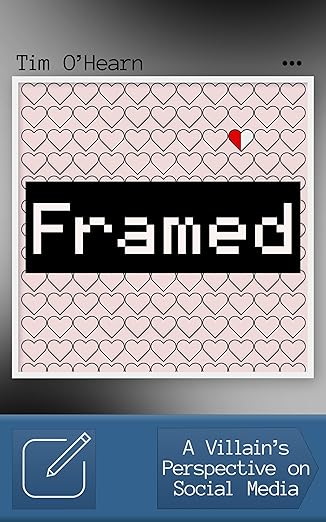

Tim O’Hearn’s Framed is part confessional, part manifesto, and part digital history lesson. It’s an unflinching look at the dark underbelly of social media from the eyes of someone who didn’t just observe the chaos but actively fueled it. The book is split into two distinct thematic halves: one that offers a raw and tragicomic commentary on the evolution of online platforms and another that lifts the curtain on the black-market mechanics behind Instagram growth services. It reads like a fever dream stitched together by code, ambition, nostalgia, and regret.
The writing is sharp, sarcastic, often hilarious, and, at times, deeply unsettling. O’Hearn opens with a blunt confession—he bought fake followers in 2012, then built systems responsible for hundreds of millions of Instagram engagements. There’s something haunting about watching a man justify digital manipulation as retribution for “all the hours stolen” by addictive apps. His tone wavers between playful arrogance and reflective melancholy, especially when he recalls declined payments from users who emptied their bank accounts chasing online validation.
Where the book really shined for me was in its documentation of the “Instagram Underworld.” I had no idea how deep the rabbit hole went. Chapters like “Instagress Alternative Alternatives” and “The Puppeteer Part II” read like noir thrillers. O’Hearn walks us through SMM panels, botnet mechanics, and the endless game of cat-and-mouse with Instagram’s legal team. He doesn’t just tell you what happened—he shows you the gritty details, the hustle, the absurdity. I was shocked by how openly he talks about skirting terms of service, about creating entire ecosystems to sell illusions. Yet somehow, you’re compelled to keep reading. It’s like watching someone build a house out of matchsticks—fascinating and inevitably destructive.
Still, what moved me most wasn’t the technical stuff—it was the nostalgia. In the section on Myspace, O’Hearn lets his guard down. He describes being a “computer nerd” who found solace in HTML, emo bands, and chaotic whore trains. That chapter, “A Place for Friends, Pimps, and Whores,” might be one of the best tributes to early internet culture I’ve read. He captures the weird, wonderful mess of Web 2.0 with affection and insight, highlighting how Myspace wasn’t just a platform—it was a playground, an identity factory, a war zone of teenage hormones and CSS. I couldn’t help but smile through those pages.
Framed isn’t trying to solve social media’s problems—it’s just telling you what’s been swept under the rug. O’Hearn doesn’t ask for redemption, and he doesn’t offer any, either. His honesty is disarming, his sarcasm sharp, and his storytelling addictive. If you’re a digital marketer, a tech skeptic, or just someone who’s spent way too much time scrolling through curated lives, this book is for you. It’s a ride through the seedy backstage of social media—and once you’ve seen it, you’ll never look at your feed the same way again.
Pages: 436 | ASIN : B0DW2X8YSK



