Blog Archives
Choice: A Strategic Guide For High-Achievers to Stop Autopilot and Navigate Travel with Integrity


Elaina Kelly Smith’s CHOICE is a practical guide to using travel as a setting for greater self-awareness, intentional decision-making, and personal growth. At its center is the PARQS Method, a flexible framework built around Preferences, Awareness, Right Action, Questions, and Self-Acceptance. Smith presents these elements as a personal guidance system, allowing readers to begin with whichever practice best suits the moment. This structure makes the book useful both as a travel companion and as a broader resource for people who want to respond to unfamiliar situations with more clarity and self-trust.
The book’s strongest quality is the way it combines reflective principles with concrete action. Smith provides breathing exercises, grounding techniques, cultural-awareness practices, decision-making prompts, and scripts for setting boundaries. Her advice is often simple enough to use in an airport, hotel room, crowded market, or difficult conversation. The statement “No is a complete sentence” captures the book’s direct approach to personal agency, while the recurring question “What do I actually want right now?” gives readers a practical way to interrupt automatic choices. These tools are especially relevant for travelers who tend to overplan, accommodate others, or ignore their own physical and emotional limits.
Smith’s personal travel experiences give the framework credibility and warmth. Her accounts of cultural overwhelm in Cambodia, emotional exhaustion in India, airport stress, communication problems, and unexpected logistical challenges show PARQS operating under real pressure. She writes openly about moments when fatigue, anxiety, or habit affected her judgment, then explains how reflection helped her make more grounded choices later. The combination of vulnerability and practical analysis keeps the book from feeling abstract. It also reinforces one of its central ideas: self-trust develops through repeated acts of noticing, choosing, adjusting, and treating oneself with compassion.
The later sections expand the book into a workbook through structured reflection prompts, daily check-ins, and practices that carry the traveler’s insights back home. This progression gives CHOICE a clear purpose beyond preparing for a trip. It encourages readers to approach ordinary routines with the same curiosity they might bring to a new destination. Smith’s professional yet personal voice supports that purpose, and the book’s modular design makes it easy to revisit specific exercises when needed. CHOICE is a thoughtful and accessible guide for travelers who want their journeys to deepen their awareness, strengthen their boundaries, and support a more intentional relationship with themselves.
Pages: 87 | ASIN : B0H59NHSQJ

Traveling Solo Later in Life


Traveling Solo Later in Life, by Mary Strobbe, is part travel guide, part memoir, and part warm hand on the shoulder for anyone who’s wondered whether they’re too old, too nervous, too tired, or too alone to go see the world. Strobbe writes especially for older solo travelers, with a strong awareness of women’s safety and independence, but the book stretches beyond that audience. She moves through the practical machinery of travel, insurance, passports, lodging, money, food, cruises, transportation, accessibility, health, packing, and mental wellness, while threading it all with lived stories: a friend’s painful fall at Teotihuacan, a near-miss on a dim Milan street, a curse in Cuba, a lost phone in Copenhagen, a robbery in Jamaica, and the quiet triumph of dining alone without apologizing for it.
What I liked most is that Strobbe doesn’t romanticize solo travel into something glossy and weightless. She knows the world can be generous, strange, exhausting, funny, and occasionally frightening, and she lets all of that sit on the page together. The writing has an appealing conversational ease. I found myself especially drawn to the way she treats mishaps as a kind of travel currency. The Grand Bazaar jacket episode, where the “gift” feels more like a trap than a kindness, says more about instinct than a whole lecture on safety could. Likewise, her story of throwing fruit into the ocean after upsetting a Santería altar is funny, yes, but also tenderly human. Who among us hasn’t performed some small irrational ritual just to feel a little steadier in an unknowable world?
The book’s ideas are practical, but underneath them is a deeper argument about agency. Strobbe is really saying that later life doesn’t have to narrow. It can widen. I appreciated how seriously she takes fear without letting it become the final authority. Her chapters on anxiety and depression surprised me in the best way because they acknowledge that travel doesn’t magically cure loneliness or inner weather. Sometimes you’re in a beautiful place and still feel fragile. That honesty gives the book emotional weight. The prose can lean into punchlines and exclamatory travel-guide rhythms. Still, the voice is so candid, seasoned, and companionable that its exuberance feels earned.
Traveling Solo Later in Life is a book about train tickets, hotel cards, compression socks, street food, passports, and packing cubes, but it’s also about trusting yourself in motion. Strobbe makes travel feel less like a performance of bravery and more like a practice, one built through wrong turns, better questions, lighter luggage, and a willingness to begin again. I’d recommend it to older women considering their first solo trip, seasoned travelers who enjoy reflective travel writing with a practical backbone, and anyone who needs a kind, witty reminder that independence can still bloom beautifully in the second half of life.
Pages: 202 | ASIN : B0FFNFRPDR
A Fusion of Essays and Photos

Meanwhile, Here in Austin is a seasonal portrait of a city becoming home, blending intimate essays and photography to capture the quiet beauty, chaos, and heart of everyday life in Austin. Did you begin this project knowing it would become a book, or did it grow organically?
It grew organically. When we first moved to Austin, every weekend felt like a vacation. I’d grab my camera and head out to explore our new home. Over the years, I built up a large collection of photos, but I eventually wanted to do more with them than let them sit in an online gallery. My first thought was a photography book. But some of the images needed context. A line or two didn’t seem to be enough.
The first time I started writing longer pieces was after a storm, when I realized a single photo couldn’t capture its intensity. We had previously lived in Los Angeles, where unplugging devices during a storm never even crossed my mind. In Austin, though, after hearing a few horror stories about fried electronics, I decided to play it safe. That experience needed explanation beyond the image itself.
Then came the winter storm. Photos of icicles alone couldn’t accurately explain what we went through. The images needed my experience alongside them so readers could understand what photographing those icicles really meant and how they fit into the larger context.
As a result, the book expanded to become a fusion of essays and photos. But I still wanted to “lead” with photos and have the essays serve as a larger explanation. I think the only instance where I wrote an essay purely for the sake of written content was when a shooting occurred at our favorite slushie café. This was part of my discovery of Austin, and it felt necessary to include it.
What does photography allow you to express that writing alone cannot?
For me, photography is purely about feeling and capturing a mood. While it’s true that I can describe those feelings with words, photos are more universal. You don’t need language, a translator, or an explanation of cultural differences. You see it, you feel it, you get it… within seconds. Photography allows me to share what I saw and exactly how I felt in that moment with a much wider audience.
Many of the book’s most powerful moments come from everyday scenes—storms, deer, swimming holes. Why do small moments matter so much to you?
That’s a two-part answer, I guess. From a photography perspective, I usually notice the larger elements first: the people, the architecture, and the landscape. But when I return to the same place a second or third time, I start to see the smaller moments. Those details matter because photographers are always searching for a unique way to capture a scene. You have to train your eye to find new angles or fresh perspectives. That process teaches you to notice everything, because you’re always looking for that something that will make your photos feel different.
The second part of that answer is that a city’s character, or even a neighborhood’s character, is often defined by smaller moments. It’s the subtle cultural differences that stand out. When comparing what makes Austin unique versus a larger city like L.A. or New York, it comes down to the people, of course, and what I usually call “the little things,” or those small details that give the city its character.
What aspects of the city surprised you most once you started paying close attention?
How much Austin is changing right before my eyes. It’s a lot like raising children. When you see them every day, the changes aren’t obvious. It’s only when a friend visits after a couple of years and says, “Your kid has changed so much!” that it really hits you, because you didn’t notice it happening.
Austin feels the same way. I didn’t truly see the changes until I started comparing my downtown cityscape photos. That’s when it became clear just how quickly the city is expanding and evolving. It’s going through real growing pains.
Author Links: GoodReads | Website | Amazon
Volcanic Adventures in Tonga – Species Conservation on Tin Can Island
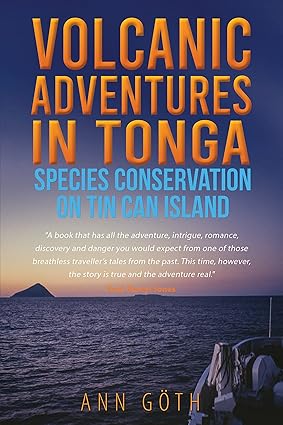
Volcanic Adventures in Tonga is an enthralling travel memoir that blurs the lines between fact and fiction, taking readers on a captivating journey to the remote Kingdom of Tonga alongside scientist Ann Göth. Departing from the picturesque Austrian Alps in the early 90s, a spirited 21-year-old Ann, accompanied by her German boyfriend and fellow scientist, Ivo, embarks on a daring 17-month expedition to save the endangered “Malau” bird, whose existence is exclusive to the volcanic island of Niuafo’ou. These enigmatic chicken-like creatures emerge from subterranean nests, buried deep beneath the ground.
In this vividly portrayed memoir, Ann and Ivo’s modest abode, a humble hut constructed from wood and leaves, becomes their sanctuary amidst the untamed beauty of Tonga. Here, they immerse themselves in the unhurried rhythm of life, embracing the “Anga faka Tonga,” the laid-back lifestyle unique to the region. The enchanting melodies of kava-drinkers echo through their hearts, while they marvel at the intricate craftsmanship of handwoven mats and traditional church dresses. Adventurous palates relish the indigenous cuisine, savoring dishes like breadfruit, succulent meats bathed in coconut water, and the delectable “Tongan ice cream.”
Despite grappling with concerns over animal welfare and the local consumption of Malau eggs, Ann and Ivo cultivate meaningful relationships with the Tongan community, earning the privilege of bestowing a name upon a newborn baby. However, the stark contrasts in Tonga leave an indelible impression on their minds: the regal Tongan king, stepping onto a ceremonial mat at the airport adorned with elegant German eyewear, juxtaposed with impoverished children, their innocent faces marked by bug bites, indulging in beetle larvae. Months of arduous camping and tireless excavation culminate in the relocation of Malau eggs to Late Island, thereby accomplishing their mission. Yet, as Ann succumbs to the allure of “island fever,” bidding farewell to Tin Can Island becomes inevitable. Within the pages of this captivating memoir, readers are transported to a world far removed from their own—a paradise juxtaposed with an inferno. Stunning coral islands surrounded by turquoise waters and pristine white sands stand in stark contrast to the pervasive poverty, environmental degradation, and the discomforts of fleas, bed bugs, and poor sanitation. Yet, it is impossible not to be awed by Ann and Ivo’s unwavering determination, profound passion, and extraordinary resilience. Through sleepless tropical nights, debilitating illnesses, relentless insect bites, and clothes stiffened by dirt and sweat, the tenacity of these “beautiful small fat palangi” shines through. Their unwavering spirit persists, even in the face of constant volcanic threats.
In Volcanic Adventures in Tonga, Ann Göth faithfully fulfills a promise she made to herself three decades ago. Her exceptional tales of volcanic exploration have been meticulously preserved within the pages of this remarkable book, which undoubtedly deserves a five-star rating. Seamlessly blending captivating storytelling with enlightening information, Ann’s contagious passion resonates from the first page to the last, creating an immersive experience that will captivate readers seeking an escape to a world both mesmerizing and unforgiving.
Pages: 277 | ASIN : B0BZSJT5TT
First Steps to Fly Fishing
![First Steps to Fly Fishing: The 1924 Classic Updated for Today by [Michael Temple, Kris Neely]](https://m.media-amazon.com/images/I/51LICzWb5eL.jpg)
Nothing is as great as learning a little history about something before getting to the main content in the book. First Steps to Fly Fishing takes us back to 200 B.C., describing fly fishing as one of the most challenging, artistic and aesthetic forms of fishing. Their description of fly fishing make it look like an art where one has to use special techniques. Fly fishing may not be a new method of fishing, but fishermen today keep looking for ways to make it appear sophisticated. When writing about this kind of fishing between the years 1500 and 1800, the authors quote iconic figures in history, scholars and historians who have written about fly fishing. The narratives in the book are supported by historical writings and documents that are still used for reference today.
To help the readers familiarize with the main subject in First Steps to Fly Fishing, the authors include fun facts, historical evidence along with explaining the importance of fly fishing. The first chapter of the book is about rods, reels, line and other equipment. One good thing about this book is that the authors don’t just mention the equipment; they go into detail, talking about the pros of using the mentioned equipment, the challenges fishermen faced and how some equipment have evolved. The content in the book is evergreen. First Steps to Fly Fishing makes one appreciate antique things and classics.
Do you want to know how to fish like an expert? Is fishing a hobby that you want to develop? Do you want to learn about different fishing styles and how significant they are? Then this is the book that you need. The chapters on how to fish, where to fish and when to fish are eye opening and make fishing feel like the fun an enjoyable activity that it is. Authors Michael Temple and Kris Neely’s tone in the book is encouraging. Their words are stirring and give one the drive to not only keep on fishing but to also engage in other hobbies and activities that they love. One can read the enthusiasm in the author’s text and the love they have for fishing.
There are also stories in the book that have a personal touch, allowing readers to connect with the authors on a deeper level. First Steps to Fly Fishing is an illuminating instructional guide that provides fantastic tips and pointers about sports fishing, and how to go about implementing the concepts you have learned. First Steps to Fly Fishing provides a lot of great advice that is easy to understand and actionable. Perfect for anyone headed for the great outdoors.
Pages: 138 | ASIN: B08946S6ZZ



