Blog Archives
Dramatic Similarities

When Liberty Enslaves: The Toxic Blend of Faith and Politics offers a detailed look at how the intersection of faith and politics has shaped the course of American history, particularly through the lens of liberty. Why was this an important book for you to write?
The death of George Floyd on May 25, 2020, dramatically impacted the viewing world at the time. Watching George Floyd’s life seep away while his cries of not being able to breathe were ignored did something to me. Watching the replayed video of a police officer continuing to kneel on the neck of a handcuffed Black man for nine minutes and 29 seconds opened my eyes. For the first time, I could “see” the plight of Black people in our nation’s history. This was the genesis of the inspiration for writing this book.
How much research did you undertake for this book and how much time did it take to put it all together?
Being trained as an engineer my appetite for learning and understanding our nation’s history was never compelling. After a thirty-year avocation as a lay minister in various Christian denominations, it took a spiritual “awakening” to take on the broad spectrum of topics covered in trying to describe the intersection of faith and politics. Over approximately eighteen months I used the writings of contemporary historians, ministers, journalists, and authors to pull together a diverse approach to the subject.
What were some ideas that were important for you to share in this book?
The first critical idea of this writing is to point out that the blending of faith and politics is not a new concept. To illustrate the point, I suggest that there was a deliberate blending of faith and politics even during Christ’s earthly ministry. The primary point of the writing is to compare the dramatic similarities between our times and those immediately before the Civil War. The implied emphasis with that comparison is that the possibility of a Civil War occurring in our nation again is very possible.
The second critical idea of this writing is that these efforts to blend faith and politics are deliberate. The current experience of blending faith and politics in our nation began with a concerted effort in the early 1970s. I can attest to being part of that movement in the 1980s when I was part of Jerry Falwell Sr.’s ministry in Northern Virginia.
What is one thing that people point out after reading your book that surprises you?
I was pleased to hear the reader is drawn into the case being made through the personalization of the story. My experiences make the points being made credible to the reader. Additionally, the many references used in the writing illustrate that the case being made is not only my opinion. This writing is a compilation of the prevailing thoughts of many contemporary historians, authors, ministers, and journalists.
Author Links: GoodReads | X (Twitter) | Facebook | Website | Amazon
There is a common experience between our experiences today and those before the Civil War many years ago. The effect of the intersection of faith and politics during these two experiences has had on our elections and our governance is uncanny in their similarities. Both times an election insurrection was stopped by the sitting vice president. Both times had people of the same faith on both sides of the social issues of the day claiming God’s favor and willing to divide the nation over those competing positions.
Part 1 of this writing focuses on the Civil War era and how liberty centered around the issue of equality. Some people of faith believed all men were equal, some did not. Part 2 focuses on our present times and how liberty centers on the sanctity of life concerning abortion and gun control. Some in our nation feel enslaved by the liberty of others. Part 3 describes methods for closing the divide in our nation beginning with the faith communities.
When Liberty Enslaves: The Toxic Blend of Faith and Politics
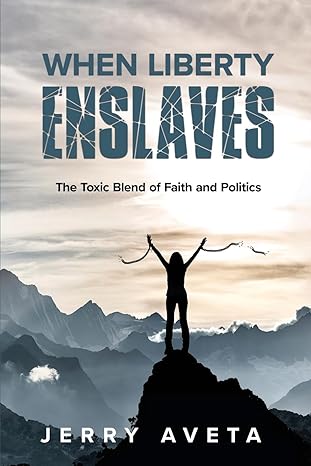

When Liberty Enslaves: The Toxic Blend of Faith and Politics by Jerry Aveta offers a detailed look at how the intersection of faith and politics has shaped the course of American history, particularly through the lens of liberty. The book draws comparisons between the pre-Civil War era and the present day, exploring how issues like faith, politics, and social justice continue to divide the nation. It examines themes like freedom, enslavement, and the consequences of intertwining religious beliefs with government decisions. Aveta ultimately reflects on the parallels between America’s past and its current political climate.
Aveta’s writing gets personal quickly, which makes the book feel relatable. The introduction about his disinterest in history early on hit home for me. I wasn’t expecting such a confession in a book that digs into heavy political and social themes. But it worked. The way he ties his personal disinterest in history to his eventual realization of its importance drew me in. There’s a clear shift when he discusses how today’s political climate echoes the tensions before the Civil War. That felt eerie and relevant, especially the parts comparing faith’s role in both eras. Aveta doesn’t just lecture; he reflects and invites you to think about it with him. One thing that kept me hooked was the comparison between old and current political issues. Aveta draws bold parallels between the pre-Civil War issues of slavery and today’s debates around gun rights and abortion. I didn’t expect the sections about the sanctity of life and how they pit people of the same faith against each other. That hit hard. The discussion on gun rights, especially how people interpret “liberty” differently in this context, made me stop and think. Aveta’s point about one person’s liberty potentially enslaving another was something I hadn’t considered before, and it made the book feel timely.
When Liberty Enslaves is a thought-provoking and timely read that encourages deep reflection on the role of faith in politics. Jerry Aveta’s personal approach, historical insight, and the way he connects the past to our present make the book both engaging and eye-opening. It’s a call to reconsider the impact of intertwining religion with governance, and it challenges readers to think critically about the state of liberty in America today. I’d highly recommend this book to anyone interested in politics, history, or religion.
Pages: 223 | ASIN : B0DCMG8MYK

I Had to Look Harder and Deeper

Until I Have No More to Give follows a Union Civil War survivor who joins a group of workers trying to fix the issue of millions of displaced Southern whites and freed slaves who have no place to go and no means to support themselves. What inspired you to write this story?
When all this began, I had preconceived notions of what the Civil War was all about and discovered that my grandfather’s half-brother played his minor role and my father and his siblings knew little to nothing about him, even who he was. So, I had to look harder and deeper. Using the internet and established historical venues, I had tremendous advantages over my immediate ancestors. They had a picture of a group of Civil War officers and they had Hiram’s Appointment Certificate into the Veteran Reserves Corps, signed of course, by President Abraham Lincoln and the Secretary of War; but they had no idea what they had.
As I began looking on sites, I kept finding more and more. Military records, retirement pensions, etc. It took several years to realize that I needed to share this information and by this time, my dad and his siblings were all gone. I had to find someone who would be interested, so, at the urgings of my sisters, I decided to write a book. The approach I took was to take all of the historical facts I had discovered and put them in a time sequence. I took A and B and tried to figure how would Hiram have got from one point to the other. Using a lot of history and and an untested imagination, a story somehow began to take form.
My biggest and most pleasant discovery was how Hiram was historically right in the middle of major efforts that actually helped to shape who we are and perhaps even what we still stand for. I hope so.
So, ‘Chauncey’s Blood A Hiram Robinett Story of the Civil War‘ was published. However, my discoveries continued. I found new data and facts. I found answers that I did not have when writing book 1. Being the novice that I still am, I asked my editor/publisher if it was feasible to edit and update the story as a new edition. She suggested properly a second book, a story that expanded on the first book. So, that is what I decided to do.
I offered no apologies for changes that I found that modified the original story line somewhat. Such is life and why not reflect it accurately as fiction can be. I did that. The second book is a continuation of the story line from book 1 but reflects the accuracy discovered since the first writing. I additionally believe that I developed my interpretation of who Hiram was to be more accurate. He is definitely more human, with emotions that hopefully serve to make him more real. I love the guy and hope that who I described is who he was, an American average male who appreciated what life had handed him and felt a patriotic duty to give back when he could. His actions seem to dictate that to be true.
What are some things that you find interesting about the human condition that you think makes for great fiction?
I should strive to say something really profound, but I’m not capable. At my age and in my condition, I have virtually every emotion under the sun. I can still be serious, I am quite feeble, I still love heartily and can only talk and sometimes dream with my new reality. So, I can soar with the eagles one day and have a difficult time getting out of my bed the next. I am getting a new rescue dog on Friday and expect to be all better by Monday. Life is good, sometimes hard, but always good. I should write about it.
What were some themes that were important for you to explore in this book?
The role that the President of the United States of America plays in history.
History is far more favorable to the Reconstruction Era than is warranted.
Historically, The Bureau of Refugees, Freedmen and Abandoned Lands was deemed a huge failure. I disputed that before the book and I continue to believe that an organization of 1,000 employees took on ‘fixing’ America’s 36 million ‘broke’ people. Their successes to support a million people is truly a highlight of a very dismal time in our country’s history.
Will there be a follow-up novel to this story? If so, what aspects of the story will the next book cover?
I would love to make it a trilogy, however, the remainder of the story doesn’t have Hiram in the picture. There is a good story remaining, so I will just have to explore a bit more before making a decision. The other big question I still have is of 4.2 million freed slaves, approximately 1 million made use of the Freedmen’s Bureau. There has to be an amazing story as to how the additional 3 million survived. By 1870 Census, the black population had grown to more than 6 million, so something worked for them. Someone deserves credit.
Author Links: GoodReads | Second GoodReads
Award-Winning Author of “Chauncey’s Blood: A Hiram Robinette Story of the Civil War”
UNTIL I HAVE NO MORE TO GIVE: A Hiram Robinett Novel of the Civil War

Until I Have No More to Give by Curt Robinette is a compelling work of historical fiction that brings to life the story of Hiram Robinette, a Union survivor of Gettysburg who later served in the Freedmen’s Bureau until his death in 1868. The novel offers a raw and honest portrayal of the Civil War and post-war America, effectively teaching, entertaining, and moving readers with the poignant tale of Hiram’s life.
Hiram Robinette is presented as a fully realized person with dreams, aspirations, and a deep sense of duty that drives him throughout his life. Curt Robinette’s skillful narrative makes the Civil War feel real, as he explores the inner conflicts of those who lived through it—questioning the righteousness of the war, grappling with its moral implications, and seeking the true meaning of good amid such turmoil. The novel underscores the complexity of the era, showing that while slavery was indeed a great evil, it was not the focal point for many who fought. By emphasizing the humanity at the core of this historical period, Curt Robinette has crafted a must-read for any Civil War scholar. As someone who has studied the Civil War extensively, I found Until I Have No More to Give to be a refreshing and insightful addition to the genre. Curt Robinette has a knack for capturing the complexity of the era through the eyes of a man who, despite his physical and emotional scars, continues to fight for what he believes is right. The novel is a testament to the resilience of the human spirit and the enduring importance of justice.
Until I Have No More to Give is a must-read for anyone interested in historical fiction that goes beyond the battlefield to explore the personal and social ramifications of the Civil War. It’s especially recommended for those who appreciate character-driven narratives with rich historical context. The novel’s emotional depth and historical insight make it a worthy addition to any Civil War enthusiast’s bookshelf.
Pages: 355 | ASIN : B0D7HN4614



 LITERARY TITAN