Blog Archives
Society’s Inequality

Hijacked connects deregulation, corporate consolidation, political influence, and inequality in a sweeping examination of how economic power can become political power and what you believe citizens can do about it. Why did you choose Hijacked as the title?
The business community, for at least the past fifty years, has been the prime mover behind all the changes you list in your question, functioning through a multiplicity of funds, agencies, think tanks, lobbying, and organizations like the Chamber of Commerce and the Business Roundtable. The Constitution was written by our founding fathers as a new kind of government, a government that rejected aristocracy and kingship, that argued that all men are created equal. In the 1950s and 1960s, we were growing closer to realizing that initiative. It strikes me that over the past fifty years, the corporate elite have hijacked our country and taken it down an entirely different, dangerous, and damaging path.
You begin by examining what inequality actually means, and acknowledge that some economic inequality is inevitable. Where do you believe inequality becomes harmful to a democratic society?
A society’s inequality becomes harmful when that inequality harms a significant number of its citizens. Disinterested rational folks can argue about whether that is two tenths of a percent, two percent, five percent, or ten percent of the population, depending on their view about minority rights. But today, when the harm is to more than ninety percent of the population, with a small minority responsible for the damage, inequality has been out of control for at least thirty years and is becoming more so by the month.
Hijacked examines healthcare, housing, education, finance, agriculture, transportation, media, privacy, science, the arts, and many other areas. What did examining them together reveal that studying them separately might not?
I am not an expert in every area. In fact, to begin with, I did not know for sure when the problems I was identifying had started, nor how extensive they were. I discovered that, in nearly every field, the problem began in the mid to late 1970s, and that the impact was pervasive, with very few occupations or disciplines escaping the changes corporations were introducing. I discovered that it wasn’t just that money was becoming the only thing that mattered that if an activity was not remunerative, it did not get addressed properly. It was that the new focus was destroying our society.
After spending so much of the book diagnosing problems, why was it important to conclude with a proposed path forward, and what role do you envision ordinary citizens playing in the reforms you propose?
Clearly, telling people what was happening without providing a practical solution would be unkind and also inaccurate. We do still have the opportunity to vote into office people who are incorruptible and focused on helping the people that vote for them. The major issue is trust. So many promises have been broken that citizens are understandably suspicious of all new promises. Most ordinary citizens don’t have the time to devote to active support of an alternative party, but those who do can poll and represent those who don’t. And the biggest role for ordinary citizens would be to express their wishes and their views. Any viable new party, and any viable new politicians, will need to ask them what they think, by e-mail, on social media, in focus groups, and/or text messages, etc., and respond with policies that represent them. One can imagine that when a bill comes to a committee or comes up in Congress for a vote, the representatives would poll their constituents and vote as they wish–ignoring the lobbyists, pressure groups, and visits from CEOs, because government is supposed to be of, by, and for the people.
Author Links: GoodReads | Facebook | Amazon
In Hijacked, Alan Cohen provides a diagnosis to elucidate America’ s shift from a nation “of, by, and for the people” to one dominated by corporate interests, financial elites, and entrenched oligarchies. Through vivid case studies—from the corporatization of medicine to the consolidation and monopolization of finance, agriculture, the media, housing, politics, etc. — Cohen exposes the mechanisms that have hollowed out our democracy while prioritizing profit over citizens’ well-being.
But diagnosis is only the first step. Cohen outlines a path to recovery: a new, transparent, and decentralized political movement capable of restoring equality, opportunity, and the practical problem-solving spirit envisioned by the Founding Fathers.
Hijacked is both a wake-up call and a roadmap for citizens ready to reclaim their country.
Hijacked
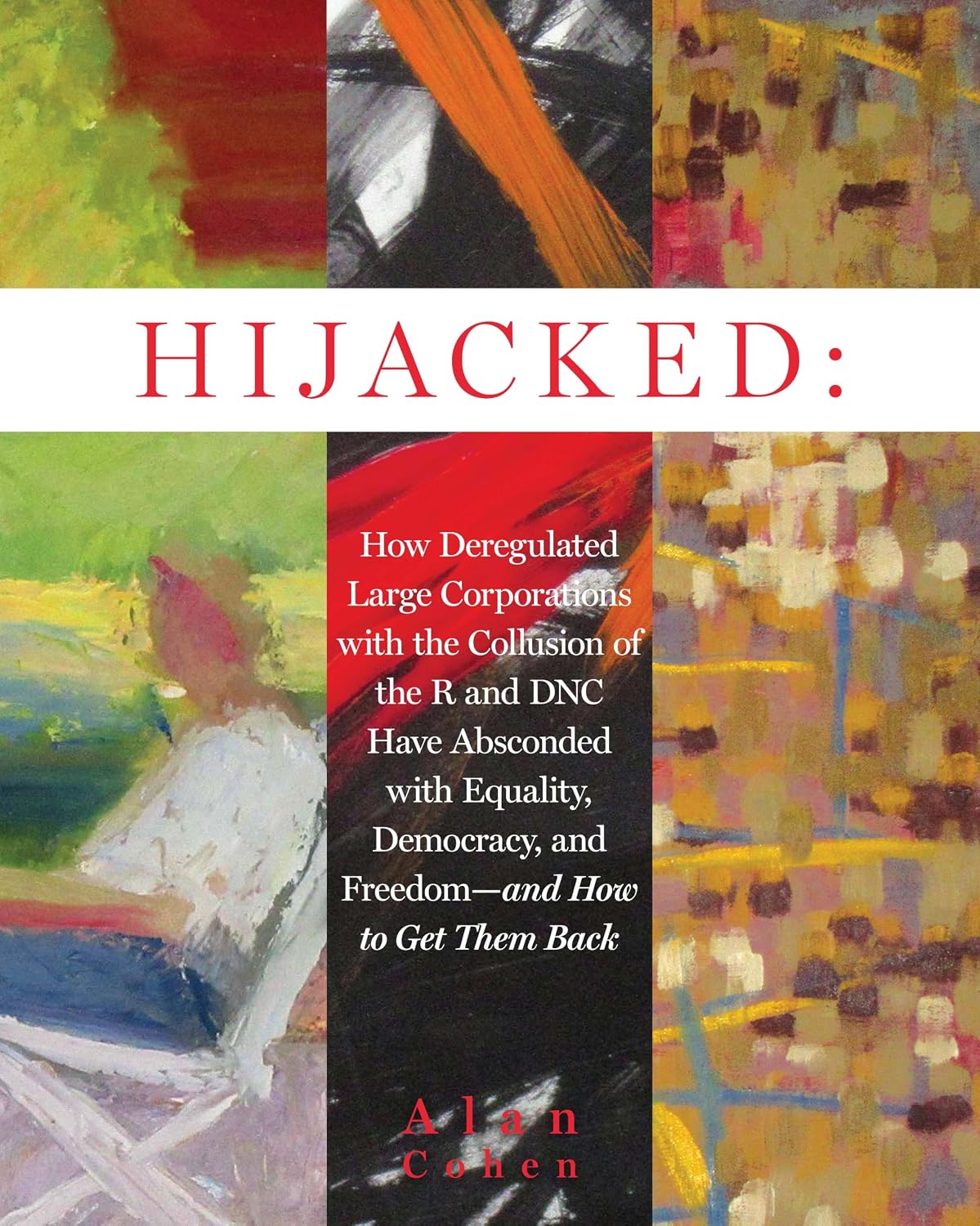

Alan Cohen’s Hijacked: How Deregulated Large Corporations with the Collusion of the R and DNC Have Absconded with Equality, Democracy, and Freedom, and How to Get Them Back is an ambitious work of political and economic criticism built around a straightforward concern: who actually exercises power in the United States, and who benefits from it? Cohen argues that over roughly the past fifty years, large corporations and wealthy interests have gained increasing influence over government while ordinary citizens have lost economic security, political influence, and equality of opportunity. He approaches this subject as someone who believes strongly in capitalism but also believes capitalism requires active government oversight to remain competitive and socially useful. The result is a book driven less by party loyalty than by Cohen’s conviction that concentrated economic power has distorted both major political parties. He describes the book as a selective introduction drawing together hundreds of sources on inequality and corporate behavior, and that description captures its character well. It’s essentially a very large argument assembled from history, economics, politics, journalism, and case studies.
One of the book’s most effective choices is to begin by asking what inequality actually means and how much of it a society should accept. Cohen acknowledges that differences in ability, responsibility, effort, and circumstance will naturally produce some inequality. His deeper concern is equality of rights, opportunity, treatment under the law, political influence, and access to economic security. From there, Hijacked builds its central case that markets don’t operate independently of government. Laws establish everything from minimum wages and bankruptcy procedures to union rights, taxation, corporate charters, environmental standards, and financial regulations, so political decisions inevitably shape economic outcomes. Cohen argues that decades of deregulation have steadily changed those rules in favor of large corporations and wealthy individuals. This historical framework is important because it keeps the book from treating present-day inequality as an isolated problem. Cohen places it in a much longer struggle between concentrated wealth and democratic power, moving through ancient societies, the American founding, the rise of corporations, the Gilded Age, the New Deal, postwar prosperity, and the turn toward deregulation beginning in the late twentieth century.
The middle of Hijacked is where its scale really becomes apparent. Cohen moves through pollution, climate change, corporate welfare, military contracting, privatization, food production, medicine, pharmaceuticals, finance, law, housing, education, the arts, retail, transportation, privacy, labor, media, science, and other parts of everyday life. His purpose is cumulative. He wants readers to see these subjects as connected expressions of the same underlying problem. The section on corporate welfare is especially revealing of his method. Cohen surveys tax advantages, subsidies, contracts, bailouts, bankruptcy protections, liability protections, failures of regulation, and other mechanisms that he believes transfer wealth and risk from the public to large corporations. From there he turns to what he calls the destruction of businesses, institutions, and professions, examining how corporate consolidation can alter the priorities of industries that once operated according to professional, civic, or local values. Reading these sections can feel like moving through an enormous case file. Cohen is interested in accumulation, patterns, and connections, and the sheer number of examples is part of his argument.
Cohen writes with urgency and with a strong personal point of view, so readers are rarely left wondering what conclusion he wants them to draw. At his best, he takes subjects that are usually discussed separately and makes their relationships easier to see. A discussion of deregulation leads naturally into corporate influence, which leads into campaign financing, regulatory capture, weakened professional independence, and growing inequality. He also spends considerable time challenging what he considers misleading cultural narratives about free markets, government, taxation, privatization, corporate efficiency, upward mobility, and the political identities of the two major parties. His style is closer to an extended civic argument than a detached academic study. That gives Hijacked energy, but it also means the reader is continually being asked to evaluate Cohen’s interpretation of a very large collection of evidence. The book rewards an engaged reader who’s willing to follow hundreds of examples and pause occasionally to consider where the evidence is strongest, where a conclusion is more interpretive, and how the pieces fit into the broader thesis.
I think Cohen wants Hijacked to produce political action. His proposed answer is an alternative party organized around what he repeatedly calls government “of, by, and for the people,” with reducing inequality and limiting concentrated corporate power as its central commitments. He argues that reform efforts in health care, environmental protection, labor rights, education, voting rights, and numerous other areas keep encountering the same political obstacles, so people working on separate causes would gain more by joining forces to change who controls government. Whether readers embrace that solution or reach a different conclusion, the book makes clear why Cohen believes structural political change has to accompany economic reform. I’d recommend Hijacked most strongly to politically engaged readers who are interested in economic inequality, corporate power, regulation, American political history, and the relationship between capitalism and democracy. It will especially appeal to readers who enjoy big-picture nonfiction that gathers material from many fields and tries to turn it into a single explanation of how contemporary America got where it is. Even when readers disagree with Cohen, there’s plenty here to argue with, think about, and investigate further.
Pages: 628 | ASIN : B0H8W5SMSX

Influence, Governance, and Accountability

Our Next 250 Years is a wide-ranging civic examination of American democracy, framed by the notion that democracy isn’t sustained by sentiment alone. Why was this an important book for you to write?
Democracy is one of the most successful forms of government ever created, but success in the past does not guarantee success in the future. America today faces challenges that the Founders could not have anticipated, including a population more than one hundred times larger, a vastly more complex economy, rapid technological change, and institutions operating at a scale never before imagined.
I wrote this book because I believe citizens should periodically step back and ask whether the systems that served previous generations are still serving us as effectively as possible. Too much public discussion focuses on personalities, parties, and daily controversies. I wanted to focus on the underlying structures of representation, influence, governance, and accountability that shape outcomes regardless of who holds office.
The goal is not to criticize democracy, but to strengthen it by encouraging thoughtful examination of how it can continue to serve citizens over the next 250 years.
How do you define meaningful political influence for ordinary citizens in a modern democracy?
Meaningful political influence exists when citizens have a realistic ability to affect public policy and government decisions through lawful democratic processes. Voting is an important part of that influence, but it is not the only part.
Citizens should be able to communicate their concerns, organize around shared interests, participate in public debate, and reasonably expect that elected representatives remain responsive to the people they serve. Influence does not mean always getting one’s preferred outcome. In a democracy, disagreement is inevitable. It means having a voice that can be heard and a system that remains accountable to the public.
As societies grow larger and more complex, preserving that connection between citizens and decision-makers becomes increasingly challenging. One of the central questions explored in the book is whether existing institutions continue to provide that connection as effectively as they once did.
Why do you think many citizens feel politically powerless even while living in a democracy?
Many citizens feel politically powerless because modern government operates on a scale that is difficult for individuals to comprehend, let alone influence. Decisions affecting millions of people are often made within large institutions, bureaucracies, regulatory agencies, courts, and legislative bodies that can seem distant from everyday life.
At the same time, citizens are exposed to a constant stream of political information, much of it focused on conflict, controversy, and problems that appear beyond individual control. This can create the impression that participation has little effect.
Whether that perception is entirely accurate is less important than the fact that it exists. A democracy depends on citizens believing their participation matters. If large numbers of people conclude that their voices no longer make a difference, civic engagement declines and trust in institutions weakens.
One purpose of this book is to examine why that perception has developed and to explore ways democratic systems might be strengthened so citizens can maintain confidence that their participation still matters.
What is one thing you hope readers take away from Our Next 250 Years?
More than anything, I hope readers come away with a renewed appreciation for the importance of thoughtful citizenship. Democracies do not sustain themselves. They depend on informed, engaged citizens who are willing to think critically about the challenges facing their nation and the institutions that govern it.
The book does not attempt to tell readers what to think or which political positions to adopt. Instead, it encourages them to examine important questions about representation, influence, accountability, governance, and the long-term future of American democracy.
I also hope every reader makes a commitment to vote in every election. Voting remains one of the most important responsibilities of citizenship, and every election helps shape the future direction of our communities, states, and nation. Beyond voting, I hope readers discuss these issues with family, friends, neighbors, and colleagues. A healthy democracy depends on citizens who are willing to exchange ideas, learn from one another, and help build a more informed electorate.
If the book encourages readers to become more knowledgeable voters, more active participants in civic life, and more thoughtful stewards of America’s future, then it will have achieved its purpose. The next 250 years of American democracy will be shaped not only by elected leaders, but by millions of citizens who choose to stay informed, stay engaged, and take seriously their role in self-government.
Author Links: GoodReads | Website | Amazon
In Our Next 250 Years: Representation and Influence, Charles Patton examines how America’s system of representation has drifted from its original purpose. As the population grew and institutions evolved, the connection between citizens and their elected officials weakened. At the same time, organized influence—through money, lobbying, and privileged access—expanded its role inside government.
The result is a system in which influence often outweighs representation.
Drawing on history, constitutional design, and modern political realities, this book explores how that shift occurred and why restoring meaningful representation is essential to the future of American democracy.
Representation and Influence is the first volume in the Our Next 250 Years series.


