Blog Archives
Society’s Inequality

Hijacked connects deregulation, corporate consolidation, political influence, and inequality in a sweeping examination of how economic power can become political power and what you believe citizens can do about it. Why did you choose Hijacked as the title?
The business community, for at least the past fifty years, has been the prime mover behind all the changes you list in your question, functioning through a multiplicity of funds, agencies, think tanks, lobbying, and organizations like the Chamber of Commerce and the Business Roundtable. The Constitution was written by our founding fathers as a new kind of government, a government that rejected aristocracy and kingship, that argued that all men are created equal. In the 1950s and 1960s, we were growing closer to realizing that initiative. It strikes me that over the past fifty years, the corporate elite have hijacked our country and taken it down an entirely different, dangerous, and damaging path.
You begin by examining what inequality actually means, and acknowledge that some economic inequality is inevitable. Where do you believe inequality becomes harmful to a democratic society?
A society’s inequality becomes harmful when that inequality harms a significant number of its citizens. Disinterested rational folks can argue about whether that is two tenths of a percent, two percent, five percent, or ten percent of the population, depending on their view about minority rights. But today, when the harm is to more than ninety percent of the population, with a small minority responsible for the damage, inequality has been out of control for at least thirty years and is becoming more so by the month.
Hijacked examines healthcare, housing, education, finance, agriculture, transportation, media, privacy, science, the arts, and many other areas. What did examining them together reveal that studying them separately might not?
I am not an expert in every area. In fact, to begin with, I did not know for sure when the problems I was identifying had started, nor how extensive they were. I discovered that, in nearly every field, the problem began in the mid to late 1970s, and that the impact was pervasive, with very few occupations or disciplines escaping the changes corporations were introducing. I discovered that it wasn’t just that money was becoming the only thing that mattered that if an activity was not remunerative, it did not get addressed properly. It was that the new focus was destroying our society.
After spending so much of the book diagnosing problems, why was it important to conclude with a proposed path forward, and what role do you envision ordinary citizens playing in the reforms you propose?
Clearly, telling people what was happening without providing a practical solution would be unkind and also inaccurate. We do still have the opportunity to vote into office people who are incorruptible and focused on helping the people that vote for them. The major issue is trust. So many promises have been broken that citizens are understandably suspicious of all new promises. Most ordinary citizens don’t have the time to devote to active support of an alternative party, but those who do can poll and represent those who don’t. And the biggest role for ordinary citizens would be to express their wishes and their views. Any viable new party, and any viable new politicians, will need to ask them what they think, by e-mail, on social media, in focus groups, and/or text messages, etc., and respond with policies that represent them. One can imagine that when a bill comes to a committee or comes up in Congress for a vote, the representatives would poll their constituents and vote as they wish–ignoring the lobbyists, pressure groups, and visits from CEOs, because government is supposed to be of, by, and for the people.
Author Links: GoodReads | Facebook | Amazon
In Hijacked, Alan Cohen provides a diagnosis to elucidate America’ s shift from a nation “of, by, and for the people” to one dominated by corporate interests, financial elites, and entrenched oligarchies. Through vivid case studies—from the corporatization of medicine to the consolidation and monopolization of finance, agriculture, the media, housing, politics, etc. — Cohen exposes the mechanisms that have hollowed out our democracy while prioritizing profit over citizens’ well-being.
But diagnosis is only the first step. Cohen outlines a path to recovery: a new, transparent, and decentralized political movement capable of restoring equality, opportunity, and the practical problem-solving spirit envisioned by the Founding Fathers.
Hijacked is both a wake-up call and a roadmap for citizens ready to reclaim their country.
Hijacked
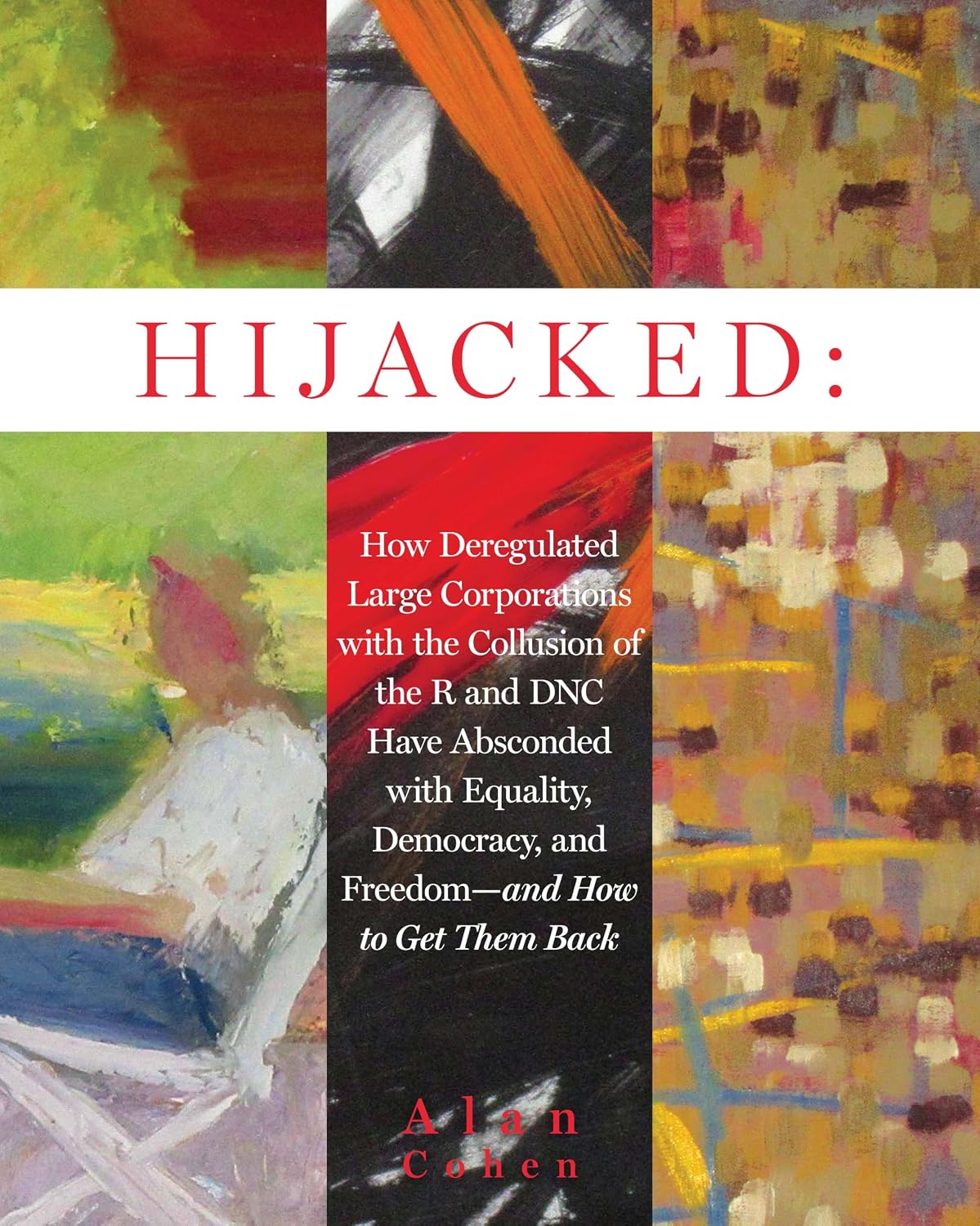

Alan Cohen’s Hijacked: How Deregulated Large Corporations with the Collusion of the R and DNC Have Absconded with Equality, Democracy, and Freedom, and How to Get Them Back is an ambitious work of political and economic criticism built around a straightforward concern: who actually exercises power in the United States, and who benefits from it? Cohen argues that over roughly the past fifty years, large corporations and wealthy interests have gained increasing influence over government while ordinary citizens have lost economic security, political influence, and equality of opportunity. He approaches this subject as someone who believes strongly in capitalism but also believes capitalism requires active government oversight to remain competitive and socially useful. The result is a book driven less by party loyalty than by Cohen’s conviction that concentrated economic power has distorted both major political parties. He describes the book as a selective introduction drawing together hundreds of sources on inequality and corporate behavior, and that description captures its character well. It’s essentially a very large argument assembled from history, economics, politics, journalism, and case studies.
One of the book’s most effective choices is to begin by asking what inequality actually means and how much of it a society should accept. Cohen acknowledges that differences in ability, responsibility, effort, and circumstance will naturally produce some inequality. His deeper concern is equality of rights, opportunity, treatment under the law, political influence, and access to economic security. From there, Hijacked builds its central case that markets don’t operate independently of government. Laws establish everything from minimum wages and bankruptcy procedures to union rights, taxation, corporate charters, environmental standards, and financial regulations, so political decisions inevitably shape economic outcomes. Cohen argues that decades of deregulation have steadily changed those rules in favor of large corporations and wealthy individuals. This historical framework is important because it keeps the book from treating present-day inequality as an isolated problem. Cohen places it in a much longer struggle between concentrated wealth and democratic power, moving through ancient societies, the American founding, the rise of corporations, the Gilded Age, the New Deal, postwar prosperity, and the turn toward deregulation beginning in the late twentieth century.
The middle of Hijacked is where its scale really becomes apparent. Cohen moves through pollution, climate change, corporate welfare, military contracting, privatization, food production, medicine, pharmaceuticals, finance, law, housing, education, the arts, retail, transportation, privacy, labor, media, science, and other parts of everyday life. His purpose is cumulative. He wants readers to see these subjects as connected expressions of the same underlying problem. The section on corporate welfare is especially revealing of his method. Cohen surveys tax advantages, subsidies, contracts, bailouts, bankruptcy protections, liability protections, failures of regulation, and other mechanisms that he believes transfer wealth and risk from the public to large corporations. From there he turns to what he calls the destruction of businesses, institutions, and professions, examining how corporate consolidation can alter the priorities of industries that once operated according to professional, civic, or local values. Reading these sections can feel like moving through an enormous case file. Cohen is interested in accumulation, patterns, and connections, and the sheer number of examples is part of his argument.
Cohen writes with urgency and with a strong personal point of view, so readers are rarely left wondering what conclusion he wants them to draw. At his best, he takes subjects that are usually discussed separately and makes their relationships easier to see. A discussion of deregulation leads naturally into corporate influence, which leads into campaign financing, regulatory capture, weakened professional independence, and growing inequality. He also spends considerable time challenging what he considers misleading cultural narratives about free markets, government, taxation, privatization, corporate efficiency, upward mobility, and the political identities of the two major parties. His style is closer to an extended civic argument than a detached academic study. That gives Hijacked energy, but it also means the reader is continually being asked to evaluate Cohen’s interpretation of a very large collection of evidence. The book rewards an engaged reader who’s willing to follow hundreds of examples and pause occasionally to consider where the evidence is strongest, where a conclusion is more interpretive, and how the pieces fit into the broader thesis.
I think Cohen wants Hijacked to produce political action. His proposed answer is an alternative party organized around what he repeatedly calls government “of, by, and for the people,” with reducing inequality and limiting concentrated corporate power as its central commitments. He argues that reform efforts in health care, environmental protection, labor rights, education, voting rights, and numerous other areas keep encountering the same political obstacles, so people working on separate causes would gain more by joining forces to change who controls government. Whether readers embrace that solution or reach a different conclusion, the book makes clear why Cohen believes structural political change has to accompany economic reform. I’d recommend Hijacked most strongly to politically engaged readers who are interested in economic inequality, corporate power, regulation, American political history, and the relationship between capitalism and democracy. It will especially appeal to readers who enjoy big-picture nonfiction that gathers material from many fields and tries to turn it into a single explanation of how contemporary America got where it is. Even when readers disagree with Cohen, there’s plenty here to argue with, think about, and investigate further.
Pages: 628 | ASIN : B0H8W5SMSX

Inferno


Inferno, by Alan Cohen, is an ambitious piece of literary fiction that follows Nancey Reese, a young nurse in 1980s Holyoke, as she stumbles from innocence into something like self-awareness, all while a chatty, self-conscious narrator and his “Doctor” creator keep stepping in to talk about genes, consciousness, and what stories are for. We move between Nancey’s cramped apartment and chaotic hospital shifts, her friendships and near-relationships, and long reflective chapters on genetics and the mind that frame her life as one experiment among many. By the end, Nancey is left standing in an open future rather than wrapped up neatly, the “inferno” of experience still burning but no longer completely opaque.
On one level, there is this very grounded, almost stubbornly ordinary story of a plain young woman who smokes too much, works nights, and learns how to pay rent, navigate a toxic head nurse, cling to a glamorous friend like Susan, and decide what kind of intimacy she can stand. Those scenes feel relatable and authentic. On the other level, the narrator piques interest with intriguing ideas, talking about DNA as “snakes” inside us and consciousness as a new “light” that lets us see our own thoughts. Instead of feeling like a gimmick, it worked for me as a kind of echo chamber. Nancey’s small choices and the essayistic chapters keep reflecting each other, so her drifting, timid, half-woken life sits next to these big questions about how much freedom any of us really have.
What surprised me most was how much the book leans into self-awareness. The narrator reminds readers that he is a construct, trying to tell Nancey’s story under the Doctor’s rules. Then the Doctor himself appears as a character. It sounds clever, but I read it as someone worrying, out loud, about responsibility: to a character, to real patients, to family, to a life you could have lived but didn’t. There were times when the philosophical chapters stretched on, and I wanted to get back to Nancey and Susan or the drama at Mercy Hospital. But even there, I felt the pull of the ideas. The book keeps asking, in different ways, whether we are more than our genes, our conditioning, our old stories. It is curious, sometimes grand, and then suddenly very tender, like when the narrator pauses to wonder what kind of future Nancey should be allowed to have and admits he is still just curious, still compassionate, still vigorous, and cannot walk away from her fate.
By the time I reached the end, with Nancey facing the consequences of her choices and then offered back to the reader as a full-length portrait rather than a closed case, I felt oddly protective of her. It did not feel like a neat moral tale. It felt more like watching someone you know muddle through their twenties in slow motion. The genre is literary fiction, with a strong philosophical streak and a taste for metafiction, so it asks for patience and attention instead of dishing out quick thrills. I would recommend Inferno to readers who enjoy long, idea-driven novels, who are happy to sit with a flawed, sometimes frustrating protagonist, and who like their stories spliced with essays on science and consciousness. If you like the thought of George Eliot arguing with Oliver Sacks inside a hospital drama, you are the right audience.
Pages: 624 | ASIN : B0FTRPQ7NQ
Changing the Way We Manage People

Easy in Harness: A Productive Approach to Hiring a Good Manager explores how poor management and leadership impact not only the financial side of companies, but the overall well-being of the people, customers, and the organization as a whole. Why was this an important book for you to write?
I experienced first-hand the impact of management, good and not so good, in my life and on my productivity. The difference was enormous. Under the one regime, I was anxious and inefficient and lost sleep; under the other, I was resilient and looked forward to going to work every day.
Then I applied the lessons I’d learned over the first half of my career when I became a manager and had a great deal of success. Employees who had looked at the floor and vanished at 4:30 when I arrived, looked me in the face and smiled just before I left for a new position, often still at work on their projects at 6. I felt it was important to share what I’d learned, since autocratic management in the workplace remains relatively common, is still often viewed in economic literature as just one strategy among many, and continues to do a good deal of harm. I wrote this book in the hope that more people would have the opportunity to develop and apply their skills in a vibrant workplace.
How much research did you undertake for this book, and how much time did it take to put it all together?
I did probably an average amount of book and interview research. I took management training, read probably 30 books, lots of articles, and asked everyone I knew and met about their experiences. But, more important, it took 40 years of workplace living. My research was my hopes and dreams, my failures and successes, my anxieties and elations, my frustrations and breakthroughs; and seeing others find their way, become better employees, better teachers and better people, become managers themselves, blossom.
What were some goals you set for yourself as a writer in this book?
I wanted to be intuitive but rigorous, comprehensive but succinct, reflective but clear.
What is one thing that you hope readers take away from Easy in Harness?
Autocracy is no better in the workplace than it is in a society at large.
That is a message with different implications for people in different roles. Most of us are happy to learn to do things better and to be productive contributors. Few of us want to be abused or belittled or to have our ideas and suggestions ignored. I’d hope that managers would take this to heart, that workers would find ways, difficult as this can be, to share this insight with their managers, and that administrators would be more likely to hire entrepreneurial managers.
Author Link: GoodReads
In Easy in Harness by Alan Cohen, the dire consequences of flawed management are discreetly delineated. Employees often recount tales of vindictive and abusive bosses, to whom they attribute responsibility for toxic work environments, downsizing, job relocations, strained relationships, health problems, and sleepless nights. Yet employees generally deem such ordeals unavoidable, inevitable “woes of the workplace.”
However, Cohen takes a constructive approach to addressing workplace dysfunction. He provides pragmatic insight into its primary causes and presents a range of relatively simple yet effective solutions to foster better relationships between management and employees.
Easy in Harness provides a practical and perceptive guide to help organizations identify, hire, and develop competent managers who can steer companies toward success. By implementing these strategies businesses, free of the shackles of flawed management, can forge a path toward a brighter future.
Easy in Harness: A Productive Approach to Hiring a Good Manager

In the intricate tapestry of corporate success, the individuals driving a company forward serve as its defining threads. Leadership, often seated at the pinnacle, can steer an organization either toward a harmonious, flourishing future or into a desolate landscape of dispassion. Easy in Harness offers a compelling exploration into the pitfalls of imperfect leadership and management in today’s work environments.
Drawing from many real-life accounts, this book underscores the challenges many professionals face under the shadow of inadequate leadership. Among these is the poignant tale of a college friend who, having been thrust into an atmosphere of intimidation by a shift in leadership, opted for early retirement. Another account recalls the author’s personal experience at an Ivy League University health plan, which witnessed a decline in harmony and satisfaction due to a change at the helm.
Alan J. Cohen captures the essence of these experiences with a writing style that is both descriptive and informative. He draws upon factual and relatable real-world examples to reinforce his arguments. Through a lens that is both reflective and analytical, Cohen expresses deep empathy for the individuals who have grappled with professional tribulations.
Easy in Harness commences with a deep dive into the ramifications of dysfunctional leadership for those who endure it. The narrative artfully unpacks the resultant feelings of mistrust, disillusionment, and waning job satisfaction. Cohen’s authoritative voice, seasoned by personal experience, offers a holistic view of the subject. By weaving in anecdotes from diverse professions and sectors, including his own, he crafts a narrative that many will find both touching and relatable.
The book follows a logical trajectory, exploring the impacts of subpar leadership on employee well-being before dissecting the topic layer by layer. This systematic progression ensures an engaging reader experience, enhanced by the timely relevance of the subject matter in modern workspaces.
Easy in Harness stands as a beacon of clarity, authenticity, and meticulous dissection of workplace dynamics. It is an invaluable resource for anyone seeking insights into the repercussions of flawed leadership—ranging from high employee turnover and plummeting morale to potential health ramifications.
Pages: 136 | ASIN : B0CL2JMG1Z


