Blog Archives
Guilt and Solitude

Where Despair Comes To Play follows a man consumed by the voices in his head who is convicted of murder and sentenced to prison, where the isolation drives him deep into paranoia, delusion, and dissociation. What was the inspiration for the setup of your story?
The inspiration for Where Despair Comes to Play came from a fascination with the fragile boundary between the mind and reality—how isolation, guilt, and fear can twist perception until the world itself becomes an echo of one’s thoughts. I wanted to explore what happens when a person is left alone with their own darkness, with no distractions, no noise—only the voices that feed on doubt and memory.
The prison setting became a metaphor for internal confinement. I wasn’t as interested in the crime itself as in what happens afterward—how a mind begins to fracture when trapped in silence and shame. Each of Malcolm’s voices—Paranoia, Delusion, and Dissociation—represents a piece of his psyche trying to survive the unbearable weight of guilt and solitude.
I always start my books with a well-refined thesis statement, similar to what I did for my doctoral dissertation. In many ways, the story was inspired by the question: If you can’t trust your own mind, where can you hide?
Malcolm is a fascinating character who draws readers into his mind and the horrors that reside within it. What scene was the most interesting to write for that character?
The most intriguing scene to write for Malcolm was the one where he finally stops resisting the voices—when Paranoia, Delusion, and Dissociation stop feeling like intruders and start feeling like his only companions. It’s the moment where his isolation becomes complete, and instead of fighting for sanity, he begins to negotiate with his madness.
Writing that scene felt like walking a tightrope between horror and heartbreak. I wanted readers to feel both fear and empathy—to see that Malcolm isn’t a monster but a man slowly breaking under the weight of his own thoughts. Capturing the moment when his inner voices start making more sense to him than reality itself.
What were some themes that were important for you to explore in this book?
My key theme was the personification of mental illness—turning Paranoia, Delusion, and Dissociation into living entities. It allowed me to explore how mental struggles can feel external and invasive, like something whispering just behind your thoughts. My ultimate goal for the book was to explore what happens when the mind becomes the battleground—and whether redemption is possible when your worst enemy is yourself.
What is the next book that you are writing, and when will that be published?
My next book is actually a love story, Framed in Love, that is steeped in fantasy and explores the psychological condition of “How far will you go, and what are you willing to do to keep that love alive?” In a world where love can be bound by spell and sacrifice, a devoted lover discovers that devotion has no bottom, and is preserving love worth losing everything that makes a person human?
Author Links: GoodReads | Amazon
As Malcolm struggles to separate reality from nightmare, every letter etched on the wall draws him closer to a final word he may not survive. The line between guilt and madness blurs, and the only question left is chilling: is he haunted by his own mind—or by something far worse that feeds on silence itself?
Where Despair Comes To Play
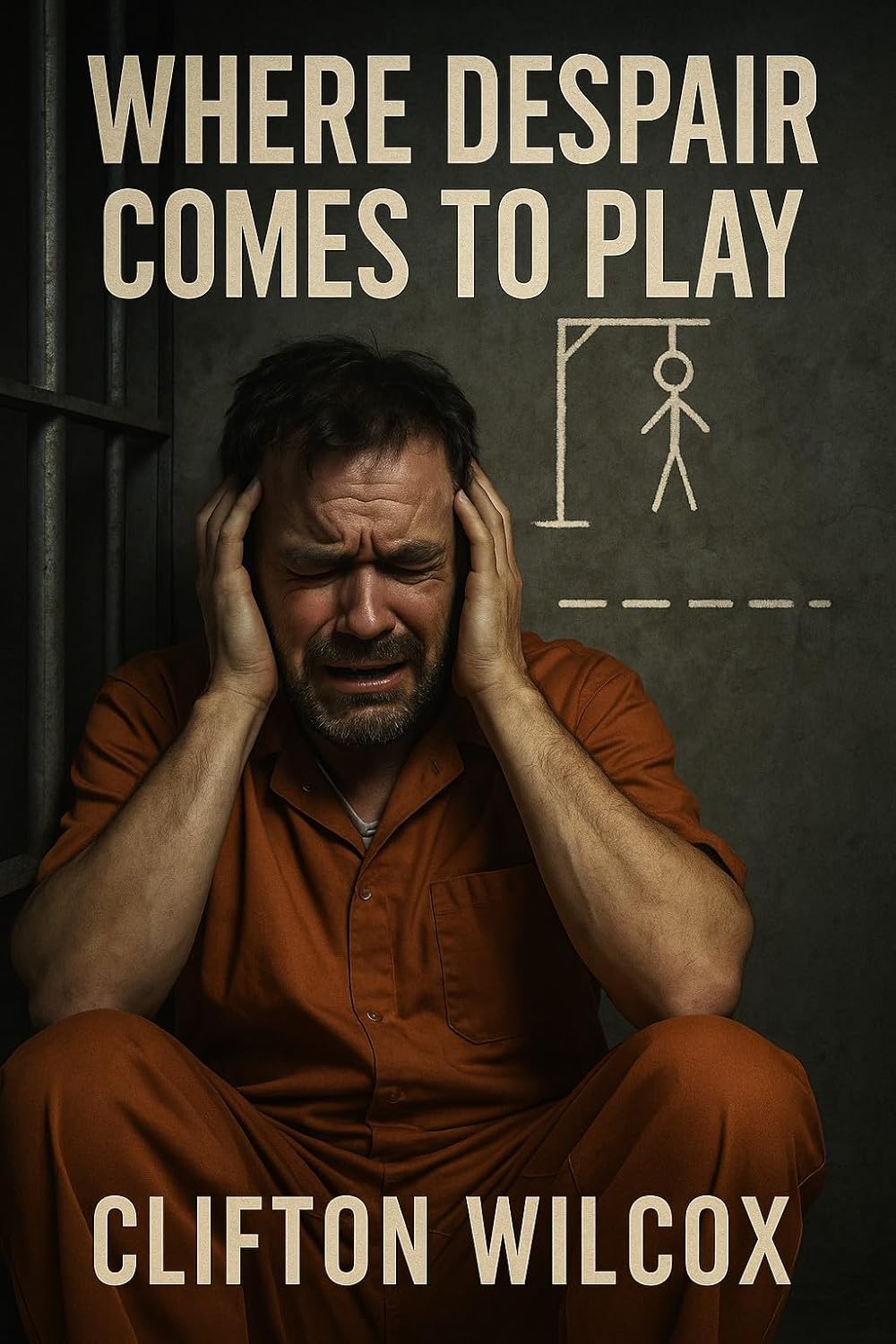

Where Despair Comes To Play tells the story of Malcolm Rowe, a man consumed by the voices in his head. What begins as faint whispers of paranoia soon grows into a chorus of torment that drives him into isolation, suspicion, and despair. Paranoia, Delusional, and Dissociative, personified fragments of his own mind, compete for control while his grip on reality slips further away. The book follows him from his crumbling apartment to the unforgiving walls of prison, where the “game” of Hangman becomes a metaphor for his unraveling mind and his struggle to reclaim even a sliver of himself. It is a descent into madness told with haunting detail and relentless intimacy.
This book is unsettling, and I mean that as praise. The writing has a raw, jagged rhythm that mirrors Malcolm’s own fractured state. I often felt claustrophobic, like the walls were closing in with him. The voices are written so convincingly that they felt alive, not just figments of imagination but true characters with their own logic and presence. That disturbed me. It also impressed me. Wilcox captures the terrifying way the mind can betray itself, and he doesn’t dress it up in fancy words or clinical explanations. It’s simple, direct, and all the more powerful because of that.
The book doesn’t offer many moments of relief, and when hope does show up, it feels fragile, almost cruel. Yet maybe that’s the point. This isn’t a story designed to comfort. It’s designed to confront. I admired the bravery in that choice, even while it made me uneasy. I also appreciated how the story shifts in layers, first as a psychological thriller, then almost as an allegory of mental illness. By the later chapters, I caught myself questioning whether the prison walls were literal at all or if the real cage was inside Malcolm’s head. That ambiguity kept me thinking.
I’d say this book is for readers who want to be rattled. It’s not for someone seeking light entertainment or tidy answers. If you like narratives that blur the line between reality and madness, or if you want to see mental illness depicted with a chilling kind of honesty, Where Despair Comes to Play will grip you and not let go.
Pages: 258 | ASIN : B0FNDGQTZV




 LITERARY TITAN