Blog Archives
Coexistence and Domination

Black Forest Protocol is an alternate-history thriller in which a UFO crash in Nazi Germany forces an SS officer to confront the gulf between domination and preservation when the regime tries to weaponize a sacred alien presence. What sparked the idea of placing a first-contact story inside Nazi Germany?
There had been reports and a number of journals/books dedicated to the Black Forest crash in 1936. This is roughly 10 years before the Roswell incident. Through my research on the rise of the Nazi regime, German manufacturing made extensive technological leaps from 1936 through 1939, prior to the invasion of Poland. It mirrored the technological leaps the US made post-Roswell. I used creative license to involve the Nazi SS and advanced technology/alien abilities that would have been used to reshape a totalitarian regime reality to fit ideology.
How did you approach writing Ernst Falk so that his moral awakening felt gradual and believable rather than heroic from the start?
The key was to start with competence instead of conscience. Falk is intelligent, disciplined, and emotionally detached. He isn’t written as a monster or a secret hero—he’s a professional who follows systems without questioning them. That makes his starting point believable and grounded. From there, I avoided any sudden “moral epiphany.” Instead, his change happens through accumulated friction: small moments that feel off, observations he can’t fully explain, and emotional reactions he initially suppresses. Importantly, he fails repeatedly. He hesitates, rationalizes, and makes the wrong choices even after he begins to feel doubt. That delay is what makes the awakening feel real—he understands before he acts. Finally, his awakening comes with cost, not reward. He loses certainty, identity, and alignment with the system that once defined him. He doesn’t become heroic—he becomes unable to ignore the truth.
The aliens feel mournful, vulnerable, and almost sacred. What did you want them to represent beyond their role in the plot?
The aliens were meant to represent a form of intelligence untouched by human corruption, that is something gentle, restrained, and morally unbroken. Their vulnerability highlights the contrast between coexistence and domination, making humanity’s instinct to control feel invasive rather than justified. They serve as a mirror to Falk and the reader, suggesting that intelligence doesn’t have to lead to cruelty—and that what we often call progress may actually be a loss of something more sacred.
How did you balance the book’s eldritch atmosphere and allegorical reach with the historical weight of writing about the Third Reich?
I balanced the eldritch atmosphere with the historical weight of the Third Reich by keeping the human reality grounded and specific, never abstracting or stylizing the regime’s brutality, while letting the cosmic elements emerge as a destabilizing force around it. The horror doesn’t replace history; it intensifies it, exposing the dangers of ideology, control, and moral certainty when confronted with the unknowable. By anchoring the story in authentic human behavior and consequence, the allegory expands the meaning without diminishing the reality.
Author Links: GoodReads | Website | Amazon
SS officer Ernst Falk is stationed on a quiet rural post when the forest itself seems to recoil, where animals vanish, the air vibrates, and the night splits open with a light no human technology should be able to produce. By dawn, a seamless metallic object lies embedded in the earth, warping the trees around it and defying every known law of physics.
It is not wreckage.
It is not dead.
And it is not alone.
Hidden beneath the pines, Falk and a small team of scientists discover survivors, beings not of this world, wounded and terrified. What should have become humanity’s first moment of cosmic contact instead becomes a nightmare of secrecy and ambition. The Nazi regime seals the forest, erases witnesses, and delivers the discovery into the hands of the SS and the Ahnenerbe, who see not life but opportunity.
As alien technology is dismantled and alien biology harvested, a terrifying project takes shape: the Blackforest Protocol. Under the direction of fanatical ideologues, the crash is transformed into a weapons program, a genetic experiment, and a propaganda miracle meant to fuse extraterrestrial power with Nazi myth.
But the forest is changing.
The survivors are not silent.
And Falk begins to realize the visitors did not come as conquerors-but as explorers, carrying knowledge that was never meant to be bent into instruments of domination.
Decades later, the consequences of what happened in the Black Forest resurface, dragging the modern world into a buried legacy of stolen technology, erased crimes, and a truth powerful enough to destabilize history itself.
Blending historical horror, science fiction, and psychological suspense, Blackforest Protocol is a chilling alternate-history thriller about first contact gone wrong, where humanity’s greatest discovery becomes its most unforgivable crime, and the forest that witnessed it refuses to forget.
Black Forest Protocol
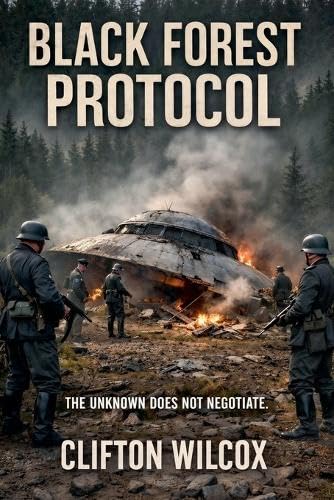

In Black Forest Protocol, author Clifton Wilcox drops a UFO crash into Nazi Germany and uses that collision to build a dark, morally charged speculative thriller: SS officer Ernst Falk witnesses an alien arrival in the Black Forest, discovers that the survivors are not invaders but vulnerable pilgrims, and slowly turns from functionary to witness as the Reich tries to convert wonder into doctrine, biology into propaganda, and contact into domination. The novel eventually broadens beyond the 1930s crash into a longer historical reckoning, revealing that what the Nazis tried to weaponize was never meant as a tool of conquest at all, but as a system of preservation and balance.
I enjoyed the book’s atmosphere. Wilcox gives the forest a living pressure, and the opening movement has a genuine eldritch shimmer to it: the silence feels predatory, the ship feels less manufactured than grown, and the aliens arrive with a sadness that keeps the novel from sliding into pulp. I was especially taken with Falk as a protagonist. He’s not built as a swaggering resistor; he is a cautious, thinking man whose decency emerges by increments, which made his bond with the surviving alien feel more persuasive than a louder, more cinematic version would have. When the book is operating in that register, cosmic mystery filtered through dread, pity, and moral nausea, it has real voltage.
The novel is at its strongest when it lets horror and conscience share the same room. The most unsettling passages are not the extraterrestrial ones, but the scenes where Nazi ideology tries to metabolize the unknown into its own diseased mythology. That is the book’s sharpest idea: not simply that evil destroys, but that it narrates, repackages, and aestheticizes destruction until it sounds inevitable. I also found the prose interestingly uneven, and I mean that as praise because it can be a touch overwrought, but it is rarely inert. Wilcox reaches, sometimes flamboyantly, for a language of omen and scar tissue, and I’d rather read a book that risks a little melodrama than one that settles for sterile competence.
I’d recommend Black Forest Protocol to readers of historical science fiction, alternate-history suspense, UFO fiction, first-contact horror, and conspiracy thrillers with a moral spine. Readers who like the historical unease of Philip Kerr’s wartime settings, or the idea-driven speculative pressure of Philip K. Dick, will probably find something to grab onto here, though Wilcox is more earnest than either and more openly allegorical. For the right audience, this is a grim, curious, haunted book about what happens when wonder falls into the wrong hands. When the stars finally spoke, the worst men on Earth tried to translate them into power.
Pages: 394 | ISBN: 1969770090

Balance Between Closeness and Cost
Framed in Love follows a man who, after a lightning strike, has the ability to step inside a fading painting where he falls in love with a woman trapped inside it. What was the first spark behind the idea of stepping into a painting?
The story started with an actual painting that I own. The date of the painting is 1858; it is of a Victorian woman who has a striking resemblance to my wife. So, I thought, if I wanted to know this woman, how could I get to know her? I would have to enter the painting to strike up a conversation. Hence, the lightning strike, because there is something mysterious about lightning.
How did David evolve as you wrote the book?
I introduced the twist that the painting fades each time David enters. I did that for a reason. David, with the help of Abby, sees himself differently. Instead of viewing love as something risky or temporary, he begins to see it as transformative and grounding. Earlier in the story, David often reacts to situations emotionally or defensively. As his bond with Abby deepens, he becomes more intentional by choosing honesty over avoidance and commitment over uncertainty.
The book explores love as both connection and sacrifice. What drew you to that tension?
What drew me to that tension is that love rarely feels pure or simple in real life. Love is almost always a balance between closeness and cost. In Framed in Love, the relationship between David and Abby works because it recognizes that loving someone deeply often means giving something up: control, certainty, or even parts of the version of yourself you’ve carefully built.
What do you hope readers carry with them after finishing the book?
The most compelling love stories (to me) live in that uncomfortable middle space. Too much connection without sacrifice feels shallow. Too much sacrifice without connection feels destructive. I wanted readers to feel that push-and-pull. The fear of losing yourself versus the desire to belong, because that’s what makes emotional stakes feel real.
Author Links: Barnes & Noble | Website

Framed In Love

Framed in Love by Clifton Wilcox is best described as a romantic speculative novel with a mystery thread and a slow-burn heartbreak engine. The setup is clean and high-concept: David Cross gets struck by lightning and discovers he can step into an old painting, where he meets Abby, a young woman trapped inside a Victorian park that is literally fading away. As they fall in love inside the canvas, they also dig into why the painting is unstable, tying the park’s decay to the original painter, Stephanie Moreau, and her unresolved grief. In the end, the story pushes toward a hard choice: love as presence versus love as protection, and what it costs to keep someone “alive” when the world holding them is fragile.
I liked how committed the book is to its central image: love framed, literally. The early chapters lean hard into sensory description, and when it works, it really works. You can almost smell the damp earth and flowers in the painted park, and the idea of a world that’s beautiful but slightly “off” gives the romance an edge of dread. At the same time, Wilcox repeats certain emotional beats on purpose, circling grief and longing again and again, the way people actually do when they’re stuck in something. Sometimes that repetition felt like a slow tightening. Other times, it felt like the book was explaining itself a beat longer than it needed to. Still, the tone stays sincere, and I appreciated that it never treats Abby like a cute fantasy prize. The story keeps reminding you that she’s the one paying the highest price.
I also liked the author’s choice to make the mystery emotional instead of procedural. The “why” of the painting isn’t solved with a single clever trick; it’s tied to Stephanie’s memories, loss, and what it means for art to carry a person’s inner life. That’s a smart match for this genre. In romantic fantasy and speculative romance, big feelings are the point, and here the worldbuilding serves the feelings instead of competing with them. The ending decisions land in that same lane: David ultimately steps back, not because the love was fake, but because staying would destroy the one place Abby can exist. It’s a quiet kind of bravery. Then the book takes the idea further, showing him translating that loss into writing, painting, and music, which is both tender and a little bruising.
I felt like the novel was making a simple argument and standing by it: love does not always mean holding on, and art can be a bridge even when it can’t be a doorway. The epilogue, with Abby still in the painting and David refusing to cross again because it would make the canvas fade, is the kind of ending that aches in a controlled way. It doesn’t chase shock. It chooses restraint. I’d recommend this most to readers who like bittersweet romance, gentle mystery, and speculative premises that stay focused on the heart rather than action set pieces. If you enjoy slow-burn love stories where the “magic” is really a lens for grief, memory, and acceptance, you’ll enjoy this story.
Pages: 244 | ISBN : 9781969770043

An Important Lesson

The Case Against Jasper is an allegorical mystery where a farm’s rush to judgment after a tragic accident exposes how communities distort truth when fear takes hold. What inspired you to explore human justice and mob mentality through the lens of animal characters?
The book was born out of a rush to judgement on my daughter’s part, who is age seven and arguing with her five-year-old brother and gossiping about him with her friends in the neighborhood. In order to teach both of them an important lesson, I created this theme about Jasper the squirrel and his endeavors. The story is a way to connect with them and give them an example that rushing to judgement and gossiping can have detrimental effects. Then enter Ink and Fiona, who represent intellect. Before rushing to judgment, look at the situation, study it and come to a conclusion. Ink and Fiona represented the internal intellect to look at things from all sides, test theories, and make decisions on the results. I liked the story so much that I decided to write the book.
Did you model any of the farm’s characters, like Ink or Fiona, after real people or archetypes?
Regarding real people, not really. The name Fiona is my mother’s name, so I used it in that way. Archetypes, absolutely. Jasper represents the scapegoat and those that are misunderstood. Jenny is the catalyst for the story. Others, like the group of squirrels, rabbits, etc., represent the mob. The hens, they are the hypocrites.
How did you balance the fable-like simplicity of the narrative with the weight of its moral themes?
By writing Jasper with a leaning towards gentle naivety, I allow the reader to experience injustice through the innocent eyes of Jasper. Although Jasper never fully comprehends the malice directed at him, he definitely feels it. It is this emotional honesty that preserves the purity of the fable while allowing readers to impose their own interpretations of guilt, grief, and alienation.
I think the ending leans toward restoration rather than punishment. What message did you hope readers would take from that choice?
Take any classic fable, and they typically end with punishment: the liar is caught, the greedy are undone, and the cruel are devoured by their own cruelty. Yet, The Case Against Jasper is written to break that cycle because the true tragedy of the story is born from misunderstanding, not malice. Jasper, as it turns out, never commits a crime. The crime is the community’s judgment itself. To punish would affirm the same broken logic that condemned him and would fall in line with classic fables. The stories’ true resolution must come from recognition and reparation, not vengeance.
Author Links: GoodReads
As rumors tangle like briars, a chorus of barnyard witnesses steps forward—some earnest, some opportunistic, all convinced they know what happened. Unreliable testimonies pile high: a jealous hen with a glint for shiny narratives, a rabbit fond of order and outrage, and a skittish mouse who “saw something.” With the farm on edge and a tribunal brewing, Jasper must prove his innocence before the story hardens into a sentence.
Enter Ink, the investigative ferret with a nose for hidden threads, and Fiona, the whisper cat whose quiet intuition hears what pride and fear try to bury. Together, they sift through half-truths and harvest-time politics to uncover what grief looks like when it’s weaponized—and what justice requires when the crowd wants a culprit.
The Case Against Jasper


The Case Against Jasper is an allegorical mystery set on Wildwoods Farm, where gossiping hens, nervous rabbits, and a wrongly accused squirrel turn a simple accident into a full-blown witch hunt. It begins with Jenny’s fatal fall and the farm’s rush to blame Jasper, her closest companion. From there, the story unravels like a rural courtroom drama with animals as witnesses and moral philosophers. Ink the ferret and Fiona the cat, unlikely detectives, sift through lies, fear, and half-truths to reveal that the tragedy is less about guilt and more about how communities twist truth when panic takes hold.
I found the writing to be both charming and haunting. Wilcox blends the innocence of a children’s tale with the sharp edge of social commentary. The dialogue feels lively, sometimes gossipy, and the pacing, though deliberate, mirrors how real-life rumors spread, slow at first, then uncontrollable. The tone is simple but carries a quiet intelligence, like an old storyteller who knows how to make you see yourself in the animals. Some sections are weighed down by exposition, yet the prose always pulls you back with its sincerity. The setting, rustic, quiet, full of whispering fields, feels alive, almost cinematic.
What struck me most was how human the story felt. Beneath the feathers and fur, Wilcox explores bias, fear, and the instinct to assign blame when truth is inconvenient. The farm becomes a mirror for our own world, where perception often wins over evidence. I felt anger for Jasper, admiration for Ink’s calm logic, and deep sadness for how easily the crowd turns cruel. The ending, more restorative than punitive, felt like a sigh of relief and a reminder that justice is as fragile as reputation.
I’d recommend The Case Against Jasper to readers who enjoy thought-provoking fables and slow-burn mysteries. It’s perfect for those who liked Animal Farm or Watership Down but crave something more intimate, something about forgiveness and truth in small places. It’s not just a story about animals. It’s a story about us, the way we talk, accuse, forgive, and finally, understand.
Pages: 273 | ASIN: B0FRYJLV4W
Guilt and Solitude
Where Despair Comes To Play follows a man consumed by the voices in his head who is convicted of murder and sentenced to prison, where the isolation drives him deep into paranoia, delusion, and dissociation. What was the inspiration for the setup of your story?
The inspiration for Where Despair Comes to Play came from a fascination with the fragile boundary between the mind and reality—how isolation, guilt, and fear can twist perception until the world itself becomes an echo of one’s thoughts. I wanted to explore what happens when a person is left alone with their own darkness, with no distractions, no noise—only the voices that feed on doubt and memory.
The prison setting became a metaphor for internal confinement. I wasn’t as interested in the crime itself as in what happens afterward—how a mind begins to fracture when trapped in silence and shame. Each of Malcolm’s voices—Paranoia, Delusion, and Dissociation—represents a piece of his psyche trying to survive the unbearable weight of guilt and solitude.
I always start my books with a well-refined thesis statement, similar to what I did for my doctoral dissertation. In many ways, the story was inspired by the question: If you can’t trust your own mind, where can you hide?
Malcolm is a fascinating character who draws readers into his mind and the horrors that reside within it. What scene was the most interesting to write for that character?
The most intriguing scene to write for Malcolm was the one where he finally stops resisting the voices—when Paranoia, Delusion, and Dissociation stop feeling like intruders and start feeling like his only companions. It’s the moment where his isolation becomes complete, and instead of fighting for sanity, he begins to negotiate with his madness.
Writing that scene felt like walking a tightrope between horror and heartbreak. I wanted readers to feel both fear and empathy—to see that Malcolm isn’t a monster but a man slowly breaking under the weight of his own thoughts. Capturing the moment when his inner voices start making more sense to him than reality itself.
What were some themes that were important for you to explore in this book?
My key theme was the personification of mental illness—turning Paranoia, Delusion, and Dissociation into living entities. It allowed me to explore how mental struggles can feel external and invasive, like something whispering just behind your thoughts. My ultimate goal for the book was to explore what happens when the mind becomes the battleground—and whether redemption is possible when your worst enemy is yourself.
What is the next book that you are writing, and when will that be published?
My next book is actually a love story, Framed in Love, that is steeped in fantasy and explores the psychological condition of “How far will you go, and what are you willing to do to keep that love alive?” In a world where love can be bound by spell and sacrifice, a devoted lover discovers that devotion has no bottom, and is preserving love worth losing everything that makes a person human?
Author Links: GoodReads | Amazon
As Malcolm struggles to separate reality from nightmare, every letter etched on the wall draws him closer to a final word he may not survive. The line between guilt and madness blurs, and the only question left is chilling: is he haunted by his own mind—or by something far worse that feeds on silence itself?
Endless Fiction
I, Monster follows a boy born into poverty, abuse, and neglect who is shaped by these experiences into a predator that aims to not only silence those in the concentration camp, but also erase their existence. What was the inspiration for the setup of your story?
I had done extensive research on the Nazi SS and their rise to power for a nonfiction book when I was still a professor. I had always wanted to know how could a person commit such acts of terror, document that terror, and still function as a human being? That is when I got the idea of following some of the prominent SS figures and charting their course. I had found that a number of them were outcasts, bullied, and considered on the fringe socially.
So, I used my extensive psychology background and created Hans, who grew up in the post-World War 1 era and the punitive Treaty of Versailles, where hardship, deep resentment of the West, poverty, and political instability thrived. That was the fuel; now all you needed was a spark. Enter the National Socialist German Workers Party, a.k.a. the Nazis, and you have Hans.
What are some things that you find interesting about the human condition that you think make for great fiction?
I believe that the human condition is a source of endless fiction because life is full of contradictions, struggles, and the intense desire to do or have something. Yet, at the same time, much of life is routine—we work, eat meals, sleep, and get up to do it all over again. Fiction allows me to reveal the strangeness that lurks beneath the ordinary. This offers me the ability to remind readers that life is stranger and more fragile than it appears.
What were some themes that were important for you to explore in this book?
It was probably the overarching theme that embodies the “monster” within an otherwise rational man. The novel makes the unsettling point that “monstrosity” is not an external force—it already exists within the human condition, just waiting for the right circumstances and choices to call it forth.
What is the next book that you are working on, and when can your fans expect it to be out?
My next book is actually a love story, Framed in Love, that is steeped in fantasy and explores the psychological condition of “How far will you go, and what are you willing to do to keep that love alive?” In a world where love can be bound by spell and sacrifice, a devoted lover discovers that devotion has no bottom, and is preserving love worth losing everything that makes a person human?
Author Links: GoodReads | Amazon
To the world, he was just a bureaucrat in a coat too neat, boots too polished. But behind those cold eyes was a man obsessed with silence. Where others saw genocide, he saw design. And now, decades later, as investigators unearth the ruins and whispers resurface, the question echoes louder than ever: What happens when the monster is the one who writes the ending—and signs no name?


