The Two Oceans: A Personal Account of Life, Finance and Business Philosophies
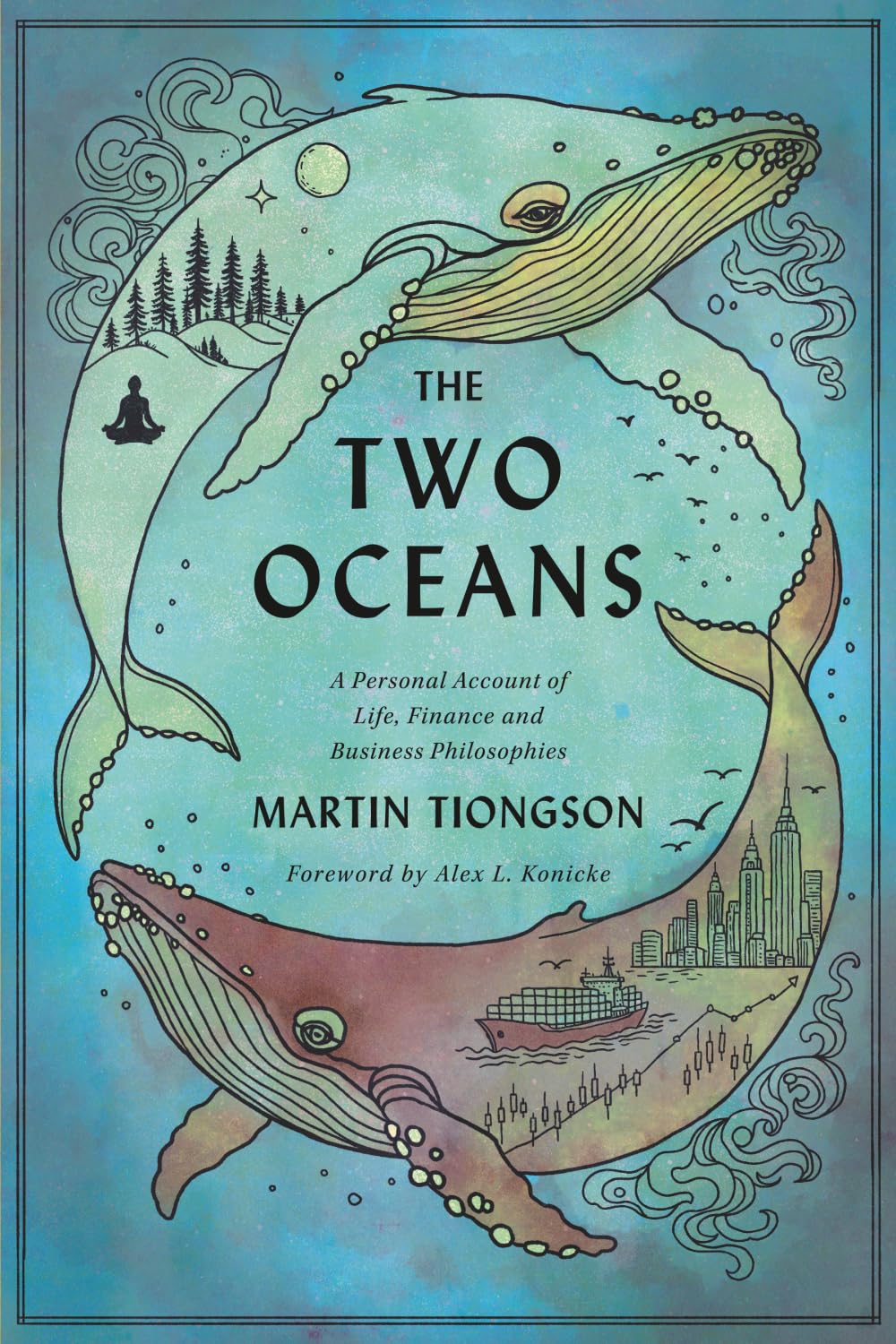

Martin Tiongson’s The Two Oceans: A Personal Account of Life, Finance and Business Philosophies is a hybrid of memoir, personal essay, financial reflection, and philosophical inquiry. Organized into five parts, “The Present,” “Finance,” “The Person,” “Business,” and “The World,” the book moves between outward experience and inward interpretation. That structure reflects the image introduced in the prologue, where two whales come to represent “the inside and the outside, consciousness and the unconscious, push and pull, yin and yang, and temperance.” Tiongson draws material from an unusually broad range of experiences: fostering an elderly cat, enduring a disastrous trip to Florida, whale watching in Mexico, navigating investments and taxes, pursuing business opportunities, facing rejection in a job search, dealing with insurance, volunteering, and observing the changing seasons of the Pacific Northwest. These episodes function as more than recollections. Each becomes a point of departure for considering how a person might approach uncertainty, money, work, relationships, adversity, and time.
The book’s defining quality is Tiongson’s habit of connecting ordinary experience to larger systems of thought. Zen Buddhism, Stoicism, Taoism, Jungian psychology, existentialism, and other traditions recur throughout the essays, giving the collection a consistent intellectual framework despite its varied subject matter. A cup of tea becomes an exercise in presence, a difficult vacation becomes a lesson in distinguishing what can and can’t be controlled, and a failed business acquisition becomes an examination of detachment, negotiation, and judgment. The chapter on gray whales offers one of the clearest expressions of the book’s central metaphor. Reflecting on the barnacles carried by the animals, Tiongson writes, “The whales are outside our windows, but there exists a sea within us, with all that it contains.” That sentence captures the book’s method particularly well. The external world supplies its stories, while the internal world gives those stories their significance. Tiongson’s descriptive passages about animals, landscapes, weather, cities, and changing seasons also give the philosophical material a physical setting, allowing abstract ideas to remain tied to lived experience.
The finance and business sections add another dimension by making the book practical as well as contemplative. Tiongson discusses savings accounts, certificates of deposit, Treasuries, index funds, risk levels, private investments, bookkeeping, budgeting, fraud prevention, grants, and business acquisition with the perspective of someone describing his own working methods. His recurring concern is disciplined stewardship of finite resources, particularly money and time. The chapters on entrepreneurship are similarly grounded in experience, including negotiations over the “Sugar and Salt” business, the mechanics of pursuing government grants, and lessons carried forward from years in small business. One of the book’s most concise statements, “Resourcefulness can, in fact, be our greatest resource,” develops into a discussion of preparation, adaptability, self-investment, and purposeful effort. This combination of concrete procedure and reflective interpretation gives the book much of its character. Financial planning, business decisions, emotional regulation, and philosophical inquiry are treated as related practices that depend on patience, attention, and the ability to respond thoughtfully to changing circumstances.
The Two Oceans is a record of a person attempting to make coherent meaning from experience while remaining attentive to the practical demands of everyday life. Its episodic form suits that purpose because the book develops through accumulation: cats, whales, birds, businesses, bank accounts, friendships, disappointments, journeys, storms, and routines gradually become parts of the same meditation on impermanence and balance. Tiongson explains in the afterword that the project grew from twenty-five stories written over twenty-five weeks, drawing on journaling, recent experiences, financial knowledge, and his study of philosophy. He later discovered connections among subjects that had initially seemed unrelated, particularly the ways different philosophical traditions addressed questions such as human suffering. That history is visible in the finished work. The Two Oceans reads as a personal philosophy assembled from observation and practice. Its strongest passages invite readers to notice how much meaning can reside in experiences that might otherwise pass without examination, and its enduring subject is the continuing effort to balance the world around us with the world within.
Page: 231 | ASIN : B0GY49CPBZ


Posted on September 2, 2026, in Book Reviews, Four Stars and tagged author, book, book recommendations, book review, book reviews, book shelf, bookblogger, books, books to read, business, ebook, entrepreneuriship, goodreads, indie author, kindle, kobo, literature, Martin Tiongson, money, nonfiction, nook, novel, personal finance, read, reader, reading, small business, story, The Two Oceans, writer, writing. Bookmark the permalink. Leave a comment.



Leave a comment
Comments 0