Blog Archives
Knowledge, Experience, Intuition

In The Two Oceans, you combine your memoir, philosophy, finance, and business knowledge to explore balance, resilience, money, work, relationships, and how to find meaning in everyday experience. How did the metaphor of the two oceans, the inner world and the external world, develop?
The metaphor developed from needing a book title that could encapsulate its wide breadth of contents. At one point, the book’s title was going to be Whales Outside Our Windows, the name of one of its chapters. However, it seemed to me that title puts the focus on the external world.
I arrived at the conclusion that what we can control – the aspects within ourselves – and what we cannot control – the factors outside of us – were equal halves in my manuscript. Consequently, both are important to recognize, understand, and navigate. From there, I made the connection to what would be the book’s eventual title and central metaphor.
The Two Oceans concept then guided the shape and structure of my book project, including the inspirations I pulled from. I hope that this collection of essays and short stories translates as a cohesive body of work to its readers.
Zen Buddhism, Stoicism, Taoism, Jungian psychology, and existentialism all appear throughout the book. Why was it important to connect philosophy to ordinary experiences rather than discuss it primarily in abstract terms?
This book started as a project with the intention to document some of my experiences in entrepreneurship, personal finance, and human society. At the same time, I sought to reflect on my emotions, thoughts, and ideas at this stage of life. Journaling allowed me to do both, while the study of various philosophical traditions helped me metabolize all these real-life events.
I didn’t set out to write a book about different philosophies; it just became its logical, natural, and organic progression. As I was writing, I continued this exploration, inspiration, and research into them.
I feel like making these stories grounded in present times and rooted in practical applications contextualizes these ancient and historic philosophies, making them more specific, relatable, and accessible in the process.
All of us begin to search for answers, meaning, or coherence at some point in our lives. I looked towards the named philosophies for my own edification. My intention with this book was to write it in a conversational or storytelling manner, like an old friend sitting across from you sharing a hot cup of tea.
You write about money and time as finite resources. How has that perspective influenced your own decision-making?
The perspective that everything in life is temporary or ephemeral has hopefully taught me to live in the present in moderation and with greater appreciation. Thus, I try to make decisions with greater awareness and intention.
Progress is not a straight line, and I am nowhere near being enlightened. Sometimes, I still catch myself falling back on old habits, making the same mistakes, repeating bad patterns, or experiencing dark gray skies. I continuously remind myself of these teachings through the importance of having ritual, routine, and rhythm.
Each of our decisions has consequences, both on ourselves and the people around us. Since there is no catch-all solution to every decision, the best we can do is make sound judgments informed by knowledge, experience, intuition, or a combination of these. It is about being purposeful and balancing perspectives, so we have a life without regret and a future with plenty of consideration.
What practices from the book can readers begin applying to their own lives without needing extensive knowledge of philosophy or finance?
First, cultivate personal virtues in our everyday lives, which are within our power — wisdom, courage, justice, temperance, resourcefulness, resilience, etc.
Take the opportunity to be a better version of yourself. It will pay great dividends.
Second, start simple and small, learn from your mistakes, and course-correct when necessary. Ask others, find resources, gain experience. The best time is now, and every journey starts with a single step.
Take the risk by putting yourself out of your comfort zone once in a while. If you are in a rut, try new or different things.
Third, individuation through introspection. Don’t be a stranger to your own self. Find out what works and doesn’t work for you. Stick to a plan that works, knowing that emotions and setbacks, though not optional, are momentary and impermanent.
Take the time to sit with yourself, look inside, and identify what would truly give you purpose or personal fulfillment, knowing that it is not the same for everyone, and everyone has their own journey to take.
Author Links: GoodReads | Website | Amazon
In The Two Oceans, the author draws on his lived experience to recount tales of empathy, kindness, suffering, resourcefulness, contentment, and happiness, reflecting on them through the lens of philosophical principles. These tenets are intended to guide us toward integrating the two halves of ourselves — the conscious Self and the unconscious Shadow.
This collection of twenty-five short stories explores philosophies such as Zen, Stoicism, and Jungian psychology, and proffers practical applications of their central concepts such as detachment, impermanence, resilience, virtue, response, individuation, and introspection. These simple lessons can be useful tools in both vast, equally turbulent oceans, helping us cross unfathomable depths as we sail through life’s treacherous waters, and guiding us safely back to shore.
The Two Oceans: A Personal Account of Life, Finance and Business Philosophies
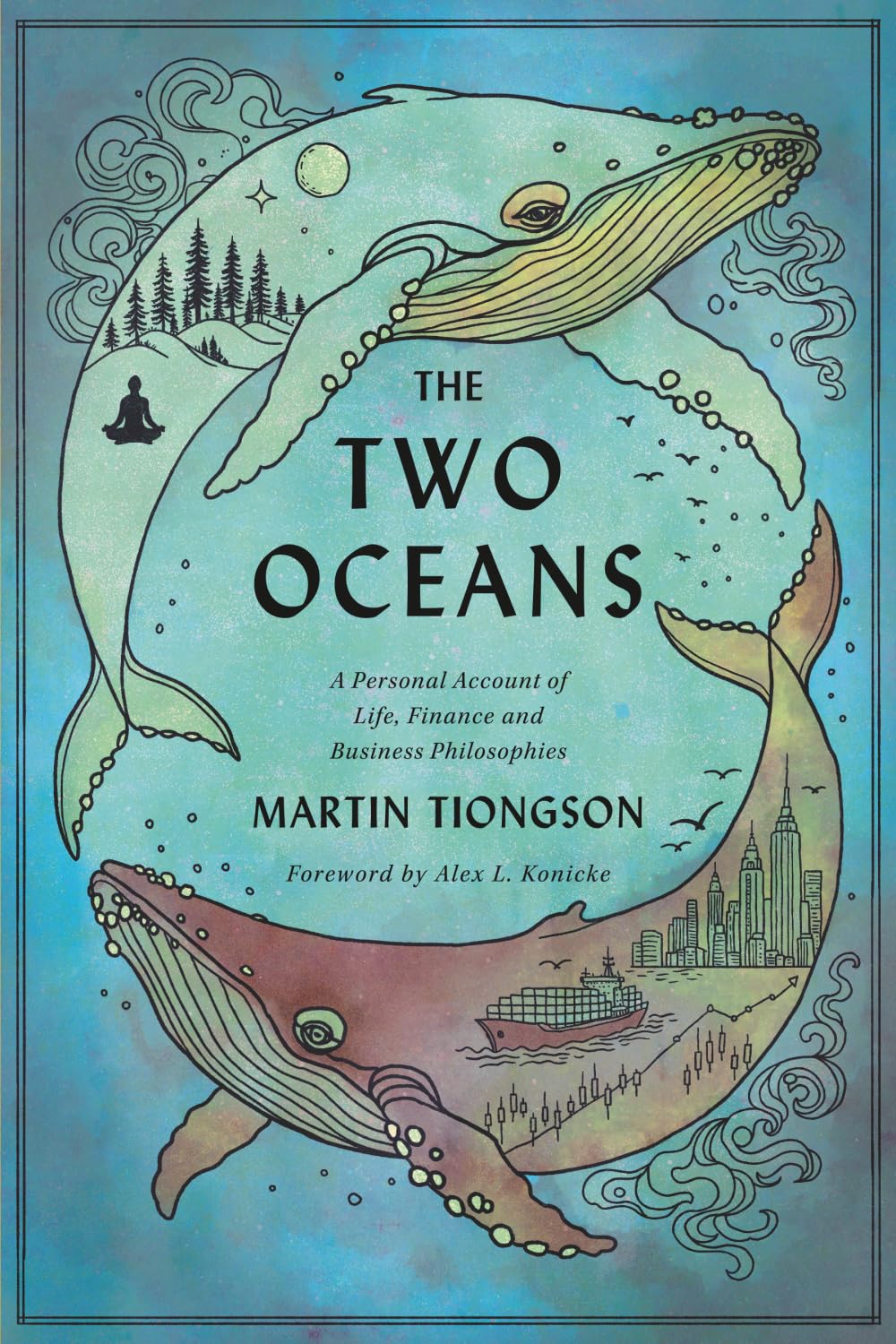

Martin Tiongson’s The Two Oceans: A Personal Account of Life, Finance and Business Philosophies is a hybrid of memoir, personal essay, financial reflection, and philosophical inquiry. Organized into five parts, “The Present,” “Finance,” “The Person,” “Business,” and “The World,” the book moves between outward experience and inward interpretation. That structure reflects the image introduced in the prologue, where two whales come to represent “the inside and the outside, consciousness and the unconscious, push and pull, yin and yang, and temperance.” Tiongson draws material from an unusually broad range of experiences: fostering an elderly cat, enduring a disastrous trip to Florida, whale watching in Mexico, navigating investments and taxes, pursuing business opportunities, facing rejection in a job search, dealing with insurance, volunteering, and observing the changing seasons of the Pacific Northwest. These episodes function as more than recollections. Each becomes a point of departure for considering how a person might approach uncertainty, money, work, relationships, adversity, and time.
The book’s defining quality is Tiongson’s habit of connecting ordinary experience to larger systems of thought. Zen Buddhism, Stoicism, Taoism, Jungian psychology, existentialism, and other traditions recur throughout the essays, giving the collection a consistent intellectual framework despite its varied subject matter. A cup of tea becomes an exercise in presence, a difficult vacation becomes a lesson in distinguishing what can and can’t be controlled, and a failed business acquisition becomes an examination of detachment, negotiation, and judgment. The chapter on gray whales offers one of the clearest expressions of the book’s central metaphor. Reflecting on the barnacles carried by the animals, Tiongson writes, “The whales are outside our windows, but there exists a sea within us, with all that it contains.” That sentence captures the book’s method particularly well. The external world supplies its stories, while the internal world gives those stories their significance. Tiongson’s descriptive passages about animals, landscapes, weather, cities, and changing seasons also give the philosophical material a physical setting, allowing abstract ideas to remain tied to lived experience.
The finance and business sections add another dimension by making the book practical as well as contemplative. Tiongson discusses savings accounts, certificates of deposit, Treasuries, index funds, risk levels, private investments, bookkeeping, budgeting, fraud prevention, grants, and business acquisition with the perspective of someone describing his own working methods. His recurring concern is disciplined stewardship of finite resources, particularly money and time. The chapters on entrepreneurship are similarly grounded in experience, including negotiations over the “Sugar and Salt” business, the mechanics of pursuing government grants, and lessons carried forward from years in small business. One of the book’s most concise statements, “Resourcefulness can, in fact, be our greatest resource,” develops into a discussion of preparation, adaptability, self-investment, and purposeful effort. This combination of concrete procedure and reflective interpretation gives the book much of its character. Financial planning, business decisions, emotional regulation, and philosophical inquiry are treated as related practices that depend on patience, attention, and the ability to respond thoughtfully to changing circumstances.
The Two Oceans is a record of a person attempting to make coherent meaning from experience while remaining attentive to the practical demands of everyday life. Its episodic form suits that purpose because the book develops through accumulation: cats, whales, birds, businesses, bank accounts, friendships, disappointments, journeys, storms, and routines gradually become parts of the same meditation on impermanence and balance. Tiongson explains in the afterword that the project grew from twenty-five stories written over twenty-five weeks, drawing on journaling, recent experiences, financial knowledge, and his study of philosophy. He later discovered connections among subjects that had initially seemed unrelated, particularly the ways different philosophical traditions addressed questions such as human suffering. That history is visible in the finished work. The Two Oceans reads as a personal philosophy assembled from observation and practice. Its strongest passages invite readers to notice how much meaning can reside in experiences that might otherwise pass without examination, and its enduring subject is the continuing effort to balance the world around us with the world within.
Page: 231 | ASIN : B0GY49CPBZ

HIDDEN PROFIT How to Find and Capture $500K–$2M+ in Hidden EBITDA Without Gutting Your Business


In Hidden Profit, David H. Tolly argues that many mid-market businesses already contain substantial recoverable value, not in some glamorous new market or sweeping transformation, but in the quieter places leaders often stop seeing: pricing leakage, procurement waste, working capital, customer mix, overhead discipline, and execution cadence. The book moves from EBITDA fundamentals into a practical diagnostic framework, then through seven “hidden profit” levers and a 90-day execution model, grounding its advice in turnaround cases such as Creative Solutions Group, Renaissance Cosmetics, and Savage Arms. What gives the book its force is its repeated insistence that profit is not found by gutting the business, but by making the economics visible enough that leaders can act with precision.
I found the book most compelling when it stripped away the romance of growth and asked harder, more adult questions about the quality of that growth. Tolly’s point that revenue can rise while margin quietly deteriorates feels simple at first, almost obvious, but the examples make it land with real weight. The $50 million manufacturing company that had rising EBITDA but declining margin becomes a small drama of managerial blindness, and the Renaissance Cosmetics case is even sharper: a company chasing shipments so aggressively that it created its own flood of returns. I admired the moral clarity of that lesson. Less revenue at a real margin is better than more revenue at a loss. It’s the kind of sentence that feels plain until you imagine saying it in a boardroom full of people addicted to top-line growth.
The writing is at its best when Tolly sounds like someone who has actually sat in the room when the lender called, and the spreadsheet stopped being theoretical. There’s a bracing directness to the voice, and the book’s recurring phrases, such as “build the bridge” and “assign the owners,” give the material a useful drumbeat. The prose can become procedural, especially in the checklists and worksheet sections. But I didn’t mind that much. The book doesn’t merely describe rigor; it practices it. Its ideas are not especially mystical, but they’re powerful because they honor the unglamorous truth that businesses usually fail in the seams between functions, not in the slogans on strategy decks.
I came away seeing Hidden Profit as a practical, unsentimental, and quietly humane book about restoring agency to leaders under pressure. It understands that numbers are never just numbers when payroll, debt, legacy, and reputation are attached to them. The strongest conclusion I drew is that hidden profit is less a treasure hunt than an act of disciplined attention. I’d recommend this book to CEOs, CFOs, board members, private equity operators, and business owners who suspect their company is working harder than its cash position suggests, especially those preparing for a sale or trying to strengthen EBITDA without damaging the living organism of the business.
Pages: 315 | ASIN : B0GX2QBG9X
Turn Words Into Wealth: 7 Ways to Make 7 Figures as a Thought Leader

Turn Words Into Wealth is a playbook for experts who want to turn their ideas into a seven-figure thought-leadership business in the age of AI. Author Aurora Winter blends her own stories from yacht sales, film, and grief coaching with frameworks on messaging, branding, book writing, media, and AI tools. She walks through how to craft a “Million-Dollar Message,” build a luxury-level personal brand, design a media ecosystem of books, podcasts, and video, and then plug that into seven different revenue paths, from high-ticket consulting to speaking and licensing. The later chapters shift into mindset, coaching, and purpose, so the book ends less like a tech manual and more like a call to build a legacy.
The writing is clear, upbeat, and often quite personal. The scene where she and her husband are broke in a tiny office, then stumble into the “Five weeks of sun, fun and tax shelter” line, has real energy and makes her main point about messaging land in a very concrete way. Her grief story and the birth of the Grief Coach Academy also give the book emotional weight, so it does not feel like a cold business manual. I liked the way each chapter ends with questions and simple actions, since that nudged me to pause, think, and scribble in the margins instead of just skimming.
The ideas themselves line up with what I see happening in the market right now, and that made the book feel current. Her split between “luxury” and “commodity” work, and the push to build even a small amount of “star power,” is a helpful way to think about expertise in a noisy world. I also liked her framing of AI as an amplifier, not a ghostwriter, and her insistence that your stories, your judgment, and your presence are the real assets. The sections on the Hell-to-Heaven transformation, myth-busting, and the simple hero’s-journey template give very usable tools for anyone who needs to talk or write about their work. The steady stream of big success stories gives the book a really upbeat and aspirational feel, with a strong focus on seven-figure outcomes, deal flow, and media empires that will really appeal to readers who are excited by bold positioning and high-ticket offers.
I would recommend Turn Words Into Wealth to coaches, consultants, founders, and senior professionals who already have solid expertise and now want to package it, write a serious book, and use AI and media more strategically. If you enjoy case studies, checklists, and clear “do this next” prompts, you will probably have fun with it and get a lot of ideas to test. It’s a motivating and practical guide that can easily spark a fresh plan and maybe a new business chapter for you.
Pages: 246 | ASIN : B0GKCJPHXN
I Was Tired of Starting Over

Side Hustle & Flow: The Daily Grind – 365 Days to Shine is a yearlong guide of short, daily reflections designed to help creatives, entrepreneurs, and side-hustlers build momentum without burnout. Was there a moment in your life when consistency finally “clicked” for you?
Yes. It was not some glamorous breakthrough. It was when I was tired of starting over. I had talent. I had ideas. I had big goals. But I kept relying on motivation. The real shift happened during my health journey when I reversed Type 2 diabetes and lost 50 pounds. I realized it was not about intensity. It was about daily reps. Same with sobriety. Same with building my music catalog. Same with scaling operations at Beautytap. Once I saw that small, boring, repeatable actions compound into freedom, consistency stopped feeling restrictive and started feeling empowering. That is when it clicked.
Your background spans music, business, and operations. How did those worlds shape this book?
Music taught me rhythm and discipline. You do not get better on stage. You get better in rehearsal. Business taught me structure. Systems beat willpower every time. Operations taught me leverage. If something is not documented and repeatable, it does not scale.
This book sits at the intersection of all three. It is creative but structured. It is motivational but practical. I am an artist who also thinks like an operator. So The Daily Grind is not just inspiration. It is about building frameworks that help creatives, entrepreneurs, and professionals win long term. Whether I am producing a record, hosting Deeper Grooves, or managing digital operations, the principle is the same. Show up. Execute. Improve.
What does “showing up” actually look like on days when motivation is gone?
It looks smaller than you think. It might mean writing one paragraph instead of ten pages. It might mean walking instead of crushing a two-hour workout. It might mean sending one email instead of building the whole funnel.
Showing up is protecting the streak. It is voting for the identity you want. On bad days, I lower the bar, but I do not remove it. I focus on one non-negotiable action that moves the needle forward. Momentum is easier to maintain than to restart. Most people quit because they think showing up has to be dramatic. It does not. It just has to be consistent.
How do you recommend readers use this book—morning ritual, night reflection, or something else?
I designed it to be flexible but powerful. Morning is ideal because it sets intention. It helps you frame the day before the world gets loud. But night reflection works too. It can help you audit how you showed up.
Personally, I like pairing it with a short daily planning session. Read the reflection. Identify one action for the day. Then execute. Every 30 day,s there is a deeper challenge, which I see as a reset point. It is not about perfection. It is about rhythm.
The goal is not to finish the book. The goal is to build a life where you do not need motivation to move forward.
Author Links: GoodReads | X | Facebook | Website
Side Hustle & Flow: The Daily Grind – 365 Days to Shine is your year-long guide to consistency, clarity, and momentum. Designed for creatives, entrepreneurs, side-hustlers, and anyone chasing a better version of themselves, this book delivers 365 short, powerful daily reflections to help you stay focused, motivated, and moving forward—even on the hard days.
Written by entrepreneur, musician, author, and VP of Digital & Operations Cliff Beach, The Daily Grind blends real-world experience with practical wisdom. Each day offers a concise lesson, mindset shift, or action prompt you can apply immediately—no fluff, no overwhelm.
This isn’t about hustle culture burnout. It’s about intentional progress, sustainable habits, and showing up for your goals one day at a time.
Inside, you’ll discover:
Daily motivation you can read in under two minutes
Practical insights on discipline, confidence, health, creativity, and money
Honest reflections on doubt, failure, growth, and resilience
Monthly reflection checkpoints to recalibrate your direction
A steady reminder that consistency beats intensity—every time
Whether you’re building a side hustle, leveling up your career, improving your health, or simply trying to stay inspired in a noisy world, this book meets you where you are—and helps you keep going.
You don’t need a perfect plan.
You don’t need permission.
You just need to show up today.
One day. One page. One step closer to shining.
Side Hustle & Flow: The Daily Grind

Side Hustle & Flow lays out a year’s worth of short daily reflections that nudge you toward steady progress and personal growth. Each entry gives a simple idea that builds on the last, and the rhythm of the book feels like a long conversation about staying focused and grounded while pursuing your goals. It’s a mix of encouragement, tough love, and practical reminders, all wrapped in a calendar format that makes the journey feel structured and personal.
As I made my way through the book, I found myself settling into its cadence. Some days really resonated with me and felt personally applicable, especially the ones that lean into patience or the messy nature of growth. The writing is direct without feeling harsh. It tries to lighten the load even when it reminds you that the grind is yours to carry. I caught myself nodding along more than once, which surprised me because the daily-motivation can feel repetitive. Here, though, the repetition works and gives the book a steady heartbeat.
I also enjoyed how the ideas stay simple. There’s no preachy tone, no ten-step systems, no complicated theories. Just daily nudges that feel doable, even on the days when your energy is low. Sometimes I wanted the book to go deeper into storytelling or personal examples. Still, the minimal style kept the focus on me and my own thoughts, which made the experience feel intimate. The book felt like a daily life coach.
Day 141 struck me on a personal level because it put the responsibility back in my hands in a way that felt both grounding and energizing, “If you wanttoseechange,bethechange.” I caught myself thinking about how often I wait for things around me to shift, when in truth I could take the first step and set the tone. Day 225 hit even deeper. The reflection, “Reflection: What’s one thing you can control today that will help you make progress?” helped me, and reminded me that day, to focus on what I can control. Together, they made me feel lighter and more capable, almost as if the path forward cleared just by choosing to act on what is already mine to manage.
I would recommend this book to anyone who wants a gentle push to stay consistent with a personal or professional goal. It works especially well for people who feel overwhelmed by huge ambitions and need smaller, steady reminders to keep going. If you like daily journals, habit trackers, or motivational quotes, this would fit right into your routine. It’s a book you can read easily read at the start of every day to get you ready and motivated to tackle the world.
Pages: 385 | ASIN : B0GDW12379

Messy and Imperfect is Still Meaningful

In Rainbow Gold, you share your losses, lessons learned, and the long-term effects of making meaningful choices as you transitioned from struggling restaurant owner to building a thriving aviation insurance group. Why was this an important book for you to write?
Rainbow Gold was important for me to write because it captures the philosophy that has shaped every stage of my life, that you can build something valuable and meaningful at the same time. During my early struggles owning a restaurant and retail business in South Africa, I made many missteps and got some hard lessons in business and leadership, and success seemed elusive and distant. Over time, I realized the real reward isn’t at the end of the road; it’s woven into the journey; the relationships, resilience, impact, and identity you build along the way.
When my teams surprised me one holiday season with deeply personal notes about why they loved working at our company, it crystallized what I now call Rainbow Gold: the belief that fulfillment doesn’t need to be deferred. You can build it into your business and your life right now.
I wrote this book to show entrepreneurs and leaders that the process of building something, or learning how to build something, even in its messy, imperfect stages, can be just as meaningful as the outcome.
I appreciated the candid nature with which you told your story. What was the hardest thing for you to write about?
The hardest parts to write were the chapters where I had to revisit failures, missteps, and emotionally heavy moments, both from my early ventures in South Africa and later, from navigating sensitive family partnership dynamics in our current business. Those years were formative, but they also involved painful mistakes and setbacks that I hadn’t revisited in a long time.
As a leader who values responsibility and clarity, admitting where I fell short required vulnerability. But leaving those moments out would have made the lessons less authentic. Readers don’t benefit from a polished highlight reel; they benefit from the full picture, including the chapters where the stakes were high and things didn’t go right.
Those candid moments ended up being some of the most resonant for readers, which affirmed why they needed to be in the book.
Did you learn anything about yourself as you wrote this book?
Absolutely. Writing Rainbow Gold reaffirmed that resilience is built in the small, daily choices you make when no one is watching, those “butterfly effect” moments, not in dramatic turning points. As I revisited years of experiences, I saw that it wasn’t one brilliant strategy or one lucky break that moved me forward; it was consistency, perseverance, and staying anchored to my values even in uncertainty.
I also learned that people, my teams, clients, mentors, and family, have always been my true driving force. I learned from my father and I’ve said for years that relationships matter more than anything in business, but writing the book helped me understand how deeply this principle has shaped my identity and my approach to leadership.
What is one thing you hope readers take away from Rainbow Gold?
If readers take only one idea away, I hope it’s this: You don’t have to choose between building a successful business and building a meaningful life.
When you invest in people, relationships, and values-driven decisions, financial success will follow organically and it will be financial success that is sustainable and legacy building.
Rainbow Gold is about rejecting the idea that fulfillment comes only at the end of the journey. Instead, it shows that the “pot of gold” is much broader than profit alone. Making money and being financially successful is certainly an important part of it, but equally important is the legacy you create, the people you grow, the impact you make, and the pride you can take in the work you do every day. When you get your business to the point where you can both fill your wallet and fill your soul, you’ve struck Rainbow Gold!
If this book encourages someone to build a business with purpose instead of pressure, with sustainability instead of scale, and to enjoy the journey instead of waiting for one perfect moment, then it will have been a success from my perspective.
Author Website
“David Hampson has written the antidote to startup culture’s obsession with quick exits and venture capital. Rainbow Gold presents a compelling case for building businesses that become life’s work-sustainable, profitable enterprises that provide both financial rewards and deep personal fulfillment. Through his journey from restaurant owner in South Africa to aviation insurance entrepreneur, Hampson demonstrates that the real treasure isn’t reaching the end of the rainbow, but enjoying every step of the journey while building something lasting for your family and community.”-J.J. Hebert, Founder & CEO, MindStir Media; USA Today, WSJ, and #1 Amazon Bestselling Author
In Rainbow Gold, David Hampsonshares his journey from a college student immersed in science courses—with no formal business education—to becoming a successful acquisition entrepreneur and recognized industry thought leader. This book is for aspiring and seasoned entrepreneurs alike, offering a candid look at the challenges, triumphs, and transformative lessons of finding and building a business that is not just a stepping stone but the ultimate destination. Central to the narrative is the “butterfly effect”; the idea that small, decisive actions can create monumental shifts in your life and business. Through David’s story, readers will learn how embracing opportunities and acting decisively can lead to extraordinary outcomes, often in unexpected ways. Rainbow Gold shows what the real “end game” looks like: not an exit strategy, but a deeply fulfilling business that doesn’t need to be sold because its value goes far beyond dollars. It’s about creating a business that represents the pot of gold at the end of your rainbow, one that provides both tangible and intangible rewards. And once obtained, rainbow gold doesn’t trade in fiat currency! With humor, honesty, and practical advice, Rainbow Gold inspires readers to see entrepreneurship not just as a career path, but as a calling that can transform their lives and the lives of those around them.
Rainbow Gold: Building a Business That’s Both the Journey and the Destination
Rainbow Gold tells the story of an entrepreneur who learns, often the hard way, that business is really about people and purpose. The book follows David Hampson from his early struggles owning a restaurant in Cape Town to building a flourishing aviation insurance group in New England. The narrative blends personal loss, gritty lessons, and the slow shaping of a philosophy centered on long-term thinking, responsibility, and the butterfly effect of small but meaningful choices. It reads like a roadmap for building a business that gives back and grows people rather than one designed for quick exits and flashy valuations.
As I read, I found myself pulled into the raw honesty of Hampson’s voice. He doesn’t puff out his chest or pretend every move was a stroke of genius. He shares the messy parts. The moments he panicked. The moments he learned the hard way that trusting the wrong person can empty your stockroom or sink your cash flow. The chapters about the tragic accident involving his restaurant staff hit me hard. I could feel the weight he carried as he tried to care for his team while holding a broken business together. Those scenes made me pause more than once. They also made me appreciate how sincerely he views business as a human endeavor, not a numbers game. His focus on relationships, service, and showing up for people comes through clearly.
I also found myself energized by the parts where he reflects on decisive choices. His take on the fear that keeps people frozen felt familiar to me. The book urges readers to pick a road and walk it with conviction, even if it bends or darkens. That theme threads through his years in South Africa and later through his aviation career. I enjoyed how he mixes practical stories like fighting with VAT filings or chasing down a credit card machine with larger ideas about passion, equity, mentorship, and building a legacy. The writing feels close and direct, like sitting across from someone who has lived a lot and is finally ready to tell you the truth about what it cost. I appreciated that.
I walked away feeling inspired. Hampson writes with humility, and that makes the book accessible even when the subject matter gets heavy. I would recommend Rainbow Gold to new entrepreneurs who feel overwhelmed, small business owners who want to build something that lasts, and anyone who is tired of the startup world’s obsession with speed and exits. The book speaks to people who want a business with a heart. It’s a good read for those who want to build something slow, steady, and worthwhile.
Pages: 317 | ASIN : B0FWSZTMHP


