Blog Archives
Knowledge, Experience, Intuition

In The Two Oceans, you combine your memoir, philosophy, finance, and business knowledge to explore balance, resilience, money, work, relationships, and how to find meaning in everyday experience. How did the metaphor of the two oceans, the inner world and the external world, develop?
The metaphor developed from needing a book title that could encapsulate its wide breadth of contents. At one point, the book’s title was going to be Whales Outside Our Windows, the name of one of its chapters. However, it seemed to me that title puts the focus on the external world.
I arrived at the conclusion that what we can control – the aspects within ourselves – and what we cannot control – the factors outside of us – were equal halves in my manuscript. Consequently, both are important to recognize, understand, and navigate. From there, I made the connection to what would be the book’s eventual title and central metaphor.
The Two Oceans concept then guided the shape and structure of my book project, including the inspirations I pulled from. I hope that this collection of essays and short stories translates as a cohesive body of work to its readers.
Zen Buddhism, Stoicism, Taoism, Jungian psychology, and existentialism all appear throughout the book. Why was it important to connect philosophy to ordinary experiences rather than discuss it primarily in abstract terms?
This book started as a project with the intention to document some of my experiences in entrepreneurship, personal finance, and human society. At the same time, I sought to reflect on my emotions, thoughts, and ideas at this stage of life. Journaling allowed me to do both, while the study of various philosophical traditions helped me metabolize all these real-life events.
I didn’t set out to write a book about different philosophies; it just became its logical, natural, and organic progression. As I was writing, I continued this exploration, inspiration, and research into them.
I feel like making these stories grounded in present times and rooted in practical applications contextualizes these ancient and historic philosophies, making them more specific, relatable, and accessible in the process.
All of us begin to search for answers, meaning, or coherence at some point in our lives. I looked towards the named philosophies for my own edification. My intention with this book was to write it in a conversational or storytelling manner, like an old friend sitting across from you sharing a hot cup of tea.
You write about money and time as finite resources. How has that perspective influenced your own decision-making?
The perspective that everything in life is temporary or ephemeral has hopefully taught me to live in the present in moderation and with greater appreciation. Thus, I try to make decisions with greater awareness and intention.
Progress is not a straight line, and I am nowhere near being enlightened. Sometimes, I still catch myself falling back on old habits, making the same mistakes, repeating bad patterns, or experiencing dark gray skies. I continuously remind myself of these teachings through the importance of having ritual, routine, and rhythm.
Each of our decisions has consequences, both on ourselves and the people around us. Since there is no catch-all solution to every decision, the best we can do is make sound judgments informed by knowledge, experience, intuition, or a combination of these. It is about being purposeful and balancing perspectives, so we have a life without regret and a future with plenty of consideration.
What practices from the book can readers begin applying to their own lives without needing extensive knowledge of philosophy or finance?
First, cultivate personal virtues in our everyday lives, which are within our power — wisdom, courage, justice, temperance, resourcefulness, resilience, etc.
Take the opportunity to be a better version of yourself. It will pay great dividends.
Second, start simple and small, learn from your mistakes, and course-correct when necessary. Ask others, find resources, gain experience. The best time is now, and every journey starts with a single step.
Take the risk by putting yourself out of your comfort zone once in a while. If you are in a rut, try new or different things.
Third, individuation through introspection. Don’t be a stranger to your own self. Find out what works and doesn’t work for you. Stick to a plan that works, knowing that emotions and setbacks, though not optional, are momentary and impermanent.
Take the time to sit with yourself, look inside, and identify what would truly give you purpose or personal fulfillment, knowing that it is not the same for everyone, and everyone has their own journey to take.
Author Links: GoodReads | Website | Amazon
In The Two Oceans, the author draws on his lived experience to recount tales of empathy, kindness, suffering, resourcefulness, contentment, and happiness, reflecting on them through the lens of philosophical principles. These tenets are intended to guide us toward integrating the two halves of ourselves — the conscious Self and the unconscious Shadow.
This collection of twenty-five short stories explores philosophies such as Zen, Stoicism, and Jungian psychology, and proffers practical applications of their central concepts such as detachment, impermanence, resilience, virtue, response, individuation, and introspection. These simple lessons can be useful tools in both vast, equally turbulent oceans, helping us cross unfathomable depths as we sail through life’s treacherous waters, and guiding us safely back to shore.
The Two Oceans: A Personal Account of Life, Finance and Business Philosophies
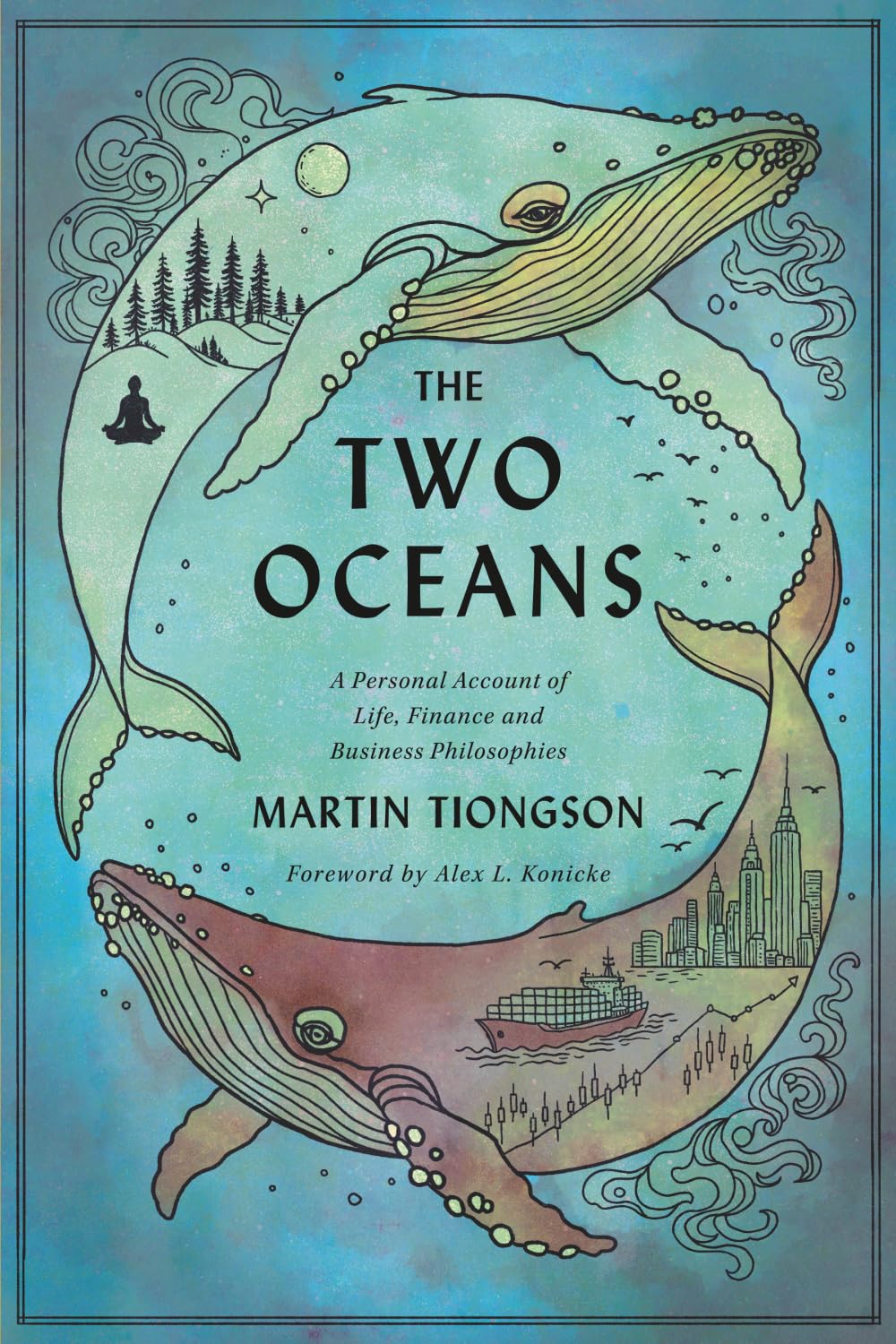

Martin Tiongson’s The Two Oceans: A Personal Account of Life, Finance and Business Philosophies is a hybrid of memoir, personal essay, financial reflection, and philosophical inquiry. Organized into five parts, “The Present,” “Finance,” “The Person,” “Business,” and “The World,” the book moves between outward experience and inward interpretation. That structure reflects the image introduced in the prologue, where two whales come to represent “the inside and the outside, consciousness and the unconscious, push and pull, yin and yang, and temperance.” Tiongson draws material from an unusually broad range of experiences: fostering an elderly cat, enduring a disastrous trip to Florida, whale watching in Mexico, navigating investments and taxes, pursuing business opportunities, facing rejection in a job search, dealing with insurance, volunteering, and observing the changing seasons of the Pacific Northwest. These episodes function as more than recollections. Each becomes a point of departure for considering how a person might approach uncertainty, money, work, relationships, adversity, and time.
The book’s defining quality is Tiongson’s habit of connecting ordinary experience to larger systems of thought. Zen Buddhism, Stoicism, Taoism, Jungian psychology, existentialism, and other traditions recur throughout the essays, giving the collection a consistent intellectual framework despite its varied subject matter. A cup of tea becomes an exercise in presence, a difficult vacation becomes a lesson in distinguishing what can and can’t be controlled, and a failed business acquisition becomes an examination of detachment, negotiation, and judgment. The chapter on gray whales offers one of the clearest expressions of the book’s central metaphor. Reflecting on the barnacles carried by the animals, Tiongson writes, “The whales are outside our windows, but there exists a sea within us, with all that it contains.” That sentence captures the book’s method particularly well. The external world supplies its stories, while the internal world gives those stories their significance. Tiongson’s descriptive passages about animals, landscapes, weather, cities, and changing seasons also give the philosophical material a physical setting, allowing abstract ideas to remain tied to lived experience.
The finance and business sections add another dimension by making the book practical as well as contemplative. Tiongson discusses savings accounts, certificates of deposit, Treasuries, index funds, risk levels, private investments, bookkeeping, budgeting, fraud prevention, grants, and business acquisition with the perspective of someone describing his own working methods. His recurring concern is disciplined stewardship of finite resources, particularly money and time. The chapters on entrepreneurship are similarly grounded in experience, including negotiations over the “Sugar and Salt” business, the mechanics of pursuing government grants, and lessons carried forward from years in small business. One of the book’s most concise statements, “Resourcefulness can, in fact, be our greatest resource,” develops into a discussion of preparation, adaptability, self-investment, and purposeful effort. This combination of concrete procedure and reflective interpretation gives the book much of its character. Financial planning, business decisions, emotional regulation, and philosophical inquiry are treated as related practices that depend on patience, attention, and the ability to respond thoughtfully to changing circumstances.
The Two Oceans is a record of a person attempting to make coherent meaning from experience while remaining attentive to the practical demands of everyday life. Its episodic form suits that purpose because the book develops through accumulation: cats, whales, birds, businesses, bank accounts, friendships, disappointments, journeys, storms, and routines gradually become parts of the same meditation on impermanence and balance. Tiongson explains in the afterword that the project grew from twenty-five stories written over twenty-five weeks, drawing on journaling, recent experiences, financial knowledge, and his study of philosophy. He later discovered connections among subjects that had initially seemed unrelated, particularly the ways different philosophical traditions addressed questions such as human suffering. That history is visible in the finished work. The Two Oceans reads as a personal philosophy assembled from observation and practice. Its strongest passages invite readers to notice how much meaning can reside in experiences that might otherwise pass without examination, and its enduring subject is the continuing effort to balance the world around us with the world within.
Page: 231 | ASIN : B0GY49CPBZ



