Blog Archives
Inspired By Frightening Displays Of Inhumanity

Meshkwadoon follows several characters as they experience fear, obsession, trauma, and terror while they navigate a world where things are not what they seem. What was the inspiration for the setup to your story?
Just average, everyday human behaviour mixed with a concern about what the true Canadian identity is. If Canadian society is a ‘mosaic’ of diverse cultures, then what does that leave for those Canadians who are reliant on a Canadian national culture? There always seems to be this uncomfortable, unsaid acceptance of a Canadian identity that is connected to something that average Canadians don’t actually feel associated with (or is fundamentally superficial), not to mention the pre-existence of what was here prior to Canada’s nationalization. Natasha came to me through a desperate need to understand what exploring this identity could be… and what kind of spiritual impact the reality of Canada’s melting pot society has on a land as ancient and beautiful as any ancient cultural identity.
What intrigues you about the horror and dark fantasy genres that led you to write this book?
I honestly only identify it as horror because people told me it is horror. Most people seem to struggle to define the genre, and I am loathe to pinpoint one except for magical realism. I wanted real, and sweaty, and grimy. I wanted anxiety to be clear and uncomfortable, yet understood. And really, reality is just naturally dark and filled with minute traumas inspired by frightening displays of inhumanity. The magical, mythological (or fantasy) elements grew through the need to stay connected to the spirit of the land and my love for elements of cultural mythology.
What were some themes that were important for you to explore in this book?
Anxiety, fear, hyper reality, Canadian diversity, pent-up human trauma, and the commonplace misunderstandings of the actions and intent committed by other people. It was also very important to me to ensure the integrity of the spiritual world was associated with and connected to the physical.
What is the next book that you are working on and when will it be available?
I’m currently working on Meshkwadoon: Book 2. I anticipate that I could initiate the publishing process by Fall 2022, but who knows what path those edits will take and what my ‘non-writing’ life puts on me. I also have a novella in development… Something more in line with literary fiction, but that could dwindle with a potential loss of the right emotion or be publishable by January 2023; it’s a mystery even to me.
Author Links: GoodReads | Instagram
As a perspective driven tale, it delves into the minds of a woman, a man, and a boy, as they are dragged through an experience of fear, obsession, trauma, and terror. Where the foundational spirit of the land seeks to fulfill its obligation to an exchange of life for the life of all.
Discover the unspoken impact a melting pot society has on the folk lore and language of a land whose roots go deeper than 150 years. A world whose spirits carry on despite the hunger of the living.
Meshkwadoon: Book 1
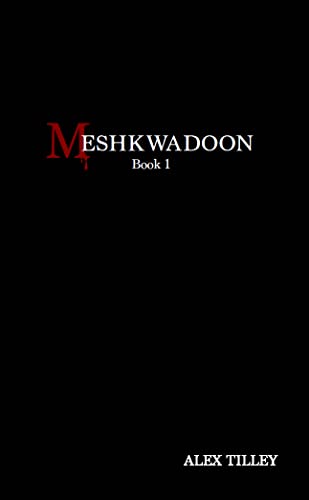

Alex Tilley has crafted a world where people in the melting pot of Ontario, Canada, come face to face with the spirits of the lands they call home. Blending beliefs and personalities from India and Japan with the indigenous Anishinabek traditions and mythologies forges a new map to follow through these forests and small towns. Meshkwadoon translates as a bargain, trading or exchange. As the novel unfolds, readers discover many other words found in Ojibwe, and some Japanese and Hindi peppered in. Within the context of the story, many terms get defined while reading, and using other languages helps the reader step into the unknown a little less sure-footed, but with a sense of wonder.
The story opens with the dreamy Natasha, who we soon find out appears to be having delusions or hallucinations in the forest, if not visitations from powerful old spirits. Begging for help or direction home, she is told in few and broken words that they don’t want her to leave. Her hazelnut eyes drink in the trees and waterways as she tries to escape. Seasons seem to flash forward as we discover all is not what it seems in the woods.
We follow mild-mannered teacher Arjun on a class trip into Algonquin park from Huntsville Ontario when his hiking group finds Natasha covered in mud, nude, and unable to explain where she had come from, or otherwise who she is. One student, Yutta, assists Arjun with the exhausted and injured girl and soon becomes inexplicably enraptured with her.
After handing the strange girl over to the authorities, Arjun, the teacher, is visited by a mysterious reporter named Chloe who is digging for clues about what may have happened to Yutta’s grandparents. Arjun, certain the strange girl and his student’s tragedy must be connected, goes to the hospital and visit the enigmatic Natasha. Much like Yutta, he can’t get her out of his mind and proves oddly compelled to seek her out. Natasha, now missing from the hospital, has this unlikely duo– man and boy– seeking her out. Visions, apparitions, spirits, and tricksters fade in and out as the men travel together, then separately, unraveling as best they can what happened to Natasha before they found her and uncovering clues to the journey she is on now. Many of the people they meet sometimes help or otherwise hinder their quest to find the striking girl who seems to call from them through miles of the surrounding forest.
Chloe’s father, Ogi, is a medicine-man of sorts and has some answers and guidance but warns them all is not what it seems in terms of the meshkwadoon between Natasha and the earth. Peppered with moments of nightmarish visions, and the terror of being alone in the forest, the book has only a few main characters but many short scenes with unnamed apparitions, spirits, and strangers they meet along the way, perhaps many guises of the trickster spirit Nanabush or the greater spirits of the earth itself. From modern hospitals to the most ancient groves, the story paints a picture of Ontario that is recognizable when Arjun and Yutta are interacting with the familiar, yet a murky mystical world lurks under all of this as they take guidance from the various monsters, guides, and spirits.
Some of these characters may be familiar to readers of fantasy or folklore, and certainly to those who are acquainted with indigenous legends. From the stoic brother bear that lends Arjun clarity and wisdom to the mischievous Puk-wudgie, a tiny woodland troll-creature that accompanies Yutta; there are extremes of delightful whimsy and cold reckoning worked into each chapter as they encounter clues to Natasha’s true nature. The very human elements of exhaustion, pain, nudity, confusion, and dread weave through the story, making this sit very close to the realm of horror without being overly graphic. This is despite the beautiful descriptions of the landscapes these creatures and our cast travel through. The woods are dense between the towns and cities we discover, Huntsville to Sudbury, and it soon becomes clear people can be very close to one another, yet be lost and alone at the same time.
Meshkwadoon spans the genres of dark fantasy, thriller, horror, and magic realism, creating a complex storyline with many twists. Readers will find themselves on a journey questioning what is real as they follow the characters through this chilling novel.
Pages: 242 | ASIN : B09PBKYBBP




 LITERARY TITAN