Blog Archives
Drop (The Police Annals of Jax Book II)
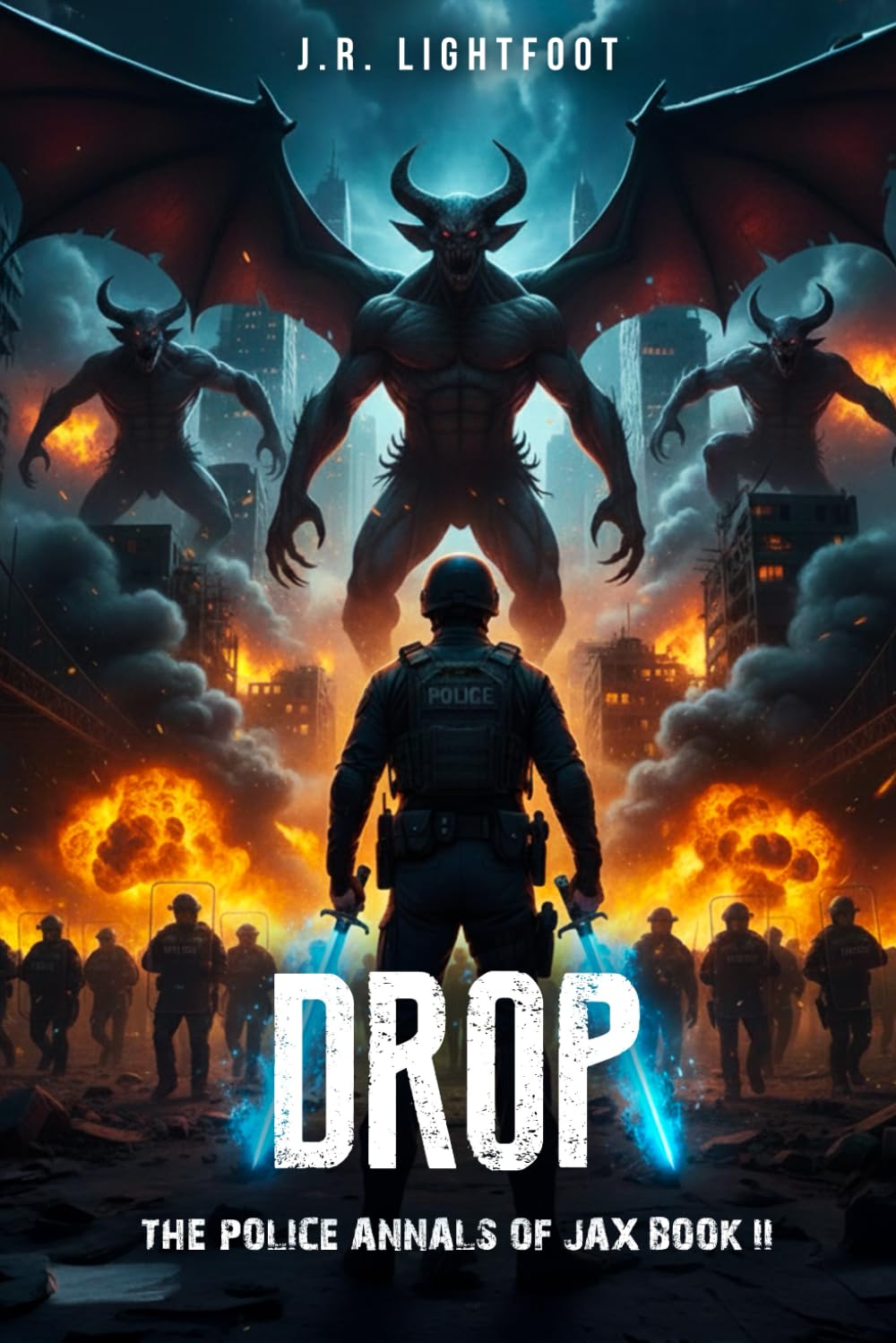

Drop by J.R. Lightfoot is a fast, violent blend of urban fantasy, police thriller, and martial-arts adventure. The story follows Jax Ferris, a Fort Worth officer turned supernatural enforcer, as he hunts the sorceress Debro and the creatures serving the Order of Light. Jax is driven by grief, revenge, and a belief that he’s the person best equipped to confront threats most people don’t even know exist. The book establishes that mission early, placing him on a joint FBI and Fort Worth task force charged with hunting sorcerers, berserkers, and harpies. From there, the conflict expands into a much larger war involving portals, rival factions, hidden alliances, political influence, and powerful beings stranded between worlds.
Jax gives the novel its personality. He’s cocky, funny, ruthless, and often genuinely frightening, even when he’s fighting on the side readers are meant to support. His magical gauntlets let him summon weapons suited to each battle, which gives the action scenes plenty of variety. Lightfoot writes those confrontations in close detail, tracking blades, kicks, spells, injuries, and tactical decisions almost move by move. The result feels like an action movie translated directly onto the page. Jax’s relationships with Mary, Mahla, Robin, Linda, and the rest of the team also give the story an emotional center. As the casualties mount, his swagger starts to sit alongside exhaustion and guilt, making him more interesting than a simple unstoppable hero.
The novel moves through a large cast and several competing groups, including Debro’s Order, Zach’s organization, law enforcement, supernatural outsiders, and characters whose loyalties keep shifting. That broad scope gives the book a busy, unpredictable quality. The dialogue is blunt and frequently profane, while the narration has the direct energy of someone telling an outrageous story without slowing down to soften it. Betrayals, romantic tensions, gruesome deaths, and sudden reversals arrive quickly, particularly in the final chapters. The ending is especially effective as a continuation hook. It changes the meaning of Jax’s apparent victory, advances him into a new position of authority, and brings his conflict with Debro back into the everyday world in a clever way.
This book will appeal most to readers who enjoy hard-edged urban fantasy with antiheroes, graphic combat, police-team dynamics, and comic-book-sized supernatural stakes. It’s also a good match for fans of action stories where the main character solves problems through nerve, physical skill, and overwhelming force. Since it’s the second entry in the series and refers often to earlier battles, deaths, and relationships, readers who begin with Book I will get the fullest experience. For someone who likes relentless confrontations, dangerous magic, dark humor, and heroes who operate far outside ordinary rules, Drop offers a wild and energetic ride.
Pages: 350 | ASIN: B0GLGVLQ2X

Paranormal Beings and Mythical Creatures

Lab Rat follows a captured teen with powers that can be forced on against his will, who is stripped of his name and turned into a numbered experiment inside a ghost-realm prison. What was the inspiration for the setup of your story?
I pulled inspiration from many sources that sparked my imagination when I was growing up. I loved reading books by J.R.R. Tolkien, C.S. Lewis, Madeleine L’Engle, Alexandra Bracken, Cinda Williams Chima, Christopher Paolini, Suzanne Collins, Julianna Baggott, Susan Ee, etc. as well as watching television shows and movies like X-Men, Danny Phantom, Static Shock, Teen Titans, Avatar: The Last Airbender, Teenage Mutant Ninja Turtles, Blue Exorcist, Attack on Titan, Spiderman, MCU movies, and more. My sister and I were obsessed with the Sly Cooper video games when we were young, which likely added an “honor among thieves” type of influence, too. I loved fantasy and dystopian books but was drawn to shows/movies featuring characters with superhuman powers. I’m also a sucker for found family stories and fugitives on the run. Essentially, the Chronicles of Avilésor was a culmination of my favorite story elements blended into a series that crosses genres by taking place in a version of our world with ghost hunters and sci-fi weapons juxtaposed with the fantasy Ghost Realm inhabited by paranormal beings and mythical creatures.
The tenderness between prisoners feels fragile but powerful. Why does found family matter so much in this story?
Despite the threat of a society-ending war, a top-secret government agency conducting morally reprehensible experiments, and humankind trying to survive against supernatural adversaries, this is very much a character-driven story. Cato survived his torture because of the connections he forged during the darkest time of his life—not because of his powers or physical strength. Readers have seen the resilience of the lab-family’s bond throughout the other three books, but Lab Rat was an opportunity to reveal the root of their relationship and provide a new perspective of just how meaningful that bond really is.
The book treats bodily autonomy as something that can be “managed.” Why was that theme important to you?
That theme was an organic inevitability when exploring Cato’s incarceration. He’s been suffering from PTSD for almost as long as fans have known him, and Lab Rat explores the cause rather than just the effects. The Agents view Cato as sub-human and therefore deny him basic human rights, including bodily autonomy. He has very little control over any aspect of his life, which is one of the primary foundations of his lasting trauma.
What will the next book in the series be about, and when will it be published?
The Demikan will be the next installment in the series. Without giving too much away, it will directly pit the Agents against Azar’s new alliance. The lab-family will have to grapple with a new power dynamic within the group, and the two societies will clash and collide. I don’t have a publication date set yet.
Author Links: GoodReads | Facebook | Instagram | TikTok | Website
Outside his cell, a desperate rescue attempt will involve breaking into the Prison in the heart of the Ghost Realm. Azar is gathering his dark forces while Agent Kovak scrambles to create the weapon that will save humankind. Phantom Heights is in the warpath. Seven to bring the Seventh, but Eight are the key . . .
. . . They must decide what the fate of the Realms shall be.
Two Destinations

13: Stone Corners and Other Stories is a collection of ghost stories rooted in memory, family, guilt, faith, and the strange comfort of being scared on purpose. What was the inspiration for the setup of your story?
I used to split my time between writing lyrics, and songs, and stories. My songs were well-received (the other bandmates liked them, and a few got on the St. Louis radio). So, I wondered what the difference was between my songwriting and my failed fiction writing. There were a few reasons: the lyrics were concise, had a good rhythm, and hit with emotion, whereas my fiction meandered and often didn’t connect. The goal was to make my fiction more like my songwriting: to the point, playful with the rhythm, and to pack an emotional punch.
Adding to that goal would be what to write or which genre to explore. As a teen and a young adult, I had tried fantasy (which was derivative and boring) and science fiction (which wasn’t very plausible). In college, I tried creative writing and realized I had a lot of maturing to do in order to write convincing fiction, so I gravitated to alternative rock and roll music, which gave me immediate satisfaction and feedback. However, that lifestyle wasn’t too healthy to maintain without serious deliberating habits.
In my first try at sobriety at age thirty-five, I decided to write a ghost story and use the lessons learned in my songwriting. I made a Ghost Emotion list, which would be the kind of things that might linger after death and feed a ghost: lust, murder, betrayal, despair, coveting, guarding someone or guarding against something, etc.
“Night At the Black Orpheum” was my first ghost story and the first story I wrote that I thought was publishable. From there, it was finding the seeds for a ghost story and mixing the reality with something weird.
At some point, I decided to name the collection under the umbrella title of 13 and all the connotations that number brings, though, for me, the number thirteen has some personal connections.
Are any of the locations featured in your book inspired by places you’ve known in real life?
Several, as it turns out. Some are first-hand experiences, such as ghost tours in the Crescent Hotel in Eureka Springs, Arkansas. That is the weirdest and most haunted place that I have been to. At the Meridian Coffee House in Alton, Illinois, I experienced orbs (quite a lot of that activity) and saw second-hand evidence of other manifestations. A nightmare about my grandparents’ huge basement inspired “A Sort of Homecoming.” In this dream, there were secret doors in closets that led to secret rooms that I had never explored. Taking the house as a metaphor for the mind, I used it to make a story of hidden secrets. “Blue Harvest” was a second-hand story told to me by my band-mates who all went to a haunted barn where there had been a mass killing by a deranged father (I had to leave early that night and was not present). Two of my bandmates gave me some details, but the third refused to talk and quit the band soon afterwards. A little later, I went to his house, and he told me his version of the events, which provided the climax for the story. He had been so upset by what he had seen that he eventually became a Christian preacher.
Faith is woven naturally into many of these stories. How important was it to treat spiritual belief as an active part of the supernatural rather than simply a background detail?
My upbringing in a Christian home instilled a belief in an afterlife with two destinations. As a history student, I read a lot about the Egyptian and Greek beliefs and depictions of the afterlife. As a reader, I discovered that the best ghost literature hinged on one important fact: the people in the stories believed in the phenomena happening to them in order to understand it, combat it, or resolve it. At some point, after watching ghost documentaries, reading nonfiction accounts of hauntings, and watching debunkers, I came to the conclusions that there could be four assumptions: one, it’s just in our imaginations (but if I can project ghosts, I wish I could learn how to project so many other things like money and gold); two, it’s all real like people say they’ve experienced (which tends to make people very uncomfortable); three, it’s not real, but seems real due to magnetic fields or some kind of local force in the environment that acts upon our brain and causes the projection to manifest; or four, this phenomena is real and can only interact in our section of reality by using certain electrical wavelengths or light spectrums and has other attributes beyond our knowing.
I am open-minded to the phenomenon. I can’t explain away everything I’ve seen, or heard, or felt other than it’s beyond me. Even as a believing Christian, can a spirit be seen, or is it actually the spirit of the deceased or something nastier? There are such stories in the Bible. Jesus was a demon hunter. They sure didn’t like it when He came to town.
Are there other haunted places or family stories waiting to be explored?
Yes, I am working on a companion collection of tales for a future 13 collection. One other tale that I posted on Substack involves a visit to the St. Augustine Lighthouse. My wife wanted to visit; I’ve never been to a lighthouse, and I love historical places. But I had no idea of the ghost activity there and only learned about it when two workers told me about it. A third worker knew their stories but was a skeptic. He said, “I’m only a skeptic because I have never seen a ghost. I would love to see a ghost and be proven wrong.” Well, there you are: that became the seed for a story.
Author Links: GoodReads | Facebook | Website | Amazon
13: Stone Corners and Other Stories


13: Stone Corners and Other Stories is a ghost story collection built around houses, basements, churches, bars, old stages, graveyards, orchards, and the emotional leftovers people carry into those places. Jeffrey Cummins frames the number thirteen as personal, spiritual, and spooky, writing in the foreword, “It haunts me pleasantly enough. It is nothing to fear.” That line fits the whole book: these stories are frightening, but they’re also deeply interested in memory, family, guilt, faith, and the strange comfort of being scared on purpose.
The collection has a strong sense of place. “A Sort of Homecoming” turns a grandparent’s house into a map of the mind, with rooms, closets, and basements holding old dread. “Lethe Home” returns to that basement in a tighter, sharper childhood nightmare. “Stone Corners” expands the book’s world through Kelley and Mercury Branscombe, whose supernatural sensitivity turns an old home into a spiritual battleground. The stories often feel like someone telling you what happened late at night, after everyone else has gone quiet.
Cummins’ horror is very physical. Floorboards wobble, doors slam, beetles crawl, shadows gather in corners, and the dead don’t stay politely symbolic. At the same time, the supernatural usually points back to something human: a mother’s fear in “Tearing at Holes,” a town’s buried violence in “Haunting My Hometown,” temptation and bravado in “Blue Harvest,” or grief and music in “Night at the Black Orpheum.” Even when the book goes big, as in “The Day the Ghost Walks,” with Shakespearean theater and old debts among actors, it still comes back to the same question: what do the living owe the dead?
Faith runs through the collection in a direct and sincere way. Scripture, prayer, forgiveness, and spiritual warfare aren’t decorative here. They’re part of how characters understand fear and how they push back against it. That gives stories like “Ghostproof” and “Church of the Holy Spook” a distinctive personality, where the haunted house story and the testimony sit side by side. Cummins also has a fondness for rough-edged, conversational narration, mixing dread with jokes, domestic detail, and working-class memory.
What makes the book engaging is the way it treats ghost stories as something close to home. These aren’t just tales about apparitions. They’re about places that remember, people who can’t quite shake the past, and fear that keeps looking for a door back in. Near the end of the foreword, Cummins writes, “All I really have to do to find one is fall asleep.” That’s the book in one sentence: intimate, haunted, personal, and always listening for something moving in the dark.
Pages: 467 | ASIN : B0FLB6NHNP
Grand Battles and Long Journeys

Awakening follows a former quarterguard who turned killer-for-hire in an underwater nation filled with class violence and magic, who is forced into the Bishop’s rebellion. What was the inspiration for the setup of your story?
I’ve been building the world of Atlamaria and eventually writing the Goremage story for over nine years. It originally started as a completely different novel idea that came about from a short story in a high school creative writing class. I shelved that and ended up expanding the world into a homebrew Dungeons and Dragons campaign a few years later, which only got two sessions in. I really liked the world I had started building, and kept working on the lore and world, until I had built up the entire world of Atlamaria and Aurelithia. I’ve always loved fantasy novels and movies, and have written multiple in the past, so the finished product of the Goremage series was a sort of love-child of the years of worldbuilding I had done and some abandoned characters I wasn’t ready to let go of.
What challenges came with designing a believable underwater civilization?
I had a pretty soft science system when it comes to the sci-fi side and kind of leave a lot of it up to the reader’s imagination, which I think helps. I’ve done a lot of research on it and how it would actually be built in the world, but I think writing out the nitty gritty of that would be boring, and lose a lot of the whimsy, so it feels more believable for the reader to have a ‘less is more’ approach. I think the biggest challenge was reminding myself that they were underwater, meaning there were limitations to where they could go and what they could do (though this is a bigger issue with books two and three). Because I enjoy epic fantasy, I like the idea of grand battles and long journeys, but the entirety of Atlamaria is smaller than the state of Texas, so I had to have them travel with that in mind.
How did you balance horror elements with fantasy adventure and political intrigue?
Book one definitely focuses a lot more on the fantasy and horror elements, whereas book two leans a lot more into the political intrigue and horror. Since my goal wasn’t to write a traditional fantasy, I think it was easier to just focus on what I wanted the story to be, rather than what it ‘should’ be.
Can you give us a glimpse inside Book 2 of the Goremage series? Where will it take readers?
Book two is a much deeper dive into the politics of Atlamaria and the relationship between Pearl and Elio. Returning to Atlamaria, Pearl and Elio find the Triarch has already started their push for total control — and will stop at nothing to get it. As they struggle with their interpersonal relationship, the grieving process, and the ongoing political upheaval, they must also face just how far they’ll go for the greater good.
Author Links: GoodReads | Threads | Instagram | Website | Amazon
The Society (Book 3 of the Blood & Flesh Saga)

The Society by D.A. Chan is an urban epic fantasy built around bargains, bloodlines, and people trying to keep promises that have already cost too much. As the third book in Blood & Flesh, it drops us into a world where Damien, Emilia, the Brotherhood, and the Society are all moving pieces on a board no one fully controls. Damien’s opening line, “I should be dead,” sets the tone right away. This is a story about survival after revenge, and about what comes next when revenge doesn’t fix anything.
What makes the book work best is its focus on uneasy alliances. Damien and Emilia don’t trust each other cleanly, but they need each other, and that tension gives the story a steady pulse. Damien is calculating, damaged, and often frighteningly practical, while Emilia carries grief, pride, fear, and loyalty in ways she can’t always hide. Their dynamic feels less like instant partnership and more like two dangerous people slowly learning where the other person’s limits are.
The plot is dense in a good way. The Society isn’t just a vague evil organization, it’s a system with habits, patterns, killers, Watchers, leverage, and old rot built into its structure. Damien sums up the strategy neatly when he says, “They control, repeat, predict.” This is a war story where information matters almost as much as violence.
The action is bloody and cinematic, but the book’s real weight comes from guilt. Characters are constantly asking what can be justified, who gets used, who gets saved, and what kind of person you become when the plan works but leaves bodies behind. The Brotherhood scenes add scale and personality, especially through members like Callum and Mateo, but the quieter moments with Emilia, Chrissy, Anja, Charlie, and Damien’s private doubts give the story its emotional shape.
The Society is a dark, busy, emotionally charged fantasy about monsters fighting monsters while still trying to protect something human in themselves. It’s at its strongest when it lets strategy and conscience collide, and when it treats trust as something fragile, useful, and dangerous all at once. The ending doesn’t feel like a door closing so much as a boat leaving the shore, carrying Damien and Emilia toward another version of the question that haunts the whole book: what does “done” even mean when the promises keep multiplying?
Pages: 322 | ASIN : B0FX5YT4X9
Doryto and the Door of Wanderers

Doryto and the Door of Wanderers is a genre-bending speculative fantasy novel with a strong comic streak, and at its core it follows Doryto O’Shannassy, a homeless finder in Birmingham who can locate almost anything, as a simple missing-person job opens into interdimensional travel, alternate selves, dangerous Squatch, and a much larger struggle around the mysterious Door of Wanderers. What struck me first is how much the book trusts Doryto’s voice to carry the whole ride, and for me, that gamble mostly pays off. He’s funny, scrappy, oddly tender, and so specific that even when the story gets wild, I still felt like I had a real person to hold onto.
What I liked most was the writing’s looseness and personality. It doesn’t feel polished into something cold. It feels authentic. Doryto talks the way a person might actually talk when life keeps getting stranger by the hour, and that gives the book a warm, offbeat energy. There’s a real charm in the way the novel moves from lost dogs and storefront rent to Celtic bloodlines, dimension-hopping, and metaphysical rules about suffering. That sounds like a lot because it is a lot. But the book often makes that excess part of its appeal. I kept feeling like I was listening to somebody tell me an unbelievable story on a long drive, and somehow the best choice was to let them keep going.
I was also interested in the author’s choices around identity, pain, and belonging. Beneath the humor and fantasy mechanics, the book keeps circling loneliness, family damage, and the question of what it means to find something, or someone, or even yourself. That idea of Doryto meeting other versions of himself could have been played just as a clever fantasy device, but here it feels more personal than that. It becomes a way of asking who we might have been under different pressures, and what suffering does or does not teach us. The novel can feel crowded with ideas, and there were moments when I wanted a little more clarity in the worldbuilding. Still, I respected the ambition. The book isn’t trying to be neat. It’s trying to be big-hearted, strange, and searching.
I would recommend this to readers who like fantasy that is more voice-driven than rule-driven, and to anyone who enjoys weird fiction, multiverse stories, or character-led adventures with humor, heart, and a Southern flavor. It’ll probably land best with readers who are happy to follow an unusual narrator into increasingly unusual territory. I think people who like speculative fiction with emotional messiness, eccentric mythology, and a strong first-person presence will find a lot to enjoy here.
Pages: 269 | ASIN : B0GNKHXD18
Joshua Creed: Keeper of Worlds

Joshua Creed: Keeper of Worlds is a middle-grade portal fantasy with a strong coming-of-age thread, and at its core, it follows twelve-year-old Joshua as his already-shaky life cracks open even further. His parents are divorcing, school feels like a minefield, and then his strange blue eye starts pulling him into another world, where prophecy, dangerous magic, and creatures like Wormly, Selia, and Gonthragon force him into the role of a keeper between worlds. What makes the book more than a simple quest story is that Joshua is not just trying to save a fantasy realm. He’s also trying to understand his family, his anger, and the fear that he ruins everything he touches.
I liked how directly the author, Dawnette Brenner, writes Joshua’s inner life. The fantasy setup is big, but the emotional entry point is small and human: a tetherball game, a suspension, a kitchen table conversation, a kid trying not to cry. I think that choice works great. It gives the book real footing before the world-hopping begins, and it keeps the stakes personal even when the plot expands into prophecy and interdimensional danger. I also liked that the magic has rules and consequences. The idea that crossing between worlds costs Joshua something, even time from his own life, gives the story weight and keeps it from feeling too easy.
I felt the book was at its best when it slowed down and let character and emotion breathe. Joshua’s bond with Jonah, his guilt over his mother being hurt, and the way fantasy becomes tangled up with family pain all land well. Those parts felt honest. The novel throws a lot at the reader: prophecy, magical tools, multiple creatures, vision lore, world rules, and escalating threats. Some readers will enjoy that rush. I respected the author’s instinct to make this adventure about responsibility instead of simple wish fulfillment. The book keeps asking a solid question: what does it actually cost a kid to become “chosen”? That question gives the story its backbone.
I’d recommend this most to readers who like middle-grade fantasy that blends portals, prophecy, and magical objects with family strain and emotional growth. Kids who enjoy stories in the lane of classic quest fantasy, but want something more grounded in school, home, and identity, will probably connect with it. I think adults who read middle grade closely will also notice the heart behind it. This is a fantasy novel, but it is really about carrying too much too young and learning that bravery is not the same thing as pretending you are fine.
Pages: 281 | ASIN : B0GPP1XLTD


