Blog Archives
The Secret History of Time Travel


The Secret History of Time Travel, by William Patrick Martin, is a linked collection of alternate-history time travel stories built around the Dunn family, whose unusual bloodline allows certain descendants to slip into temporal loops. Across twenty-two chapters, the book moves from AD 536 to AD 2099, revisiting figures and events such as Leif Erikson, Joan of Arc, Isaac Newton, William Penn, the Titanic, the Christmas Truce, Hitler’s rise, Eleanor Roosevelt, Jimmy Carter, 9/11, and even interstellar exploration. Rather than treating time travel as machinery or spectacle, Martin frames it as inheritance, accident, and moral intervention: history bends when a Dunn wakes up with one more chance.
I enjoyed the book’s restless curiosity. Each chapter feels like a historical “what if” delivered with the momentum of a fable, and the best entries have a mischievous confidence about them. Martin is not timid about rearranging monuments. He lets witches colonize Pennsylvania, gives Joan of Arc a hidden protector, reshapes political legacies, and asks whether catastrophe is always inevitable or merely the result of one missed warning. That speculative boldness gives the book its lift. It reads less like a conventional novel than a cabinet of peculiar clocks, each one set to a different crisis.
I also appreciated the way the book keeps returning to the idea of second chances without making them simple. Some changes are heroic, some are intimate, and some raise uncomfortable questions about who gets saved and who remains trapped in the machinery of history. The episodic structure can occasionally make the time-loop mechanism feel familiar, but the variety of historical settings keeps the pattern from going stale. Martin’s prose is direct and approachable, with flashes of moral heat, especially when the stories touch on injustice, war, prejudice, and political failure. The book’s charm lies in its refusal to treat history as dead matter; here, the past is volatile, corrigible, and sometimes heartbreakingly stubborn.
The target audience for The Secret History of Time Travel is readers who enjoy science fiction, fantasy, alternate history, historical fiction, time travel, and multiverse stories with a strong historical spine. Fans of Stephen King’s 11/22/63 may recognize a similar fascination with changing the past, though Martin’s book is broader, more episodic, and more openly enchanted. This is a good fit for book clubs, classroom discussions, and readers who like their history served with paradox, consequence, and a little fairy dust. The Secret History of Time Travel turns history into a door left ajar and dares us to wonder who should walk through it.
Pages: 290 | ASIN : B0H3LQNYH2

Berkeley Arcane

Berkeley Arcane, by Marie Judson, is an adult portal fantasy that blends epic fantasy, alternate history, time travel, and a sharp thread of near-future science fiction. The story begins in Berkeley, where Rousseau is pulled into trouble by Onyx, a mysterious woman whose brother Sol may be trapped outside ordinary time. At the same time, Kay discovers a strange old cottage that does not belong where it is. From there, the novel opens into a layered conflict involving medieval magic, AI, mind powers, portals, old betrayals, and a future where technology has pushed human identity into uneasy territory.
What I liked most is how grounded the strange things feel. Judson doesn’t treat magic as glitter sprinkled over the plot. It has weight. It has rules, history, and consequences. A café, an eBike, a Trader Joe’s, a university classroom, and a Berkeley co-op all sit beside ancient Norway, Cornwall, dragons, sylphs, and mind-speak without the book winking too hard at the contrast. That choice gives the story an authentic feel. I believed these people had been carrying impossible things for a long time, sometimes with grace and sometimes with total exhaustion. Honestly, that exhaustion made them feel more real.
The book is also busy. There are many characters, timelines, and a lot of past history pressing against the present. As a reader, I sometimes had to slow down and reorient myself. But I didn’t mind that as much as I expected to, because the emotional through-line is clear: people are trying to protect one another while deciding what kinds of power should exist in the world. That idea really resonated with me. Judson’s most interesting choice is bringing AI into a fantasy framework without making it feel like a gimmick. The book asks whether technology can imitate magic, whether it should, and what happens when people gain abilities without a culture or ethics strong enough to guide them. That’s a big question, but the novel keeps bringing it back to family, memory, friendship, and responsibility.
I recommend Berkeley Arcane to readers who already enjoy character-rich fantasy with complicated histories, especially those who like portal fantasy, alternate history, Celtic and Nordic influences, and stories where ancient magic collides with modern technology. New readers may want to start earlier in the Braided Dimensions series, because this fifth book carries emotional and plot history from the previous novels. But for readers who enjoy being dropped into a dense, strange, and heartfelt world and slowly finding their footing, this is a thoughtful and imaginative novel.
Pages: 197
Coexistence and Domination

Black Forest Protocol is an alternate-history thriller in which a UFO crash in Nazi Germany forces an SS officer to confront the gulf between domination and preservation when the regime tries to weaponize a sacred alien presence. What sparked the idea of placing a first-contact story inside Nazi Germany?
There had been reports and a number of journals/books dedicated to the Black Forest crash in 1936. This is roughly 10 years before the Roswell incident. Through my research on the rise of the Nazi regime, German manufacturing made extensive technological leaps from 1936 through 1939, prior to the invasion of Poland. It mirrored the technological leaps the US made post-Roswell. I used creative license to involve the Nazi SS and advanced technology/alien abilities that would have been used to reshape a totalitarian regime reality to fit ideology.
How did you approach writing Ernst Falk so that his moral awakening felt gradual and believable rather than heroic from the start?
The key was to start with competence instead of conscience. Falk is intelligent, disciplined, and emotionally detached. He isn’t written as a monster or a secret hero—he’s a professional who follows systems without questioning them. That makes his starting point believable and grounded. From there, I avoided any sudden “moral epiphany.” Instead, his change happens through accumulated friction: small moments that feel off, observations he can’t fully explain, and emotional reactions he initially suppresses. Importantly, he fails repeatedly. He hesitates, rationalizes, and makes the wrong choices even after he begins to feel doubt. That delay is what makes the awakening feel real—he understands before he acts. Finally, his awakening comes with cost, not reward. He loses certainty, identity, and alignment with the system that once defined him. He doesn’t become heroic—he becomes unable to ignore the truth.
The aliens feel mournful, vulnerable, and almost sacred. What did you want them to represent beyond their role in the plot?
The aliens were meant to represent a form of intelligence untouched by human corruption, that is something gentle, restrained, and morally unbroken. Their vulnerability highlights the contrast between coexistence and domination, making humanity’s instinct to control feel invasive rather than justified. They serve as a mirror to Falk and the reader, suggesting that intelligence doesn’t have to lead to cruelty—and that what we often call progress may actually be a loss of something more sacred.
How did you balance the book’s eldritch atmosphere and allegorical reach with the historical weight of writing about the Third Reich?
I balanced the eldritch atmosphere with the historical weight of the Third Reich by keeping the human reality grounded and specific, never abstracting or stylizing the regime’s brutality, while letting the cosmic elements emerge as a destabilizing force around it. The horror doesn’t replace history; it intensifies it, exposing the dangers of ideology, control, and moral certainty when confronted with the unknowable. By anchoring the story in authentic human behavior and consequence, the allegory expands the meaning without diminishing the reality.
Author Links: GoodReads | Website | Amazon
SS officer Ernst Falk is stationed on a quiet rural post when the forest itself seems to recoil, where animals vanish, the air vibrates, and the night splits open with a light no human technology should be able to produce. By dawn, a seamless metallic object lies embedded in the earth, warping the trees around it and defying every known law of physics.
It is not wreckage.
It is not dead.
And it is not alone.
Hidden beneath the pines, Falk and a small team of scientists discover survivors, beings not of this world, wounded and terrified. What should have become humanity’s first moment of cosmic contact instead becomes a nightmare of secrecy and ambition. The Nazi regime seals the forest, erases witnesses, and delivers the discovery into the hands of the SS and the Ahnenerbe, who see not life but opportunity.
As alien technology is dismantled and alien biology harvested, a terrifying project takes shape: the Blackforest Protocol. Under the direction of fanatical ideologues, the crash is transformed into a weapons program, a genetic experiment, and a propaganda miracle meant to fuse extraterrestrial power with Nazi myth.
But the forest is changing.
The survivors are not silent.
And Falk begins to realize the visitors did not come as conquerors-but as explorers, carrying knowledge that was never meant to be bent into instruments of domination.
Decades later, the consequences of what happened in the Black Forest resurface, dragging the modern world into a buried legacy of stolen technology, erased crimes, and a truth powerful enough to destabilize history itself.
Blending historical horror, science fiction, and psychological suspense, Blackforest Protocol is a chilling alternate-history thriller about first contact gone wrong, where humanity’s greatest discovery becomes its most unforgivable crime, and the forest that witnessed it refuses to forget.
Black Forest Protocol
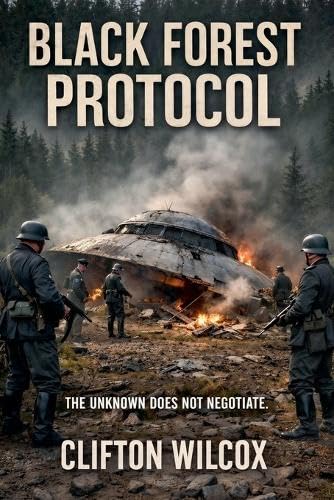

In Black Forest Protocol, author Clifton Wilcox drops a UFO crash into Nazi Germany and uses that collision to build a dark, morally charged speculative thriller: SS officer Ernst Falk witnesses an alien arrival in the Black Forest, discovers that the survivors are not invaders but vulnerable pilgrims, and slowly turns from functionary to witness as the Reich tries to convert wonder into doctrine, biology into propaganda, and contact into domination. The novel eventually broadens beyond the 1930s crash into a longer historical reckoning, revealing that what the Nazis tried to weaponize was never meant as a tool of conquest at all, but as a system of preservation and balance.
I enjoyed the book’s atmosphere. Wilcox gives the forest a living pressure, and the opening movement has a genuine eldritch shimmer to it: the silence feels predatory, the ship feels less manufactured than grown, and the aliens arrive with a sadness that keeps the novel from sliding into pulp. I was especially taken with Falk as a protagonist. He’s not built as a swaggering resistor; he is a cautious, thinking man whose decency emerges by increments, which made his bond with the surviving alien feel more persuasive than a louder, more cinematic version would have. When the book is operating in that register, cosmic mystery filtered through dread, pity, and moral nausea, it has real voltage.
The novel is at its strongest when it lets horror and conscience share the same room. The most unsettling passages are not the extraterrestrial ones, but the scenes where Nazi ideology tries to metabolize the unknown into its own diseased mythology. That is the book’s sharpest idea: not simply that evil destroys, but that it narrates, repackages, and aestheticizes destruction until it sounds inevitable. I also found the prose interestingly uneven, and I mean that as praise because it can be a touch overwrought, but it is rarely inert. Wilcox reaches, sometimes flamboyantly, for a language of omen and scar tissue, and I’d rather read a book that risks a little melodrama than one that settles for sterile competence.
I’d recommend Black Forest Protocol to readers of historical science fiction, alternate-history suspense, UFO fiction, first-contact horror, and conspiracy thrillers with a moral spine. Readers who like the historical unease of Philip Kerr’s wartime settings, or the idea-driven speculative pressure of Philip K. Dick, will probably find something to grab onto here, though Wilcox is more earnest than either and more openly allegorical. For the right audience, this is a grim, curious, haunted book about what happens when wonder falls into the wrong hands. When the stars finally spoke, the worst men on Earth tried to translate them into power.
Pages: 394 | ISBN: 1969770090
What If No One Controlled You At All

Cuban Sliders follows a former operative who is sent to 1951 Havana, where a time-fracturing technology has evolved into a machine that locks the future into a single path, and he needs to stop it before it is too late. “Decision Locking” is deeply unsettling. Where did that idea originate?
It began with a quieter question than people expect. We spend a great deal of time worrying about machines that control minds. That’s a familiar fear. It belongs to dystopia. It’s theatrical.
What interested me more was something subtler: what if no one controlled you at all—but the range of available futures narrowed before you even knew you were choosing?
Decision Locking came from observing how institutions behave under pressure. In intelligence work, in politics, in war planning—there’s always a desire to remove friction. Debate is messy. Delay is dangerous. Consensus feels efficient.
So I asked myself: what if you could remove dissent without coercion? Not by force, not by persuasion, but by altering the timing of thought itself. That is more frightening than brainwashing. Most moral failure doesn’t occur in chaos. It occurs in clarity.
Decision Locking doesn’t insert ideas. It doesn’t rewrite personality. It simply ensures that one conclusion arrives first—and that all others arrive too late to matter.
The technology in Cuban Sliders is speculative. However, the impulse behind it is not. We are always tempted by certainty, especially when the stakes are high. The novel just pushes that temptation to its logical extreme.
How has Max changed since the first book, and how has the Mirror evolved across the trilogy?
Max, in the first book, is disoriented. He’s a man trying to survive an anomaly. The Mirror is something external—dangerous, mysterious, almost mythic. He reacts to it.
By Cuban Sliders, Max understands that the real danger isn’t the physical distortion of time. It’s the ethical distortion of responsibility. Max isn’t heroic in the traditional sense. He’s not decisive. He’s not ideologically pure. What he does possess is hesitation. That hesitation becomes a form of resistance.
He’s become more deliberate. More haunted. Less reactive. At first, he wants to repair the fracture. Later, he realizes that fractures are sometimes honest. It’s false smoothness that frightens him. I think Max survives because he refuses to reach conclusions too quickly.
In the first book, the Mirror bends time. In the second, it destabilizes identity. In the third, it stops pretending to be about physics at all.
By Cuban Sliders, the Mirror has become infrastructural. It isn’t just a device. It’s an influence. A method. A way of structuring decisions. And that evolution mirrors Max’s own realization: the enemy isn’t time travel. It’s inevitability. And Max doesn’t trust it.
The book seems deeply concerned with choice. Was that always central, and were you exploring power as control over time, or over people?
Choice was always the center. But not in the heroic sense. I’m less interested in whether someone chooses bravely than in whether they are allowed to choose slowly. I’m drawn to the moment after the decision—when a character realizes something irreversible has just occurred.
The trilogy examines two kinds of power: Power over time and power over people. The unsettling truth is that they converge.
If you control the timing of decisions, you control the outcome. Not because you force anyone, but because you compress the space in which doubt lives. And doubt is where moral weight accumulates.
So yes, the books are about time. But they’re also about institutions that prefer efficiency to accountability. About systems that reduce friction in the name of progress. And convenience, historically, has been far more transformative than malice. I wanted readers to feel unease at the smoothness of how things play out. What sounds like it might be a good idea actually isn’t!
Do you see yourself returning to this world someday?
Yes.
Not because I think there are any loose ends. But because the core question hasn’t gone away. It hasn’t ended. One of the misconceptions about the early Cold War is that it was purely ideological theater. In reality, it was procedural. Committees. Authorization chains. Redundancy systems.
The hydrogen bomb wasn’t just a weapon—it was a decision problem. Once destructive capability exceeded moral comprehension, the question became: who decides, and how?
The next novel, Teller Threshold, moves into the early Cold War thermonuclear era and examines what happens when Decision Locking intersects with nuclear doctrine. If the hydrogen bomb represents destruction at scale, Decision Locking represents certainty at scale. The combination is potentially highly volatile.
More importantly, what happens when a room tasked with deciding on irreversible action is deprived of dissent? Decision Locking is fictional, but the desire to remove dissent from high-stakes environments is very real. The ethical tension still feels alive and worthy of further exploration. The stakes become explicit: what happens if the most destructive weapon ever built is paired with a technology that eliminates dissent in the room deciding whether to use it?
What interests me now is whether a society can fracture dissent so thoroughly that it mistakes silence for stability. I don’t think I’m finished with that question. It isn’t about control of territory or control of weapons. The deeper anxiety is about control of outcomes. It’s not about expertise overriding democracy—it’s about timing overriding deliberation. The whole subject feels like it fits well with Cold War noir-style espionage storytelling!
When a Soviet scientist from a Cuban rum distillery is found in Havana, grotesquely aged, former Bureau operative Max Calder is dragged back into a world he thought he’d escaped. The Mirror — an experimental technology capable of fracturing time — has returned, no longer as a single machine, but as a growing web that entangles minds as easily as moments.
As Calder and Alicia Rayes uncover the truth, they discover a terrifying spinoff: Decision Locking, a process that removes dissent and collapses debate until only one future remains – clearing the path for, among other outcomes, a coming Cuban coup.
Caught between Soviet pursuit, CIA ambition, and betrayal from within British intelligence, Calder must decide whether the Mirror can be contained—or erased entirely.
Cuban Sliders is a noir-inflected Cold War thriller about memory, power, and the danger of a world where certainty arrives too soon.
Some technologies change history.
This one decides it.
My Twelve-Year-Old Wife: Erased Memories

My Twelve-Year-Old Wife: Erased Memories drops the reader straight into a world where time folds, grief bites hard, and reality keeps shifting under the characters’ feet. The book follows Dan, a man who loses his wife brutally, then hurls himself backward through time to save her. He lands in 2003 and discovers a teenage version of Celia, a younger and sharper incarnation of the woman he loved, and a chilling truth about Lang, the man who killed her. As Dan struggles to protect her, time glitches, memories warp, and past and future versions of Lang collide. The story moves fast, and the stakes sit right at the throat from the opening chapter.
I kept feeling the tension coil in my chest whenever Dan slipped between timelines. His heartbreak is loud. His fear is louder. I found myself rooting for him even when he made choices that scared me. The writing surprised me with small, quiet moments tucked between scenes of dread. A breakfast. A joke. A breath of calm before the ground cracked open. They made the danger feel personal instead of mechanical, and I loved that steady tug between ordinary life and cosmic consequences. There were times when the dialogue carried more weight than the action itself, and those were the moments that resonated with me.
Time travel is usually all rules and logic, but here it felt messy and emotional, which I liked. Time behaves like a living thing. It twitches when Dan pushes it. It punishes him when he presses too hard. I also appreciated how the author handled trauma. Nothing is graphic, but the emotional fallout hit real. Celia’s distrust, Dan’s guilt, the thin places in the world that react to their fear, all of it landed with a strange mix of warmth and dread. I kept forgetting to breathe during the scenes under the bleachers, especially when the masked figure flickered in and out of sight. The writing there felt sharp and cold in the best way.
I would recommend this book to readers who enjoy psychological thrillers with a strong emotional core, and to anyone who likes their time travel tangled with heartbreak instead of gadgets. If you want a story that creeps under your skin and sits there long after the last page, this is a good one. Author Dan Uselton turns time itself into a monster, and the result is unforgettable.
Pages: 323 | ASIN : B0G2FLTQSP

My Twelve-Year-Old Wife
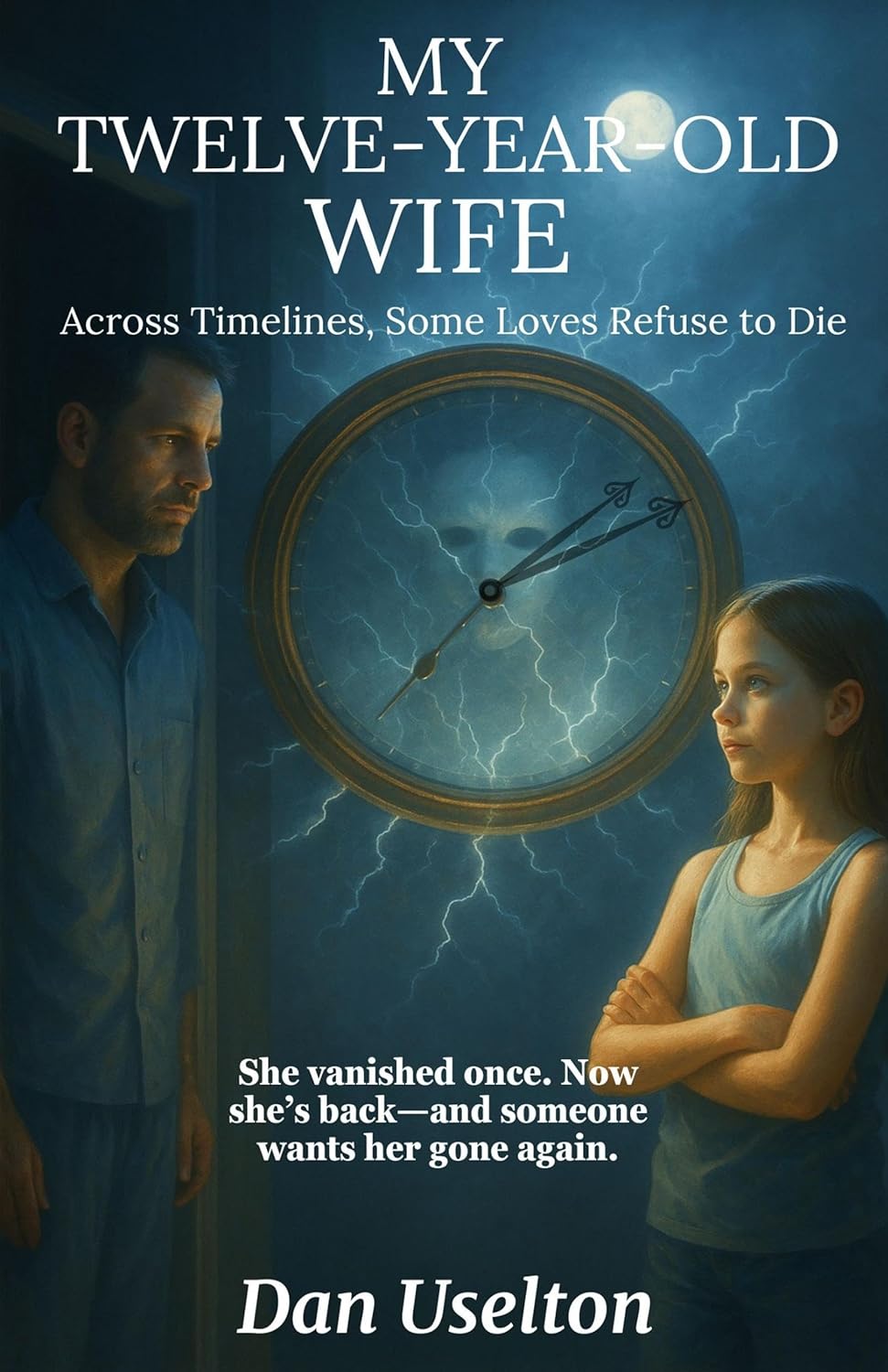
My Twelve-Year Old Wife is a dark, time-bending thriller about love, grief, and the unrelenting pull of fate. It follows Dan Fox, a husband desperate to find his missing wife, Celia, only to have a twelve-year-old girl appear at his door claiming to be her. What begins as a mystery about disappearance spirals into something stranger, a story that slips between timelines and emotions, showing how trauma, memory, and devotion can warp across the years. The book plays with horror and science fiction but stays grounded in its aching humanity. Each chapter peels back another layer of the impossible, until the reader is as disoriented and haunted as Dan himself.
The writing is cinematic and unnerving, full of tight, fast sentences and moments that hit like a punch. I could feel Dan’s confusion and fear, his disbelief when he’s confronted with a version of his wife that shouldn’t exist. The story toys with logic but never loses its emotional truth. The prose has this eerie stillness, a rhythm that feels like breathing in the dark, and the pacing moves between slow dread and heart-hammering tension. I caught myself whispering “what?” out loud more than once, which almost never happens when I read. The author’s control over mood and momentum is impressive. Even when scenes leaned into the surreal, the characters kept me anchored.
But what hit me hardest wasn’t the time travel or the mystery, it was the loneliness. Beneath the weirdness, this is a love story about guilt and obsession. Dan’s desperation feels raw and a little ugly, and Celia’s time-fractured existence is both tragic and strange. Their connection stretches and twists, but it never breaks. I could sense how much the author wanted to explore what happens when love is stronger than reality itself. At times, the dialogue can feel blunt, but it works here, it fits people who are terrified and grasping for sense in the middle of madness.
My Twelve-Year Old Wife is for readers who like their stories unsettling, who don’t mind questioning what’s real and what’s imagined. If you liked Dark, Arrival, or The Time Traveler’s Wife but wished they were more psychological and eerie, this book is for you. It’s weird, bold, and relatable.
Pages: 194 | ASIN : B0FD87Y85R
The Creation Of The ‘Other’ People

“Five Million Epics” unravels the story of humanity’s decline through the interconnected lives of characters across generations, sparking a conversation on empathy, unity, and the importance of learning from our past. Why was this an important book for you to write?
Before the 1980s, you will be seen arguing with your friends, relatives or even strangers against fanaticism, fascism and feudalism. They were the worst philosophies for a democratic well-wisher. By the end of the 1990s, you started to master the art of keeping away from criticising other religions, terming it as their right to believe in their own faith and worshipping the deities they possess. By doing that, you were slowly in the process of thinking only about your own religion, political party and philosophy. All the rest were the ‘other’ for you. This book deals with the creation of the ‘other’ people. It is a political discourse in the name of fiction. Sometimes reality is more engaging and fictional than fiction.
What were some sources that informed this books development?
I have a vast collection of books, all bought from my savings. I didn’t possess anything else, not even a cent of land or habitat, other than the books I owned. Being a journalist for more than 25 years, I got the opportunity to witness all the events of our time in great detail. My books and social engagements might have helped. It is the reader who has to assess what the book does carry.
What were some ideas that were important for you to share in this book?
We were told in textbooks that we are a developing society. Usually, that term comes from assessing the buildings we built and the technological advances we have reached. But, when you determine humankind from an extraterritorial point of view, we understand that he is more of a deteriorated creature than he was fifty years ago. All the open conversations humans performed had fallen in the journey.
What is one thing you hope readers take away from your book?
A writer can’t ask an individual to dedicate his time to reading his book; You can’t even ask your spouse or best friend to do that. That will be an emotional attack. If someone happens to come through the book, let him share his point, that too only if he wants.
Author Links: GoodReads | Twitter | Facebook
Aouthakkutty thus released the teaser. This is the teaser of FIVE MILLION EPICS too. It is a book that travels through two dozens of riots. But, it is not the reportage of riots. It is also not the story of the victims. It is the story of fifty million people who lived in that country of diversity and differences. All of them decided to write an epic each. That madness created five million epics.
***************
‘Priests seldom worry about history; Believers seldom question the priests.’
How came Thomas the Apostle disembark in the middle of a forest in the 1st century, where men began to inhabit only in the Century of Queen Elizabeth? Is it for lions, elephants, and foxes he had erected a church? Or for bear and deer? How come he carved the modified Pahlavi of the sixth century in the cross-arch before dying in 72 Anno Domini? And that too in a rock excavated only in the 19th century?’
That time was ripe for Dhananjayan to speak anything that came to his mind. Xavier replied with much clarity: ‘Pagans seldom worry about misery; Mysteries seldom wait for the conversion of pagans. Let all the pagans of the world forgive this believer. If there was no cross, if there was no Saint Thomas, if there was no exodus and if there were no churches, I would have been still eating my meal from a pit incurved in the backyard of your house.’ He raised his hands to the sky.
********
Bilal stood up.
‘Mr Dhanajayan…’ Dhananjayan was expecting an uncle call from this young man who is some 40 years junior to him.
‘Mr Dhananjayan. You are at the wrong end. I don’t read poems. I don’t read fiction. I don’t read even a single short story before my college days. ‘There were not even books in the house where Susmitha and I grew up. Her mother, Mary, came to our house regularly carrying the smell of hypochlorite, not of books. She was my mother too. My father was not a landlord of Colonial California to buy a bike for me and allow me to roam around. He was a roadside merchant in Kolkata, India escaped from Advala with his brother at a young age. He never participated in any riots. He never walked on the shoulder of any revolutionaries. The mob murdered him because he was the son of Muhammad Ali, who was hanged by the Britishers in Advala 60 years ago.’ Dhananjayan looked at him. ‘The grandson of Sultan Muhammad Ali, The self-proclaimed Calipha of Nathala.’
**************
The ‘Vaishnav Janato’ ended with an addition. The Sindhu Bhairavi repeated thrice unusually, and a vocal humming followed. All the forty-three faces are now waiting like the sandy shores for a slow tide embrace. A touch from the fingertip resonated the ‘sympathetic pegs’ continuously. Pigeons can’t wait for any more. They flew towards the red spot. Susmita, with wide-opened eyes, is a horizon now. They entered with extended wings. ‘Nobody in the world can beat Ustad Amjad Ali Khan Bangash in this Sindhu Bhairavi.’ Bilal once again touched the lower string peg. Susmita vibrated.
*********
It is the ninth hairpin bend. A decade-old state corporation bus used its wiper from the fourth or the fifth bend. In trying to wipe out the fog, the rubber blade had made another layer of masquerade. The bus would have comfortably gone uphill if the energy used to run the wiper were saved: thought Suman, as she had no other unyielding waves disturbing her mind. Quite a long since the pacific in her touched the shore so gently. The waves hurled like in a rock for a decade.
Now she had entered a world where there are no ebb and flow. It’s a re-entry from the 3rd generation to the high ranges of the Western Ghats. Susmita never tried to reach there. Nobody called her either.
*************
Three women tell an unusual story of the massacre, elopement, sojourn and jihad.


