Blog Archives
The Magnificent Legend of the Steampunk Warrior
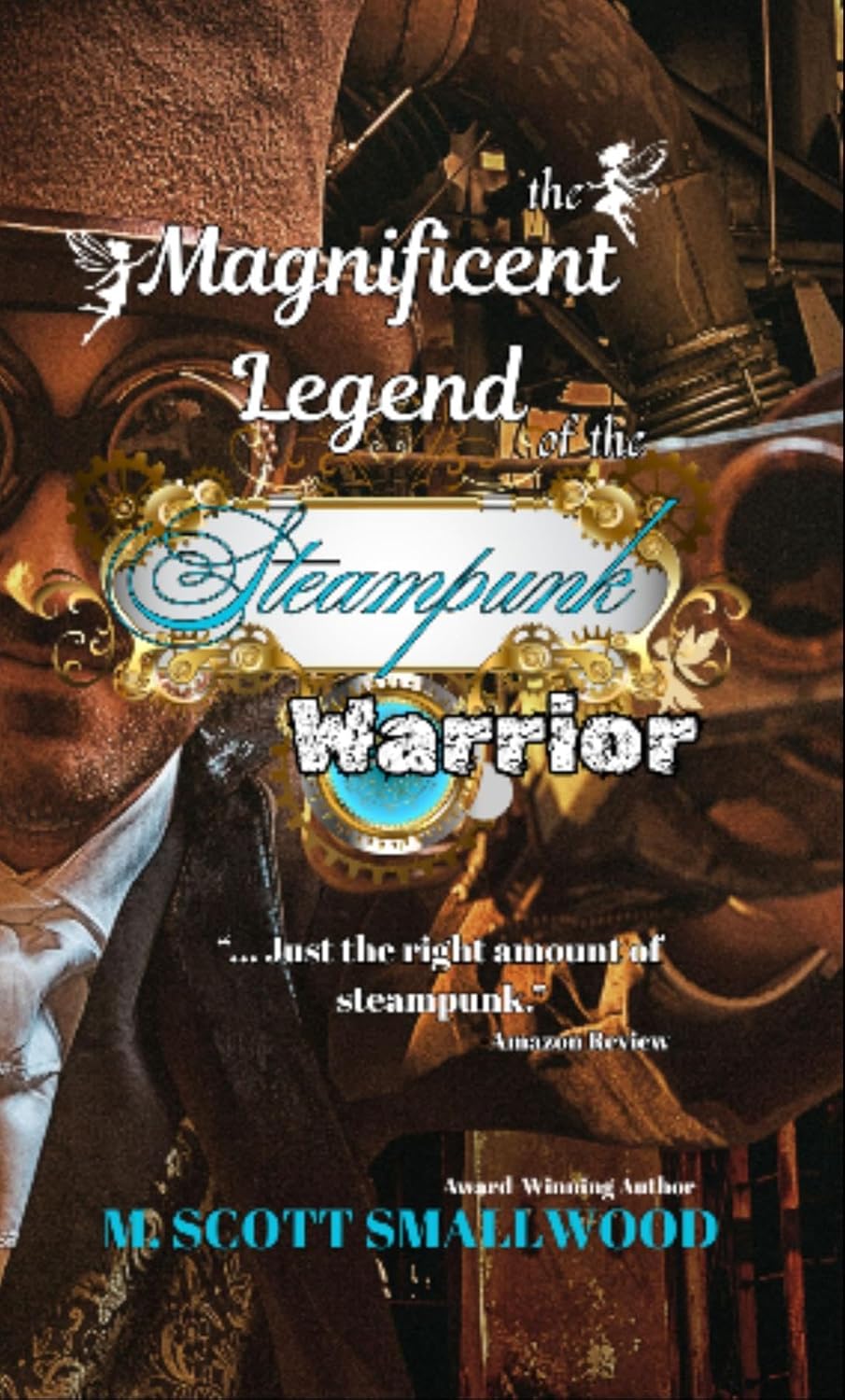

From the first page, The Magnificent Legend of the Steampunk Warrior feels like diving headfirst into a swirl of brass gears, magic dust, and heartbreak. It’s a strange and beautiful mix of time travel, friendship, and redemption. The story follows Thaddeus Might, a self-proclaimed Time Magician, along with Clyde, Arnold, Karl, and others as they tumble through centuries and worlds chasing after fragments of the fabled Golden Lion. The book blends steampunk invention with mystical lore and even a touch of science fiction, all while threading through themes of loss and second chances. It’s a wild, cinematic journey, jumping from Victorian England to alien worlds, filled with wit, wonder, and a surprising amount of emotion.
The writing is lush, full of rhythm and melody, almost poetic at times. Author M. Scott Smallwood clearly delights in language, spinning dialogue that feels both archaic and alive. Sentences twist and turn like clockwork spirals, sometimes dazzling, sometimes dizzying. Still, the characters kept me grounded. Clyde’s weariness and Arnold’s loyalty hit close to home. Thaddeus, with his tragic backstory and impossible hope, stood out the most. He’s eccentric and endearing, the kind of character who makes you smile even when he’s rambling about time’s cruel logic. What I liked most was how human it all felt beneath the fantasy, people clinging to purpose, trying to fix what can’t quite be fixed.
At times, I caught myself grinning. Other times, I found myself working to keep up with the story’s many threads. Yet, I never wanted to stop reading. There’s something earnest in the storytelling, something old-fashioned and heartfelt. You can feel the author’s joy and pain in every page, the same way you can hear a musician’s soul in the flaws of a live song. The mix of humor and heartbreak worked for me, especially when the story leaned into its quieter moments, those small pauses between battles where the characters actually breathe. That’s when the book shone brightest.
The Magnificent Legend of the Steampunk Warrior is an ambitious and oddly touching ride. I’d recommend it to readers who love sprawling adventures, old-school fantasy, and stories that aren’t afraid to get weird and sentimental. It’s messy, it’s moving, and it’s magnificent in its own peculiar way.
Pages: 268 | ASIN : B0FR2PMMPD

Gynarchy’s Golden Sire

The story picks up in the Zhiva Legacy universe, a strange and intoxicating place where women rule absolutely, men are property, and technology blurs the line between flesh and machine. The story opens with Erin Prisco as she struggles to reconcile her new role as a Duchess in the Gynarchy with her lingering feelings for Ethan, a man now trapped in the system of control. The narrative weaves her political and personal dilemmas together with Ethan’s harrowing descent into the Institution of Male Education, where bodies and minds are broken down to be rebuilt in submission. Running alongside these arcs is the scheming of Dr. Morgana Bennett, whose obsession with revenge pushes her into darker and darker manipulations. The book also threads in flashbacks and interludes, like the Patel children’s tragic past, which add weight and scope to the wider galactic power plays. It’s equal parts political intrigue, erotic dystopia, and space opera.
I was blown away by the sheer ambition of this world. The Gynarchy feels vivid and lived-in, equal parts terrifying and fascinating. The author leans into sensory description, making scenes lush and immersive. The erotic content isn’t just window dressing. It’s tied tightly to the politics, the power, and the characters’ own battles with identity. I sometimes found myself jarred by how clinical certain scenes of control and humiliation were, almost like reading a medical report stitched into a love story. As though the intensity tipped from emotional to procedural. I admired how unflinchingly the book asked me to confront the mix of desire, shame, and survival.
Erin feels caught in a tug-of-war between vulnerability and authority, and I often sympathized with her. Ethan, meanwhile, broke my heart. His resistance against the collar’s influence felt raw and real, and I think his chapters carried the most emotional punch. Morgana, on the other hand, is larger than life in her cruelty, and while she’s a compelling villain, her obsession sometimes teetered into melodrama. What I appreciated most, though, was that none of these characters felt safe. The book thrives on tension, political, sexual, and personal, and it kept me on edge in a way I didn’t expect.
Gynarchy’s Golden Sire is a bold, confrontational, and deliberately uncomfortable book, and I think that’s its greatest strength. If you’re willing to dive into a world where power, sex, and politics are tangled in ways that are sometimes ugly and sometimes beautiful, then you’ll find something here worth wrestling with. I’d recommend it to readers who enjoy dark science fiction with erotic and psychological edges, people who want their stories to provoke as much as they entertain.
Pages: 350 | ASIN : B0DFKD7LCT

Gynarchy’s Collar

In Gynarchy’s Collar, the first book in the Zhiva Legacy series, T.R. Schneider crafts a futuristic, sensual tale where gender dynamics are upended and power plays out through collar technology, political seduction, and raw emotional entanglement. The novel begins with a space expedition led by Lieutenant Ethan Drake and his crew, who are flung 200,000 years into the future and awaken in a galaxy now ruled by the Gynarchy—a matriarchal empire where men are property and emotions are often weaponized. Amid the sweeping backdrop of galactic intrigue and technological marvels, Ethan finds himself entangled in a dangerously intimate triangle with Anaisa, a brilliant engineer, and Dr. Bennett, a calculating psychologist with dark designs of her own. As passion meets submission and politics slips between the sheets, survival hinges on loyalty, vulnerability, and the cost of surrender.
The writing often walks a tightrope between lush and lurid, sometimes dipping into camp, but it works. Schneider isn’t afraid to lean into the drama, and that boldness kept me flipping pages late into the night. The world-building is ridiculously imaginative. Cryogenic sleep cycles, neural dampeners, collar-based control systems—these aren’t just sci-fi gimmicks, they’re woven into the emotional core of the story. Ethan’s internal war between duty and desire struck a chord with me. He’s a character who starts out commanding and composed, only to be slowly and methodically unraveled. And Anaisa is the heart of the book. Fierce, brilliant, but haunted. Her slow dance between empowerment and submission made her feel utterly real. And then there’s Dr. Bennett—seductive, sadistic, and absolutely terrifying in the best way. I hated her. I feared her. I was riveted by her.
At times, the eroticism felt heavy, and the psychological games Bennett plays, though chilling, sometimes strayed into over-the-top villainy. Still, I admired how Schneider used sensuality not just for heat, but to explore identity, control, and the ways trauma clings to us in unexpected ways. The prose flits between stark, almost clinical observation and poetic sensuality, which kept me off-balance, in a good way. The story thrives on tension, and the love triangle is both steamy and agonizing. I felt the ache of their choices, the way intimacy gets twisted in the gravity of power. And that final moment of self-doubt Ethan experiences stuck with me. It’s rare for a sci-fi novel to leave me feeling so bruised and breathless.
Gynarchy’s Collar is not for the faint of heart. It’s erotic, intense, and unapologetically subversive. But if you’re drawn to stories that blend sci-fi spectacle with intimate human messiness, and if you’re into high-concept world-building with sharp emotional stakes, this one’s worth your time. I’d recommend it to fans of The Expanse, Dune, and Fifty Shades of Grey. It’s a rare cocktail: space opera meets dark romance with a psychological edge.
Pages: 528 | ASIN : B0D8P91SV1
Everything Is at Stake

Until the Rescue Ship Arrives follows a retired priest who discovers a washed-up alien on a beach and chooses to protect this visitor and not turn them over to the authorities. What are some things that you find interesting about the human condition that you think make for great fiction?
Regardless of genre, what I consider great fiction always reveals the strengths and weaknesses of the characters who are presented with a problem or crisis in which much or everything is at stake. Great fiction requires presenting characters with great challenges.
What was one scene in the novel that you felt captured the morals and message you were trying to deliver to readers?
There are numerous scenes in Until the Rescue Ship Arrives in which characters had to reach deep within themselves, especially in Chapter 22, but to avoid giving those surprises away, a scene I would mention is in Chapter 4 when the female alien, already physically depleted and functioning almost on force of will alone, battles fatigue and the elements in her struggle to reach the Oregon shoreline.
What is the next book that you are working on, and when will it be available?
I am still exploring little fragments of stories that come into my head. Sooner or later, I’ll conjure a scene, a situation, or an exchange of dialogue that tells me there is a story here waiting to be discovered. I constructed the Until the Rescue Ship Arrives from the opening of Chapter 1 in which Father Hughes discovers the alien female on the beach. I saw everything pretty much as I wrote it up to the point when he kneels down and realizes he has discovered a person from another world. For some time thereafter I engaged in “what happens now?” until finally, I just began writing that scene. From then on, I was mostly just a reporter describing what I saw and what I heard the characters saying. The next book will probably follow that pattern.
Author Links: GoodReads | Amazon
The Morally Grey Character

The Dark Without follows a young woman living in a world where the Earth is dying, who is abducted by aliens and becomes a powerful mystical leader charged with bringing Earth back from the brink of death. What was the inspiration for the setup of your story?
When I first started, I had no idea where it was heading, but I knew it had to be along the lines of a total power failure and the ensuing outcome of what that brings. But by the third chapter, things started to veer sideways and new ideas hit me all at once. Having aliens in the mix wasn’t in the plans at first. But if I’d kept to the original, it would’ve been pretty drab and predictable, with the backdrop of an Earth falling dreadfully into a dystopian apocalypse with no hope of ever coming out of it. I did toy around with having the aliens as the good guys, but that would’ve been boring, and again, predictable. So I made the protagonist, Esme, the morally grey character – one who the reader would hopefully root for, yet be unsettled with her choices.
The inspiration for the “original” story came about several years ago during a power cut. I sat there feeling absolutely stranded and at a loss of what to do next. No power meant no WiFi, television, or even the air conditioner. What a cushy, entitled life we live in now, right? And from there, a thought bubble formed and a story – what if the power never came back on, what would happen? What would people do? And that ended up the base of the story.
I find the world you created in this novel brimming with possibilities. Where did the inspiration for the setting come from, and how did it change as you were writing?
The setting just sort of manifested organically. I keep a list of names for future characters in future books (which author doesn’t, right?), and I grabbed “Esme” because it sounded right for the story. A simple, classic name, and a little unusual from the norm. From there, I went with it, and decided she didn’t have to be the typical “English-speaking” protagonist, and why not have things happen in Spain, rather than the usual places…and from there, it spiralled onto a wider platform.
What were some themes that were important for you to explore in this book?
Not anything in particular, but by the time I was a quarter way into the first draft, I knew this was going to be a dark story. A vengeful story. One that would reflect humans at their core, as in what and how we would react in extreme situations and conditions. Just seeing what’s happening around the world is enough to understand what we can and will do, especially to another human being. That was the motivator for Esme’s character. A normal, young girl who is thrown into an impossible, horrific reality. What would she do, and how would she do it? And to what extremes would she go to, to get it done?
Will there be a follow-up novel to this story? If so, what aspects of the story will the next book cover?
Tempting, but no. While the end of the story left things ambiguous, the story is done. I enjoyed writing it.
Author Links: GoodReads | X (Twitter) | Threads | Instagram | Facebook | Website | Amazon
“Humankind is always doomed to fail. It has fallen many times before, and many times we have intervened to ensure it stays on the correct course. Earth is salvageable, but if you had continued along the path you were on, it would not have been. You have billions of years more to exist before your planet’s final destruction. We are only making certain it survives that long, and ensuring your survival until the ultimate end. At times you progress too fast, but such is humankind’s way. So we had to accelerate this current failure sooner in order to restart. As we have done before, a guide with a better objective and understanding of how to protect your world, will be inserted…”
But why did they care what humans did with their lives? They were aliens—beings from another dimension! Earth wasn’t their home.
Esme Serrano’s predestined encounter with the trans-dimensional anthropomorphic Aakehollats sends her on a multi-pathed journey spanning ten thousand years. A journey riddled with lies, manipulations and untold layers of deception. She guides Earth as the Sibyl, a powerful and mystical leader, and brings the dying world back from the brink of death. She helps the Aakehollats, and ensures that Earth survives until its ultimate destruction in the cosmos.
But her one true goal is, and always will be, to kill the Aakehollats.
A Sci-Fi Retelling

Pilgrims is a riveting near-future dystopian epic where humanity faces moral decay, societal collapse, and alien annihilation, forcing desperate characters to grapple with their darkest choices. What was the inspiration for the setup of your story?
I’ve never felt satisfied with first-contact sci-fi stories where aliens show up at Earth and we learn we’re not alone. That’s because the reasons the aliens come to Earth don’t usually stand up to scrutiny. For example, the aliens in Independence Day come to Earth because they want our “resources” despite the fact that if you can travel across interstellar space you will encounter all the resources you could ever want on lifeless rocks that don’t have pesky Earthlings defending them. The same goes for The Three Body Problem. Incredible novel, but the Trisolarans have such amazing technology that they don’t really need Earth for their species to survive. The motives are usually weak.
So I wanted to create a first-contact sci-fi story where the aliens’ reason for coming to Earth stands up to scrutiny. And, as outlandish as it sounds, aliens that are devout believers of an Earth religion (in my novel – Catholicism) have a very compelling reason to travel all the way to Earth. It’s such a good motivation in fact, that I was shocked to see no other writer had ever addressed it. And so, I took it upon myself to do so.
Austin DeSantis is an intriguing and well-developed character. What were some driving ideals behind your character’s development?
Pilgrims is a sci-fi retelling of Saint Augustine’s Confessions which was published sometime around 400AD. Now that’s an old book, and yet we still study it because it paints such a brilliant portrait of a troubled man finding his redemption. That’s something we can understand across the ages.
So I kept Saint Augustine as a vision when crafting my protagonist – Austin DeSantis. He is struggling at the beginning of the novel but, through the various trials he encounters, he grows, albeit in an enormously painful way.
What were some themes that were important for you to explore in this book?
Forgiveness – why we need it and why it is so hard. That is the core theme. But the book also explores why it can be so difficult for us to change our minds sometimes because of the things that are unknown even to ourselves that hold us back.
What is the next book that you are working on, and when will it be available?
Austin’s story is not over. The book concludes about fifty days after aliens arrive on Earth and proclaim to be Catholic. What happens to society ten years after such a momentous event? Fifty years? There is still so much story to tell. And I expect the sequels will be coming out over the next few years.
Author Links: GoodReads | X (Twitter) | Facebook | Website | Amazon
Out-of-work Latin teacher and borderline alcoholic Austin DeSantis is determined to spend his final days in the arms of a prostitute-that is if the aliens don’t exterminate humanity first.
But when the aliens land at the Vatican, begin speaking Latin, and reveal themselves to be Catholic, the world turns upside down.
Pressed into service as a translator and thrust into the center of humanity’s first contact with a cryptic alien race, Austin must uncover their true intentions before religious turmoil rips the planet apart. But with Austin caught between the Catholic Church, the US military, and an enigmatic alien AI, he’ll have to decide where his loyalties lie as the fate of humanity hangs in the balance.
PILGRIMS is a sci-fi retelling of Augustine’s Confessions, mixing a high-concept premise à la Children of Time with the ceaseless pacing and rich characterization of Red Rising.
Gravity of Sol-3

Gravity of Sol-3, the first book in The Sentinel Suppressions series by J.H. Gruger, plunges into a fractured world teetering between human resilience and alien oversight. The story alternates between a near-future Earth plagued by eugenics and societal unrest and a distant galactic frigate tasked with suppressing civilizations that challenge universal protocols. At its heart, the narrative grapples with the conflicts between progress, oppression, and morality through the lens of deeply personal struggles and cosmic consequences.
From the opening chapter, the writing grabs readers’ attention with its visceral imagery—especially Robby’s sensory overload and his refuge in tacos and tools. The perspective of a neurodivergent child juxtaposed with the larger societal collapse felt raw and uncomfortably authentic. Yet, I do feel that the pacing varies greatly in places; the second chapter’s romantic setup feels abruptly interrupted by a dystopian twist. While this mirrors Scott’s tumultuous life, the shift left me somewhat disoriented, almost like being thrust into an entirely different book.
The ideas in Gravity of Sol-3 are ambitious, with Gruger exploring everything from primordial black holes to telepathic suppression. The scientific discussions, especially Scott’s work with Dr. Agosti, fascinated me. Agosti’s theories about dark matter felt eerily plausible and made me yearn for more scenes in the Pecos lab. Scott’s budding camaraderie with Agosti hinted at a warmth the book rarely lets breathe. The scenes with Scott and Robby—a neurodivergent brother whose joy for simple tools balances the chaos around him—are tender and heart-wrenching. Gruger crafts these moments with precision, letting Robby’s innocence highlight humanity’s potential for both cruelty and care. By the end, the stakes reach astronomical heights, but the climax leans on complexity rather than clarity. I was left with more questions than answers—both a frustration and a testament to Gruger’s knack for intriguing setups. Readers who thrive on hard sci-fi concepts with heavy doses of moral quandaries will find plenty to chew on.
I’d recommend Gravity of Sol-3 to fans of gritty, thought-provoking science fiction. If you appreciate tonal shifts and dense scientific exposition, it’s a rewarding journey. However, readers seeking streamlined plots or character-driven narratives might feel somewhat lost in the intellectual labyrinth Gruger constructs. The unique reading experience offered within Gruger’s complex novel is one well worth exploring.
Pages: 444 | ASIN : B0D2X1V4HB
Born in Space: Unlocking Destiny
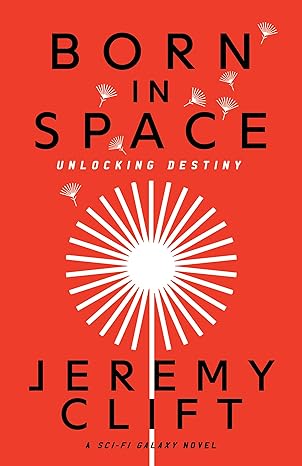

Born in Space: Unlocking Destiny, by Jeremy Clift, transports readers to Tucson, Arizona, in 2063, introducing the Ward family amid a society where artificial intelligence seamlessly integrates into daily life. This relatable yet futuristic setting immediately captivates, highlighting the pervasive role of AI in human existence. We learn that the children’s mother, Clara, is stationed on the Moon as a botanist, working to establish a sustainable food supply. As Earth’s conditions deteriorate, humanity seeks refuge on other planets, though these colonies also face growing unrest.
The narrative intensifies as the Ward family relocates to an orbiting space habitat, delving into profound ethical and moral dilemmas that resonate deeply. Despite its futuristic backdrop, the story remains relatable, reflecting issues not far removed from our current reality. Clift skillfully evokes emotions of remorse, pity, and sadness early in the tale, crafting a narrative that explores the essence of humanity and the potential alienation brought by technological and societal advancements. As a mother, I found myself moved to tears on multiple occasions.
The plot follows both Teagan and Hunter Ward, though Teagan’s journey particularly stands out. While Hunter’s storyline contributes to the overarching message, Teagan emerges as the central figure, her experiences deeply engaging. The antagonists in the novel are portrayed with striking malevolence, and certain scenes are intense, featuring violence and gore that may be challenging for some readers.
Born in Space: Unlocking Destiny serves as a poignant reminder of the consequences of overstepping natural boundaries, especially concerning the future of AI and technology. It’s a compelling read that I highly recommend, and I look forward to adding a physical copy to my collection.
Pages: 443 | ASIN : B0D1PWPRBJ



 LITERARY TITAN