Blog Archives
Awakening – There is Only One Truth


Awakening is a spiritual historical-fantasy novel that follows Dr. Stefano Mondi, a modern clinical researcher from Basel who is unexpectedly pulled into a vivid, fully embodied journey to first-century Jerusalem. The book begins with Stefano’s very ordinary, structured life, then drops him into an ancient world that feels startlingly real. What starts as a strange dream becomes a full immersion: the heat of the streets, the chaos of the marketplace, the brutality of Roman soldiers, and eventually the quiet mystery surrounding the Teacher of Righteousness. Through Stefano’s eyes, we watch historical, religious, and mystical elements intertwine as he tries to understand why he has been transported across time and what role he is meant to play. The story blends elements of spiritual fiction, adventure, and historical drama.
The writing is straightforward and clear, and it leans heavily into sensory detail. I liked how quickly I felt the weight of the sun on him, the claustrophobia of crowds, the tension of being an outsider. The author doesn’t rush the plot. Instead, the early chapters dwell on Stefano’s confusion and slow adaptation, which helped me feel grounded in the strangeness of his situation. Some passages move with a measured, almost reflective rhythm, letting the atmosphere build, while others jump into sharp, breathless moments of danger. That mix kept pulling me forward.
I also liked how the author handles the historical and spiritual material. The book is bold in how it reimagines familiar figures. Seeing Yeshua, Miriam of Magdala, Nicodemus, and even Saul through Stefano’s skeptical, modern eyes gave their scenes a refreshing angle. The Essenes, the politics of the Temple, and the tensions of Roman-ruled Judea are woven into the narrative in a way that feels accessible even if you don’t have a background in theology. Sometimes the novel leans close to spiritual allegory, then it swings back toward intimate character moments that feel almost like a conversation between past and present. It’s a curious balance, and while not every leap completely landed for me, I admired the ambition behind it.
I think Awakening is a story for readers who enjoy spiritual fiction with a historical edge. Its heart lies in personal transformation: one man waking up to a world far larger and more mysterious than the life he knew. If you like novels that explore faith, identity, and destiny through an accessible, story-driven lens, this one will speak to you. It’s a reflective, imaginative journey, and I think readers who appreciate thoughtful historical spiritual drama will connect with it most.
Pages: 193 | ASIN : B0F4M4PMLJ

Human Nature

The Great Hunter follows a young hunter living in Mesolithic Britain about 10,000 years ago who is determined to wed the woman he loves, but to earn her hand, he must kill a rare and dangerous giant stag. What was the inspiration for the setup of your story?
I’ve always been a big fan of ancient myths and legends. The GREAT HUNTER is written in that style. It is a classic tale, a quest in which the hero must kill a dangerous beast in order to marry the woman he loves. A re-awakened family feud, subsequent betrayal, and long-awaited revenge are essential parts too.
What were some themes that were important for you to explore in this book?
I know a lot of authors would probably say this, but it’s the age-old theme of human nature. I don’t think it has changed very much since humans first appeared on this planet.
What intrigues you about this time period enough to write such a thrilling period piece?
I have always been into history – and prehistoric times in particular. I like the mystery of it.
But there was another reason too. Many years ago I started to experience these images – recurring images in my head. They were of ancient people who wore clothes made from animal-skins, lived in what looked like wig-wams, travelled on foot or by canoe and used tools of stone, wood, bone and antler. These images kept coming to me over several years. They really were vivid and after a while I could tell certain individuals apart. Many of the places I saw, too, looked somehow familiar.
Research led me to believe these people were part of a hunter-gatherer tribe who lived in what is now England about 10,000 years ago. I knew I had to give them a voice.
What is the next book that you are working on, and when can your fans expect it to be out?
If The Great Hunter does well, there will be a sequel: THIRTEEN MOONS – which follows on from where the first book ends.
If that does OK too there could be a series: TALES FROM THE DREAMTIME. Another two or three books about Garetto and the Nahan tribe. But also other people, other hunters and gatherers in different times and places.
I have a long-term medical condition which, though not deadly, does slow me down a bit. I have to work at my day job too. So it would probably take me about 2 1/2 years or so to write another book.
Author Links: Facebook | Website
Powerful spirits and other supernatural beings influence everything in the minds of these people, from the weather to illness, to childbirth and success in hunting or courtship.
Life is not without its challenges, but the real hardships of the Ice Age that ended over sixty generations before are becoming a distant memory. There is an abundance of game animals, fish and plant foods too, in season. Rich pickings for the numerous bands of hunter-gatherers. Yet the country is as hazardous as it is bountiful. Bears, wolves, aurochs and other wild animals that could kill a man roam the landscape. Floods, blizzards, wildfires and tree-felling storms may strike with little or no warning. Still more danger comes from the tribal wars that might suddenly flare up, with their brutal raids and counter-raids. Destruction may also come from enemies within.
A young hunter, Garetto, is determined to wed Harenshi – a woman of another camp, who he loves. True, there was trouble between their families many winters before, but all they want is to stay together, and stay with their own people.
Challenged to go away from the gathering to kill a very rare – and very dangerous – giant stag, Garetto travels far from the camps, with only his dog for company. It is the middle of a freezing, snowy winter, and the hunting-ground is a hostile one.
It seems an impossible quest, but only when Garetto returns with the sacred antlers will the ox-chief Haranga – Harenshi’s father – allow him to wed his daughter.
But the past is far from forgotten, or forgiven. Haranga breaks his promise, resolved Garetto must never return to his people. This act of betrayal – and the sudden appearance of a mysterious and powerful shaman – will have fateful consequences for the whole tribe…
The Great Hunter

Kel Paisley’s The Great Hunter follows the life of Garetto, a young man living in Mesolithic Britain about 10,000 years ago, when hunter-gatherer tribes struggled to survive in harsh landscapes shaped by ice, wind, and rising seas. At its heart, the story is about love and loyalty. Garetto longs to wed Harenshi, a woman whose father not only disapproves of him but actively threatens their bond. What unfolds is a tapestry of tribal politics, sacred rituals, dangerous hunts, and the daily fight for food and honor. The novel blends historical imagination with intimate storytelling, letting the reader step into a time when survival and tradition dictated nearly everything.
The writing is vivid, almost cinematic, and the world feels tactile. But at times, the descriptions ran long. The dialogue, though, had a sharp edge. It carried both warmth and menace, and I often felt the tension of being in a camp where every look and every word could spell danger. I liked that it didn’t sugarcoat the violence of the time or the rawness of relationships. It made the book feel honest, though also heavy.
What struck me most was how much of the book pulsed with longing. Garetto’s love for Harenshi is desperate, almost reckless, and it pulled me in. I felt for him, even when he acted out of pride or anger, because his emotions rang true. The book made me think about how love, fear, and family ties have always shaped human lives, no matter the era. Still, I’ll admit there were moments when I wanted less ritual detail and more forward momentum, but the ideas always kept me hooked. The mix of survival and spirit, blood and devotion, felt raw and human.
This is not a light read. It’s immersive, dense, and full of grit. I would recommend The Great Hunter to readers who enjoy historical fiction that leans into the primal side of human nature. If you want an adventure that is full of danger and love, and you’re seeking a story showing a clash between tradition and desire, this book is for you.
Pages: 453 | ASIN : B0FM58B2TW

Ramparts of Winter Iron: When Frost Hammers the Gate
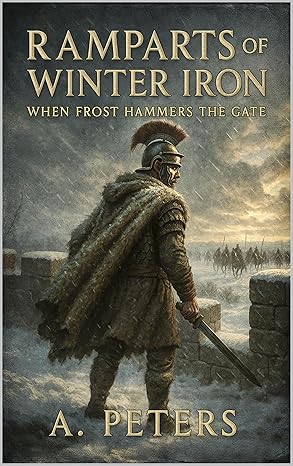
Ramparts of Winter Iron is a gritty and tightly woven historical fantasy set on the snowy fringes of a fading Roman frontier. The story follows Flavius Marcellinus, a seasoned Roman officer tasked with holding the fortress city of Caesarea against a rising tide of nomadic Alan invaders. With only raw recruits, improvised weapons, and the bitter cold at his back, Marcellinus must forge discipline out of desperation. The novel tracks his struggle through military drills, political tension, and a climactic night raid meant to cripple the enemy’s supply line. It’s both a tale of war and a meditation on duty, leadership, and the endurance of civilization under siege.
What I loved most was the sheer sense of place. The cold felt like a character all on its own. It was biting, unforgiving, and always present. Peters’ writing style is direct and powerful. There’s no fluff here, no purple prose. Every sentence pulls its weight. I appreciated how the author balanced action with introspection. Marcellinus isn’t a superhero. He’s tired. He doubts himself. But he pushes on. That kind of worn determination struck a chord with me. The battles are gripping, the tactics believable, and the stakes always feel real.
The book asks a lot from the reader. You’re dropped right into a cold and crumbling world with little time to catch your breath. At times, I found the sheer amount of logistical detail overwhelming, especially regarding the tactics. It’s clear the author did his homework, and I admire that. This book is a great pick for readers who love diving into the gritty, boots-on-the-ground details of Roman combat, from shield formations to siege engines and everything in between. But the details slow the story in moments when I wanted the story to move. Still, those slow patches are outweighed by the raw emotional honesty of the characters. Antonus, the reluctant farmer-turned-soldier, especially stood out. He gave the story a human core beyond all the spears and orders.
Ramparts of Winter Iron surprised me with its depth. It’s about building something worth protecting when the world seems bent on tearing it down. I’d recommend it to readers who enjoy Roman-era fiction, military history buffs, and anyone who’s drawn to stories of quiet bravery and stubborn hope.
Pages: 259 | ASIN : B0F71QK934
Rome’s Culture

In The Altar of Victory, you take readers on a journey into the days of the Western Roman Empire and the political fallout following the death of Emperor Valentinian I. Why was this an important book for you to write?
It was important to me for several reasons. My interest in this era began long ago, when I was a European History major in college and had taken a class on the period from Late Antiquity through Charlemagne (300-800 AD roughly). The period up to Constantine was well covered, as was the actual catastrophe of the sack of Rome in 410 AD and the subsequent barbarian invasion. However, the course jumped past the last half of the 4th Century, when the Roman empire was still intact and just before these catastrophes began to increase. The more I read in the intervening years, the more evident this gap appeared. Even Gibbon’s Decline and Fall of the Roman Empire tended to treat this critical period of European history in summary fashion.
I also decided that the question of how such a technologically advanced civilization like Rome, with the most organized army and engineering in the world, could fail to see the threat and fall so quickly to less organized enemies. Was there a point when the decline could have been arrested? Did it really come down in part to the deaths of perhaps three key emperors (Valentinian, Valens, and Gratian)? Was it cultural change and the loss of a Roman identity? What role did the advent of organized Christianity play? It was a host of puzzles that I wanted to understand, if not solve.
Can you share with us a little about the research that went into putting this book together?
Before I began writing, I spent several years accumulating various non-fiction sources- books by more contemporary historians like David Brown and Michael Grant; biographies of Ambrose of Milan, etc. I also went to the limited primary sources- Ammianus Marcellinus, of course, Zosimus, the letters of Symmachus, St. Jerome, Ausonius, the Notitia Dignitatum, and others; the military manual of Vegetius. Even as I began to outline the plot and write the first chapters, I continued to read and learn what I could, and still felt that so much was still missing from the historical record. Which was also good, because it enabled me to fill in with a plot of my own devising!
What were some themes that were important for you to explore in this book?
I wanted to explore what remained of Rome’s culture in the 4th Century, and how it had been eroded or replaced as the empire had grown and the city of Rome was no longer the center of the empire. I was also interested in the courts of the emperors, when the emperors no longer came from Rome or even visited very much. The idea that the key military and administrative figures had now become Gauls, Franks, and other nationalities/tribes who had only recently been enemies of Rome seemed to me to be critical in understanding how “Romanness” could have been disappearing for decades before a military transition occurred.
Another theme of importance to me was the figure of Gratian. By all accounts, he was a decent and brave military leader and tried to be a good emperor. He was also a fairly devout Christian and took an interest in the ecumenical issues of the day. And yet, he did not last, and after his reign, the Roman army did not do well in the west. I wanted to explore whether he was the last, best hope for Rome and what factors worked against his success.
Can we look forward to more work from you soon? What are you currently working on?
I am both researching and writing the sequel to The Altar of Victory, in which I intend to conclude Gratian’s story. I am also trying valiantly to finish a collection of short stories set in the 19th and early 20th centuries of Louisiana and Texas before year end.
Author Links: GoodReads | Facebook | Website | Amazon
The Altar of Victory
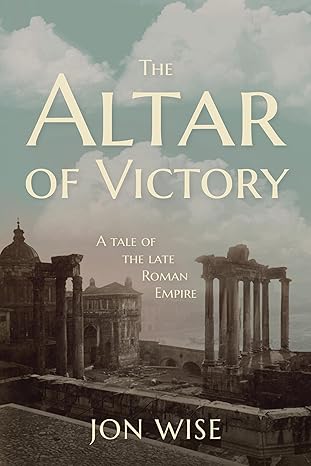
The Altar of Victory is a historical novel that plunges the reader into the waning days of the Western Roman Empire, centering around the death of Emperor Valentinian I and the political maneuvering that follows. Set in 375 A.D., it opens with Valentinian’s dealings with barbarian tribes and internal dissent, leading to his sudden death after a fit of imperial rage. The story then shifts into high-stakes political chess as the ambitious general Merobaudes races to install young Valentinian II on the throne before rivals can seize control. Along the way, the novel wrestles with themes of legacy, power, faith, loyalty, and the slow unraveling of an empire.
I found myself immediately immersed in its stark, lived-in world. The writing is richly atmospheric and historically informed, without ever feeling like a lecture. Every decision, every letter, and every small detail, like the crack in the aqueduct or the placement of a chair, feels purposeful. The prose is tight, clear, and evocative. What struck me most was how human the characters felt, especially Valentinian. He’s brutal, weary, proud, and oddly sympathetic. When he collapses mid-sentence, the emotional weight lands hard. The tension is just as strong in the quieter moments, furtive whispers in palace halls, long rides through uncertain terrain, as it is in battles and tribunals. I especially appreciated the balance between dialogue and action; the pacing kept me glued.
That said, what I really liked was the depth of the ideas. The book takes a hard look at power and how it mutates in uncertain times. The clash between the old gods and Christianity is not just window dressing; it’s a lens through which every character sees the world. Merobaudes, in particular, is a fascinating figure. He’s clever, opportunistic, not fully Roman yet entirely molded by Rome’s ideals. The women in the story, especially Justina and Mirjeta, are sharp and compelling, with agency that matters. There’s also an aching sense of decay in every corner of the empire, ruined towns, forgotten monuments, fading gods, that gives the story a haunting quality. I found myself thinking a lot about how empires die, not just politically, but spiritually.
I’d recommend The Altar of Victory to anyone who enjoys political intrigue, ancient history, or character-driven stories with bite. It’s a slow burn, but a rewarding one. If you like your historical fiction thoughtful, gritty, and emotionally textured, this one delivers. It’s not light reading, but it’s deeply satisfying, and in more than a few places, surprisingly moving.
Pages: 537 | ASIN : B0DCQ783YW
Colloquialism and Exoticism

Damnatio Memoriae is the final, emotionally raw, and beautifully written chapter of the Nero and Sporus saga. How do you feel now that you have completed Sporus’s story, and were you able to achieve everything you wanted with the characters in the novel?
This is really one long novel, but now that I’ve reached an advanced age, I always worry about being able to finish things so I decide to do it as a trilogy so that even if I were to pass away, that would still be some parts of the book out as separate books. Because of this, I’ve lived with the characters for a very long time. One thing though is that we do know how the story ends, and we’ve always known it because it’s one of the few things that the historical record actually tells us. One problem with releasing the story in smaller chunks has been people getting the last chunk and complaining bitterly about the protagonist’s fate. Unfortunately, it’s one of the few things I couldn’t change without violating the whole idea of a historical novel.
What goals did you set for yourself as a writer in this book?
My largest aim was to truly inhabit the world of the first century and completely eschew any kind of moral or philosophical biases I might have as an inhabitant of our modern era. This is very difficult because so many things that were taken for granted are now shocking, and something that taken for granted today would’ve shocked the Romans. For example, the idea of people actually being equal would have been astonishing. Sex and violence, so much a cause of societal uproar today, were not only not that profound, they were even mostly entertainment. One reader complained bitterly that I didn’t use archaic language. But the Romans didn’t know they were ancient! I had to strike a balance between colloquialism and exoticism. Everyone doing what I do has to find their own happy medium. I hope that that which is exotic or horrific about the Roman world comes across most successfully when it is treated as completely commonplace.
What experience in your life has had the most significant impact on your writing?
Bringing up a child who was completely comfortable as either gender and had no qualms about switching whenever he felt like it. This book is actually dedicated to him. I use the word him because the language I usually speak to him in is Thai, a language in which most pronouns are gender-neutral. People who grow up in this culture simply don’t suffer any agony about pronouns.
What is the next book that you are working on, and when can your fans expect it to be out?
I’m returning to science fiction and fantasy at the moment with a new post-holocaust trilogy set among wolves. I’m also doing a sixth novel in a series that I’ve been working on for over 40 years. It was very popular in the 80s and I’m reviving it. It’s one of those vast Galactic Empire kind of things.
Author Links: GoodReads | Facebook | Website | Amazon
Captured by pirates as a boy and trafficked to the slave markets of Rome, Sporus rose from a poet’s plaything to one of the most powerful figures in the Roman Empire.
The historian Suetonius tells us that the Emperor Nero emasculated and married his slave Sporus, the spitting image of murdered Empress Poppaea. But history has more tidbits about Sporus, who went from “puer delicatus” to Empress to one Emperor and concubine to another, and ended up being sentenced to play the Earth-Goddess in the arena.
The decadence of Imperial Rome comes to life in S.P. Somtow’s Literary Titan Award-winning trilogy about one of ancient history’s wildest characters.
Damnatio Memoriae

Somtow’s Damnatio Memoriae is the final, emotionally raw, and beautifully written chapter of the Nero and Sporus saga. It’s a deeply personal journey told through the voice of Sporus, a former slave and imperial concubine, who relives his (and her) rise and fall at the edges of empire, identity, and power. This isn’t your average Roman epic—it’s visceral, surreal, darkly poetic, and hauntingly queer. With Nero’s collapse and Rome’s chaos as the backdrop, Sporus reflects on life, gender, betrayal, and the myth of love, all while waiting to be executed in a packed arena. It’s intense.
What hit me first was how lyrical the writing is. It reads like a fever dream soaked in garum and incense. Somtow doesn’t hold back—there’s real pain here, but also twisted humor and staggering beauty. The opening monologue, for example, where Sporus describes the reek of sand, blood, and beast dung in the arena, while cracking dry jokes about makeup and waiting for a death scene, felt like Oscar Wilde doing Gladiator cosplay. And yet, it’s achingly tragic. And then there’s the ring scene in the marketplace, where a carved image of Persephone triggers a spiritual collapse and sparks an impromptu imperial crucifixion crisis. Absolutely brilliant and brutal.
That said, this book isn’t an easy read. It expects a lot from you—emotionally, intellectually, even morally. Nero is magnetic and monstrous, sometimes at the same time, and the dynamics between him and Sporus swing from disturbing to tender. Somtow nails this complexity. But the heartbreak really comes from how aware Sporus is of their own powerlessness, even while being dressed up as a goddess or cherished as a boy. In “Clipped Wings,” the metaphor of the clipped doves—meant to be freed in a religious ritual but secretly recaptured—just gutted me.
If you like your historical fiction brutal and beautiful, if you’re into mythology reimagined through a queer lens, if you can handle morally messy characters and poetic trauma—this is for you. Fans of Mary Renault, Madeline Miller, or even Game of Thrones at its sharpest will probably find something to love here. But it’s also for people who want to feel something deep and uncomfortable. I’m not gonna lie, it’s sometimes hard to stomach—but I didn’t want to look away.
Pages: 232 | ASIN : B0F2YZ1HRH


