Blog Archives
My Version of Vampires

To End the Night follows Julius Caesar as he battles a secret enemy, one that is dark and sinister and exists in the shadows of the Roman Empire. What was the inspiration for the setup of your story?
I really wanted to do a different take on vampires and I was watching a documentary about Julius Caesar and just thought, huh, that would be a good setting to do my version of Vampires in. I wrote the story originally in the late 90’s as a short story and then beefed it up to a novella later.
Can you share with us a little about the research that went into the historical aspects of your novel?
Loads and Loads! I have an entire bookcase dedicated to Julius Caesar and ancient Rome now. Many hours reading with highlighters and googling things for clarification. I also went on a history channel binge for JC documentaries. I listed some of the most used research items in the back of the book. I wanted the history in my historical fiction to be as accurate as possible. I am writing a book starring Genghis Khan now and already have 18 history books I’m going through.
How were you able to strike a balance between historical accuracy and supernatural events?
For me, it was a matter of motivation. Why did JC cross the Rubican? Why did he pursue power so doggedly? And then finding places to slip in the motivation. I wanted the history to be the star of the show with the supernatural as a supporting cast.
What is the next book fans can expect to see from you?
I have a book with the editor right now called The Ballad of Jayce: Not Your Mother’s LitRPG. It is my take on LitRPG. I’ve been told it is like a LitRPG meets Ready Player One. I am using an editor that is completely unfamiliar with the genre to help me make it as accessible as possible to people who do not read LitRPG. I needed a fun thing to do after all the research that went into this book. I am also 25 thousand words into my Genghis Khan historical fiction and have plans for a Terry Pratchet style book after that. I plan on bouncing between more serious historical fiction and light hearted fun things.
Author Links: GoodReads | Bluesky | Facebook | Website | Amazon
A Poet and An Artist

Moses and Akhenaten: Ancient Egypt Fiction Series Book 1 explores with great detail and some imaginative storytelling the theory that the biblical Moses and the Egyptian Pharaoh Akhenaten were the same person. Where did the idea for this novel come from and how did it develop over time?
Akhenaten amazed me as a child. He was considered the “first monotheist” and “first individual in history”.
As an adult, I wanted to write literary fiction and chose Akhenaten as a subject. This book is a response to a man who was not only a king with a unique religious vision, but also a poet and an artist.
Fiction is an art form that uses elements of the imagination as an artist uses paint. Many paintings are layered and this was my approach. It seemed appropriate because King Akhenaten was many things.
First, there is the little boy, Akhy, and his family, all of whom are based on real people instantly recognizable to those familiar with Egyptian history.
Akhenaten crossed his own time and culture to be of interest to people in many countries living in times different from his own. It is the reason he debates with modern academics in the novel and why a time machine is included.
The real King Akhenaten was an artist so far ahead that much of his work appears to be out of his time. His art, for instance, has been described as expressionistic. It is the reason this novel shows him painting both within his own time and in ours.
Likewise, his ownership of Bessie, the dinosaur is an echo of the Biblical leviathan. This creature is mentioned in Psalm 104, which is also dubbed the Song of Moses. It is this psalm that scholars have equated with Akhenaten’s own Hymn to the Aten. They both appear at the end of this novel where readers may compare the two works at their leisure.
There have been heated responses to the Moses and Akhenaten theory. Ahmed Osman had his book, which boldly stated that Akhenaten was the prophet, burned in the streets of Cairo.
My book is not an altogether serious religious discussion, which is better served in the academic realm of non-fiction. Rather, it is a celebration of the artist and the poet whose religious ideas still intrigue us.
Children appear in the novel because they, more than any of us, express the joy of life and creativity.
As for Akhenaten, Egyptologist and Director General of the Cairo Museum (2004 to 2010), Wafaa El-Saddik once said he was of huge importance, not simply as an Egyptian pharaoh but to the history of the world.
It must be remembered there is still a lot for us to discover about the Egyptian king. In the meantime, while the academics debate and archaeologists dig, this novel invites the reader to celebrate a genius who was a significant thinker and innovator in human history.
Did you find anything in your research of this story that surprised you?
My conclusion, which is that Akhenaten is not Moses.
Once heralded as a forerunner of Christ and the first monotheist, Akhenaten was later considered to be a fanatic who ruled in a manner not unlike that of the Nazis. (This is the reason there is a reference by Akhenaten in the novel to this latter-day interpretation.)
Many people, including the famous psychoanalyst Sigmund Freud, were captivated by both the prophet Moses and the pharaoh Akhenaten without making a connection that the two could be the same individual. Other writers made the connection, including the Egyptian author Ahmed Osman, who declared Akhenaten to be none other than Moses.
I visited Egypt several times, fuelled by the desire to discover more about both Moses and Akhenaten. I am also qualified in Egyptology with a postgraduate degree in the discipline.
The whole process was a massive undertaking and the novel was shelved for many years. Now, after further thought, I have concluded that Akhenaten was not the prophet Moses. Part of the reason is that there are new academic theories and archaeological evidence that support this conclusion.
However, Akhenaten’s revolution was important and still intrigues many historians. What is interesting is that the prince of Egypt, who caused issues in Egypt has no other historical parallel except with Pharaoh Akhenaten.
Both Moses and Akhenaten were raised in Egypt. Moses’ Ten Commandments are a brilliant abbreviation of the Negative Confessions within ancient Egyptian writings. It is no accident, either that there are echoes of Akhenaten in the holy books.
Even while scholars debate Psalm 104 and the Hymn to the Aten, and whether Akhenaten was a monotheist or not, his city is still out there. Badly in need of restoration, my view is that it is a city of global importance, not simply another local heritage site (as valuable as such sites are).
Despite the deep connections between Akhenaten and Moses, for me, Akhenaten stands on his own as a great Egyptian prophet who was light years ahead of his time. There is no need for him to be Moses to hold his place in history.
Egypt should be credited with his achievement as with other great works of their civilization such as the pyramids. The ancient Egyptian civilization was the most advanced of its time, and as Wafaa El-Siddik pointed out, Akhenaten is of immense importance to the world.
What were some ideas that were important for you to share in this book?
I wanted people to think about Akhenaten. We are all aware of Moses from holy texts. Three monotheistic religions recognize him as a prophet. However, archaeological evidence shows that there once lived a king who spearheaded a religious revolution and did something so extraordinary that we are still talking about it. The site of Akhenaten’s city, Tell el-Amarna, which the ancient Greeks referred to as the City of Moses, still exists in the middle of Egypt.
When will book two be available? Can you give us an idea of where that book will take readers?
Book two is available. The Tutankhamen Friendship has a British style because it is about the English discoverers of Tutankhamen’s tomb. Both English and European readers love it, perhaps due to the style and their familiarity with the story.
Book three, The Queen Who Became King is also available. It is based on the true story of an ancient Egyptian queen, and incidentally one of Akhenaten’s ancestors. Feeling that she had to protect her young nephew Tuthmosis, this extraordinary woman stepped up to rule as king. At her death, Hatshepsut left a legacy of a strong country to her nephew. Tuthmosis III, known as Tuthmosis-the-Great, inherited her throne and went on to become Egypt’s greatest conqueror. To this day, he is thought to be Egypt’s foremost military ruler.
Author Links: GoodReads | X | Facebook | Website | Book Review
He could inherit the throne of Egypt …
… and change the world forever.
But does he?
This is the first novel to set Akhenaten in his childhood.
Making use of the theories surrounding a king, who has been thought to be Moses, the book entertains with a poetic tale of children and what might have been, if only it were true!
Moses and Akhenaten: A Child’s Tale
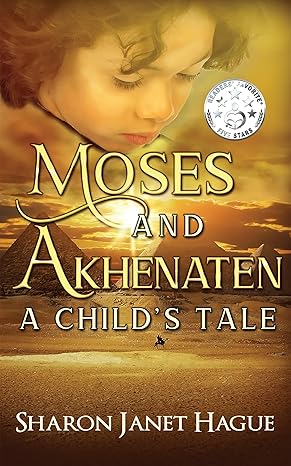

Moses and Akhenaten by Sharon Janet Hague takes on the ambitious theory that the biblical Moses and the Egyptian Pharaoh Akhenaten were the same person. The book weaves historical analysis and imaginative storytelling, proposing that the famous biblical exodus and Akhenaten’s religious revolution are intertwined stories of the same man. Through a blend of fictional dialogue, historical narrative, and philosophical musings, Hague presents a compelling story for this theory.
The book is a unique mix of informal conversation and deep historical exploration. At times, it feels like sitting in on a heated debate among scholars as characters such as Walter, Tom, and Ernest discuss the possible connections between Moses and Akhenaten. For instance, Tom’s logical statement, “If Theodore Davis’ discovery in cache number fifty-five was Akhenaten’s body, then Akhenaten cannot be Moses,” drives home the tension between hard evidence and speculative theory. This dynamic made the book engaging and made me feel like I was part of an intellectual journey, though I feel that sometimes the debates veered into detailed and repetitive territory.
One of the things I loved about the book was its willingness to tackle big ideas with an unapologetic mix of history and conjecture. The idea that Akhenaten’s monotheism predates and even influences the Jewish faith is thought-provoking, and Hague doesn’t shy away from pushing that theory. She writes, “Nobody can convince me that billions of people worshipping one god, thirty-one centuries later is anything but a success”, showcasing Akhenaten’s monumental impact, whether or not he was Moses. While the story borders on speculative fiction, Hague’s presentation of Akhenaten as a revolutionary and somewhat tragic figure is heartfelt, bringing life to what could otherwise have been a dry historical argument. At one point, Akhenaten himself complains about modern perceptions of him: “I can’t tell you how heartily sick I am of being labeled everything from a weak king to a Nazi.” Moments like this add a humorous, almost anachronistic flavor that, while entertaining, sometimes undermines the gravitas of the subject. Still, the book’s casual conversations helped break down the dense historical material, making it more digestible and approachable for readers less familiar with ancient Egypt’s intricacies.
Moses and Akhenaten is a fascinating blend of historical theory and speculative storytelling. It’s ideal for readers who enjoy mixing history with a splash of imaginative fiction. If you’re a fan of ancient history, religious studies, or philosophical debates on the origins of faith, this book will keep you thinking long after you’ve finished it.
Pages: 301 | ASIN : B0BQCT1G1Q

Matilde’s Empress: Book Three of the Visigoth Saga


Matilde’s Empress by Robert Philips delves into the turbulent aftermath of Gainas’ failed coup, leading to his death and Matilde’s desperate flight to her maternal home. There, her family embraces her, offering solace as she mourns both her husband and their unborn child. Soon after, Matilde marries her stepbrother Alaric and gives birth to their son, Theodoric. When Matilde is summoned for her connection to Gainas’ rebellion, Alaric steps in to protect her, but at a heavy cost. His intervention results in the loss of his position within the Roman Empire and his people being deprived of critical resources. Tragedy strikes again when Matilde’s tribe is attacked, and she, along with her son and servant, is taken prisoner. After enduring these hardships and eventually reuniting with her family, Matilde faces more losses, with several close family members having perished. For a brief time, she finds love and achieves high status within the Roman Empire, but it is short-lived. Though peace is eventually restored, Matilde is left with only a bittersweet resolution.
Set between 400 CE and 422 CE, Matilde’s Empress is rooted in historical fiction, drawing from real events of the Roman Empire. Some characters, like Matilde, are fictional, while others, such as Constantius, are based on historical figures. The novel explores the complexities of life in the Roman Empire, particularly highlighting how women’s femininity often overshadowed their intelligence. Matilde, a woman of sharp mind and wisdom, consistently provided sound advice, something Constantius himself acknowledged. However, her failure to bear him a child distanced him from her, favoring Placidia as empress due to her ability to give him an heir. Despite Matilde’s many contributions, she is never granted an official position, emphasizing the harsh reality that her influence depended on her attachment to powerful men. As she ages and is considered past her prime, her ability to make a significant impact fades, and she spends her later years bonding with her grandchildren. Philips excels in exploring the theme of “death by natural causes,” which adds an unexpected twist and depth to the narrative.
Matilde’s Empress is a richly layered tale of survival, loss, and resilience in a time when a woman’s worth was measured more by her ability to bear children than by her intellect. The novel succeeds in painting a vivid picture of life during the Roman Empire and offers readers a thoughtful exploration of the complexities faced by women in history.
Pages: 273 | ASIN : B0DBGQQ26F
Matilde’s General: Book Two of the Visigoth Saga
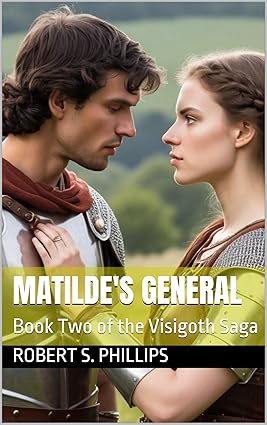
Matilde’s General by Robert S. Phillips is a captivating sequel to Elodia’s Knife that delves into the tragic love life of Matilde, Elodia’s daughter. Set against the backdrop of historical events between 394 CE and 400 CE, the novel masterfully intertwines fiction with history, providing readers with a vivid portrayal of the era’s complexities. The story begins with Matilde, who, at the tender age of 11, falls in love with Gisalaric, a young warrior. However, her heart is shattered when Gisalaric dies in battle. Despite this loss, Matilde eventually finds love again with Ildefons, only to face another heartbreak when he is killed while delivering a crucial message to the Thessalians regarding Rufinus’ decree. This decree, which demanded the Goths be awarded one-third of the Thessalians’ land, sparked conflict, leading to the Goths’ victory and eventual settlement. The peace of the Goths is short-lived as General Stilicho’s actions force them to give up two hostages to the Roman Empire, one of whom is Matilde. While in captivity, Matilde discovers love and happiness once more, but her time as a hostage ultimately leaves her emotionally broken upon her return home.
Phillips skillfully uses Matilde’s story to highlight the low value placed on women in the Roman Empire. Despite her intelligence and wit, Matilde finds herself sidelined when Gainas, who once sought her counsel, rises to power. Her pregnancy serves as a stark reminder of the limited roles available to women during this time, reducing her from a trusted advisor to a figure treated according to societal expectations. While Matilde’s General is rooted in historical fiction, with Matilde as a fictional character, the wars and events depicted are based on real historical occurrences. This blend of fact and fiction not only enriches the narrative but also educates readers on the period. Readers familiar with Elodia’s Knife may notice similarities between the two novels. Both Elodia and Matilde find themselves in similar circumstances, taken as captives and developing relationships with powerful men who hold them. These parallels might make the story feel repetitive to those who have read the first book. Matilde’s General remains an engaging read, especially for those new to the series. Phillips provides ample background information, allowing readers who haven’t read Elodia’s Knife to easily follow the story and understand the context of events and characters.
Matilde’s General is a well-crafted historical novel that offers a poignant exploration of love, loss, and the harsh realities faced by women in the Roman Empire. While it may feel familiar to fans of Phillips’ earlier work, it stands on its own as an enjoyable and thought-provoking read.
Pages: 348 | ASIN : B0DBGNXVSY
Elodia’s KnifeElodia’s Knife: Book One of the Visigoth SagaElodia’s Knife

Elodia’s Knife, a novel by Robert S. Phillips, immerses readers in the tumultuous era of the Gothic-Roman conflicts. At its heart is the story of a young Gothic woman, Elodia, who, after a dramatic escape from her abusive marriage, finds shelter under the wing of a Roman Limitanei. Despite the cruel treatment from Military Tribune Bitorix, Elodia discovers love and a semblance of peace. The narrative takes a turn as the Roman emperor allows the Tervingi Goths to cross the Danube. This leads to a series of events where Elodia is claimed by Bitorix, bought by Military Count Lupicinus, and ultimately given to Lord Fritgern. Remarkably, Elodia transitions from a slave to a leader, marking her journey with resilience and determination.
Set against the backdrop of the Gothic War, Elodia’s Knife blends historical facts with fiction. While characters like Elodia and Caius are products of Phillips’ creativity, figures such as Emperor Valens and the Battle of Adrianople anchor the story in historical reality. The novel explores themes of greed and its consequences, particularly through Military Count Lupicinus’ actions, which escalate tensions and crush any hopes of peace. Additionally, it depicts the hardships faced by the Goths, exacerbated by Roman exploitation.
One of the book’s strengths is its portrayal of Elodia’s character arc. From her initial struggles to her ascent as a leader, Elodia’s journey is a testament to her resilience and refusal to be defined by her circumstances. Her story underscores the importance of skills and inner strength over fleeting beauty, as these qualities ultimately contribute to her survival and success. While the novel primarily focuses on Elodia’s remarkable journey, the character of Caius is intriguingly presented. Phillips introduces him in a way that piques readers’ interest. Although his presence is less prominent throughout the story, his reappearance towards the novel’s conclusion effectively rekindles the reader’s curiosity about his character and his relationship with Elodia. This approach adds an element of anticipation and leaves one looking forward to learning more about him.
Elodia’s Knife is a compelling blend of history and fiction, offering an insightful look into a turbulent historical period through the lens of a powerful female protagonist. Phillips skillfully navigates the complexities of war, survival, and personal growth, leaving readers with a resonant and thought-provoking narrative.
Pages: 384 | ASIN : B0CMC58LJM
“A Poem and a Mistake”

Poetic Justice follows a poet in Rome who is exiled by the emperor and winds up in a town plagued by a mysterious murder. What was the inspiration for the setup of your story?
It started with a question much asked by Classicists – why did the Emperor Augustus exile the poet Ovid? We still don’t really know though it hasn’t stopped people guessing. Ovid himself – the real poet Ovid, that is – hints that he offended the Emperor with “a poem and a mistake”. From there I started to wonder how Ovid would have coped living in a small Greek town on the edge of Empire. And when I discovered that, in his youth, the real Ovid possibly spent a year working in the world of law and order in Rome, that gave me the idea for him turning detective.
What kind of research did you do for this novel to ensure you captured the essence of the story’s theme?
I read Ovid’s poems – the ones he wrote in exile – and was struck by how badly he seemed to be coping. Of course, this is a portrait of himself that he wanted to convey in the poems. Interesting that he wants us to see him constantly complaining and wailing. No Roman endurance here!
I also had to research the town of Tomis, now covered by the modern Romanian city of Constanta. I was fortunate in that Constanta has a wonderful Museum of History and Archaeology, and its website freely publishes many useful documents.
I read a lot about how witchcraft is depicted in Roman writers, and I discovered that Ovid stopped at Samothrace on the way to Tomis. It is likely that he was initiated into the mysteries of the Great Gods at the huge temple complex on the island. You know the famous Winged Victory statue in the Louvre? That comes from Samothrace. These cults from the east were embraced by the Romans quite readily, which I found interesting.
What were some themes that were important for you to explore in this book?
I always like to explore the difference between what the sources tell us and what common sense tells us. If you just read Ovid, then you would wonder why anyone ever lived in Tomis, so I wanted to show life here as normal, relatable. A small town like Tomis would have a long history but there would be none of the huge buildings we see in Rome, none of what I call the Hollywood element. There would be far fewer slaves than in Rome, and the population would be mixed – Greeks, some Romans, people who had settled from around the Black Sea, lots of locals from the tribes around the Danube, and traders from around the Mediterranean. And Ovid would have been the most famous person ever to live in Tomis – just imagine if your favourite writer came to live in your ordinary, nobody’s-heard-of-it small town!
When will book 2 be available? Can you give us an idea of where that book will take readers?
Book 2 should be available by the autumn, and it takes the reader away from Tomis to an extent, giving an Empire-wide view. It’s set around the death of Augustus, and this was important because an Emperor had never died before. Everyone was waiting to see what would happen. I’m afraid our hero is still in trouble – we find out what it was that was so terrible that Augustus could never forgive Ovid…
Author Links: Goodreads | Twitter | Facebook | Website | Amazon
Rome’s celebrated love poet Ovid finds himself in exile, courtesy of an irate Emperor, in the far-flung town of Tomis.
Appalled at being banished to a barbarous region at the very edge of the Empire, Ovid soon discovers that he has a far more urgent – and potentially perilous – issue to address. A killer is at large in Tomis.
Somebody is slaughtering animals in a parody of ritual, and the Governor’s advisor Marcus Avitius is under pressure to apprehend the perpetrator.
Romans are held in low esteem by the local populace, however, and assistance is hard to come by. When the killer progresses from animal to human victims, Avitius reluctantly allies himself to the mercurial, tipsy Ovid.
It seems that Ovid has an inexplicable link to the murderer too, with his poetry providing the timetable by which the killer works.
After a secret visit from the elite Praetorian Guard, Ovid realises he is in mortal danger in Tomis. If he doesn’t follow the Emperor’s line, more than just his freedom is at risk.
With Avitius distracted by the demands of the Governor, Ovid becomes a target for dark forces at work in Tomis – and in Rome.
Recommended for fans of Steven Saylor, Lindsey Davis and Simon Scarrow.
Fiona Forsyth studied Classics at Oxford before teaching the subject for 25 years. Fiona is also the author of the Lucius Sestius Mysteries.
The Core of Innocence

Imperatrix: The Empress Who Was Once a Slave follows a young slave thrust into the decadence and danger of Nero’s court as he strives to survive and find his place in a world ruled by an insane emperor. What inspired you to choose Nero’s Rome as the backdrop for Imperatrix?
Growing up in England in the 1960s, I was one of the last generation to receive a “classical education” in which subjects like Latin were compulsory. So, the history of imperial Rome was almost as familiar to me as real life — and, compared to real life in a British boarding school, almost as weird, too. I was surrounded by fictional depictions of Nero’s Rome, in literature and film, yet they generally are as much about the mores and culture of the time they were written in as about Rome. I wanted to try to achieve the real alienness of this pagan culture while at the same time showing that these people are clearly recognizable to us in the modern world. One important difference is the entire societal treatment of sexuality and sexual morality which was in many ways more permissive than today, but also more restrictive in other ways. Relationships today are seen as two-way; in Roman times “maleness” was about doing, and “femaleness” was about being done to. Everything has to be interpreted in that light. “Of course” one could do anything to a slave, no matter what their gender or age — they were owned. Yet a modern, two-way gay relationship where the partners were equal might have been seen as eccentric, somehow un-Roman. When this one pillar of modern moral discourse — the idea of relationships being equal, going both ways — is altered, every little thing in society is seen through a different lens. That was the challenge — not to allow a modern sensibility to be interjected into characters’ attitudes — while at the same time showing characters that modern people share common humanity with.
Sporus is a complex and captivating character. Can you share the process of developing his personality and how you balanced his vulnerability and resilience throughout the story?
So many bad things happened to Sporus that he could not have survived without a great deal of native wit and real intelligence. To survive in Nero’s court was tough even for people who had been raised and bred for it. To develop his character, I imagined him talking to me, letting me share his innermost, often contradictory thoughts. It’s the core of innocence that people around Sporus love — the thing they themselves do not possess. But that innocence is constantly besieged by the realities of his world. I think that making this a first-person narrative makes you constantly strive to understand the realities of that world. It’s an imaginative exercise in chanelling if you will.
How did you approach crafting Nero’s character, and what were the challenges in depicting his divine madness and capricious nature?
Of course, we know a lot more about Nero than we do about Sporus. This means not only that it’s easier to create a character people would recognize as Nero, but also harder to bring out qualities that might be concealed behind the very well-known persona. Nero was not raised to be an Emperor, so on some level, he must have been able to understand how ordinary people felt. The evil madman image is to some extent anti-Julio-Claudian propaganda — followed by Christian propaganda. He was, almost to the end, rather popular, but the mob was fickle.
Can you give us any insights into what we can expect in the next installment of this enthralling trilogy?
In a way, the big events are all in the third part, a large part of which is set during a single year in which four emperors came to the throne, and Sporus’s fortunes ping pong rapidly. Nymphidius “took” Sporus for a while but his bid to become emperor did not work out. Otho, like Nero, married Sporus (and of course both were Poppaea’s ex-husbands.). The first part of Book III, the Grecian tour, is also an immense spectacle. So I hope the third volume will be suitably climactic.
I didn’t mean to do this in three volumes. It’s just that at my age, I worry about not finishing big fat books, so breaking them up is a way that least parts of them reach the audience. At about 180,000 – 200,000 words the three volumes together are a pretty fat work, but they are continuous, so it may also be necessary to do an omnibus edition.
Author Links: GoodReads | Amazon
Imperatrix, the second volume of the tale, takes us into the heart of the Imperial palace with all its intrigue, depravity, and splendor.



 LITERARY TITAN