Blog Archives
Healing the Wounds

Uncovering Amy shares your experiences of being diagnosed with Dissociative Identity Disorder and working with Bryan Redfield using the brain training method to integrate your inner Parent, Adult, and Child into a single unified self. What were some ideas that were important for you to share in this book?
It was incredibly important to me that I get across the frame of mind I was in when the whole situation began: Searching for answers outside of myself in every way I had available to me because I had no conception that there could be more going on INSIDE my own mind. I also wanted to be sure to give the reader hope: whether they suffered from a similar experience or not, there is a solution to bringing all parts of your mind together as one.
What was the most challenging part of writing your memoir, and what was the most rewarding?
The most challenging part of this was explaining the process I went through, because I feel that the only way someone can truly understand it is to go through it. This concept is not just about affirmations or subliminals or NLP; this is recognizing the multiple parts of your own personality and healing the wounds they’ve carried for your entire life so you can be reborn as the person you were always meant to be. It’s not a process everyone can handle.
What do you hope is one thing readers take away from your story?
I hope my book makes its way into the hands of those who need it most: the person who is afraid to be themselves, afraid of what society might do to them, and doesn’t know how to protect themselves from the abusers in the world. I want you to know: there is hope.
Author Links: GoodReads | Facebook | Website | Amazon
Uncovering Amy is Amelia South’s raw, unfiltered memoir of living with dissociative identity disorder (formerly known as multiple personality disorder) — and the radical, self-directed process she used to retrain her brain and reclaim internal control.
This is not a story of gentle healing. It is a firsthand account of internal wars, competing identities, and the desperate, sometimes dangerous attempts to make the chaos stop. Alcohol. Exorcisms. Extreme self-experimentation. Moments of terror. Moments of breakthrough. And the slow, deliberate work of learning how to lead a fractured inner world.
With a chapter by Bryan Redfield, her guide through the process, Uncovering Amy explores a structured framework for internal leadership — not surface-level coping, not spiritual bypassing, but the gritty, methodical reorganization of the mind from the inside out.
This book does not claim to be the only answer. It is one person’s documented path from psychological fragmentation to internal coordination. Along the way, it raises a provocative question: if a divided mind can learn to work together, what might that mean for the internal conflicts we all carry?
If you’re looking for comforting platitudes, this isn’t it.
If you’re ready for honesty, courage, and a story that challenges what you think is possible for the human mind — keep reading.
Meaningful Struggles

Universe 25: When Perfect is Not Enough revisits the infamous mouse utopia experiment by John B. Calhoun and asks whether abundance, convenience, and perfection are unraveling modern society. Why was this an important book for you to write?
The Universe 25 experiment conducted by John B. Calhoun fascinated me because it forces us to confront an uncomfortable idea. What if collapse does not begin with scarcity, but with comfort? In Calhoun’s controlled mouse utopia, food was unlimited, predators were absent, and physical needs were met. Yet social breakdown still followed. When I looked at modern society, I could not ignore the parallels. We have unprecedented access to food, technology, entertainment, and comfort. But anxiety, division, loneliness, and identity confusion are rising.
This book was important to write because it challenges the assumption that progress automatically equals improvement. Material abundance does not guarantee psychological resilience or social cohesion. I wanted to explore whether we have removed too many meaningful struggles from life and whether, in doing so, we may also be removing purpose. The experiment becomes a mirror. It asks whether we are building a civilization that satisfies appetite but neglects responsibility.
For me, Universe 25 was not about condemning modernity. It was about questioning it. That questioning is necessary if we want to avoid repeating patterns we do not fully understand.
What does Universe 25 suggest about purpose, struggle, and shared responsibility?
One of the strongest lessons of Universe 25 is that purpose cannot be manufactured by comfort alone. The mice were physically secure, yet socially disoriented. Roles dissolved. Hierarchies collapsed. Parental instincts failed. Without meaningful challenges, many withdrew into passive existence. Calhoun called this the “behavioral sink.”
In human terms, struggle is not simply an obstacle. It is a framework that shapes identity. Responsibility to family, to community, and to something beyond the self creates cohesion. When everything is provided but nothing is required, a strange emptiness can emerge. Shared responsibility becomes optional, and optional responsibility is rarely sustained.
The experiment suggests that abundance without structure weakens societies. Struggle, when constructive and shared, builds resilience. It forces cooperation, adaptation, and accountability. Purpose often arises from overcoming difficulty together. Remove the need to contribute, and you risk removing the sense of belonging.
Where do you think the analogy breaks down—and where does it hold strongest?
The analogy breaks down where human complexity begins. We are not mice in cages. Humans possess self-awareness, culture, philosophy, and the ability to reflect on our own decline. We can change course. We can redefine meaning. We can recognize when something is wrong and act intentionally to correct it. The mice could not hold conferences about their existential crisis.
However, the analogy holds strongest in the realm of social behavior under artificial abundance. When natural pressures disappear, internal pressures often increase. Competition shifts from survival to status. Identity becomes fragile. Isolation grows. Social fragmentation accelerates. In that sense, the parallels are powerful.
Universe 25 does not claim we are destined to follow the same path. It simply shows that removing hardship does not automatically produce harmony. That lesson remains deeply relevant.
You end the book with cautious hope—what gives you that hope?
Hope comes from awareness. The very fact that we can examine experiments like Universe 25 and debate their implications sets us apart. Humans are capable of adaptation on a conscious level. We can reintroduce meaning, responsibility, and shared goals deliberately rather than waiting for collapse to force it upon us.
History shows cycles of decline and renewal. Societies fragment, but they also reform. Individuals rediscover purpose. Communities rebuild. The modern world is not doomed because it is comfortable. It is only at risk if it forgets that comfort must be balanced with contribution.
Cautious hope comes from the belief that struggle does not need to be catastrophic to be meaningful. We can choose growth over decay. That choice remains available to us.
Author Links: GoodReads | Facebook | Amazon
Instead, it became a nightmare. Violence, neglect, and sterility spread until the entire colony died out. The project became infamous as Universe 25—a chilling lesson about the dangers of comfort without purpose.
This book retells the story of Universe 25 and draws its unsettling parallels to our own time. From falling birth rates to lonely megacities, from consumerism to digital grooming, the echoes are hard to ignore. Humanity dreams of freedom and abundance—but what if those dreams are exactly what destroy us?
With sharp insight and dark humor, Universe 25: When Perfect Is Not Enough is not just about mice. It is about us. And it carries a warning: be careful what you wish for.
Uncovering Amy
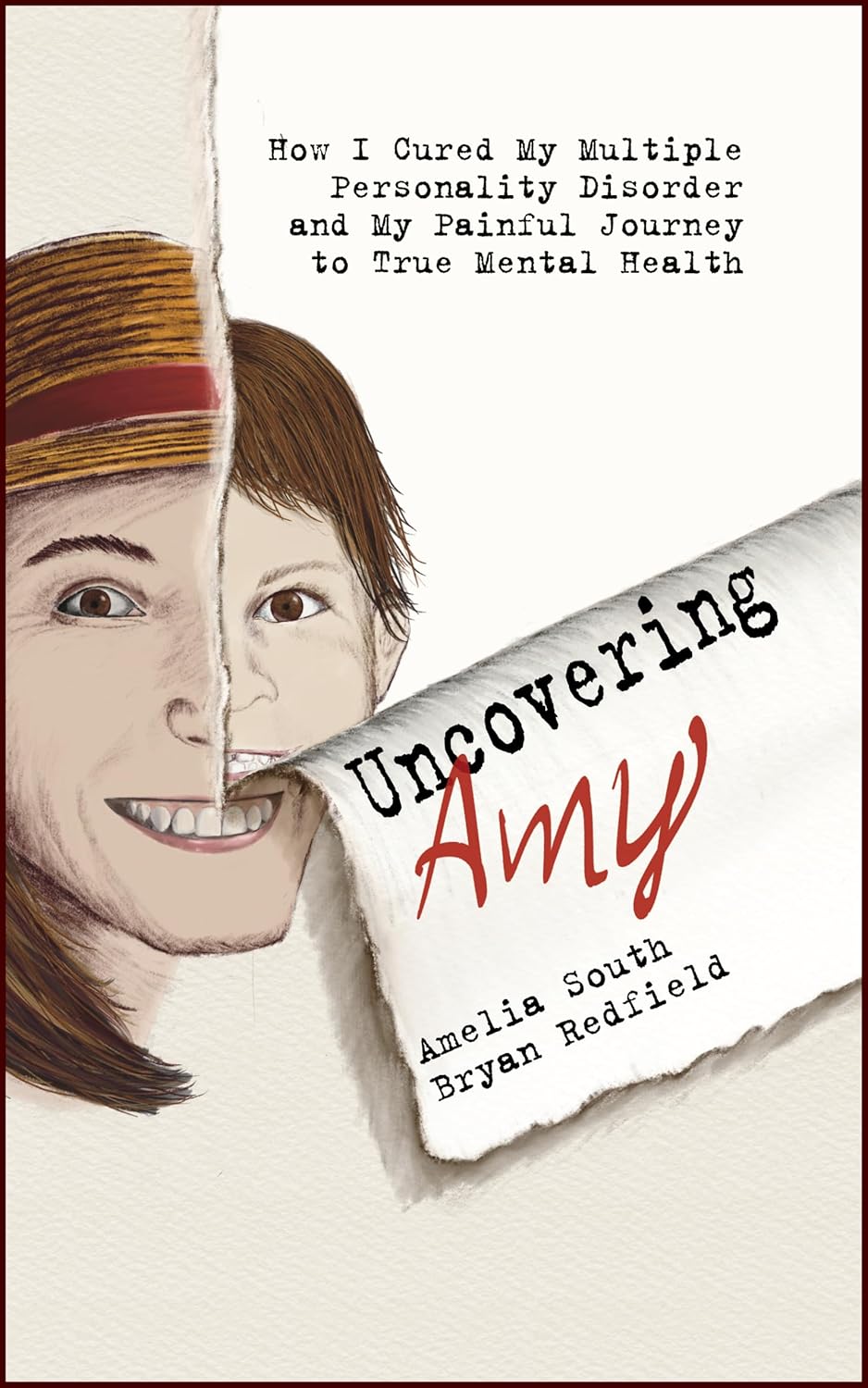

Uncovering Amy follows herbalist and coach Amelia South as she tells the story of how she went from a chaotic, abusive childhood to a full-blown mental and spiritual crisis, then to what she calls “true mental health.” The book traces her early trauma, her toxic relationships, her heavy drinking, and her obsessive search for meaning in pagan and Indigenous spiritual traditions. From there she describes hearing an internal voice she names “Robert,” going through exorcisms, wrestling with the idea of schizophrenia or Dissociative Identity Disorder, and finally working with Bryan Redfield’s “Super Team” brain training method to integrate her inner Parent, Adult, and Child into a single unified self. The result is a hybrid of memoir, spiritual testimony, and lay self-help that argues DID is misunderstood and that her method can “cure” it.
The book feels raw and very direct. I felt like I was sitting across from someone who decided to tell me everything, swear words and all. The early chapters about her family, her stepfather’s cruelty, and her string of relationships have a blunt, almost confessional rhythm. Sometimes that worked really well for me. Her anger, shame, and loneliness come through in plain, sharp lines, and I could feel the teenage girl who learned her worth was tied to her body and her usefulness to men. At other points, the storytelling meanders. Scenes with drum circles, graveyard visits, and spiritual chats sometimes pile up.
I admire the courage it takes to frame your own mind as “broken,” lay out the ugliest moments, then insist that healing is possible and that you are living proof. Her focus on self-responsibility, on ending generational harm, and on giving tenderness to the scared inner child felt powerful. The way she gradually recognizes “Robert” as Amy, her young self, and then starts to love that part instead of fighting it, hit me in the gut in a good way. She is confident that the Super Team method works every time, and very sure that DID can be resolved if you do the work she describes. There is also a mix of spiritual explanations, dowsing rods, ancestors, demons, and telepathy.
I believe that Amelia is telling the truth as she understands it, and I respect the sheer effort it took for her to claw her way out of despair and claim a life that feels stable and whole. I also think this book works best as a personal testimony. I would recommend Uncovering Amy to readers who like spiritual memoirs, people interested in alternative or experiential approaches to healing, and survivors who may feel less alone seeing their own confusion and rage mirrored on the page. For me, it is a raw, messy, and relatable story that can spark reflection and hope.
Pages: 220 | ASIN : B0GKJLXPFC

Universe 25: When Perfect is not Enough

Universe 25: When Perfect Is Not Enough walks through John Calhoun’s famous mouse utopia experiment and then turns the spotlight on us. Author Heinrich Wilson starts with the “perfect cage” and follows the colony as it grows, peaks, cracks, and finally collapses. Each phase gets its own chapter, from the early rush of life to the violent outcasts, the neglectful mothers, and the “Beautiful Ones” who stop fighting and stop breeding. Later sections jump out of the box and talk about crowded cities, falling birth rates, consumer culture, and a future where technology removes more and more struggle. The book lands on a blunt message. Abundance can rot a society from the inside, and comfort can be as deadly as hunger.
I enjoyed Wilson’s writing style. The prose feels clean and direct, not stuffy. He paints the scenes inside the mouse enclosure in simple images, and that makes them stick in my head. I could see the pileups at the feeding stations and the nervous males in the corners. The description of the “Beautiful Ones” hit me hardest. They groom themselves, look perfect, and yet do nothing. The language is easy to follow, and the short chapters give the book a steady rhythm. At times, he repeats the cage metaphor, and a few slogans feel a touch on the nose, but overall, the pacing kept me turning pages.
The ideas in the book are both fascinating and unsettling. Wilson argues that the real threat is not scarcity but a life stripped of meaning, roles, and shared effort. He links the mice to our own world, to lonely high rises, quiet nurseries, endless scrolling, and the sense that survival is automatic, so commitment can wait. Those parts made me pause. I could feel him pushing the analogy hard, and sometimes I wanted more data and less mood. That said, he does not just shout doom. In the closing pages, he points out a key difference. We carry memories of war, plague, and hardship, and those hard times gave humans a kind of resilience and a habit of rebuilding that the mice never had. That mix of warning and cautious hope felt authentic to me.
This is not a technical textbook, and it is not a pure history of one lab experiment. It is a social mirror in story form. I would recommend it to readers of pop science, sociology, psychology, and anyone in tech or policy who thinks about cities, demographics, or digital life. It also suits general readers who like clear writing and big questions and who do not mind a book that pokes at their comfort. If you want a sharp, accessible warning about what happens when a society gets everything it asked for, this book is well worth your time.
Pages: 131 | ASIN : B0FR3GCF4K
CONEtrolled: How We’ve Lost Our Freedom and How to Reclaim it


CONEtrolled delves into the intricate dynamics of power structures and societal control mechanisms through an innovative concept termed the “Cone Model.” The book is divided into several parts, exploring the origins of societal issues, the manipulation of needs and solutions, the development of systems into dogmas, and the ultimate rise and fall of these controlling structures. It concludes with a hopeful vision for reclaiming individual and collective freedom.
Dr. Israel’s writing is both engaging and thought-provoking. She skillfully uses metaphors and detailed examples to illustrate complex social phenomena. For instance, in Chapter 1, the discussion on Core Certainties and their transformation is particularly compelling. The author’s ability to connect abstract concepts with everyday experiences makes the book accessible without oversimplifying the issues. However, there are moments when the dense academic language might overwhelm readers who are not accustomed to such in-depth analyses.
One of the most striking parts of the book is Chapter 16, “Belly of the Beast,” which delves into how Cone Systems devolves into sluggish bureaucracies while expanding its power and reach. Dr. Israel vividly describes the propagation of rules and the ills of bureaucracy, illustrating how these systems prioritize self-preservation over the welfare of individuals. The chapter’s exploration of the expansion and colonization of Cone Systems is particularly relevant, shedding light on how power structures entrench themselves and stifle innovation and freedom. This chapter not only critiques the inefficiencies and oppressiveness of bureaucracies but also serves as a cautionary tale about the dangers of unchecked power.
CONEtrolled is a rigorous exploration of societal structures and the mechanisms of control. It is particularly suited for readers interested in sociology, psychology, and political science. Dr. Israel’s book challenges readers to critically assess the systems around them and consider active steps toward reclaiming personal and collective autonomy.
Pages: 707 | ASIN : B0D6WKCKRY

Tickling is Bizarre

Almost Everything You Wanted to Know About Tickling is a fascinating study on a topic that is not often discussed or looked at from the unique perspective of women. Why did you want to write about subjects such as tickling?
Tickling is bizarre physiologically and psychologically. On balance, it must be a good thing or humans would not have evolved to become ticklish in a way that is different from all other animals. On the other hand, tickling is often unpleasant and detrimental to relationships. Any behavior that causes many different kinds of positive and negative consequences, none of which are well-understood, is worth exploring.
The second reason I wanted to write this book was that I was especially qualified to do so. Not only did I have excellent experience using the necessary methodologies during a long career in academic research, but I was retired. Tickling is not a respected topic, and active researchers who pursue it risk their careers.
What were some goals you set for yourself as a writer in this book?
My goals changed throughout the study. They appeared in the following order.
1. Design a method for an independent researcher working alone to study tickling?
2. Identify the most interesting questions that could be studied about tickling. I found many, but the ones most thoroughly explored in the book were how ticklish are women throughout the world, and how much did women throughout the world enjoy being tickled.
3. Evaluate what characteristics of the women influence how ticklish they are and how much they liked being tickled.
4. Finally, I wanted to present respectable science so that it would be understandable and interesting to the general reader. I predicted that scientists would consider this topic trivial, but some general readers would be curious. This book is for them.
How much research did you undertake for this book, and how long did it take to put it all together?
This book involved a huge amount of research over more than four years. Much of the research I did was left out of the book because my target audience was the general reader. I spent more than a year trying to hire someone who could write this book for me. When I realized that was not possible, I spent another couple of years writing it myself.
What is the next book that you are writing and when will that be published?
You sound like my wife. I have ideas for several possible books on the topic of how people relate to each other. I’m not far enough along on any of them to make a meaningful prediction of when one might be completed.
Author Links: GoodReads
Why read this book.It is the best book about tickling that has been written. Since it’s the only book about tickling, that’s not a big claim, but it is a good book.
It makes you think about why tickling evolved and what good it may do.
The information is interesting and socially important.
It provides fodder for book groups and informal conversations.
Almost Everything You Wanted to Know About Tickling: An International Study

Duncan Taub’s Almost Everything You Wanted to Know About Tickling delves into the curiously underexplored world of tickling, challenging the common assumption that tickling is a trivial subject. Taub’s comprehensive research spans various cultures and demographics, providing a refreshing perspective on this often-overlooked aspect of human behavior. His commitment to treating tickling as a serious research subject is evident throughout the book, offering a rich blend of information on its prevalence, cultural perceptions, and societal boundaries.
Taub’s work stands out for its depth and rigor. It effectively argues for the significance of tickling in understanding human social interaction. He approaches this topic with a commendable balance of academic diligence and engaging storytelling. His exploration of tickling’s evolutionary origins and its varied responses—from laughter to discomfort—highlights the complexity of this phenomenon. His willingness to address the uncomfortable or ‘icky’ aspects of tickling adds an honest and candid layer to the narrative.
The book excels in making academic research accessible and engaging. Taub skillfully navigates between scholarly discourse and reader-friendly language, ensuring the content resonates with lay readers and seasoned researchers. He thoughtfully explains his statistical data clearly, and his flexible approach to the material allows readers to engage with the book according to their interests. Taub’s transparent and curiosity-driven research process, evident even in the book’s title, invites readers into a world of scientific exploration. His concise summary of key findings and implications towards the end of the book is a testament to his thoughtful consideration of the reader’s experience.
Almost Everything You Wanted to Know About Tickling could potentially open new avenues of inquiry in the field. Taub’s meticulous work and novel perspective make this a noteworthy addition to scientific literature. This book is compelling for anyone with an open mind, whether they are casually curious or deeply involved in research.
Pages: 176 | ASIN : B0CVRBX8F6


