Blog Archives
American Dreaming: A Memoir of Interracial Love, Estrangement, and Race Equality
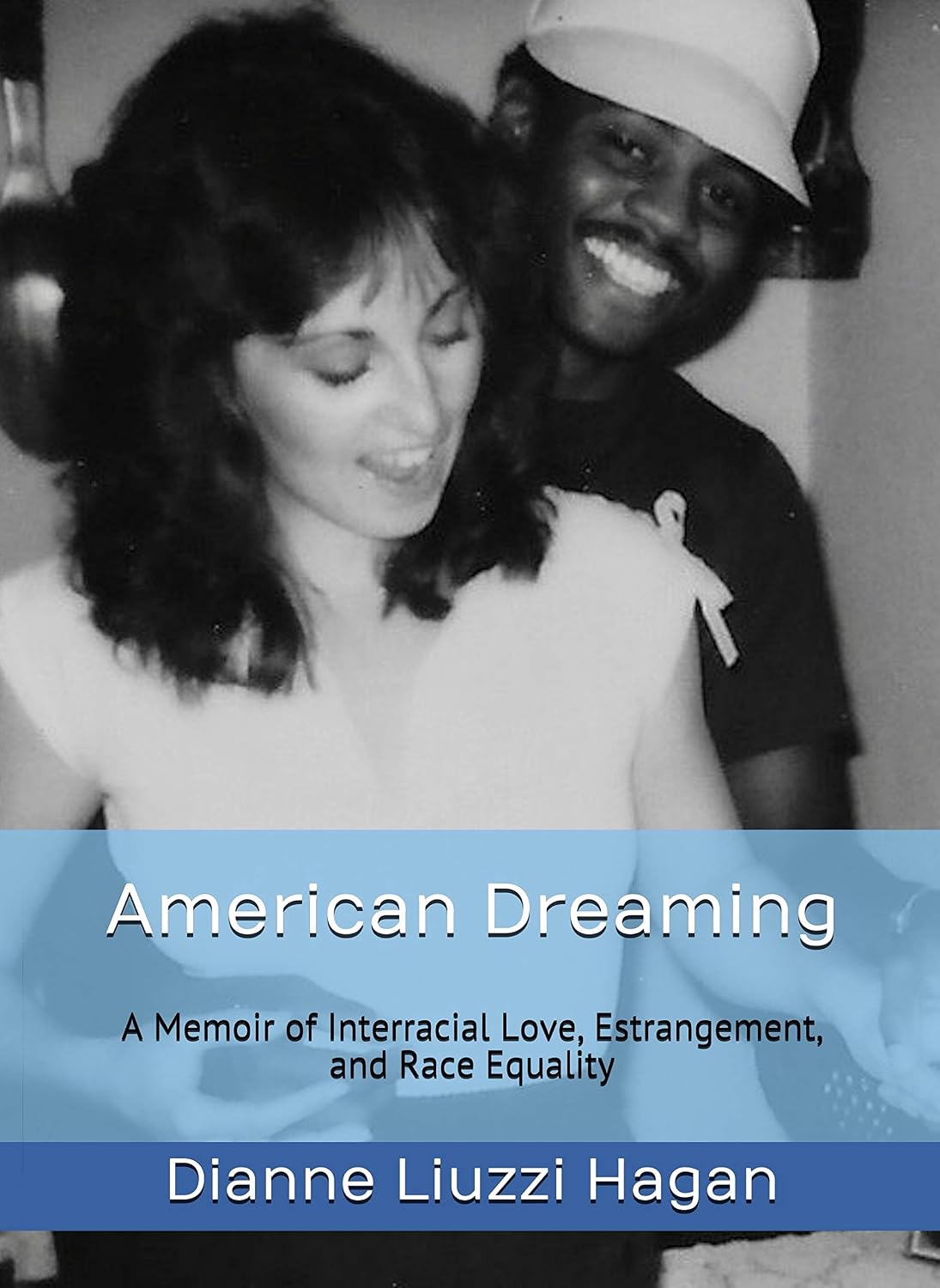

American Dreaming is a personal examination of marriage, family, and the enduring influence of racism in American life. Drawing on more than four decades of marriage to her Black husband, Ronald, author Dianne Hagan explores how love and commitment intersect with racial prejudice, social expectations, and the complicated bonds of family. Their relationship began in 1976, less than a decade after the Supreme Court struck down laws prohibiting interracial marriage. Although the legal landscape had changed, the attitudes they encountered often reflected generations of entrenched discrimination. Hagan uses their experiences to consider the distance between America’s promises of freedom and equality and the realities faced by interracial couples and Black Americans. Her central concern is expressed in three simple words: “We dream of equality.” That aspiration informs a memoir that combines personal testimony, family history, and an urgent examination of the country’s racial divisions.
The book’s six chapters explore Hagan’s relationships with relatives whose lives and personalities shaped her understanding of belonging, acceptance, and estrangement. Her accounts of her Italian American father, Australian mother, siblings, and extended family reveal a household influenced by cultural differences, emotional distance, alcoholism, and complicated loyalties. Hagan approaches these relationships with a combination of affection, disappointment, anger, and reflection, acknowledging the contradictions that make family connections so difficult to understand. Her parents’ bicultural marriage provides a particularly meaningful parallel to her own interracial relationship, allowing her to examine how prejudice and social pressures affect intimate relationships across generations. The memoir also includes vivid recollections of raising her daughters, navigating public encounters with racism, and building a life with Ronald. These experiences give the narrative its emotional foundation. Hagan’s willingness to revisit painful memories creates a candid portrait of someone determined to understand her family’s history while establishing her own principles concerning dignity and respect.
The book is distinct in its use of dreams to connect personal recollections with broader questions about identity, fear, and the human experience. Hagan opens each chapter with an elaborate dream, frequently populated by recognizable cultural figures, surreal situations, and unexpected humor. These sequences reflect her imaginative personality while introducing the emotional concerns explored in the chapters that follow. Her writing moves between intimate anecdotes and discussions of American history, including segregation, interracial marriage laws, systemic discrimination, police violence, and the racial tensions surrounding the COVID-19 pandemic. The historical material is informed by research and references to contemporary events, giving the memoir a documentary dimension. Hagan’s political convictions are unmistakable, and her commentary is frequently forceful, particularly when addressing racial injustice and the treatment of Black Americans. This directness gives the book a distinctive voice, one that conveys both the accumulated emotional weight of lived experience and a determination to confront uncomfortable truths.
I think American Dreaming is a meditation on the meaning of family, the price of speaking openly, and the possibility of building a more equitable society. Hagan writes with evident tenderness about Ronald and their daughters, grounding her larger social concerns in the people whose lives matter most to her. Her reflections on estrangement are especially compelling because they acknowledge the grief associated with fractured relationships and the difficult decisions involved in preserving one’s sense of integrity. Photographs throughout the book add intimacy, allowing readers to connect faces and moments with the memories being recounted. Hagan describes her undertaking as “a memoir about America,” a fitting characterization of a work that uses one family’s experiences to examine the nation’s historical and continuing struggles with inequality. By weaving together personal history, cultural commentary, and an enduring commitment to love, she creates a thoughtful and emotionally engaged account of what it means to pursue the American dream across racial and generational boundaries.
Pages: 248 | ASIN : B08T8JGY1C

Another Day in Post-Racial America: To the Mothers of the Black Lives Matter Movement, With Love


Dianne Liuzzi Hagan’s Another Day in Post-Racial America is a personal and emotionally charged examination of racism in America, told through the eyes of a white woman who has spent more than four decades married to a Black man. Drawing on her experiences as a wife, mother, writer, and advocate for racial equality, Hagan offers an intimate look at how prejudice shapes everyday life, from seemingly ordinary encounters to moments of genuine danger. The book begins with an unexpected meeting at a Winston-Salem restaurant, where Hagan recognizes several mothers whose children died in encounters with police officers or vigilantes. That experience provides the emotional foundation for a collection of essays that confront racial injustice, honor those who’ve lost their lives, and recognize the extraordinary courage of families who’ve turned their grief into activism.
Hagan has the ability to connect national events with the experiences of her own family. Her husband, Ronald, served his community as a firefighter for twenty-five years, yet his professional accomplishments and character haven’t protected him from racial profiling, hostility, or discrimination. Hagan recounts encounters with police, battles over housing discrimination, and incidents in which strangers questioned their relationship simply because of their different skin colors. These stories give the book an especially compelling human dimension. Readers come to know Ronald as a husband, father, musician, golfer, and public servant, someone whose life is rich with the same relationships, ambitions, and ordinary pleasures that make any life meaningful. Hagan’s affection for him is evident throughout, and the tenderness of their marriage provides a moving counterpoint to the anger and sorrow that run through the book.
Organized around essays originally published on Hagan’s blog, the book follows America’s racial and political tensions through the Obama presidency and into the Trump administration. Hagan examines the deaths of Trayvon Martin, Michael Brown, Tamir Rice, Sandra Bland, Philando Castile, and others, connecting these tragedies to the country’s long history of segregation, racial violence, unequal treatment, and institutional discrimination. She also explores white privilege, media portrayals of Black Americans, gun culture, and the uncomfortable conversations that so often accompany discussions of race. Her writing is candid, passionate, and unmistakably personal. She’s willing to express her outrage, acknowledge her fears, and question the attitudes that allow injustice to continue. There’s an immediacy to these essays that makes readers feel as though they’re sitting across the table from someone who has carried these concerns for years and can no longer remain quiet.
What makes Another Day in Post-Racial America particularly affecting is the compassion beneath its fierce social criticism. Hagan understands that the mothers at the center of the Black Lives Matter movement carry a grief she can acknowledge and honor, even though she hasn’t experienced their particular losses. Her perspective as a white woman raising a multiracial family gives her a distinctive voice, informed by both her awareness of racial privilege and her firsthand experience with discrimination against the people she loves. Throughout the book, she challenges readers to recognize the humanity of those whose experiences differ from their own and to understand that meaningful change requires participation, empathy, and a willingness to speak out. It’s a heartfelt, thought-provoking work that asks readers to consider what equality should look like in the places where people live, work, raise families, and build their futures. With the heart of a wife, the fierce concern of a mother, and the conviction of a lifelong advocate, Hagan reminds us that racial justice begins with seeing every life as worthy of love, dignity, and protection.
Pages: 237 | ASIN : B07PFSYHST
Behaving Badly: A Tess Hammond Novel

Rochelle Staab’s Behaving Badly takes readers into the glamorous, gritty, and frequently dangerous world of 1932 Los Angeles, where Hollywood celebrities rub shoulders with gangsters, crooked cops, and ambitious newspaper reporters. At the center of the story is Tess Hammond, a sharp, determined crime reporter for William Randolph Hearst’s Los Angeles Examiner. Still grieving the death of her detective husband, Johnny, Tess is struggling to reclaim her place in the newsroom when she’s assigned to investigate the disappearance of Merilee Lockwood, the teenage daughter of a wealthy banker. What initially looks like a straightforward missing-person case soon draws Tess into a tangled world of Hollywood secrets, organized crime, and questionable loyalties. Staab wastes little time establishing the stakes, and Tess’s personal connection to the criminal underworld gives the investigation an emotional weight that makes it more than another mystery to solve.
The book has a wonderfully detailed depiction of Depression-era Los Angeles. Staab clearly knows the city’s history, and she brings its streets, restaurants, movie studios, and speakeasies to life without making the historical details feel like a lecture. The contrast between Hollywood extravagance and the desperate poverty of the Great Depression is especially effective. Wealthy socialites attend lavish parties while ordinary families struggle to survive, creating an atmosphere where money and influence can determine whose troubles receive attention. Familiar historical figures, including gossip columnist Louella Parsons and newspaper magnate William Randolph Hearst, add another layer of authenticity. The dialogue is lively, sprinkled with period slang that gives the characters personality, and Tess’s first-person narration is full of dry humor and pointed observations. Her friendship with photographer Max Grady is particularly enjoyable. Their teasing exchanges provide some welcome levity amid the violence and growing tension.
Fans of Raymond Chandler’s Philip Marlowe mysteries, particularly The Big Sleep, will recognize some familiar territory here. Both authors explore a Los Angeles where respectable appearances conceal corruption, powerful people protect their interests, and following the truth can put an investigator in serious danger. Staab shares Chandler’s appreciation for colorful characters, shadowy establishments, and the complicated relationship between crime and privilege. But Tess brings a different energy to this familiar landscape. As a female journalist working in the early 1930s, she must navigate professional expectations and personal judgments that shape how others respond to her questions. Her determination is convincing because she’s capable, stubborn, occasionally impulsive, and deeply human. Her grief over Johnny also remains a meaningful part of the story. It influences her decisions, complicates her relationships, and gives her search for answers a deeply personal urgency. Like Chandler, Staab understands that a compelling detective story depends as much on the person conducting the investigation as on the mystery itself.
Behaving Badly is a substantial mystery, with an expanding cast of suspects, witnesses, detectives, Hollywood personalities, and underworld figures. Keeping track of their connections occasionally takes some attention, especially as the investigation branches into several overlapping threads. Still, Staab keeps things moving through confrontations, unexpected discoveries, and Tess’s refusal to leave troubling questions unanswered. Some of the most engaging moments are surprisingly ordinary: conversations over coffee, newsroom banter, and Tess driving across Los Angeles while trying to make sense of conflicting information. These scenes give the story texture and make its dangerous encounters feel more immediate. What stayed with me most was Tess herself, a woman trying to rebuild her confidence and her life while doing a job she genuinely loves. Behaving Badly should appeal to readers who enjoy historically grounded mysteries, Hollywood lore, strong female protagonists, and crime fiction with a distinctly noir atmosphere. It’s an entertaining, character-driven novel that makes 1930s Los Angeles feel like a fascinating place to visit, even if you wouldn’t want to get caught in its criminal underworld.
Pages: 311 | ASIN : B0GZ1ZZTHC
Something Hidden Beneath It

What was the inspiration for the setup of your story? How did the idea of something buried beneath a landfill possessing an intimate knowledge of human memories first develop?
This story started with an article. I remember reading about a lab-grown synthetic cell, something scientists had built from scratch, piece by piece, and thinking about how strange and quiet that kind of creation is. No explosion, no warning. Just something small, sitting in a controlled room, waiting to see what it might become if anyone ever let it. That idea stayed with me longer than I expected it to, and eventually it found its way to the one place I always knew it belonged.
That place was the Landfill. I lived on Staten Island for over twenty years, and it was part of the view the whole time. It was where the city sent everything it was done with, and then it closed and the city began turning it into parkland. I chose a landfill reclamation project as the setting because buried places hold the secrets of a community. I kept thinking about what stays under a hill like that. People throw away objects with years of their lives soaked into them, like a coffee mug or a child’s shoe. I put the two ideas together: a small made thing, left alone in the dark, with all of that to learn from. It would know how a kitchen smells at six in the morning. It would know what a mother sounds like when she calls you in.
Underneath it all, I wanted to look at how the past can reach into people’s lives in ways they cannot explain. Staten Island has a distinctive identity, and I wanted to tie it to the creeping dread of something hidden beneath it. That is where Anthony’s story started.
What drew you to Staten Island as the setting for What the Ground Remembers, and how did its history influence the development of the story?
Staten Island is the borough New York forgets, and that made it the right place for this story. The city has always sent its leftovers here, and the Landfill is the largest example. I wanted the reader to feel the Island as a real place, with neighbors who know each other’s families and streets that carry old names. Those details come from living there. The history shaped the plot directly. A place that spent decades receiving what everyone else discarded gave me the idea of a place that remembers what it was handed. I fictionalized the names and locations so I had room to build, and I kept the feel of the Island as true as I could.
How does the novel explore the relationship between memory, identity, and the emotional connections people form throughout their lives?
Memory is what makes the threat personal. The thing under the ground reaches people through the objects and the family history that mean the most to them, and it shows them home. Anthony’s identity is built from his family and his neighborhood, so the thing that wants him uses exactly those. I wanted readers to ask what happens when the warmest memory you own becomes the lure. I also wanted to ask how much of who we are comes from our families. Anthony thinks he knows his, and then he learns how far back their story goes, and how much of it lies under his feet.
What is the next book that you are working on, and when will it be available?
My next book is OMNI Book Two, the sequel to OMNI: The Convergence Protocol. The story picks up where the first book left off. I’m aiming for next year, and I’ll announce the date through my author page and Rivera Press as soon as I have it.
I also have a novel in the works set in the Bronx, where I grew up. It follows a man cursed by his girlfriend’s mother, and what the curse does to his life. After that, I plan to go back to Staten Island. The borough is a city in its own right, and there are more stories above the ground than any of us know. I intend to go find them.
Author Links: GoodReads | Website | Video | Amazon
It knows your family. It knows your kitchen. And it has been waiting beneath Staten Island since before you were born.
Staten Island has always been the place New York throws away. Now the closed Landfill is becoming parkland the city can finally point to with pride, and Anthony Bruno just wants steady work leading the reclamation crew.
Then the dreams start: a warm, familiar dream of home, of a father’s workshop and a Sunday dinner. And his best friend walks calmly into the night and never comes back.
It isn’t the first disappearance tied to this ground. Anthony has to face something that was never meant to exist, something patient, something buried deep, something that remembers everyone it takes.
The ground remembers everything. And it isn’t finished. Sooner or later, it comes looking.
For readers of Stephen King’s grounded, small-world horror and the quiet dread of The Andromeda Strain.
Careering Off Course

Andy Laker’s Careering Off Course is a humorous memoir of working life and entrepreneurial ambition, shaped by the uneasy relationship between wanting success and knowing what to pursue. The first volume in the How to Get Things Badly Wrong series, it follows a succession of jobs and business ideas through two substantial sections devoted to employment and enterprise. Retail, office work, customer service, education, and ventures of varying sizes provide the settings for a sustained examination of confidence, motivation, and personal responsibility. Laker’s interest lies in the choices that accumulate over time: accepting a reassuring title, postponing an uncomfortable decision, or mistaking activity for progress. That attention to ordinary decisions gives the book its relevance to readers whose professional lives have developed through circumstance as much as intention.
Laker writes with the informality of someone telling stories to people he knows well. Direct addresses to the reader, comic comparisons, and frequent references to British television, music, and everyday products establish a distinctive social setting. His accounts of workplace routines and personalities are particularly observant, capturing the small negotiations through which people seek recognition, protect their position, or relieve boredom. The humour includes physical mishaps, blunt language, and unflattering portraits, with Laker regularly placing himself at the centre of the joke. He captures his approach in one pointed observation: “Common sense is a skill I only developed once it became expensive not to have.” It’s a voice that makes room for both the absurdity of an incident and the discomfort of remembering it.
The memoir gains depth when Laker considers the feelings beneath his behaviour. Embarrassment, envy, and the desire for approval recur across different workplaces and ventures, giving the individual stories a shared emotional basis. “That’s the dangerous thing about embarrassment: it rarely stays attached to the mistake. Eventually, it attaches itself to you.” This observation helps explain why a small humiliation can influence later decisions about applying for a role, sharing an ambition, or asking for help. Family relationships also bring texture to the account, showing how attitudes towards money, work, and independence are learned through close observation. Laker’s willingness to revisit his own temper, assumptions, and questionable judgement gives these reflections credibility. He’s often most persuasive when he allows an admission to carry its own weight.
The short chapters, opening quotations, and concluding reflections give the book an accessible rhythm, with each episode contributing to its wider inquiry into professional direction. Repeated discussions of comfort, avoidance, and follow-through make the patterns easy to recognise, although some reflections revisit points the stories have already established. The more extended anecdotal passages offer the strongest balance of pace, detail, and insight. Across the manuscript, the tension between ambition and habit keeps the account connected, while its humour makes difficult admissions easier to approach. Careering Off Course will appeal to readers who enjoy frank personal writing about work and the psychology of trying to build something of their own. Its particular strength is the specificity of Laker’s experience, which gives readers ample material for considering their own choices.
Pages: 278 | ASIN : B0HH8M2VXF
If It’s Unity We’re After

The Watersmith follows a guilt-ridden inventor caring for his wife after an accident leaves her with a rare form of dementia, who becomes obsessed with experimenting with scents to try and restore her memories. What inspired you to write this novel, and how did the idea of a man attempting to restore his wife’s memories through scent first develop?
My interest in the sense of smell is likely due to a lack thereof. I’m borderline smell-blind and sometimes wonder what I’m missing, especially because my wife and son are absolute bloodhounds. But occasionally I’ll catch a whiff of something that takes me back. We’ve all been there, minding our own business when waylaid by a scent that strikes a chord or a nerve. For some, it’s the aroma of comfort food. For me, it’s honeysuckle. If I get close enough to the stuff, I’m right back to playing in the woods as a kid on a long summer day. Perhaps smell sneaks up on us more than other senses precisely because it’s the subtlest. When you’re at a concert, you know you’re forming a memory around sound. When you’re watching a sunset, you know you’re forming a memory through sight. But smell has a way of catching us off guard. It doesn’t reveal itself in murky contrails the way it did in old cartoons.
That got me to thinking: what if this sense that seems inessential was the primary one by which we navigated the world? The deaf have eyes and the blind have ears, but what if both gave way? What was life like for Hellen Keller, whose memoir I’ve read more times than I can count, and who is an integral allusion in my book? It occurred to me that by depriving a character of certain senses, I could heighten the others, granting me license to saturate those descriptions and luxuriate in those scenes.
But I wouldn’t have skewed the five senses in favor of one if it weren’t true to form. On a recent episode of Diary of a CEO, a neuroscientist posited a convincing theory for why we humans dream; it may be our visual cortex’s way of defending its territory against the encroachment of other senses while our eyes aren’t receiving any input. Scientifically speaking, this is way above my pay grade. But literarily, I can use it to craft inner-worlds that are interesting and inherently neurodivergent, something that’s important to me as an autistic author.
What role do pride, resentment, and unspoken expectations play in shaping the relationships between the novel’s family members?
Of the seven deadly sins on which he was raised, my protagonist Jack is most susceptible to pride—or its byproduct: stubbornness. When his wife is injured due to a mistake Jack Junior makes on Jack’s watch, father banishes son instead of taking responsibility. Then he doubles down on that decision by rebuffing Jack Junior when he returns to say he’s sorry, as seen in this exchange:
“I’m trying to make amends here. Please, Dad, don’t be stubborn about this.”
“Don’t call me that.”
“Stubborn?”
“Dad.”
What do you hope readers consider about the relationship between love, responsibility, and personal freedom after experiencing Jack and Jolene’s story?
I hope this story will help a reader dissolve the skin-thin barrier between themself and others. Being that it makes up 65% of your body and mine, I believe water is what bonds us across space and time; when buried we seep into the earth and when burned we vaporize into the sky, returning to the same Reservoir regardless of our religious affiliations. Our life cycle is part of the water cycle. We are part of something bigger than ourselves. If it’s unity we’re after, why not start with that?
What is the next book that you are working on, and when will it be available?
I’m excited to announce that my second book will be published by Appalachia Book Company thanks to a generous grant from South Arts, a partner of the National Endowment for the Arts. Set amidst the national statue-removal debate, Retreat follows the crew of an antique roadshow who gets more than they bargained for while searching a retirement community for felled Confederate statues. It’s a cross between American Pickers and Get Out. Coming Fall 2027…right in time for Halloween!
_________________________
Yance Wyatt was born and raised in Nashville, Tennessee. He studied fiction at the University of Cambridge and the University of Southern California, where he has gone on to serve as a professor of writing and the director of the Writing Center. As a fiction editor with The Blue Mountain Review, he seeks to acquire the best new stories from the South. His own stories have appeared in dozens of nationally circulated literary journals and received several Pushcart Prize nominations. His first novel, The Watersmith, is a Southern Book Prize nominee and the Southern Literary Review’s “Read of the Month.”
Author Links: GoodReads | Facebook | Instagram | Website
Beyond The Veil

In K. M. McFarland’s Beyond the Veil, New Orleans is a place where a musician’s next opportunity might come with supernatural assistance, and a hotel’s resident ghosts have stories that deserve a hearing. The novel follows Gabe Stone, a struggling singer whose encounter with a powerful spirit brings him into a circle of musicians, vampires, and people who can communicate with the dead. It’s a lively mix of paranormal romance, family drama, and mystery, held together by the possibility of second chances. McFarland clearly enjoys the city, and that affection comes through in the humid streets, late-night burgers, neighborhood bars, and music spilling onto the sidewalk. Those everyday details make the supernatural feel at home. You get the sense that someone could finish a shift, order a beer, and discover something extraordinary before sunrise.
The book’s emotional appeal comes from how readily its characters show up for one another. Gabe’s growing relationship with Brooke gives the story flirtation, warmth, and some explicit sexual scenes, while his relationship with his ambitious mother, Gabriella, adds a different kind of intimacy. Their conversations capture the awkwardness of loving someone whose choices you can’t control. Rose, a medium who helps manage the Hotel St. Germain, brings compassion to the ghost mystery, and Quinn, a vampire with a background in rock music, connects much of this unusual social circle. I especially liked the way music serves several purposes: it’s Gabe’s livelihood, a source of confidence, and a carrier of emotional memory. The many recognizable song references also give the bar scenes a soundtrack you can almost hear while reading.
Anne Rice is an easy comparison, particularly her Interview with the Vampire. Both authors give New Orleans a strong presence and treat immortality as something that affects love, identity, and the practical business of continuing to exist. McFarland gives those shared ingredients a chatty, contemporary rhythm. Her vampires run businesses, negotiate relationships, and work out how to keep their unusual habits discreet in a world full of cameras. There’s humor in those logistics, especially when supernatural abilities meet ordinary social awkwardness. The novel also presents Voodoo as a spiritual framework within its fictional world, with an emphasis on protection, responsibility, and the passage between life and death. Together, these elements create a supernatural community whose members remain deeply invested in careers, friendships, family ties, and the people they love.
The writing is direct, with short chapters and plenty of dialogue keeping things moving. That accessibility has a tradeoff: characters frequently explain information the reader has already received, and some emotional moments would carry more weight with fewer statements spelling out everyone’s feelings. Quinn’s considerable powers also make parts of the investigation proceed very smoothly, so the mystery’s pull comes largely from the personal meaning of the discoveries. The early relationship scenes take their time, while several major developments arrive quickly later on. Even so, the book maintains a clear emotional purpose. It keeps returning to the value of helping someone, accepting change, and making use of the life you have. Beyond the Veil will especially appeal to readers who enjoy frank romantic chemistry, an interconnected supernatural cast, and ghost stories approached with tenderness. Its most engaging quality is the affection running through this peculiar, music-loving extended family.
Pages: 134 | ASIN : B0HHC8BWRQ


