Blog Archives
Driven: The Founder’s Seed Book 3
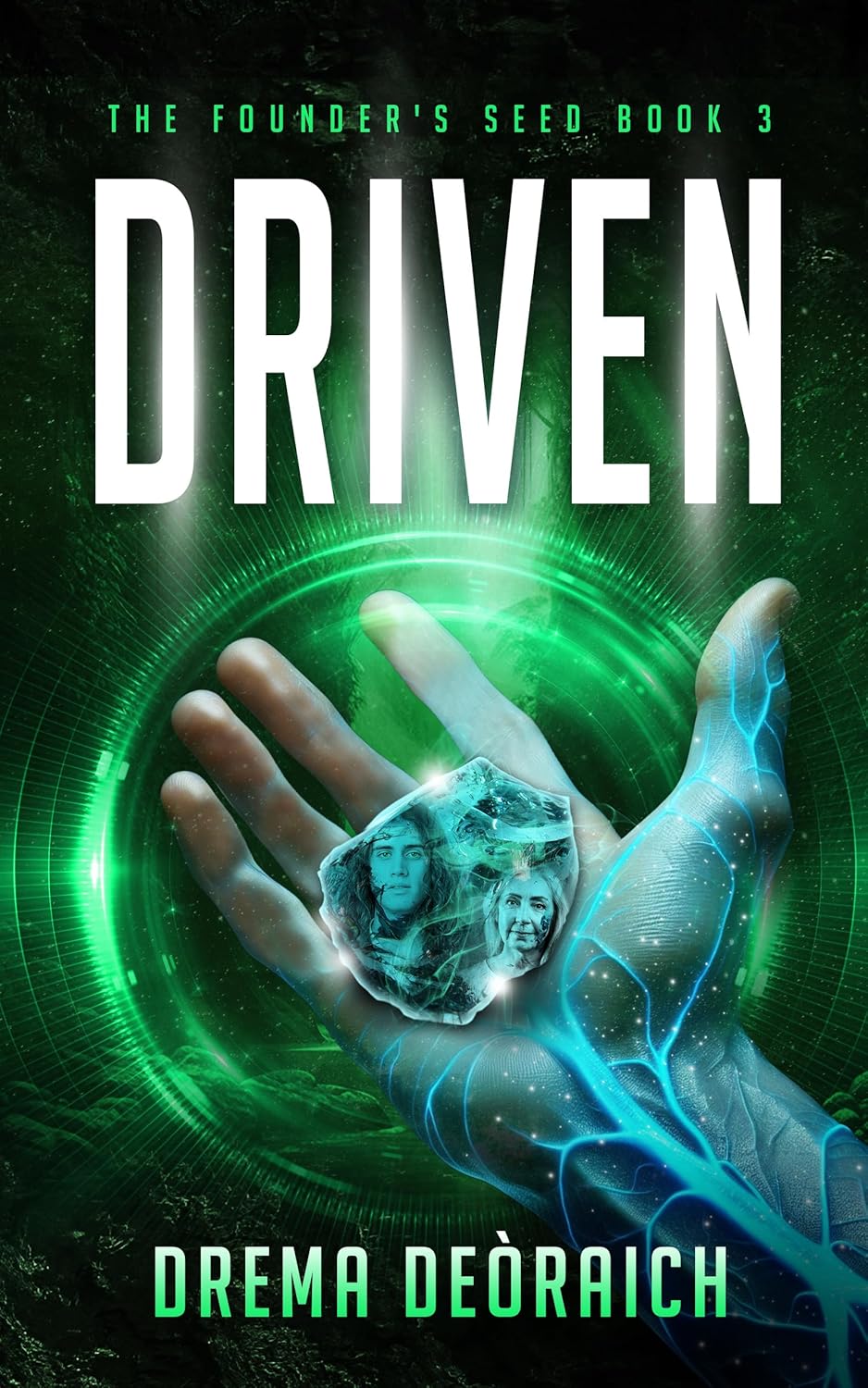

Driven is the third installment in The Founder’s Seed series, continuing the riveting saga with even higher stakes and deeper revelations. The book pulls you straight into a galaxy alive with politics, betrayal, and fragile alliances. Admirals, traders, and hidden survivors of a nearly lost people clash in a world where loyalty is currency and compassion is weakness. At the heart of it all are Alira, still wrestling with her fractured self, Botha with his quiet wisdom, and Thrace carrying the burden of leadership under constant threat. The novel moves between brutal experimentation on the mysterious Iridosians, tense negotiations among rival factions, and deeply personal struggles for survival. It is a story of ambition, cruelty, resilience, and the thin thread of hope that refuses to snap.
Reading this book stirred a mix of awe and discomfort in me. The clinical coldness of Knøfa’s experiments made my stomach twist, yet I couldn’t look away. The writing is vivid, even when it’s painful, and that’s part of its power. I found myself admiring the author’s willingness to go dark, to show how curiosity can turn into obsession, and how power can warp good intentions. At the same time, the quieter moments between Alira and Botha gave me room to breathe, to feel the warmth of trust slowly taking root in frozen soil. Their scenes lingered with me, like a candlelight after the storm.
There are a lot of moving parts here. Political factions, shifting alliances, plots within plots, and it took me a while to sort through them all. But once I settled in, I found myself hooked. The author doesn’t coddle the reader. She trusts us to keep up, and I respect that. What I loved most was the emotional honesty tucked between the battles and schemes. Fear, hope, guilt, tenderness, it all feels raw and real, even in the middle of starships and alien physiology.
Driven left me both unsettled and uplifted. It’s a rewarding read. I would recommend it to readers who enjoy science fiction with grit and heart, to those who don’t shy away from moral grayness, and to anyone who loves stories that ask what survival truly costs. If you like your space operas full of high stakes but also deeply human at the core, this book will leave a mark.

Broken: The Founder’s Seed Book 2


When I opened Broken, I was immediately pulled into a world brimming with tension, betrayal, and the complicated weight of carrying other people’s lives inside your own head. Drema Deòraich’s story follows Alira, Galen, and Thrace as they navigate shifting identities, political intrigue, and the brutal cost of survival among human and unammi factions. The author builds a layered tale of power struggles, loyalty, and moral compromise, where every choice feels like a thread tugging at the larger web. The book is about what it means to stay whole when you are forced to fracture yourself for the sake of others.
The writing has a pace that rarely lets up, and the dialogue carries a sharpness that feels lived-in. The shifting perspectives, the sudden bursts of violence, and the moments of quiet reflection all come together to create a rhythm that feels alive. At times, the narrative voices inside Alira’s head became almost overwhelming to read, but I realized that was the point. It mirrored her chaos, her crowded sense of self. I found myself admiring how boldly Deòraich leaned into that confusion, refusing to make it easy for the reader, because life inside a fractured mind is never easy.
Beyond the writing, I was moved by the book’s ideas. Questions about identity, about whether survival justifies the blood on your hands, and about how much of yourself you can give away before there’s nothing left. I was thinking about these ideas for a long time afterwards. I felt both sorrow and admiration for Alira. Her choices often frustrated me, yet I couldn’t help but ache for her struggle. The themes of slavery and exploitation, woven into the politics of the factions, hit me hard. They were ugly and uncomfortable, and that’s exactly why they mattered. Deòraich didn’t flinch from showing cruelty, and in that honesty, the book had teeth.
Reading Broken reminded me of Frank Herbert’s Dune in the way it blends political intrigue with questions of identity and survival, but it feels more intimate and raw, pulling me closer to the characters’ inner battles. I’d recommend Broken to readers who love science fiction that challenges them. If you like tales that balance heart with grit, that mix character-driven drama with political maneuvering, this book is more than worth your time.
Pages: 420 | ASIN : B0DLTLQMQP

A Pivotal Lens

Trace of Arcane follows a teenage girl navigating life in a fractured society as she struggles to find autonomy while facing the pressure of the coming ceremonial passage. What was the idea, or spark, that first set off the need to write this novel?
What drew me to this story, and to Eden as a protagonist, was the challenge of portraying the neurotype colloquially known as psychopathy with nuance and texture. Over four years, I had extended conversations with individuals living with this form of neurodivergence. I wasn’t interested in the usual caricatures. I wanted to understand them not as villains, but as whole, observant, complex human beings. Eden’s voice emerged from those conversations, and Trace of Arcane became a space to explore deeper questions around conscience, survival, and the systems we live within.
Early on, I noticed that many neurodivergent individuals don’t automatically adopt social structures the way neurotypical people often do. Instead, they examine these systems critically and only mirror them to the extent necessary to avoid social exclusion. This observation made me reflect on the psychological mechanisms embedded in our institutions—religious, political, and cultural. These structures often act as filters, helping people manage the complexity of life. But for those with shallow affect or atypical emotional processing, these filters don’t function the same way. They mimic them, rather than experience them. That dissonance opened up new questions for me: about belonging, about power, and about how easily such systems can be co-opted to marginalize outgroups or consolidate control.
I also did not want the views of the neurodivergent characters to remain unchallenged within the story. Around that time, I came across the work of Dr. Zoran Josipovic, who has studied the brains of meditating monks and found heightened activity in the prefrontal cortex—the part of the brain associated with empathy. By contrast, researchers like Dr. James Fallon have shown that in psychopathy, this same region is often underactive during decision-making. That contrast fascinated me. It felt like the two neurotypes (even though those who have meditated for many years are not a neurotype) were engaging with the world in fundamentally different ways, and I wanted to explore what might happen when they collided.
This led me to dive into monk-centered spiritual teachings, which eventually inspired the creation of other key characters—individuals whose worldviews would directly challenge the neurodivergent characters within the story. Their interplay became a core tension not just in Trace of Arcane: Viridis, but across all three novels in the series.
The science inserted in the fiction, I felt, was well balanced. How did you manage to keep it grounded while still providing the fantastic edge science fiction stories usually provide?
My primary focus wasn’t on science fiction in the traditional sense. My attention was on the social and psychological structures people use to navigate the world—institutions, belief systems, hierarchies—and how those structures shape identity, belonging, and power. The science in Trace of Arcane: Viridis emerged as a secondary layer, more as a tool for exploring those dynamics.
The story follows a neurodivergent girl trying to cope within a fractured, post-apocalyptic world, and I was more interested in her internal logic: how someone with her cognitive wiring might perceive and respond to systems that often demand emotional conformity. That lens helped keep everything grounded. The speculative elements are there, but they’re tethered to real-world dynamics and grounded human experience.
In Book Two, I do lean further into the science behind the fiction—especially in terms of technology, cognitive science, and surveillance systems—but even then, it’s all in service of the characters and the ethical questions they’re grappling with. The “fantastic edge” becomes sharper as the story unfolds, but it’s always rooted in something psychologically or politically real.
What was one scene in the novel that you felt captured the morals and message you were trying to deliver to readers?
There’s a scene early in the novel where Eden recalls using a hidden path to avoid Amaia’s constant lectures on respect. At first glance, Eden comes across as brash and disrespectful, especially in how she speaks to characters like Amaia, and I wanted the reader to sit with that impression. But as the story unfolds, we begin to see Eden’s inner world more clearly. That scene becomes a pivotal lens: Eden isn’t reacting; she is mirroring.
She sees adults demanding respect without offering it, and when she reflects their tone back at them, she’s punished for it. There’s a line where she thinks, “If she hates it so much that I mimic her, then why not change to the behavior she wants reflected?” That moment, to me, captures the core moral tension of the book: Eden is labeled as the outsider, the disrespectful one, but she’s actually holding up a mirror to a society that is itself contradictory and hypocritical.
This becomes a quiet call to the reader: when we encounter something in someone else that unsettles or irritates us, what does that reaction reveal about us? Eden challenges the social norms around her not by preaching or resisting outright, but by reflecting them back. The discomfort that causes isn’t a flaw in her—it’s a diagnostic of the world she lives in.
That’s the heart of Book One: Eden is learning, engaging, adapting—and in doing so, forcing others (and the reader) to confront the assumptions they live by.
What is the next book you are working on, and when will it be available?
Having finished the Trace of Arcane trilogy, the next book I’m working on is called Angel of Death. It follows Azrael, a character introduced in Trail of Arcane: Book Two of the Trace of Arcane series, and dives deeper into his journey: before, during, and beyond his interactions with Eden. While Trace of Arcane was focused more on societal structures and psychological dynamics, Angel of Death leans further into the science of the science fiction. It explores the technologies, surveillance systems, and hidden architectures of power that govern the post-apocalyptic world.
At its core, Angel of Death is a character study about a teenager who begins as an idealist, committed to truth and justice, but slowly transforms into someone willing to break the very rules he once upheld in order to expose systemic injustice. As society fails to respond ethically, and as the costs of truth-telling mount, he becomes increasingly disillusioned. His ideals fracture. Inevitably, he learns about what it means to evolve without losing oneself.
It’s a more expansive story in some ways: technically intricate, politically charged, and emotionally layered. It also offers a more grounded, hard science-fiction tone, exploring how systemic forces can shape a person into exhibiting behaviors we label as psychopathic—while still holding a mirror to the systems that create those very outcomes.
As for the release date, I’m currently deep in the writing process and will announce more details soon. But if Trace of Arcane asked what it means to survive within broken systems, Angel of Death asks what it means to resist them, and what it costs to do so.
Author Links: GoodReads | Amazon
Book One of the Trace of Arcane Series
Trace of Arcane follows Eden, a neurodivergent girl born in Viridis—a remote Fringe society resisting the quiet rule of Lux, an authoritarian power that rose from the ruins of a lost civilization. Lux controls history, suppresses knowledge, and manipulates the Fringe societies through fear, rumor, and erasure.
From a young age, Eden knows she’s different—not in a way that draws admiration, but in a way that draws suspicion. Her mind works differently: precise, emotionally detached, and deeply observant. To survive, she learns to hide it, to mimic what others expect. To pass.
As tensions rise and Lux’s control creeps closer, Eden begins to question the systems around her—who controls truth, who gets to belong, and what is sacrificed to keep the peace. When a forgotten archive is discovered by a society called Arcane, Lux ignites conflict in the Fringe societies before Arcane can share their knowledge with the rest of humanity.
Set in a post-apocalyptic future where memory is controlled and difference is discouraged, Trace of Arcane is the first in a character-driven sci-fi trilogy. More introspective than explosive, it’s a slow-burn story about power, perception, and what it means to live honestly in a world that asks you to disappear.
Human Stupidity
Endless Fall of Night follows a woman who is convicted as an insurrectionist and sent to prison, where she is compelled to join a mission to discover what has happened to the Martian colony that has gone dark and left severed heads in its wake. What was the inspiration for the setup of your story?
The set up was the novella Heart of Darkness by Joseph Conrad. Similar to that work, I wanted to show how the human condition and society has not changed much whether it is a Belgium Company’s outposts along the Congo River in Africa in 1899 or a US Swift Boat going up the Nung River in Vietnam in 1969, human emotions and behaviors construct our present day of 2025 and sets the stage for a future like 2126.
What are some things that you find interesting about the human condition that you think makes for great fiction?
Themes around prejudice, racisms, fascism, misogynistic and misanthropic bents will still be challenged by courage, strength in community and resilience are all part of being human. It is the journey that makes us. It is the discomfort and challenges that forge who we are.
What were some themes that were important for you to explore in this book?
Of all the themes presented, human stupidity is the focus of this story as defined by Carl Jung – blaming others for own flaws, inability to self-reflect, rigid thinking and dogmatism, lack of empathy and emotional intelligence, overconfidence without competence and repeating the same mistakes without learning.
Will there be a follow-up novel to this story? If so, what aspects of the story will the next book cover?
The Heavy Weight of Darkness, published in September 2024 follows one of the antagonists tasked with terminating the heroine, and then finds himself transformed.
Author Links: GoodReads | Instagram | Website | Second Website
Based on Joseph Conrad’s Heart of Darkness, we see our future that shows striking similarities to this age of imperialism, classism, and capitalistic expansion where racism is commonplace, slavery exists, and a minority of people are in absolute power. Instead of Belgium Company’s outposts along the Congo River in Africa in 1899 or a US Swift Boat going up the Nung River in Vietnam in 1969, this is the great Third Republic on Earth and colonies on Mars in the year 2126.
Cassandra XI, patrician and first-class citizen, is exposed to a traumatic experience that later has her questioning the established social order. She is eventually tried and convicted as an insurrectionist, her personal AI deactivated, social status and titles revoked, and she is sent to prison. Cassandra is then approached by Captain Willard Bennett of the light cruising ship the Jefferson Davis to investigate why the Martian colony New Georgia went dark, leaving severed heads on spikes and the message “Bring Cassandra Kurtz.”
With no choice but to go, Cassandra’s life is about to change in unimaginable ways.
Endless Fall of Night
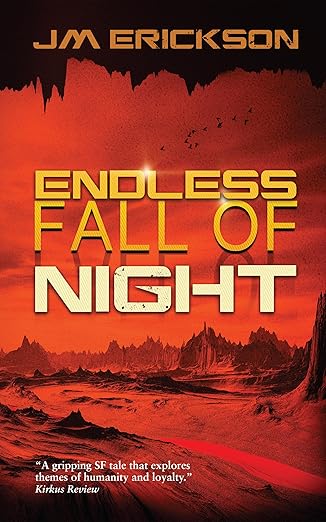
This book is a dystopian firestorm wrapped in razor wire. Endless Fall of Night throws us into a bleak future where racial purity and social stratification rule the day, and one woman, Cassandra IX, stands at the heart of it all, defiant, broken, and brilliant. The story kicks off with her trial and sentencing for crimes that are more moral rebellion than criminal offenses, and it doesn’t let up. From sterile courtrooms to hellish prisons and eventually deep space, Erickson drags us through the slow-motion car crash that is Cassie’s journey, and you can’t look away.
The writing hits hard; it is not elegant or flowery. And that’s what makes it work. The courtroom scenes early in the book are brutal, especially the way the government lawyer describes Cassie’s supposed betrayal. “She can’t help it,” he sneers while showing ancient libraries going up in flames. You want to scream. Erickson doesn’t just hint at dystopia; he makes you choke on it. His use of visuals, like the collapsing libraries or the image of Cassie bleeding and broken, is cinematic in the best (and most horrifying) way.
Cassie is no hero in the classic sense. She’s angry, complicated, and tired. Her inner voice, especially after she loses her AI companion Aletheia, is a mix of grief, sarcasm, and deep loneliness. And the prison chapters? They’re suffocating. I felt like I needed to open a window. Erickson builds this terrifying sense of powerlessness without ever turning Cassie into a victim stereotype. She fights. She cracks. She rages. She survives. Her whispered line might be one of the most powerful moments in the book; it’s a punch in the face to a rotten empire.
The pacing gets a little weird after Cassie leaves prison. Once she boards the Jefferson Davis, the tone shifts. It’s still good, creepy, mysterious, and loaded with dread, but the rhythm wobbles. Still, the moment her AI returns through a charged music device is oddly beautiful. Aletheia’s voice is like a flashlight in a cave, and it reminded me of how much I missed her presence earlier in the book. Their bond is one of the best parts of this story, part friendship, part lifeline, part rebellion.
Endless Fall of Night made me mad. It made me sad. It made me weirdly hopeful. It’s not a fun read; it’s a furious one. But it’s worth it. If you liked The Handmaid’s Tale or V for Vendetta, this is your book. Just be ready: it doesn’t hold your hand. It holds a mirror up and dares you to look.
Pages: 131 | ASIN : B0D6JSPDDY
Power and Knowledge

Raq follows a loyal soldier of the Hlad race as he faces a crashed alien ship, a lone human survivor, and a truth so shattering it threatens everything he believes about his people and the universe itself. What inspired you to create the Hlad and their unique biology and culture?
Inspiration came from those stories you hear of “lost civilisations” being discovered, people who live in remote and secluded places, and their culture, customs, language, and entire lifestyle so utterly different from the “civilised” world. And vice versa. We always see the point of view from the so-called civilised, and rarely the other way around. Exploring that avenue, begged to be told. How does one communicate? Understand their ways? Those were questions I had. What would humans look like to aliens? When it came to their social structure, I decided to use animals and reptiles for behaviour and how the whole status hierarchy works. In most, the females are more dominant, and well, honestly, that was fun to exploit and expand on. Why not, right? And then developing a social structure where the females have more power and knowledge, well now, great fun to write! Creating an entirely new physiology for the Hlad required some wild imaginings. Using a replitilan base, mainly for the hardiness and adaptability to their harsh environment the story is set in, meant slapping together some wild mutations, but making sure each part of their crazy anatomy had a purpose, or not, through evolution.
Raq’s journey from certainty to doubt is so compelling. Was his arc fully mapped out from the beginning, or did it evolve as you wrote?
Yes. You get a glimpse of his uncertainty at the very beginning. I wanted him to be flexible enough so he would become more self-aware and open-minded. Accepting. And why not, right? It’s nice to have, with some effort, something hopeful happen. To know even the most extreme polar opposites of anything, can — with a little more knowledge, understanding, and acceptance — come to the middle ground to create something new and incredible. I mean, we only have to look at what’s happening in the world to draw more inspiration. I wanted Raq as if on one side of a coin he was one way, and on the other, a different way. But when you spin the coin, you get a whole picture…complete. The Raq that he becomes, so to speak. The same could also be said for the human, David.
The relationship between Raq and David develops slowly and believably. What challenges did you face in writing their communication barrier?
Tackling the language barrier was interesting, but doable. For one, I had my own experiences to draw from. My parents, being Japanese and living in an English-speaking country (in the late 1960s and onwards), encountered numerous difficulties navigating the language and customs, not to mention enduring some interesting issues by simply being different. Then, years later, as a young girl, we moved to Brazil, and the language barrier for me was overwhelming. As a 12-year-old, you pick up languages easily (maybe for me, as I was bilingual at the time, and you get an ear for it), but in the beginning, we might as well have been speaking an alien language. But in both cases, sign language was an almost universal first-choice method of communication. Using all of this, Raq took shape, with sign language as the initial way of communicating, and then the repetitive use of words until the meaning is clear, and then, the written language. The other examples I was able to draw from are actual animal behaviours. Just watching how, for example, dogs communicate with us. It’s all about observing the little things. The big and small body language and behaviours dogs make, the noises they make or don’t. Even how dogs communicate with other dogs. Of course, by the by, I also have lizards to observe — they’re regular visitors to my patio. The way they interact with their own, the fights they have, the turf wars to show their dominance, and then how they can remain so still for so long, just to catch a fly. So, yes. I simply observed all the creatures around me and went from there. I also tried to have some things that are universal, something both had in common. Even with animals and humans, emotional responses are the same: happiness, sadness, hunger, and terror. I used these core emotions so Raq and David could discover their likenesses as well as their differences.
David’s journal entries add depth to Earth’s past. What research or influences shaped the history you created?
Picturing a future Earth is exciting, with unlimited possibilities. At the rate humanity and technology are going, deep space exploration is fast approaching. For David’s history, we’re in an Earth timeline that is thousands of centuries away. Deep-space travel is the norm, and Earth, for now, has survived and endured unimaginable turmoils and mistakes, with disasters and wars, famines and diseases — the works! So in the 29th century, upon the discovery of a habitable planet, the Harbinger generation ship embarks, in search of a better place to live. Thousands of years later, Earth has become idyllic, and this is where David’s story begins, where he joins an expedition to search for the Harbinger and the lost colony on the distant planet. As for research, you only ever have to look back in history to see the great conquests and disasters, discoveries and mysteries. Then tweak it and place it in a futuristic context and let your imagination go wild!
Author Links: GoodReads | Instagram | Facebook | Threads | Linktree | Books2Read | Website | Amazon
The Hlad are one race, the only race beneath the Great Abyss. The great Fire King deemed it so when the Great Mother birthed the Fire King’s children from the dry lake beds. All know of His power and scorn, and praise Him with each rising so He may shine down gently and with kindness.
Warrior Class Lieutenant Raq of the Imperial Guard is a proud soldier, an adoring father to his sons, brave, dutiful and honour-bound, a devout servant of the Fire King. He is a true Hlad. But his faith is shattered when an alien craft crash-lands on Hlad from the Great Abyss.
One alien, the Dayyid, survives the horrible massacre that follows the crash. Imprisoned, suffering from malnutrition, and studied by the reptilian doctors and scientists, he doesn’t forget one of the creatures from the crash site. One who hesitated to kill.
Forced to live together, Raq and the Dayyid learn to understand each other despite the language barrier. But when they learn of a threat to Earth, they discover an almost unbelievable truth that unites them against the Hlad. The rest of Hlad must learn this truth, and so, too, the rest of the universe.
Restrictive Societies

Fallen is an immersive sci-fi tale following a young woman torn between duty and defiance, navigating political intrigue, alien traditions, and the weight of inherited secrets that could reshape her entire civilization. What were some sources that informed this novel’s development?
I have always been a huge fan of Frank Herbert’s Dune trilogy (as well as the books that fleshed out the series after his death). I can’t even remember how many times I read that first book. Each time, I found Paul Atreides’ journey inspiring and motivational, especially the way he took each apparent challenge and turned it to his advantage, making him stronger and more resilient. I hope that Alira’s journey in The Founder’s Seed would offer that same kind of feeling to readers.
What inspired Alira’s character arc from idealist to survivor, and how much of her journey reflects personal experiences or broader themes you wanted to explore?
A lot of Alira’s journey reflects my own, only without the sci-fi details. Like Alira, I’ve never felt like I “fit” with others around me, regardless of how I tried. Both Alira and I stood firm in our belief that things could be (can be) different. Better. Both of us feel like an island in a vast sea of opinions and views that don’t reflect our own or, if they do, their opposition is too strong to resist. I know Alira and I are not alone in that.
It’s hard—sometimes impossible—to stay silent in the face of clear violations of a perceived Truth. Alira learns the consequences of speaking out and, eventually (by the end of book 3, Driven), she finds strength, balance, and peace with herself and those around her, but on her own terms. This is what I hope for myself, and for everyone like me who finds it challenging to be true to who we are inside while operating in a world that sometimes feels alien to us. I wanted to offer Alira as an inspirational hero, one who can show us that it isn’t easy to be true to yourself, but in the end, it is absolutely worth it.
In Alira, I also wanted to explore what would happen when something catastrophic broke down the walls that held her back and gave her the opportunity to stretch into her authentic self. I think that part worked quite well, though her journey to find that authentic self is…circuitous. But that’s like real life, isn’t it?
What were some themes that were important for you to explore in this book?
I wanted to explore the concept of restrictive societies, where there’s no room for those who don’t blend in, and how it affects not just those who are exiled (or otherwise penalized), but those who manage to hide their differences. I also wanted to explore how those many individual prices cost the society overall.
The theme of personal growth under pressure was also important to me in this trilogy. Most of us have a “line in the sand,” boundaries we’ve defined for ourselves and those we allow into our lives. I wanted to explore crossing that line, and what might motivate someone to push past that point of no return. Sometimes, the best and strongest growth happens in adverse circumstances and while it might not be predictable or proceed in expected ways, it’s often rugged and enduring. One doesn’t have to be carrying signs or weapons to be a revolutionary. Sometimes all it takes is to step off the beaten path toward the perception of a “better way,” and refuse to go back to accepted standards. It isn’t an easy choice, but it can be a very powerful one.
I also wanted to explore, to a lesser degree (at least in this trilogy), the long-term effects of the reasons for humans’ Earth exodus—the environmental destruction and resulting wars—and what that result would look like in their colonial world structures. These details are mostly in the background, but they are definitely there, if you look closely.
(The backstory of all this is in the works and will eventually be published as part of the Founder’s Seed universe saga.)
The inherited memories in the story are fascinating—what influenced your decision to weave the past so tightly into the narrative?
Well, the present is always built on the foundations of the past. What happened then will always affect what happens now, sometimes in subtle unseen ways. I wanted to make that a bit more stark, more jarring. Hearing about the past is one thing; actually seeing it through the eyes of someone who was there brings a whole new understanding to the situation. Lurien serves as the unammi’s historian, which is one reason why hers is the first voice on the council.
I also wanted that aspect of the story to serve as a fragile thread of connection between the “before” and “after” for the unammi. Since Alira’s view of that history is fragmented, she can only bring a portion of that history forward. Imagine what would happen if the human race was nearly wiped out, and all our history erased. We would have to start over from scratch. Alira’s inherited memories, incomplete as they are, give her people at least a whisper of hope that some of their past could be remembered, if not recreated. And her memories inherited from others widen the unammi perspective, at least for her. This more comprehensive view offers the potential to rebuild unammi society with a broader base, and a more accepting perspective.
Author Links: GoodReads | Facebook | BlueSky | Website | Drema Deòraich | Amazon
Alira knows the pilots—including her brother—who live among the humans will be the next target for enemies of the unammi, unless someone flies to the nearest colony world to warn them of the threat. And since Alira Harvested the last pilot on Iridos, she’s the only one who can do it. If she leaves, she’ll be outcast. If she doesn’t, her brother and the other pilots will die. To Alira, there’s no choice. She’s never going to fit in anyway.
As a shapeshifter, looking human is easy. Acting human is far more difficult, especially once her Harvests start arguing in her head. But she has to succeed. If her species is to have any chance at survival, Alira must take the form of her nemesis, Harvest souls never intended for her, and shelter the remnants of her race where her enemies would never look, in a place only a lunatic would go.
Can she succeed without going insane?
Olympus Bound
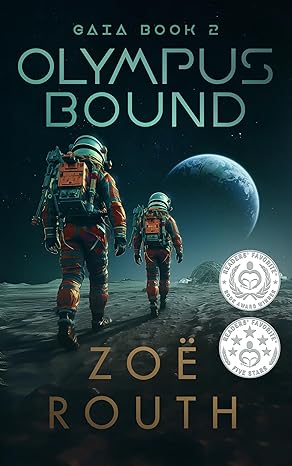
Zoë Routh’s Olympus Bound takes us to the Moon, where humanity wrestles with survival and cooperation in a harsh, unforgiving environment. The story follows Xanthe Waters, the commander of a lunar base built by Gaia Enterprises. She navigates the challenges of constructing a habitable outpost while dealing with political tensions, unexpected meteor storms, and personal struggles. Set against a backdrop of Earth’s looming climate collapse, this science fiction story dives deep into the duality of leadership, teamwork, and human ambition.
What struck me most was how vividly Routh captures the Moon’s stark beauty. The descriptions of its surface or gazing at Earth from the Atrium were breathtaking. The meticulous attention to detail in depicting life on the Moon, from the intricacies of 3D printing habitat walls to the struggle of maintaining atmospheric integrity, grounds the story in reality. It reminded me why I adore dystopian sci-fi. I love the interplay of human resilience and vulnerability. That scene with the meteor storm tearing through the Atrium left me on edge both for the characters’ survival and the symbolic loss of their view of the stars.
I think Routh also excels at character dynamics. Xanthe’s leadership is layered, balancing competence with a relatable sense of doubt. I loved her quiet moments in the Atrium, reflecting on Earth’s decline and her own fragmented past. Her interactions with Troy felt heartfelt without tipping into melodrama. The rivalry with Colonel Jin added tension, highlighting how the Moon’s desolation amplifies human conflicts.
Thematically, the book thrives in its exploration of humanity’s ambition and flaws. The contrast between the Chinese and Gaia bases underlines our tendency to compete, even when cooperation is essential. The subplot involving sabotage and past betrayals on Earth cleverly mirrors the larger stakes on the Moon. However, I occasionally found the pacing uneven. The technical descriptions are immersive but sometimes slow the narrative, particularly during the repair sequences with Athena, the base’s A.I. Still, Athena’s logs sprinkled throughout were a nice touch, offering philosophical insights that deepened the story’s themes.
Olympus Bound is a thoughtful blend of high-stakes and intimate character work. If you’re someone who loves realistic depictions of space exploration peppered with human drama and a touch of existential dread, this dystopian sci-fi book is for you. It’s a compelling reminder of why we look to the stars and why the challenges we face up there often reflect the ones we leave behind on Earth.
Pages: 500 | ASIN : B0CT567B2V


