Blog Archives
Hidden Opportunities for Growth

The Year of My Humiliation follows a brilliant but morally adrift plastic surgeon during what he dubs his “year of humility” as he documents his attempts at personal reform—not out of love or duty, but from a cold, self-imposed challenge to bring his life under control after a scandal that nearly ends his career. What was the inspiration for the setup of your story?
A friend once left his house in anger and accidentally backed up over his child’s stroller, completely wrecking it. The implication was devastating – what if his child had been in it?
What were some of the emotional and moral guidelines you followed when developing your characters?
When developing Michael, I focused on creating a character who could experience a deeply personal, emotional reckoning without losing authenticity. Morally, I wanted his choices to feel grounded in the realities of human behavior—how we resist change until forced, how pride blinds us to our flaws, and how growth often begins with small, humbling acts.
Michael starts as someone defined by pride and control, but I aimed for his transformation to unfold slowly, in moments that reveal his vulnerability. For instance, making his wife tea wasn’t just an act of humility—it was a subtle yet profound shift in how he saw himself and his relationships.
Emotionally, I focused on Michael’s relationships—especially with the hospital psychiatrist and his estranged son. These interactions highlight the vulnerability of opening oneself to others and the uncertainty of giving love or seeking forgiveness. His choices reflect the gradual, messy process of self-discovery and the risks required to change.
What were some themes that were important for you to explore in this book?
I was deeply interested in the intervention of grace—not as something soft or comforting, but as a force that’s often shocking, even brutal. Grace breaks through our carefully constructed facades and leaves us no choice but to confront the truths we’ve been avoiding. For Michael, this means grappling with the fallout of his mistakes and the painful realities of the relationships he’s damaged.
I wanted to explore how suffering, while deeply mysterious, can act as a crucible for transformation. It’s through Michael’s humiliation—those raw and uncomfortable moments where his pride is stripped away—that the possibility for redemption begins to take shape. Grace doesn’t promise an easy path, but it offers him a chance to rebuild, starting with the messy work of repairing his connection with his estranged son.
These themes—grace, suffering, and redemption—felt essential to me because they mirror the way real change often happens: unexpectedly, painfully, yet profoundly. They remind us of the hidden opportunities for growth buried within even the most difficult experiences.
What is the next book that you are working on, and when will it be available?
My next novel is more a metaphysical one, about a woman’s journey through a life review after a possibly fatal accident (yes, that’s ambiguous for a reason!) Its release isn’t imminent – I want to deliver a compelling and thought-provoking story. To keep in touch, follow me on Facebook and/or sign up for my email list on lilyfieldpress.com.
Author Links: GoodReads | Facebook | Website
Michael, an arrogant pediatric plastic surgeon, believes he controls his own life and his wife Rosie’s, until the discovery of Rosie’s duplicity punctures his self-importance and leads to tragedy. Consumed by remorse, he begins journaling his attempts at reparation, beginning with small, humbling acts – like making his wife’s morning tea.
But proving he’s emotionally fit to wield a scalpel again demands more than trivial self-abasement. Under the scrutiny of a hospital psychiatrist with unorthodox methods, Michael’s carefully constructed justifications crumble, exposing the raw truth he’s desperate to avoid.
Struggling to repair the damage only deepens his humiliation. And the one person who might pave the way to his redemption – his son, “the Jackass” – hasn’t spoken to him in years.
And he has no intention of starting now…
“The Year of My Humiliation” resonates as a tale of psychological and spiritual battles against family, God, and self – delivering a riveting, thought-provoking examination of the human heart and the life-changing power of forgiveness.
The Year of My Humiliation


The Year of My Humiliation is a raw, unfiltered dive into the mind of a brilliant but morally adrift plastic surgeon during what he dubs his “year of humility.” Framed as a daily journal, the story documents his attempts at personal reform—not out of love or duty, but from a cold, self-imposed challenge to bring his life under control after a scandal that nearly ends his career. His goal? Make his estranged wife a cup of tea every morning. That’s it. But the deeper you go, the clearer it becomes that this isn’t just about tea. It’s about control, shame, ego, resentment, and—most surprisingly—grief.
The writing floored me. There’s this calm, clinical precision to the narrator’s voice—understandable since he’s a surgeon—but it’s constantly bumping up against his inner chaos. You can feel it. The scene on Day 1, where he’s fumbling through the kitchen trying to make his wife tea for the first time in twenty-four years, was so mundane it was funny—and also sad. That tension carries through the entire book. One minute, I’m smirking at a sarcastic jab; the next, I’m sucker-punched by something brutally honest. Because underneath the smugness and detachment, there’s someone flailing to connect but absolutely terrified of intimacy.
What really hit me were the glimpses of his daughter, Michaelina. Especially the part where he looks at a school photo and focuses not on her face—but on a stray lock of her hair. That small detail holds so much love. He can’t say he misses her or that he’s grieving, not directly. But the book is full of these sideways confessions.
There are moments, though, where the narrator gets under your skin. He’s sexist, elitist, often cruel, and just plain selfish. He compares having intercourse with nurses to fast food and bashes his son with unrelenting bitterness. But I couldn’t stop reading. Because as much as I wanted to condemn him, I also wanted to understand him. When he meets Dr. Thurman, the psychiatrist who’s tasked with evaluating him, the power struggle between them is electric. She sees through him, and he hates it. She tells him, “You may be Mr. Expert on human faces, but I’m the expert on human shame.” She nailed it. That’s what this book is really about I think—shame, and how we hide from it.
This isn’t a redemption story, at least not in the traditional sense. It’s more like watching someone flail toward the possibility of change, failing often but trying in fits and starts. And maybe that’s more honest. I wouldn’t say the narrator grows into a better man—he just grows more aware of how much damage he’s done. The final chapters aren’t triumphant. They’re sobering.
I’d recommend The Year of My Humiliation to readers who like their fiction sharp, introspective, and full of complicated characters. It’s not a feel-good story. But it feels real in that uncomfortable, vulnerable way that stays with you.
Pages: 352 | ISBN : 0967149266

Run-Away Interior Thoughts

Scraps of Grace follows a single father who is grappling with losing his self-identity in the wake of multiple traumas, and longs to find a spiritual connection. What was the inspiration for the setup of your story?
The protagonist, Tyler Manion, is an ordinary young man, dealing with several issues causing him distress and sadness. He puts up a brave front of someone who is keeping it all together. One of his coping mechanisms is to not allow himself to think about memories that might cause him pain, such as thoughts of his wife, who recently died just five years after they were married. There wasn’t any specific person or situation that inspired me to tell Tyler’s story. I wrote the opening paragraph pretty much out of the blue, then set off to see where it would take me. I wanted to learn more about this man and how he would deal with loss. Only later did I develop the unlikely cast of supporting characters who would help him reclaim his sense of identity and help move him along on his rather reluctant spiritual journey.
Here’s the first paragraph in its final form:
The pity he imagines in her downcast eyes as she waits to be paid irritates him. Tyler fights the urge to explain to the babysitter that his wife’s death hasn’t crippled him, that he is still whole. Really.
What are some things that you find interesting about the human condition that you think make for great fiction?
Here are three: People who are hurting often don’t know how to ask for help.… People often are in denial about their troubles, not only to close friends, but to themselves.… And, over the course of a lifetime, we grow and change so much inside as to be almost unrecognizable to our past selves, as well as to the selves we are yet to become.
What were some themes that were important for you to explore in this book?
The spiritual journey we each are on, even if we don’t knowingly seek it out.
The sanctity of life and the specter of war as competing motifs.
The run-away interior thoughts of someone who is somewhat attention deficit, including in his prayer life. I think many people will be able to relate to this, as after all, don’t we all suffer from spiritual attention deficit disorder?
All this might sound rather heavy, but the story is told with considerable humor by a narrator with a wry sense of irony.
What is the next book that you are working on, and when can your fans expect it to be out?
The sequel novel: Grace Rediscovered. It places some of the same characters in new conflicts more than thirty years after the point we left them at the end of Scraps of Grace (which is set in Michigan in 1990-91). Tyler is still trying to make sense of life’s confusion, afraid of missing out on something important.
Grace Rediscovered will be available later this year, probably in the fall.
Author Links: Goodreads | X (Twitter) | Facebook | Website | Amazon
Twenty-six-year-old Tyler Manion is overwhelmed by the loss in his life. Six months ago, his wife died suddenly, and tomorrow will be his last day at General Motors. Raising his nearly two-year-old son alone, he puts up a brave front, pretending to have it all together. But he can’t seem to focus, and his spiritual attention deficit disorder is keeping him from any meaningful connection with the one who could help him most in his hour of need.
A high school girl basketball phenom, a gruff World War II veteran, a hippie nun and a beguilingly brainy graduate student will each help him rediscover his sense of identity, and perhaps find his spiritual bearings.
Scraps of Grace opens in Michigan in the summer of 1990, a time of turmoil and of hopefulness, across the world and at home.
Often irreverent in tone and detail, Scraps of Grace resides in the conflicted present moment but abides in the eternal.
At the end of the book, there is a page of discussion questions for book clubs, designed to deepen readers’ literary exploration of the themes of identity loss and spiritual renewal.
Scraps of Grace
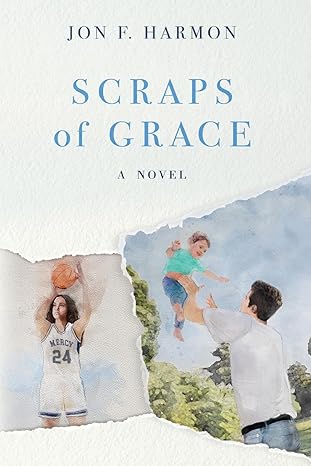
Jon F. Harmon’s Scraps of Grace is a heartfelt and deeply introspective novel that follows Tyler, a single father navigating the wreckage of his past while trying to carve out a better future. Set against the backdrop of late 20th-century Detroit, the book explores themes of faith, loss, and redemption through the lens of an ordinary man struggling with extraordinary challenges. Tyler’s world is one of missed opportunities, lingering grief, and a wavering faith that he can’t quite let go of, no matter how much life tempts him to abandon it. Through his relationships—with his young son, an old flame, and a cast of unlikely mentors—Tyler stumbles toward grace in ways that are raw, imperfect, and utterly human.
Harmon’s writing is both fluid and poetic, with moments of unexpected beauty that catch you off guard. There’s an easy rhythm to the prose, occasionally punctuated by sharp, vivid descriptions that pull you into Tyler’s world. It’s a hilarious yet oddly fitting metaphor, the kind of offbeat observation that makes Tyler feel real, like someone you’ve met before. At the same time, the novel has a way of sneaking in deep, introspective moments, like Tyler’s reluctant nighttime prayers, whispered even when he feels unworthy because not praying would feel worse. These contrasts humor and weight, skepticism and faith are what make Scraps of Grace compelling.
Tyler himself is not an easy protagonist to love, but he is an easy one to understand. He’s flawed, distracted, sometimes maddeningly passive, and yet undeniably sympathetic. His relationship with his mother, for instance, is a fascinating study in quiet resentment and unexpected tenderness. At one point, he realizes he’s spent years seeing her as weak, only to question whether he ever really knew her at all. Harmon doesn’t serve up neat resolutions; instead, he lets his characters wrestle with their own blind spots, often without clear answers.
The book also leans heavily into its themes of faith and moral reckoning, sometimes subtly, other times more explicitly. One particularly moving thread follows Nicki, a young girl facing an unplanned pregnancy, as she struggles with the weight of her decision. Her inner monologue filled with raw uncertainty and quiet desperation feels heartbreakingly real. Harmon doesn’t preach; instead, he lets his characters stumble through their own moral mazes, allowing the reader to engage with the story on their own terms. That said, there are moments when the religious undertones become more overt, which might not appeal to all readers. But whether you share the novel’s spiritual perspective or not, its reflections on grace, suffering, and redemption feel universal.
Scraps of Grace is the kind of novel that lingers. It’s not a fast-paced, action-packed story, but rather a quiet, contemplative journey, one that rewards readers who appreciate character-driven narratives. If you enjoy books that dig deep into the complexities of faith, family, and second chances, this one is worth your time. Fans of contemporary fiction with a spiritual undertone will likely find much to appreciate here. Harmon has crafted a story that feels both deeply personal and widely relatable, an honest exploration of how even the most broken among us can still find a way forward, one scrap of grace at a time.
Pages: 490 | ASIN : B0DNGS1R4R
No One Was in Physical Danger
12 New Christmas Stories is a heartwarming and nostalgic collection of short stories, each offering a different perspective on the holiday season. What was the collaboration process like with all the different authors, how did you choose what stories to include?
Smooth as cream, mostly. Any rough patches were of my own rasping. You see, my collaborators are all more civilized than I. The fact that our interactions were conducted exclusively via the ether, no one was ever in physical danger. C’mon, we’re geezers. People our age don’t come to blows, we just sigh expressively—even when one is barely housebroken. And I’m not talking about the Big Dawg, either. Sorry, an inside joke.
I’m not sure how my book-mates chose their stories, but when Terry Broxson asked me to contribute, I knew he wanted me to include Jesus and Donkey. When he asked for two more stories, I decided on Million Dollar Christmas, and Jo-Jo’s Turkey. All three stories are built around young boys experiencing the Christmas Spirit in an adult way. Read together, it’s a boyish Christmas trilogy.
What were some goals you set for yourself with this anthology?
A Pulitzer, a phone call from Stephen Spielberg, and a nice letter from my 7th grade English teacher, Miss Eliza McCarthy. Sadly, Miss McCarthy has passed. But that doesn’t take you off the hook, Spielberg!
Are you working on any other collections for different holidays?
I haven’t broached the idea to my book-mates yet, but I’ve always felt Saint Swithin’s Day has gotten short shrift. Failing that, opening day of the Major League Baseball season offers lots of possibilities. No, I ain’t kidding. I’m thinking nine original stories—one per inning. While the game seesaws in the background, each inning, we feature a story about something happening in the stands, or the dugout, or the broadcast booth, or the concession stands, or the Men’s room, for that matter. Just one caveat: I won’t take part unless the setting is Fenway Park. And that’s final.
Christmas is a time for family and traditions—the foods we eat, the songs we sing, and the stories we share.
Within the covers of this book reside real and fictional families, both familiar and unfamiliar. What they all have in common is the Christmas Spirit—in spades. These are the kind of people you’d gleefully invite to share your dining room table on the most celebrated day of the Christian calendar.
We, the authors of these stories, know the world spins faster and faster every day, and the holidays can be particularly hectic. That’s why we chose these lovely stories that can be read in ten minutes or less. Hey, even a teenager can be coaxed from his or her phone for ten inspiring minutes, right?
Deconstruction

Deconstruction: Book One of the Deconstruction Trilogy by Justin Everett is a compelling exploration of faith, culture, and the clash of belief systems. At its core, the novel follows Father Frederick Norman, a man deeply committed to spreading the Christian gospel in the remote village of Niestra. However, Frederick grapples with doubts about his own faith and longs to hear from a seemingly distant God. In the midst of his mission, he becomes captivated by the people around him, who appear to possess an inner joy and spiritual enlightenment that challenges his own beliefs.
As Frederick navigates this new world, his journey takes a perilous turn when he is tasked with confronting Ramkast, a cult leader determined to lead his followers down a dark path. Ramkast, too, has struggled with the religion of his upbringing, asking the questions his society avoided. The two men, each shaped by different religious traditions, find themselves questioning everything they once held sacred. Everett’s storytelling masterfully weaves together the perspectives of Frederick and Ramkast, drawing readers into the internal conflicts of two men from vastly different worlds. Frederick’s monotheistic Christian beliefs contrast sharply with Ramkast’s polytheistic upbringing, where multiple gods coexist. This contrast deepens the novel’s exploration of spirituality as both characters wrestle with their religious teachings and confront profound philosophical questions about faith, mystery, and devotion.
For readers drawn to stories with strong religious themes, Deconstruction offers rich, thought-provoking material. Scriptural passages and cultural narratives about gods and religious practices add layers of complexity to the novel. One striking moment comes when the question is raised, “Why would you worship someone who covers himself in so much mystery?” Such moments invite deep reflection and keep the reader engaged on both intellectual and emotional levels. The novel excels in its use of dialogue and internal monologues, keeping the focus tightly on the characters’ struggles without unnecessary distractions. The villagers’ efforts to preserve their way of life contrast starkly with the darker theme of violence, creating an atmosphere of suspense and tension throughout the story.
Deconstruction is an engrossing and evocative novel that leaves readers both satisfied and eager for more. As mysteries unfold and the characters’ convictions crystallize, the climactic ending sets the stage for the next installment of Everett’s trilogy. It’s a thought-provoking and powerful read that will resonate with those who appreciate nuanced explorations of faith and culture.
Pages: 362 | ASIN : B0DB8YVGQT
12 New Christmas Stories
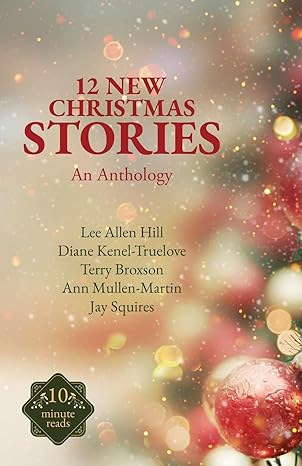
12 New Christmas Stories is a heartwarming and nostalgic collection of short stories, each offering a different perspective on the holiday season. Ranging from touching tales of family traditions to humorous fictional adventures, it’s a book that seeks to capture the essence of Christmas. Each author presents their own style, making it a delightful read for those who enjoy variety. You’ll find yourself drifting from the high deserts of New Mexico to cozy family living rooms, all while reflecting on the themes of love, kindness, and the magic of the season.
What I loved most was how relatable many of these stories were. Diane Kenel-Truelove’s “The Magic of Santa’s Christmas Box” really pulled at my heartstrings. She took me back to my own childhood, reminding me of those magical moments when Christmas seemed larger than life and was filled with mystery and wonder. The story about receiving a box of books from Santa transported me back to the days when even the smallest gestures during the holidays felt magical. The emotions it stirred were incredibly powerful. There’s something so simple and beautiful about remembering how special Christmas felt as a child.
Terry Broxson’s “The Christmas Tree,” stands out for its blend of whimsical fantasy and heartwarming tradition. The story is narrated through a conversation between the protagonist and his talking cat, Holly, who recounts a fascinating tale about the origin of their Christmas tree tradition in the Arapaho tribe. Broxson weaves humor into the narrative, especially in the playful dynamic between the cat and its owner, but the story also carries deeper themes of peace, unity, and the blending of cultures. The historical backdrop of Kit Carson and Native American customs, combined with the quirky cat’s storytelling, gives this Christmas tale a unique charm that feels both magical and thoughtful.
On the other hand, Lee Allen Hill’s “Jesús and Donkey” was lighthearted and fun but also had a deeper emotional core. This story about a boy in New Mexico trying to buy a turkey for his Christmas dinner was charming and felt like a love letter to simpler times. Hill’s writing paints vivid scenes and made me feel like I was alongside Jesús and his quirky dog, Donkey. The playful humor between the characters and the unexpected turn with the mountain lion added a nice twist. It reminded me of those feel-good holiday movies that leave you smiling at the end.
Jay Squires’ essay “Bring Back the Carolers” hit me right in the nostalgia. The way he reminisces about the simple joy of carolers and homemade hot cocoa made me yearn for a time when the holidays felt more communal. His writing was almost poetic, bringing the past alive with such vivid detail. His words felt like a gentle nudge toward rekindling old-fashioned holiday spirit.
Pages: 95 | ASIN : B0DBVCLX3S
A Sacred and Holy Right

Queering My Religion: Biblical Stories Of Queer Love In The 90’s transforms traditional religious stories into modern tales about identity, love, belonging, and the queer experience. What was the inspiration for this collection of stories?
Back in the 1960s, a bible scholar named Clarence Jordan was able to confront racism and segregation in the American South by retelling the story of Jesus as if it took place in the American South in the 1960s.
While I’m not a biblical scholar of the same magnitude, I thought these stories might be a way to do something similar. The Queer potential in these stories is discussed in even the most conservative seminaries, but I wanted to move these readings out of graduate-level classrooms into the hands of people.
What were some themes that were important for you to explore in this book?
That Queer people have always been part of human reality and as much a part of God’s interaction with people as straight people have.
Is there any moral or idea that you hope readers take away from the story?
That Queer identity is as much a part of being created in God’s image as anything else. Queerness is a sacred and holy right alongside other points of human existence.
What is the next book that you are working on, and when can your fans expect it to be out?
I didn’t begin these stories with the intention of publishing them per se. I began them because I found that writing helped me deal with grief and stress. I’m still writing regularly. But right now I’m writing comedy for performance. I don’t know if I have another book in me or not. However, I did recently read a scholarly paper theorizing that a well-known character from the book of Judges may have been neurodivergent. So, perhaps Roseville, IN will receive a new resident.
Author Links: GoodReads | Amazon
Join us as we reimagine familiar tales such as “Joseph and his Coat of Many Colors,” “David and Jonathan,” “The Centurion and his servant,” and “Philip and The Ethiopian Eunuch.” Each story tantalizingly hints at connections to the queer community, inviting readers to embrace ambiguity and explore the untold possibilities of these timeless accounts.
At the heart of this journey lies a powerful thesis challenging heteronormative interpretations, urging readers to question convention and celebrate the diverse spectrum of human experiences. Through the lens of Roseville, Indiana, themes of identity, love, and belonging come alive, offering readers a poignant reflection on the struggles and triumphs of the 1990s.
As you delve into these pages, be prepared to question preconceptions and rediscover the past through a fresh, inclusive lens. This anthology is not just a celebration of human existence but a bold call to reevaluate the narratives that have shaped our understanding of history. Join us on this literary voyage of rediscovery—one story at a time.


