Blog Archives
Mending Education: Finding Hope, Creativity, and Mental Wellness in Times of Trauma
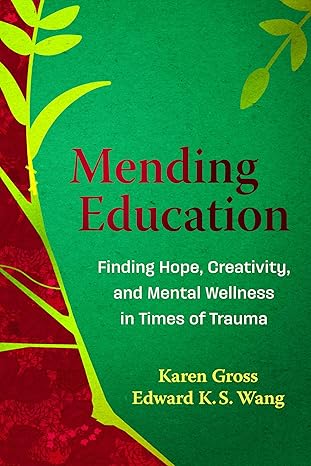

Mending Education, by Karen Gross and Edward K. S. Wang, offers a compelling examination of the U.S. educational system in the aftermath of the COVID-19 pandemic. Divided into three sections, the book focuses on the silver linings of a global crisis, highlighting positive practices that emerged during the pandemic and proposing ways to integrate these lessons into the future of education. The authors open by vividly recounting the unparalleled challenges faced by students, educators, and institutions during the pandemic. From preschoolers to university students, no learner escaped the seismic shift to online education. Gross and Wang explore the rapid transition from in-person instruction to digital classrooms, shedding light on how teachers adapted to an entirely new way of teaching.
While the book does not shy away from discussing the devastating effects of the pandemic, including social, economic, and geographic disparities, the focus remains on identifying actionable positives. The authors delve into creative solutions employed by educators during this time, demonstrating how these strategies can become enduring practices within schools. Chapter 8 stands out as a particularly impactful section. Here, the authors spotlight simple yet transformative practices, such as conducting home visits or starting each day with personalized greetings for students. These small gestures, while born out of necessity, fostered stronger connections and deeper engagement, offering lessons in human-centered education. Similarly, the text celebrates how teachers expanded beyond textbook-based teaching to incorporate diverse, innovative methods. Such shifts, according to Gross and Wang, should be embraced and institutionalized to build a more adaptive and inclusive educational system.
While the insights presented are valuable, I feel the book occasionally lacks conciseness. For readers familiar with the intricacies of education, the detailed descriptions may seem somewhat repetitive. However, for those outside the field or involved in policy-making, the depth provides an illuminating perspective on what educators endured and achieved during this unprecedented time.
Mending Education is a thought-provoking read for anyone interested in understanding the resilience of educators and the transformative potential of the pandemic’s lessons. Gross and Wang skillfully bridge the gap between crisis response and long-term reform, offering a hopeful vision for the future of education. Whether you’re a policymaker, an educator, or simply curious about how the pandemic reshaped learning, this book provides a meaningful lens through which to view the challenges and opportunities that now define modern education.
Pages: 232 | ASIN : B0CWJD6L1H

Hope to Eradicate the Vestiges of Slavery

Child Care Justice examines the historical, political, economic, educational, and cultural systems that continue to oppress early care educators and, by extension, racialized children and children in poverty. Why was this an important book to write?
The reason this was an important book to write is that during the COVID 19 pandemic, when the book project began, child care surfaced as an important factor for the country’s economic recovery in terms of parents being able to work with the comfort of knowing their children were being cared for. However, while child care was being touted as the engine for economic recovery, not many people were aware of the fact that the institution of slavery, and its low regard for humanity, through its economic and physical exploitation of the enslaved, continues to this day, and stigmatizes workers in the various care industries through racial injustice, gender injustice and economic injustice. Thus resulting in a class of low wage, low status individuals, primarily women of color, on whose shoulders the country intended to rebuild the economy.
With such a complex topic, how did you narrow the focus to the important ideas for you to share in this book?
As you can imagine, the outline for a book of such scope and complexity requires a lot of rethinking and multiple iterations in order to tell as story that has congruence and coherence. However, it was the skillful eyes and ears of my brilliant, co-editor Kyra Ostendorf who brought it all together. She took what started out as my topical outline, and converted it into chapters that made sense and hung together.
The authors cover a wide range of topics in this book and present facts from various sources. How much research did you undertake for this book, and how much time did it take to put it all together?
The selection of authors was a carefully, curated process that was a combination of matching authors that we already knew with the chapter topic and discovering new, fresh authors whose body of work was amazing, compelling and unknown. However, the beauty of this undertaking was our monthly author’s workshops that followed a protocol that created a sense of camaraderie and morphed into a problem solving lab. I believe that it created a sense of community that lent itself to the book’s cohesiveness. All total, it took about two years to bring the book to publication. However, it was a labor-intensive, multiple writes and rewrites process, with some serendipity along the way.
What is one thing that you hope readers take away from Child Care Justice?
I hope that the reader takes away a sense of hope that we can eradicate the vestiges of slavery, and past injustices by creating a national movement of low wage, low status workers across organizational lines.
Author Links: Website
Book Features:
Centers the historic and current oppression of Black people in the United States as foundational to the disregard for child care workers today.
Uses Paulo Freire’s critical consciousness framework to guide readers to see, analyze, and act.
Calls for a multiracial coalition of activists for racial justice, gender justice, and economic justice.
Child Care Justice: Transforming the System of Care for Young Children


Child Care Justice: Transforming the System of Care for Young Children critically examines the stigma rooted in this history, which has unjustly relegated modern childcare workers to a status of low prestige and pay. It features expert authors who offer research, insights, and practical knowledge on equity and social justice, dissecting the systems that sustain oppression within early childhood education. The narrative confronts both past and present injustices, advocating for social justice and cultivating critical awareness. The authors call upon educators, activists, and supporters to imagine and construct a more just system, underscoring that true national integrity—liberty and justice for all—hinges on recognizing and valuing historically marginalized childcare workers.
I found this book particularly compelling for several reasons. The dedication and passion of the authors are palpable and significantly influence my engagement with and perception of the book’s message. This commitment elevates the work from a mere academic discussion to a heartfelt call to action. Moreover, the book was revelatory for me. As someone from a predominantly Caucasian country, I was not deeply engaged with or knowledgeable about the political issues in other nations. Yet, the book opened my eyes to the fact that the injustices and inequities discussed are not foreign but are present in my own country, affecting adults and children alike, often based on ethnicity. The dialogue initiated by this book is crucial, particularly for children who are inherently vulnerable and learning to interact with the world. It suggests that broader conversations are needed, ones that the authors and readers may not even fully realize. I am convinced that change can begin with one person, and I commend the authors for their courage and advocacy.
I would recommend Child Care Justice: Transforming the System of Care for Young Children to anyone grappling with injustice, to childcare and other low-wage workers, and to anyone seeking to understand the realities faced by many people. It is an enlightening read that calls for awareness and action towards a more equitable society.
Pages: 207 | ASIN : B09Y8NRFGW



 LITERARY TITAN