Blog Archives
Cats of Ulthar – A Tale Reimagined


The story in this riveting graphic novel follows a family of cats on the eve of returning home, where a father recounts to his children the tale of their grandfather. What begins as a bedtime story quickly becomes a dark memory of captivity, vengeance, and rebirth. Through a mix of folklore and horror, the grandfather’s story shifts from being a tale of survival to one of transformation, wrath, and liberation, ultimately leading to the cats’ uprising and the claiming of Ulthar as their own. It’s framed as a fable meant to soothe children, but the truth hidden beneath is haunting and violent.
I felt the writing carried a sharp edge. The narration had a mythic quality, but it didn’t feel distant. It gripped me with its bluntness, its willingness to hold nothing back. I found myself unsettled, yet strangely compelled. The pacing worked in waves. Quiet moments of family warmth gave way to gut-punch images of horror and then swelled into something almost triumphant. The ideas in the story were compelling. Comfort as a prison, freedom as something bought in blood, and vengeance as both a curse and a gift. Those thoughts stuck with me long after closing the book.
The art and writing played well together; each panel really captures the scene beautifully. I appreciated the artistic way it conveyed the sense of dread. What I really enjoyed about this book was the tone. It never preached, it never softened. Instead, it whispered through shadow and silence. The ideas about rage and justice made me uneasy, though in the best way. I felt torn, both rooting for the cats and recoiling at the brutality. The line between freedom and cruelty blurred, and that tension made the story more than just a horror tale. It made it human, even though it was about cats.
Cats of Ulthar left me shaken and thoughtful. I’d recommend it to readers who enjoy dark fables, horror, and fans of H.P. Lovecraft. It’s for those who want a story that claws at them a little, one that scratches the surface and digs into the tender parts beneath. If you like tales that balance beauty with terror, this graphic novel is for you.
Pages: 26 | ASIN : B0FMC1X9J1

Innovative Climate Solutions

The Adventures of Captain Polo: Polo in Brazil follows an outspoken polar bear who tackles environmental challenges and human greed that are fueling climate change while he discovers new ways to heal the Earth. What was the inspiration that created the fantastic journey these characters go on?
The Adventures of Captain Polo: Polo in Brazil is a sequel to Pole to Pole, which ends on an open note as Polo and Penguin escape from Tex Greedyman’s yacht under precarious circumstances. This sets the stage for the new book, beginning in the mid-Atlantic, near the Brazilian coast and the mouth of the Amazon.
Initially, I planned for Polo’s visit to Brazil to be brief, focusing on the Amazon’s environmental issues. However, as I delved deeper into my research, I discovered a wealth of critical topics that I felt compelled to include. This led me to dedicate the entire book to Brazil, ensuring it didn’t solely focus on the Amazon. Brazilian environmentalists often point out that excessive attention on the Amazon overshadows other equally important ecosystems. My goal was to showcase Brazil’s incredible diversity—not just in landscapes but also in its people—while highlighting both environmental challenges and the innovative climate solutions emerging across the country.
To achieve this, I structured the story to allow Polo and Penguin to travel across Brazil, exploring key regions: the Amazon, Rio de Janeiro, the vastly underappreciated Atlantic Forest, and the southern cattle ranching grasslands. My research revealed that each of these locations presents compelling examples of climate solutions in action, which I wanted to illustrate. The southern rangelands, in particular, play a crucial role in challenging common perceptions about climate change. Rather than simply presenting widely accepted narratives, I wanted to encourage critical thinking. The book’s cattle ranching scenes provide an opportunity to explore the often misunderstood role of livestock in climate change. While it’s undeniable that beef and lamb production contribute to deforestation and greenhouse gas emissions, there is also scientific evidence supporting the role of well-managed natural grasslands, maintained by free-ranging herbivores, as a climate solution. Unfortunately, the nuances of this debate are often lost, leading to the blanket demonization of cattle ranching by well-meaning but misinformed environmentalists. Polo and Penguin’s journey to southern Brazil introduces an ongoing conservation project that protects natural grasslands on private cattle ranches, offering a more balanced perspective on this complex issue.
Of course, Polo and Penguin’s adventure is not solely about education. The story is enriched with secondary characters who add humor and excitement, ensuring the book remains engaging and entertaining while delivering its environmental message.
What educational aspects were important for you to include in this children’s book?
I wanted the book to meet readers’ natural expectation that a story about Brazil would include the Amazon, but I also aimed to go beyond that, showcasing other crucial regions with their own climate action stories. The most important educational goal of the book is to encourage critical thinking, particularly regarding the complex and often contradictory role of cattle in climate change, as discussed in the previous answer.
To truly understand climate issues, it’s essential to look beyond surface-level narratives and recognize deeper connections. For example, I hope readers will be shocked not only by the Amazon’s environmental destruction but also by the human rights abuses occurring alongside it—an aspect that is often overshadowed, particularly for children, who despite their tender years deserve to know the truth. Similarly, I want them to recognize how everyday consumer choices, sometimes made on the other side of the world—whether it’s buying a hamburger (potentially driving deforestation and monoculture farming) or a new cellphone (fueling mining, often illegal)—can have far-reaching consequences.
Tex Greedyman’s downfall on a deserted island also carries an important message: his wealth and power instantly become meaningless in his new circumstances. This serves as a stark reminder of the fragility of consumer-driven lifestyles and the illusion of material security.
Of course, for a children’s book, the overall message must be one of hope. Another key educational aspect is showing that real solutions exist—right now, countless people are working hard to combat climate change and broader environmental challenges. Kids need tangible, real-world examples of these efforts, and the book provides them, offering inspiration and empowerment alongside its cautionary lessons.
What was the most challenging part of writing this book and what was the most fun?
The biggest challenge, as always, was balancing educational content with an engaging, entertaining storyline. Writing an educational comic book comes with the added difficulty of limited space for text—speech bubbles must be concise, and pages can’t be overcrowded with dialogue, as too much text can overwhelm readers. This challenge was heightened by the need to include technical terms, which I consider essential for educational value, as well as the deliberate use of Portuguese phrases throughout the book—while not strictly necessary, they add authenticity and cultural depth.
The most fun part was illustrating and writing the dialogues for scenes that weren’t tied to educational content. The airplane sequence at the beginning, for instance, was inspired by my own experience flying in that exact plane, with the very same pilot. Likewise, Willy’s unexpected encounter with red ants while cutting down a Cecropia tree comes from a personal experience (I have worked for decades in the Amazon as a field biologist) that has stuck with me for years. These moments of humor and adventure added an extra layer of enjoyment to the writing process.
What is your writing process like? Are you more of a plotter or a pantser?
I am the King of all Plotters! And necessarily so. I learned early in my career that if I don’t plan my comics meticulously, I end up wasting time, energy, and far too many sketchbook pages.
For me, planning isn’t just about research (though there’s plenty of that to ensure accuracy). It’s also about carefully structuring the book’s layout. Every speech bubble must be placed in the right order, which dictates its position within the frame. Some frames need to be larger, differently shaped, or arranged to emphasize key visual elements, set a mood, or enhance the pacing of the story.
The script requires just as much precision. I have to strike the perfect balance between educational content and entertainment, making sure neither overpowers the other. The story itself has to feel like a roller-coaster ride—fast-paced and engaging enough to keep readers flipping pages, all while seamlessly delivering knowledge and insights along the way.
Author Links: GoodReads | X (Twitter) | Facebook | Website | Amazon
Stewards of a Healthy Planet
The Adventures of Captain Polo: Polo and the Yeti follows a polar bear on an adventure who is captured and in danger of being sold to a zoo if he cannot escape and continue his journey. What was the inspiration for the setup of your story?
This is the second book of a trilogy that was originally published as a single title. When I decided to split this story into three separate books, I knew I had to find a cliffhanger on which to end the first book, and the perfect scene was when Polo is captured at sea. This is what inspired the setup in Book 2 starting with Polo escaping in the port of Shanghai, and it was a good way to simultaneously continue the main character’s travelogue into a key geography for topics relating to climate change (both in terms of issues and solutions) whilst maintaining the vital element of fast-paced entertainment required to carry the story along.
Many of the scenes in this part of the book are inspired by Tintin comics, both graphically and in terms of the plot.
Captain Polo may be a polar bear, but he has human characteristics and encounters problems because he is seen as just an animal. What were some driving ideals behind your character’s development?
A fundamental driving characteristic of character development in this first trilogy that carries through all three books is that the initial reaction of most human characters to Polo is surprise or even fear. This is a rational argument denoting the most probable reaction any human would have to suddenly encountering a bipedal polar bear in the most unexpected places. The pattern that immediately unfolds is that those same people quickly realise this is not an ordinary wild animal; Polo’s human traits quickly break through people’s fear and surprise to the point where they see him on their level as a conversant and highly intelligent being. This then allows Polo to interact in a meaningful way to carry the non-fiction elements of the book.
The Adventures of Captain Polo: Polo and the Yeti, I felt, did a good job explaining climate change and global warming to young readers. What is one thing that you hope readers take away from the story?
The main thing I wanted this particular book to communicate to readers is that two of the countries in the world that rank among the highest offenders in terms of causing global warming (China and India) are actually also among the most innovative for climate solutions, whether through public policy, technology, or both. Polo and the Yeti fulfills this purpose and the geography involved also provided me with an opportunity to throw in some messages of wisdom from Eastern religions and spiritual sources, many of which explicitly allude to humans’ responsibility as stewards of a healthy planet.
This is important to me because my readers so far at least tend to be mostly from the Western world, and I want my books to present the reality of climate change while also taking into account the perspective of other parts of the world, particularly in terms of social and technological innovation to mitigate and adapt to climate change. It is important that young readers appreciate they are part of a single world, and not as isolated as they might think from kids their age who live very far away.
When will Book 3 be available? Can you give us an idea of where that book will take readers?
Book 3 is already available! The final installment of the trilogy takes Captain Polo across the Arabian Sea into East Africa, down the River Nile, and on into Western Europe. Polo has many adventures along the way and learns about even more subtle and unexpected facets of climate change, such as the combined impact of global warming and tourism on Masai populations in Kenya and how climate change is, at least in part, at the root of the problematic immigration of desperate refugees from North Africa and the Middle East seeking asylum in Europe. At the end of Book 3 Polo is guest of honor of former President Obama, befriends Leonardo DiCaprio and Edward Norton, and makes a new friend in London Zoo…
Author Links: GoodReads | Twitter | Facebook | Website | Amazon
Captain Polo and the Yeti is an exciting graphic novel in the tradition of the legendary Tintin and Asterix series. If you like stories of adventure and humour with accurate geographical and cultural settings, then you’ll love this fast-paced, educational and entertaining tale.
Captain Polo is devastated: his precious boat is in pieces, lying at the bottom of the Pacific Ocean, and he is locked in the hold of a fishing vessel, destined to be sold to a zoo in a foreign land.
In Book 2 of the series, Polo faces countless dangers and obstacles on a path that will take him across China, up the mighty Himalaya mountains into the forbidden monasteries of Tibet, through the swampy delta of Bangladesh, and into India. On his voyage Polo meets many colourful, informative, heroic, kind, mischievous and also dangerous characters, ranging from an enlightened Chinese farmer to a jealous Fakir, a disgruntled Bengal Tiger to the Dalai Lama himself. On his way Polo also meets and learns from a character drawn from legend…
Every step of the way the bear who has become Captain Polo hones his understanding of the causes and effects of climate change, the true meaning of global warming and how it is affecting all living creatures and human societies. Polo also witnesses the heroic efforts of individuals, human groups and governments who are learning to adapt to a changing world, reduce their carbon footprints by innovating in the use of cutting edge technology and becoming leaders in the adoption of clean energy.
Captain Polo is half way around the world and a long way from home. On his travels he has picked up new understanding and knowledge about how global warming is affecting people across the world.
Get Book 2 in the series to share in his learning, and have fun while doing so!
A Strong Moral Lesson
In The Adventures of Captain Polo, readers embark on a journey with a polar bear as he travels the world discovering the devastating impact of climate change. What was the inspiration for the setup of your story?
Climate change is a global problem, yet there are local effects, and also in many cases, local solutions. I wanted to depict this somehow, so very early on when drafting the script, I knew this book was going to be framed as a global odyssey. In the course of my research, I was lucky enough to talk to prominent climate professionals, such as the late Saleem Huq, who enlightened me on very specific aspects to consider, mostly from the perspective of the global south. This inspired me, as did also my own background as a person who has lived mostly in the developing world, and I also drew inspiration from my professional experience in conservation, which has exposed me to the problems faced by wildlife, as well as by local communities. Many of these problems are made worse by global warming, and those who suffer the immediate effects of this are those who are least responsible for the problem. Researching all this under a climate lens basically determined the exact geographical route Captain Polo follows.
However the story also needed to be engaging; inspiration for the fiction, adventure, and comedy inherent in the book come from my own reading while growing up – mostly TinTin and Asterix albums, with a few nods here and there to Lucky Luke and even post-war British cartoonist Carl Giles.
What was one scene in the novel that you felt captured the morals and message you were trying to deliver to young readers?
There are several such scenes, but one that stands out for me is the scene where Captain Polo meets a boatload of emigrating Kiribati islanders fleeing their island home in a desperate gamble to find asylum in New Zealand. This scene reflects a very real truth facing the Small Island Nations in the Pacific region, and it is a perfect example of climate injustice: small island nations are literally being flooded by rising sea levels entirely caused by global warming entirely caused by large, developed or emergent economy countries very far away. For this reason, there is a strong moral lesson to be read in this scene: those who are least responsible for global warming are the very same who pay the highest and most immediate price. This theme is actually present throughout the book and its sequels, and it serves as a bridge between the reality faced by Captain Polo as a polar bear whose Arctic home is literally melting beneath his feet and a great number of human communities around the world who face similar challenges as a result of glacial ice melt raising sea levels the thereby causing catastrophic flooding. As such, climate justice – or rather, injustice – serves to establish a bond between the main character and the various people he encounters.
What made you decide to write Captain Polo’s story as a graphic novel?
Graphic novels are the format I specialize in because I am actually a cartoonist rather than an author of prose per se; my ability to draw cartoons largely predetermines the format of my storytelling. I believe it gives me an edge I would not normally have over prose authors telling the same story, and at the same time, I suspect most graphic novelists would not have my scientific inclinations, interests, or knowledge to tell a story about climate change. It is this sweet spot combining art and science that defines my niche style. The graphic novel format also allows for near-constant visual movement and a dynamic dialogue and narrative, which is necessary to give the story a fast pace. This fast pace represents an unspoken sense of urgency – “the world is burning, we need to do something, NOW.” The graphic novel format crucially also lends itself to the use of visual humour, which is my most important style indicator, and I believe important for my target readers, especially when addressing a subject as grim as climate change.
Can you give readers a peek into the second installment of Captain Polo’s adventures?
In Book 2 of the Adventures of Captain Polo – Polo and the Yeti – the story continues where Book 1 ended. Spoiler alert: Captain Polo escapes his captors and crosses China before entering the mysterious realm of Tibet and beyond. This part of the trilogy is perhaps even more fast-paced than Book 1, and I allowed myself to have a bit of fun with some of the characters!
Author Links: GoodReads | Twitter | Facebook | Website | Amazon
At the beginning of his life-changing journey, the bear is hungry, frightened and alone, drifting further and further from an Arctic home that is changing in ways he cannot comprehend. But the bear without a name survives, and as he travels the world, meeting colourful characters both human and non-human and getting into all sorts of adventures, he gradually begins to understand a reality he never knew existed. The bear who will become Captain Polo realises he is not alone in seeking answers.
The Climate Change Comic is a fast-paced graphic novel depicting accurate geographical settings and detailed, colourful illustrations designed to make learning about a complex and frightening subject positive, easy and fun. In this first book of the series, readers as young as 9 will be swept into a global journey of discovery that will help them understand some of the causes and effects of the most critical environmental crisis in human history, what people are doing about it, and how each one of us can make a difference – wherever we live, and whoever we are.
Our children are facing an existential crisis in the form of ecological collapse and global climate change, but they don’t have to stay confused and anxious. Instead, give them what they want: understanding and actionable knowledge empowering them to become agents of positive change at home and at school. This is the mission of Captain Polo.
Get the first book of the series now!
Who Darwin Really Was

Charles Darwin and the Theory of Natural Selection introduces children to Darwin and his theory with captivating graphics and easy-to-understand language. Why was this an important book for you to write?
This was an important book to write and illustrate because when a student of zoology and evolution in my younger years I had initially struggled to grasp the true mechanisms describing Darwin’s theory of evolution by natural selection, and I wanted to present this information in a way that was easier to understand. The general public, including children, tends to misunderstand Darwin’s legacy, and for this reason, the subject is still shrouded in controversy. In addition, I was physically present in the Galápagos at the time of researching and creating this book, which made creating it all the more compelling.
What were some educational aspects that were important for you to include in this children’s book?
I wanted to inspire curiosity and a sense of wonder as well as awareness of the fragility of the Galápagos islands’ biodiversity and Nature in general. With the non-fiction content of the graphic novel, I wanted to highlight the scientific, geographical, historical, and biographical aspects of Darwin’s story to enable my readers to get a glimpse of what Victorian exploration and science could have looked like, who Darwin really was, and how his Theory actually works. I also wanted all this to be engaging and memorable, hence the graphic novel format.
What were some goals you set for yourself as a writer in this book?
My main goal was to stick to the facts as much as possible, and reflect what actually happened, making sure to get the science, history, and geography absolutely spot on! It was also very important for me to become so familiar with the workings of Darwin’s theory myself that I could explain it in simple language to children. At the same time, I had to make the book fun to read, hence the style of illustrations, inspired by Tintin, among others.
Will this graphic novel be the start of a series, or are you working on a different story?
This is not a series but a stand-alone work. My main focus nowadays is to document climate change, in all of its various forms and sub-topics, focusing always on showing solutions. This is a series, called The Adventures of Captain Polo, and these books, too, are graphic novels. At the moment, I am working on the 5th book in this series, which is dedicated to Brazil and why that country is a major player in the fight against global warming.
Author Links: GoodReads | Twitter | Facebook | Website | Amazon
If you are a fan of Tintin, Maus or the popular Science Comics series you will love Charles Darwin and the Theory of Natural Selection.
For most people, Darwin’s ground-breaking legacy remains shrouded in controversy. The detailed mechanics of the Theory of Evolution are largely confined to Life Science academics and professionals. Yet Darwin’s work is still the best explanation we have for the fabulous diversity of life on Earth, and it is rightly present in the science education curriculum the world over.
Researched and created on the Galápagos Islands themselves, this historically, geographically and scientifically accurate graphic novel explains Darwin’s theory in clear language, and provides thoroughly researched insight into Darwin’s thought process and the pressures he had to deal with. As an educational resource, the book provides an entertaining learning experience for curious kids, and is perfect for science teachers who want to teach evolution in their classrooms. It is also great for any adult interested in natural history, Darwin and his theory, and Victorian scientific exploration in general.
Charles Darwin: the comic
What you will discover:
How the field observations made by Darwin and his crew while visiting the legendary Galápagos islands eventually led to the Theory of Natural Selection
How Darwin tapped into the scientific minds of his time and related with his peers
Darwin’s inner struggle while developing his work, including the dilemma he faced as a God-fearing Christian
The little-known truth behind how the Theory of Natural Selection was actually stumbled upon
How the Theory actually works, explained in simple language and with cartoon illustrations
Extend your knowledge and that of your kids in finally understanding the only scientific explanation for Life on Earth by traveling back in time to enter the mind of Charles Darwin!
The Adventures of Captain Polo: The Climate Change Comic

Alan J. Hesse’s The Adventures of Captain Polo: The Climate Change Comic offers a unique and engaging take on climate change through the eyes of its protagonist, a polar bear named Captain Polo. Displaced from his melting Arctic home, Polo embarks on a global journey, uncovering the far-reaching effects of environmental degradation. As he encounters various communities, Polo transforms from a curious wanderer into a messenger, charged with the vital task of raising awareness about climate change.
This graphic novel skillfully combines education and entertainment, making it an appealing read for children and adults alike. Hesse weaves important environmental facts and figures into the narrative, providing an informative backdrop to Polo’s adventures. The inclusion of footnotes enhances understanding, making complex issues accessible to younger readers. The book doesn’t shy away from addressing the dire consequences of deforestation, pollution, and carbon emissions, presenting a clear call to action: halt the destructive behaviors contributing to global warming.
The Adventures of Captain Polo: The Climate Change Comic stands out with its vivid illustrations and clear, engaging narrative. It’s not just a story about a talking polar bear; it’s a compelling invitation to understand and engage with the critical issue of climate change. By framing this global challenge through the lens of adventure, Hesse encourages readers to consider their own impact on the world and promotes awareness in an approachable, memorable manner.
Pages: 42 | ASIN : B085W984R3

I Want To Inspire and Motivate Others

Look Within II: Environment is Key follows an ambitious and intelligent young boy who wants to help his village thrive after hearing the elders’ concerns about fuel sources. What was the inspiration for your story?
Look Within II, is the follow-up to my first ever published book! Look Within: a story about discovering the key to success. After receiving so much positive feedback, and the overwhelming love and support especially from young people. I was moved to expand the world created in the first book, and dive deeper into some of the aspects of personal development that many of the readers resonated with. Most notable the importance of environment.
Kim wants to fit in but struggles with interacting with his peers despite his intelligence. What was the inspiration for the main character’s traits and challenges?
The inspiration for our main character’s story was sparked by conversations I’ve had, mainly with young people, about the importance of looking within to identify our values, morals, and the goals we set for ourselves before seeking outside validation. We all find ourselves in various environments: school, work, community, clubs, religious groups, etc. From these environments, we naturally develop behaviors and traits, sometimes to “fit in.” However, once we truly understand ourselves—our likes, dislikes, and the things we need to help us grow and thrive—we become aware of how to shape our environment to suit US instead of trying to “fit in” to an environment that doesn’t align with our goals or bring us true happiness.
What were some educational aspects that were important for you to include in this children’s book?
At this stage of my life, I am genuinely excited about learning. The most significant difference between my current mindset and me as a child in school is when I began seeking out subjects that genuinely sparked my interest. From my experience, the educational system often adopts a one-size-fits-all approach, neglecting the importance of personal introspection and taking responsibility for learning in alignment with our individual goals. Through an easily readable and well-illustrated story, my goal was to convey this message and inspire others to embark on their unique journey of growth, igniting their enthusiasm for learning and pursuing their genuine interests. I firmly believe that if I had been exposed to this perspective earlier in life, it would have profoundly impacted me. Therefore, my goal is to utilize these stories as a means to inspire and motivate others.
What is the next book in the Look Within series that you are working on and when will it be available?
I would really like to see more feedback, and support on my work up to this point. But I can definitely see the Look Within series as a trilogy! And depending on what conversations come from LOOK WITHIN books 1 & 2 a third book could be on the way very soon! So please PLEASE support and leave feedback, and I’m always very appreciative, and will continue to inspire through writing and working in my purpose.
Author Links: GoodReads | Website
Beautifully illustrated for readers of all ages.
LOOK WITHIN 2: Environment is Key
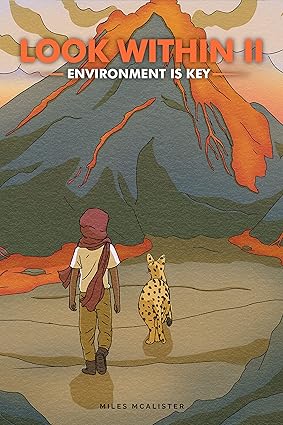
Kim has big dreams. He envisions himself as an inventor of wonderful and amazing things. Raised in a remote village, Kim pays close attention to the conversations of the many elders who have played important roles in his life. When they begin to show concern for fuel sources, Kim knows he can help. He sets about the work of gathering everything he will need to set things straight for his village. His dreams of seeing the village thrive fuel his efforts, and he puts all his energy into inventing something that will make all the difference in their lives.
Look Within II: Environment is Key, by Miles McAlister, is the story of an especially ambitious young boy with dreams of not only becoming an inventor but helping his village overcome the struggles that threaten their way of life. Kim, the book’s main character, is different from the other young people his age. McAlister has created a shining example of a young person destined for great things. He is relatable in that he is thoughtful and wise, but he also struggles with wanting to interact with others his age and not really understanding how to make that happen.
The author has incorporated the perfect blend of fantasy and realistic fiction and handed young readers an inspiring tale of hope. Kim is a fantastic role model and possesses an innate curiosity that he allows himself to follow in order to better himself and the lives of those he loves. This is truly a remarkable addition to children’s fiction.
I highly recommend Look Within II: Environment is Key, by Miles McAlister to teachers who would like to introduce students to a more scientific way of thinking. I can see this book easily blending into a STEM curriculum in any elementary or early middle school classroom.
Pages: 76 | ASIN : B0C2S719MT



 LITERARY TITAN