Blog Archives
Beautiful Journey

Reigning Fire tells the story of a princess raised in a world built on Smokeveil magic, rigid hierarchy, and brutal expectations, whose Emberkin arrives too early and in a form that is forbidden. What was the inspiration for the setup of your story?
Reigning Fire grew out of two long-standing fascinations: mythical creatures inspired by East Asian folklore, and the question of what it costs a person to exist in a world that often values conformity over authenticity.
As a late-identified neurodivergent writer, I’ve spent much of my life feeling out of sync with the rhythm everyone else seemed to follow. When I was younger, a head teacher once described me as “a square in a world of circles.” It took years to realize she was right, but also that I wasn’t a square at all. I was a triangle. And ultimately, the problem wasn’t my shape, but the assumption that everyone should be the same.
That realization shaped the world of Reigning Fire more than anything. The Emberkin system—smoke creatures that take the form of real-world animals and bond with Weavers—became a way to explore identity, hierarchy, and the rules we’re told to accept without question. Characters in this world are taught that the timing of the bond and the “acceptable” Emberkin forms dictate their social status. Through that lens, I could examine the tension between who we’re expected to be and who we actually are.
As children, many of us inherit a set of rules about “how the world works.” But as we grow, we start looking closer and asking: Who created these rules? Why do they exist? Who benefits from them?
Xun’s Emberkin arriving too early and in a forbidden form allowed me to explore what happens when someone’s identity refuses to fit the timeline—or the template—that society sets for them. It’s a fantasy world, but the emotional truth beneath it is very real: the quiet, painful, and sometimes beautiful journey of learning to take up space as you are.
What were some themes that were important for you to explore in this book?
Beyond the question of identity, Reigning Fire explores three main themes that felt important for me to write about: historical erasure, loyalty, and the politics of perception.
First, I wanted to examine historical negationism—specifically, how societies can outlaw an aspect of human variation and then gradually erase all record of its existence. In the world of Reigning Fire, certain Emberkin forms are not only forbidden but deliberately removed from documented history and rewritten as “abnormal.” That dynamic mirrors the way real-world institutions sometimes control which narratives are preserved, which are buried, and which are reframed as taboo.
The second theme is loyalty, especially the form that exists between child and parent. I wanted to explore what happens when that bond is used as a tool—when a parent treats a child’s love and devotion not as something to nurture, but as a vessel for achieving their own agenda. It’s a painful tension: the longing to honor the people who raised you, and the slow, shattering realization that they may not always have acted in your best interests.
The third theme centers on power and perception. Throughout human history, the most enduring form of power hasn’t always come from weapons or armies—it has come from whoever controls the narrative. In Reigning Fire, characters constantly navigate a world where truth is malleable and obscure, and those in authority will go to extraordinary lengths to maintain their version of events. I wanted to explore the quiet, insidious ways people manipulate stories, memory, and even “facts” to protect their position.
All three themes—erasure, loyalty, and narrative control—shape the emotional core of the book. Even in a world of magic and mythical creatures, the human consequences of these forces are strikingly real.
What were some goals you set for yourself as a writer in this book?
One of my biggest goals with Reigning Fire was to write a story that felt deeply human, even inside a world full of magic, myth, and political danger. To do that, I challenged myself not only to explore the emotional territory I naturally gravitate toward, but also to sit with characters who unsettled me. I would ask them, “Who are you underneath your facade? What drives you? And how exactly did you become this version of yourself?”
Writing from perspectives that diverged sharply from my own was unnerving at times. There were chapters where stepping into another character’s inner world genuinely messed with my head for a while. But those were also the moments I’m proudest of because they made the story richer and more honest.
Another goal was to portray human choices in all their moral complexity. I wanted to move away from clean categories of “good or evil,” “loving or cruel,” and instead explore how intentions, fear, loyalty, and survival instincts collide. In real life, choices rarely fall into neat boxes—even the most well-meaning intentions can sometimes cause harm. One question that guided a lot of my writing was: At what point do good intentions stop being able to justify the consequences they create?
If readers walk away from the book holding more questions than answers, then I’ve achieved what I set out to do. Complex questions aren’t meant to have simple resolutions—but it doesn’t make them any less important to ask.
What is the next book you are working on, and when will it be available?
I’m currently working on the sequel to Reigning Fire, which will be released in late 2026. Without giving away any major spoilers, this next book explores how Xun—now going by Ling—ironically grows more in her years as a fugitive than she ever did as a princess. Stepping outside that gilded palace cage gives her the freedom to redefine who she is when no one is scrutinizing her every breath, even when her path is still fraught with danger.
Readers can expect to encounter more mythic Emberkin and new characters, as the world expands far beyond the political and cultural boundaries of the first book. Some familiar faces from Reigning Fire will return, while others may be absent… and I’ll leave it to readers to decide which disappearances should worry them.
One of the core themes of the sequel is reclamation—of identity, of history, and of personal power. That’s all I’ll say for now, but I’m excited for readers to see where the story leads next.
Author Links: GoodReads | Facebook | Instagram | Website | Amazon
In a realm where power is sealed through smoke and blood, Yan Xun was born to inherit a crown-or be destroyed by it.
When her Emberkin arrives far too early, and in a form the world has no place for, Xun becomes a danger to the very empire she was meant to serve. As she uncovers long-buried truths and navigates a court built on silence, loyalty, and control, her existence alone threatens to unravel everything.
Set in an ancient Chinese-inspired empire of myth and ash, Reigning Fire is a lyrical fantasy about forbidden power, political unrest, and the ghosts we carry. Through richly layered worldbuilding and emotional depth, this debut novel explores the complexities of trauma, neurodivergence, and what it means to survive when your truth has no place in the world.
Perfect for readers who love introspective characters, slow-burn rebellion, and myth-infused storytelling, Reigning Fire blends co
Reputation Is Paramount

Gods of Glenhaven follows a middle-aged couple and their teen daughter trying to navigate a failing marriage and broken family dynamic in a talkative small town. What was the inspiration for the setup of your story?
I love suburbia for many reasons. What fascinates me most about it is that it seems like the goal is to eliminate as many of the hardships and vicissitudes of life as possible. In the suburbs, you try to capture and keep the good things, while either ignoring or reframing the bad things you can’t manage to avoid. And reputation is paramount — you don’t want to become known as anything other than an upstanding person who loves their job, their children, and their community.
Do you have a favorite scene in this story? One that was especially enjoyable to craft?
I especially enjoyed writing the scene in the Home Depot, which takes place the morning after the Rites of Initiation at the high school. There are seventy naked people slumbering amidst the lumber and wheelbarrows, and a stunned police sergeant has to sort it all out.
What were some themes that were important for you to explore in this book?
The value of the social contract is the big theme. This is why I needed Gods (who don’t play by the rules) and the potential for humans to have unusual power, which might encourage them to break the terms of the social contract.
Can fans expect to see more releases from you soon? What are you currently working on?
I like to write short comedy pieces — my work has been published in McSweeney’s, Points in Case, Weekly Humorist, and other magazines. I’m doing a lot of that kind of writing while also beginning work on a second novel, entitled Little Dan.
Author Links: GoodReads | Facebook | Website | Amazon
When Greek gods sweep into the quaint suburban town of Glenhaven to untangle their messy love lives, the helpless mortals don’t stand a chance.
Christian Orr, struggling with work and erectile dysfunction after discovering his wife’s infidelity, has just moved into what his daughter Francesca calls the Divorced Dads Apartment Complex. His high-powered attorney ex, Sloan, is jaded and restless, leaving precocious Francesca caught in the crosscurrents of change.
Enter Dionysus-“Dee”-the god of wine, sex, and questionable decisions, who shows up searching for his estranged wife Ari and their teenage son Maron. After three thousand years of Dee’s antics, Ari has had enough. She’s struck a deal with Zeus to start fresh-as a mortal suburban mom. And what’s more normal than falling for a regular guy like Christian? If only Dee would stop tearing through Glenhaven in his quest to win her back.
Drunk on Dee’s wine, the residents of Glenhaven form chanting covens in the woods, participate in ecstatic rituals, and experience divine revelations-all while Led Zeppelin’s “Whole Lotta Love” loops faintly in the background of their lives.
Gods of Glenhaven is a hilarious, poignant, and confronting novel about the universal fears and follies of the human condition, and the joy and freedom we can experience by letting go.
Gods of Glenhaven
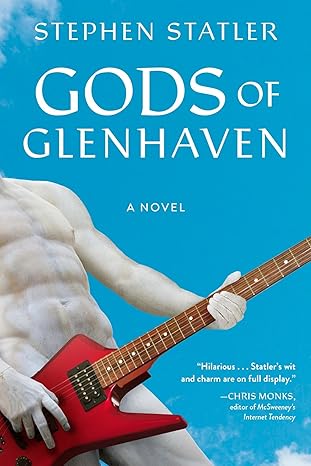

Gods of Glenhaven is a raw, darkly funny, and deeply human story about people falling apart and trying to stitch themselves back together. It follows Christian Orr, a man sliding into middle age with a broken marriage, sexual dysfunction, and a pile of humiliations that somehow keep getting worse. His wife, Sloan, is a driven attorney who mistakes dominance for control until her life unravels, too. Their teenage daughter Francesca floats between them, trying to make sense of the wreckage. Around these three, the town of Glenhaven buzzes with gossip, longing, and absurdity. It’s a small world full of big emotions, where humor and despair share the same seat.
I found Statler’s writing disarmingly sharp. Every line feels alive with awkward truth. He doesn’t flinch from embarrassment or pain, and he writes humiliation with the kind of precision that made me both laugh and squirm. The dialogue is quick and biting, but the silences hit harder. Christian’s spiraling self-awareness feels almost too real at times; I could feel the claustrophobia of his failures and the absurd hope that something, anything, might still redeem him. Sloan, on the other hand, made me furious and fascinated in equal measure. She’s brittle, proud, often terrible, but undeniably human. The novel moves like a tragic comedy that keeps threatening to tip either way.
What really struck me was how the book keeps shifting tones without losing its rhythm. One page had me laughing at Christian’s disastrous attempts at self-improvement, and the next left me staring, a little shaken, at how much loneliness the humor covered up. Statler writes like someone who has seen both the joke and the wound and refuses to pick one. The story feels like real life that’s been turned just slightly toward the absurd, so everything painful also glows with a weird kind of beauty. It’s messy, brave, and very alive.
Gods of Glenhaven is a brutal but compassionate look at failure and forgiveness. I’d recommend it to readers who love flawed people written with empathy. Fans of writers like Richard Russo or Jonathan Franzen will probably feel at home here. If you’ve ever felt lost, humiliated, or ridiculous and still had to get up the next morning, this book might hit uncomfortably close to the truth.
Pages: 378 | ASIN : B0F8KPGH67

Skull’s Vengeance (Audiobook)

Skull’s Vengeance, the fourth installment in Linnea Tanner’s Curse of Clansmen and Kings series, unfolds against the dramatic backdrop of the Roman Empire. This gripping tale follows Catrin as she embraces her destiny to become the fierce Celtic warrior queen her people desperately need, fulfilling the prophecy her father foresaw. Facing overwhelming grief and betrayal, Catrin must confront her half-brother, King Marrock, in a battle for survival. To prevail, she seeks alliances from unlikely places, including a cunning druidess who once deceived her and her Roman husband, Marcellus. Yet Marcellus is ensnared in a perilous political web, where one wrong move could doom them both. Their love stands on the brink, will they find a way to stand united, or must they part to survive?
The novel’s opening chapters moved slowly for me. While some elements intrigued me, the pace didn’t fully engage until the story hit its stride around chapter six. One contributing factor may have been the male narrator’s delivery, which progressively improved throughout the audiobook. The female narrator’s voice consistently shone.
Despite the gradual start, the plot is masterfully crafted. Action pulses through the narrative, weaving a complex tapestry of events that held my attention. Linnea Tanner skillfully navigates multiple perspectives, all while centering Catrin and Marcellus as the heart of the writing. The balance between their viewpoints enriches the depth of the tale.
Catrin herself is a powerhouse of resilience and determination. Her journey from mourning the loss of her stillborn daughter to leading her people with unwavering resolve was profoundly moving. She stands as a testament to the fact that fictional characters can inspire as deeply as real ones. Marcellus, too, captured my imagination. Trapped in a treacherous political arena, his every action demanded precision and cunning. I found myself holding my breath, fearing for him as much as for Catrin.
In Skull’s Vengeance, Tanner delivers a stirring blend of action, intrigue, and emotion. The characters feel vividly real, their struggles and triumphs resonating long after the final page. The story’s rewards make the audiobook’s journey worthwhile. I recommend this book to fans of historical fantasy who will find much to admire in this immersive and powerful tale.
Pages: 402 | ASIN : B0BC2GCFGG
I Wrote the Book I Always Wanted to Read

Tears of the Aeon: The Gothic War blends fantasy with meticulously researched historical detail, convincingly portraying the era while integrating divine intervention into human conflict. What inspired the fantastic journey your characters take?
There were several inspirations that pushed me into writing this book. For example, my first main inspiration was “Homer’s the Odyssey.” In “the Odyssey,” after the Trojan War ended, the main character, Odysseus, goes through trials and tribulations in order to go back to his home, his wife Penelope, and his son Telemachus. And Just like Odysseus, “in Tears of the Aeon: The Gothic War” Ahediel is a skillful warrior who goes through his own entire odyssey, wishing to go back and reunite with his beloved Amia, sacrificing his own kind, his training, and his world in the process. Knowing that Amia is a forbidden love, he searches for her everywhere but can’t find her, fearing the worst. And just like Odysseus who arrives on the island of the Phaeacians nearly losing his life, Ahediel crashes into earth and remains in a place where he does not belong or desires to be. He’d rather be with the love of his life than to fight in a war. Also, I took some inspiration from “the Iliad,” “the Prose Edda,” and “the Epic of Gilgamesh,” to give shape to a grandiose tale.
As a fan of Greco-Roman and Norse Mythologies, I always wanted to read or watch a movie combining both, making them take part in ancient times, like in the movie “Clash of the Titans,” for instance. But unlike like “Clash of the Titans,” I wanted to write a story that takes both mythoi into the same universe and makes them coincide in a fluid and cohesive narrative.
I can say now that I finally wrote the book I always wanted to read…simple as that.
What kind of research did you do for this novel to ensure you captured the essence of the story’s theme?
I saw a TV documentary back in 2004 or 2005 (I can’t recall the exact date). This TV documentary was the one that ignited my desire to start writing this novel. Something inside me wanted me to write this book, torturing me every time I tried to sit down and watch Television. It created some sort of anxiety in me that would not allow me to live my life in peace. I had to let it out. When I found out that the TV documentary did not have enough historical details for me to begin writing the story I wanted to tell, I decided to buy four historical books back in the summer of 2011, about the Gothic War. I immersed myself within this ancient world and started to imagine myself walking on the streets of Roman Pannonia, running scared in the mysterious Germanic forests, and stand on the marble floor inside Emperor Valens’ throne room, listening to his council speak about the politics of the time. I was overwhelmed during that early phase of my book. I had to read a lot, do a lot of research, because I wanted to write this book and make it as truthful to the era as I could make it.
One of the themes I wanted to tap into the overall storyline was the concept of “family” and “bloodline”. In ancient Greek mythology, it was a tremendous sin in the eyes of the gods for a family member to harm or kill another family member. This was very frowned upon by their gods and their society; it was the ultimate sin. It was definite that the gods would curse the aggressor for such transgression. You could count on that. To give you an idea, for example, this concept of “blood and family” is used in the story of “the Iliad,” when King Agamemnon tricks his daughter Iphigeneia in thinking that she is going to marry the hero Achilles. Then her father sacrifices her to the goddess Artemis. Because of this forbidden blood sacrifice, the goddess listens to Agamemnon’s wishes and makes the wind guide his battle ships into Troy, to unleash war on the city. Iphigeneia’s death by the hand of her father brings unfortunate events to Agamemnon’s house.
What were some themes that were important for you to explore in this book?
The theme of “family” was very important for me to explore in this book. As you well know, the title of each chapter begins with “The Son of…” or the “Daughter of…” and then the name of their father’s follows after. Back in those ancient times, it was very important for a father to leave a good track record within society if he wanted his bloodline to continue. Their children could suffer bad treatment in the society where they lived if their fathers were not well received or left a bad reputation behind. It was a very patriarchal culture, indeed, which I did not want to exclude as part of that culture.
The other themes I had fun including in the story were the concepts of “choices and consequences,” “power,” “true love versus lust,” “trust and betrayal,” and “vengeance.”
Is this the first book in the series? If so, when is the next book coming out and what can your fans expect in the next story?
Yes, it is the first book in the series I’ve been planning out for a long time. Right now, the manuscript for book two is nearly completed. Book two could be out by the beginning of 2026. At the beginning of next year, I’m planning to launch book one in Spain. Since I was a child, it has always been a dream of mine to publish a book in both English and Spanish. Book two will be longer than book one because there were a lot of loose ends at the end of “the Gothic War” that needed to be addressed. You could expect a massive resolution with the main character as he interacts with other Goths of the tribe. Also, expect more from Liecia and Chieftain Vidumavi, more of Chieftain Fritigern, the Warlord Humphrey and his children, more characters, action, horror, suspense, and the supernatural.
Author Links: GoodReads | X | Facebook | Website | Book Review
Tears of the Aeon : The Gothic War


Set against the backdrop of 376 AD, Tears of the Aeon: The Gothic War by R.F. Pina masterfully melds historical fiction with mythological intrigue. This novel plunges readers into the epic clash between the formidable Roman Empire and the resilient Visigoths, led by the enigmatic Chieftain Fritigern. In an unexpected twist, Fritigern seeks assistance from Emperor Valens, igniting a chain of events destined to reshape history. Amidst this upheaval, a powerful Roman warrior falls for a Gothic woman from the Taifali tribe, triggering a series of events that capture the gods’ attention. As cosmic deities intervene, the ensuing drama sets the stage for a world-altering saga.
Tears of the Aeon: The Gothic War evokes the grandiosity of films like “Clash of the Titans” and the intricate mythos of “American Gods.” Pina seamlessly blends fantasy with meticulously researched historical detail, convincingly portraying the era while integrating divine intervention into human conflict. This fusion of reality and fantasy is executed so deftly that readers readily accept the gods as pivotal characters in the narrative. The novel is rich with epic battles that enthrall the reader, but it is the intricate human and celestial entanglements that truly captivate. Pina’s evocative prose brings the settings and dialogues vividly to life, with the fantasy elements standing strong alongside the works of Tolkien and George R.R. Martin. Pina’s profound knowledge of the historical period adds depth and authenticity to the narrative.
Tears of the Aeon: The Gothic War is a sprawling, imaginative work that intertwines historical events with the legends of the time. Pina’s skillful blend of fact and fantasy results in a mesmerizing tale that will captivate readers from beginning to end.
Pages: 637 | ASIN : B0CTFT6PLR


