Blog Archives
Strategy, Focus, and Concentration

Readora From BookTropolis is an engaging alphabet book for young readers that presents each sports-related letter through haiku-style verses framed by the tale of Readora, a reading superhero. What drew you to using haiku-style verses for each sport?
I have been writing poetry since childhood. Haiku is a style of written communication that allows a person to say a lot with few words. Kids have short attention spans, so telling a story or teaching lesson plans in short rhythmic form is an easier and more fun approach to reaching them rather than straight conversation. Plus, an impactful or sensible haiku statement (poetry/rap) is easy to remember. Also, my voice is Readora’s voice in the readings.
Do you have a personal favorite sport featured in the book?
My favorite sport in the book is chess because it requires critical thinking, strategy, focus, and concentration. These are life-long skills that children can learn as youngsters and apply to everything they do in the future.
The artwork in your book is wonderful. Can you share a little about your collaboration with illustrators Heyjuly and Kesab Karmakar?
I found both illustrators on a design platform and posted an RFP of my requirements. More than 20 artists sent designs. The first request was for the Readora from BookTropolis character. Among other specifications, I provided a younger photo of myself so the character can be created in my image. Intellectual property rights are critical, so I wanted to ensure that my face is the only one the designers would reference. All other designs were created based on the content of each sport in the book, with the use of AI prompts, with Kesab Karmakar contributing several sports illustrations as well.
How do you hope parents, teachers, or librarians will use this book with children?
This book is the first in a series of books called the Readora from BookTropolis Learning Series. The intent is for parents, teachers, and librarians to use this book and all others to come as a method of teaching younger readers their alphabet, introducing them to various sports, both traditional and those not as well known, and through the haiku style of writing, teaching children to read and comprehend while viewing the vibrant illustrations.
Author Links: GoodReads | YouTube | Facebook | Website | Amazon
Everlasting Time

Triskele is a dreamlike collection of sensory poems where childhood memories resurface in fragments, inviting readers to linger in the quiet glow of memory and meaning. Did the collection begin with a theme or with individual poems?
The collection began when my rock covers band (as a drummer) folded with a bereaved member (my late wife). I had a stack of my original lyrics and decided to try a hand at poetry using some of my works, going through the stages of grief, and then finding a second chance and remarrying has opened up a new world in my word play, I now understand that if you experience something dramatic, then you can write about it with a true feeling to it.
How did the number nine shape the creative process?
The ‘ennead’ was a group of nine deities in Egyptian mythology; in poetry it refers to a set of nine poems. With no logic to it, it just happened that I grouped each chapter into nine. To be aware the poems are in the same order as were written with no rhyme (pun) or reason as to the order of appearance, they are in the books just how they fell from the grey matter, mostly unabridged, and as they were originally penned.
What fascinates you about memory’s persistence?
I have a poor memory (due to a head injury when young). When something pops into my head, an idea, a poem, a lyric, if I don’t write it out immediately, it is soon lost in space forever.
I’ve captured many an idea in the middle of the night, at work, and when that happens there comes a hankering to add to it until it is finished, the poems mostly spontaneous, don’t ask me why or how these come about, they just appear.
An occasional snipped of my childhood returns when I see a picture, or someone mentions something, that may be the clue to the persistence, to discover more of the missing past.
I took unusual liberty to add explanations to the poems as many people taking them at face value (which is great), may not get author’s intent, or understand in my whacky sense of humour of what they are about.
Why choose the title Triskele? What does the spiral symbol mean to you?
A triskele is a symbol of ‘everlasting time’, the pattern when followed repeats back onto itself, I love the graphic of it and wear a Celtic style bracelet with a triskele on it instead of a watch ( no batteries), so in my sense of humour, if anyone asks the time, I can point to it saying, “Everlasting”.
A hope that it is, however, the reality of life one discovers that we are all mortal, and this indeed has inspired some of the poems.
The collection of Triskele never stopped, to follow have come more books in similar format titled ‘Mousanisms’, ‘Thrice’, ‘A Fifth of Four’, ‘Sarah in Dippidy’, and currently coming together is ‘Rhyme to Pass Thyme’.
It has been a lot of fun, a hope that someone else enjoys them when starting a fire.
Triskele
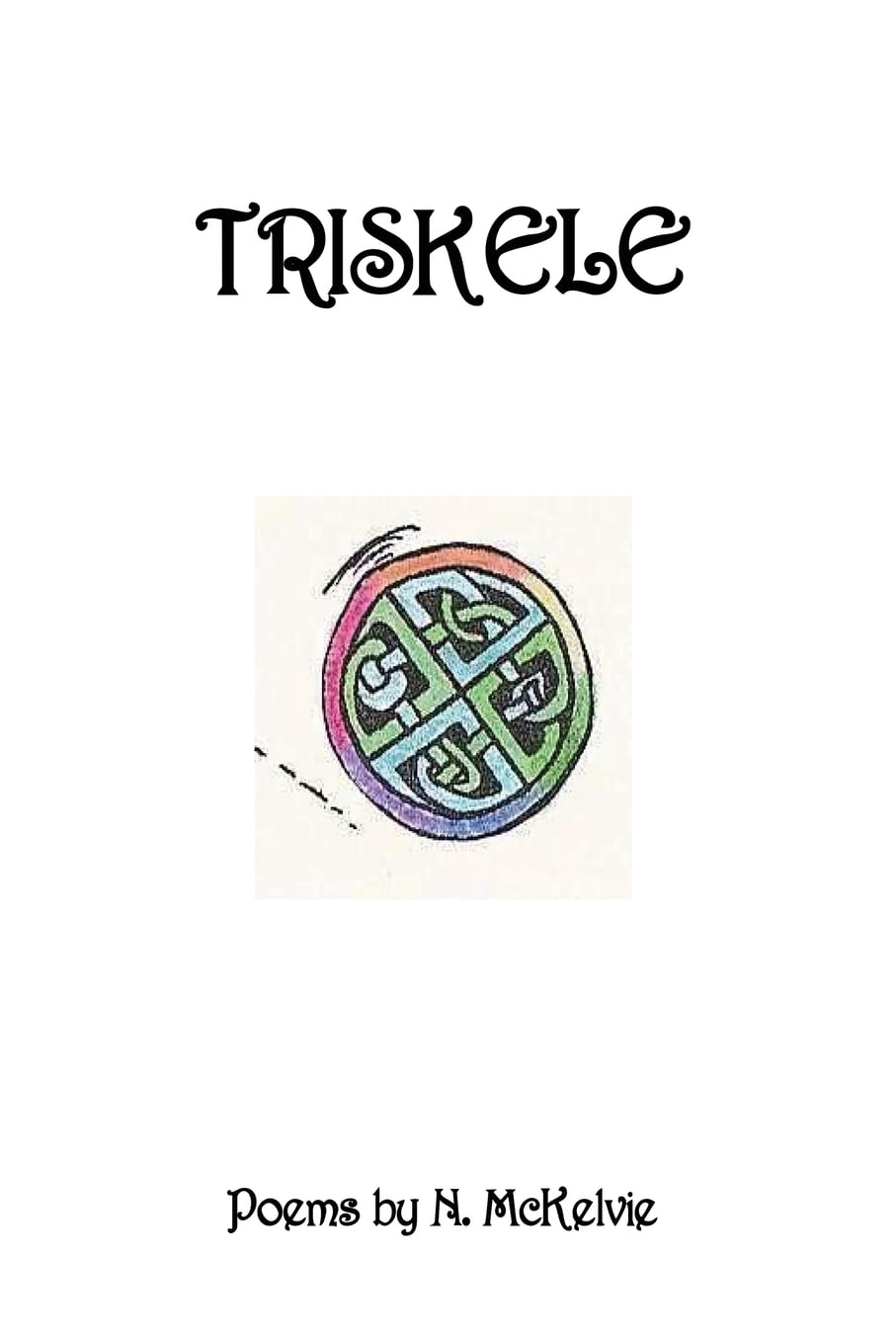

With poetry collections, it’s natural to read with an eye for repetition, for the motifs that surface, vanish, then return in a new light. Here, the clearest throughline is the way childhood keeps its grip on adulthood. Memory doesn’t stay neatly archived. It wanders. It resurfaces without warning. Many of these poems circle the experiences we gather early and never fully release. Like half-remembered dreams, they rise from deep storage as the years pass, arriving as phantom scents, stray tastes, sudden images. What are they to us? Simple recollection? Or signals from an earlier self, coded, persistent, and asking to be understood?
Triskele, by Neil McKelvie, is a poetry collection that feels, at times, reminiscent of A Visit to William Blake’s Inn. The pieces are brief yet vivid. They lean into food, childhood, love, memory, and the quiet pleasure of ordinary moments. Nothing is overworked. Nothing is forced. The language often lands like a small sensory discovery.
Poetry also invites a familiar question: are we meant to read literally, or to hunt for symbol? In this collection, either approach can stand. McKelvie shows a steady command of a dreamlike mode. The themes arrive on soft edges. Meaning glows rather than declares itself. There’s an esoteric, ethereal charge to much of what’s offered, suggestive, elusive, and deliberately unpinned.
That quality makes the reading experience pleasurable, even soothing, yet it also creates a persistent sense of distance. The poems open a door into the speaker’s inner world, then stop short of full access. You can see the room. You can’t quite cross the threshold. Some selections, such as “Red Skies Rainbows” and “The Vanishing,” are heartbreakingly lyrical, rich with beauty and ache. Others, including “IX The Ninth,” turn toward violent historical events, remembering and mourning what cannot be undone.
For readers seeking the most immediate enjoyment, it may be best to accept many of these poems at face value. Let them be what they appear to be. Let the images stand. That choice often brings you closer to the author’s emotional frequency. It also gives you the best chance to meet the collection in its intended mood, which, for poetry, is often the point.
Pages: 116 | ISBN : 1300762756

Emotional Truth

Dirty South Haiku sketches a childhood and young life shaped by family legends, Southern landscapes, and the mix of sweetness and grit that sits in so many memories. What inspired you to write this particular collection of poems?
Growing up in the South, I was surrounded by family stories that were passed down almost like folklore, along with landscapes that left a lasting impression. I wanted to capture the sweetness and grit that often sit side by side in Southern life without overexplaining them. These haiku became a way to sketch moments from childhood and young adulthood in brief, distilled scenes. In many ways, the collection serves as a prelude to my upcoming Southern short story collection, where those same themes will be explored in longer narrative form.
What is it about the format of haiku poetry that you enjoy, and why did you choose to tell your story in this format?
A visit to Japan deepened my appreciation for haiku. The form encourages attention—to language, to silence, and to what can be suggested. That approach felt well-suited to memory, which often arrives in flashes rather than complete stories.
How much do real-life events and personal experiences influence your writing?
My writing is strongly influenced by personal experience, but I’m more interested in emotional truth. Real people, places, and moments often serve as a starting point, then evolve through reflection and imagination.
What was the biggest challenge you faced in putting together this poetry collection?
The biggest challenge was learning to sit with restraint. I had to accept that some moments would remain unresolved on the page, much like they do in real life. Allowing the haiku to stay open was a challenge, but it felt true to the nature of both the form and the memories themselves.
Author Links: GoodReads | Instagram | Website | Amazon
HAIKU FOR YOU A collection of simple haikus for early readers.


Poetry and poetics often take a back seat in books for young readers. That is a missed opportunity. When children encounter poetry early, appreciation tends to grow naturally over time. This effect becomes even stronger when the focus is clear and approachable. Haiku, with its compact form and playful precision, is an ideal place to begin.
This book introduces young readers to haiku in a way that feels inviting rather than instructional. Children explore the form through a delightful collection of poems centered on penguins bursting with personality. Each poem feels lively and expressive. The result is a charming blend of structure and storytelling. Narrative skills are quietly reinforced, and vocabulary expands along the way, all while readers spend time with these curious, endearing birds.
Haiku for You by Anthony J. D’Amato is a children’s book devoted entirely to haiku. It is especially well-suited for ages three to seven, given the tone and subject matter. Still, anyone interested in a quick and enjoyable introduction to haiku will find something to enjoy here.
Haikus are sometimes seen as intimidating due to their strict rules. Yet those same constraints are what give the form its striking elegance. This collection makes that point clearly. Many of the poems are lighthearted, even silly at times, but they remain beautifully crafted. The contrast works well and keeps the reading experience fresh.
This is very much a learn-as-you-read book. Educational value is woven throughout, never feeling forced. Just as important, the author’s enjoyment of language is evident on every page. That sense of fun is contagious. It recalls the spirit of Dr. Seuss, where playful experimentation lifts the entire experience. The joy behind these haikus becomes clearer the longer you linger with them.
Both children and adults will enjoy watching this penguin cast move through their world in neat, poetic lines. There is warmth here, along with wit and imagination.
Haiku for You offers knowledge, creativity, and visual appeal in equal measure. The engaging illustrations and D’Amato’s confident command of haiku make this a pleasure to read. It has all the makings of a bedtime favorite, one that families return to again and again.
Pages: 36 | ASIN : B0F4PXF1CZ

Feeling Driven

Bridges of Words is a collection of haikus that capture the spirit, mood, and humanity of cultures around the world. Why was this an important book for you to write?
Words are bridges, I’ve always thought. A Filipino-Australian, I have experienced the nuances of cultural differences as well as the silent need for understanding after growing up in one society and now residing in another. Born prematurely in a military hospital in Nueva Ecija—where my grandmother’s refusal to choose between saving my mother or me led to both our survival—I was named Esperanza, meaning “hope.” That word has carried me through my life.
Language has the ability to bring people together and bridge emotional and physical divides in addition to informing and persuading. Through the delicate compression of haiku, rather than through dissertations or manifestos, Bridges of Words allowed me to celebrate humanity in all its textures. A haiku can capture a universe in three lines: the echo of memory, a stranger’s grin, a city street after rain.
It was also a historical experience to write this book. Japan, which occupied the Philippines during World War II and left behind heartbreaking memories of hardship and tenacity, is the source of haiku. However, engaging with this literary genre became an unconventional act of reconciliation for me. By capturing beauty and transience in the rigid yet simple syllables of haiku, I was able to recognise sorrow without being overcome by it.
Furthermore, forgiveness itself is a bridge, isn’t it? A bridge that lets us go on instead of lingering in the depths of bitterness or rage. Every haiku became a tiny act of construction, a step toward comprehension—a means of expressing that, in spite of our differences and past experiences, we can still live amicably through our common humanity.
Can you share a bit about your writing process? Do you have any rituals or routines when writing?
In addition to the other facets of my entrepreneurial and professional endeavours, writing has always been part of my daily life, though not always in the way one might imagine. From my earliest days, words have been my companions—whether scribbling on my aunts’ college books at age 3, writing verses as a Grade 5 student who unexpectedly won in a poetry contest, serving as the English literary editor of The OLCAn in high school, or later leading The Corps as its first female editor-in-chief at the Philippine Military Academy. That role, along with becoming the Academy’s first female Journalism Awardee and first Languages Plaque recipient, confirmed for me that words could be both a personal refuge and a public responsibility.
My naval career deepened this focus, as I became the inaugural Navy Digest editor and later worked on the Navy Journal, Fleet Journal, and Polaris Magazine. Today, I still edit multiple publications professionally, which keeps me grounded in the discipline and craft of writing.
But Bridges of Words emerged differently. Almost without notice, it came like a bolt of lightning across a still sky. Often, a single sight or memory would prompt me to act immediately. I still recall sitting at my computer here in Adelaide, the morning sun streaming through the blinds, when a haiku began to take shape in my mind. It was like attempting to capture a bird in midair; I had to do something before it vanished.
My approach had been less about routine and more about spontaneity. Sometimes it was the laughter of my sons, sometimes the witty jokes of my husband, sometimes a walk along South Australia’s beaches, sometimes the Zamboanga sunsets of my childhood, or the scenic sights of Taal Lake that never left my memory. That was my rhythm: focusing on the small moments and feeling driven to convey them in words that might resonate with someone else, somewhere else.
Do you have a favourite haiku in the book, and if so, why does it hold special meaning for you?
Logically, I should be more drawn to the haikus that depict the Philippines and Australia, because they are my own countries.
The Philippines’ haiku embodies resilience, a trait I witnessed from an early age. Growing up in a land prone to typhoons and eruptions, I listened to stories and even witnessed at times how families and communities would quietly rebuild lives and spirits with steady resolve. That everyday bravery—the quiet courage of people who simply endure—was etched into me from childhood.
In comparison, Australia exemplifies diversity and unity. When I first set foot in Sydney in 2006, I fell in love instantly with its order, beauty, and openness. Years later, settling in Adelaide with my family in 2010, I discovered a deeper sense of belonging. Here, languages, faiths, and cultures cohabit and enrich one another, and that spirit of coexistence is what I sought to capture in haiku.
Together, these two countries’ haikus create a bridge that spans place and time, tying together memory and lived experience, origin and destination, past and present. Poetry is not only an art of words; it is an edifice of human experience—it speaks of the depth and resilience of human life.
That said, there’s no simple or safe way to answer this question. It feels like being asked which of my children I love the most. Every haiku in Bridges of Words has its own pulse and memory. Just as I cannot love one of my children—Huey, Sev, or Noah—more than his siblings, I cannot favour one poem over the rest. Each carries its weight; each is a bridge.
What is the next book you are working on, and when will it be available?
To be honest, I haven’t made any firm plans yet. Like Bridges of Words, I have a feeling that the next project will develop naturally, as I feel driven to capture it in the moment. For me, book writing started with intuition rather than a plan—a vision, a memory, or a passing idea that begged to be put into words. Perhaps in ways I cannot yet foresee, the next piece will continue to examine metaphorical bridges—between locations, times, or the silent, unseen moments of our everyday existence, though possibly in an altogether different way. I’m letting it take shape for the time being, trusting that the right words will emerge when the moment is right. In the end, writing is simply my way of building small bridges—one fleeting moment, one word, one resonance at a time.
Author Links: GoodReads | X (Twitter) | Facebook | Website | Amazon
Seventeen syllables.
In Bridges of Words, discover a quietly powerful collection of haikus from 57 countries—each a window into the heart of a culture. These verses don’t explain; they invite. They don’t shout; they hum.
Whether you find yourself beneath banyan trees or city lights, this book is a gentle reminder that even across oceans, we’re not so different after all.
Bridges of Words: Haikus Uniting Cultures From 57 Countries of the World

Bridges of Words is a journey stitched together in three short lines at a time. Esperanza Pretila gathers scenes, scents, and sounds from across the globe, distilling them into haiku that act as tiny postcards of the human spirit. From the cherry blossoms of Japan to the samba rhythms of Brazil, from Norway’s fjords to the deserts of Saudi Arabia, each poem captures the mood of a place without overexplaining. It’s a chorus of cultures, all humming the same song of connection and shared humanity.
I found myself reading this slowly, not because it was hard, but because each haiku lingered. The brevity makes you pay attention. Some verses felt like quick Polaroids, others like whispered secrets from the past. The restraint in the writing works well. It never tries too hard to be profound, yet it often lands that way.
What I liked most is how the book manages to be both intimate and universal. The voice is warm, almost like a travel companion who notices the little things others might miss. A few haiku didn’t hit me as strongly, they slipped by too softly, but even those had a role in shaping the overall rhythm. The dedication and acknowledgments at the start also set a deeply personal tone, reminding you that this is not just about places, but about the people and lives behind them.
I’d recommend this book to anyone who enjoys poetry that travels light yet carries weight. It’s perfect for readers who appreciate slow moments, quiet reflection, and the beauty of small things. If you’ve ever wanted to tour the world without leaving your chair, or if you just need a gentle reminder that we’re all connected, these bridges of words are worth crossing.
Pages: 130 | ASIN : B0FHVTBSQ8
Sundays with Jenny

Sundays with Jenny by Jenny Bienemann is a luminous collection of haikus, thoughtfully paired with photographs and distinctive haiku art. Featuring nearly 150 poems, over 100 images, and close to three dozen pieces of haiku-inspired artwork, the book offers a multi-sensory experience. While most haikus follow the traditional three-line form, others unfold across multiple verses, inviting deeper reflection. The themes span a wide emotional and philosophical spectrum, love, resilience, serenity, hope, transformation, compassion, and the subtle nuances of human connection.
Reading this book felt like stepping into a quiet, contemplative space. I was especially drawn to its unique structure, which organizes the content by time of day, from the stillness of dawn to the hush of night. Each section carries a mood, allowing the reader to move through emotional and visual shifts as naturally as the progression of sunlight. The creative use of varying font styles throughout the book added a layer of visual interest, making each page feel curated and intentional.
What stood out most were the moments when text and image merged seamlessly. Instead of simply placing haikus next to photos, Bienemann sometimes integrates the verse directly into the visual composition. One poignant example: a haiku beginning with “Open up your door” appears written on the very surface of a door left slightly ajar, light streaming through the narrow opening, evocative and metaphorically rich.
Bienemann has a keen eye for everyday wonder. A basket of laundry, a pair of reading glasses, even a plate of strawberries, each becomes poetic under her lens. She elevates the ordinary, revealing hidden beauty in small, often overlooked details: a heart-shaped leaf on a sidewalk, a natural heart embedded in a tree stump. The vibrancy of some photographs, particularly those rich in color, is breathtaking. One personal favorite is the city skyline rendered in hues of purple and blue, the first image in the Dawn section. It set the tone with quiet grandeur.
The haiku art adds a unique and creative dimension to the book, with many pieces, particularly the watercolor-inspired ones, resonating deeply and beautifully enhancing the accompanying verses. While some artworks leaned into a more abstract or minimalist style, offering space for personal interpretation, others stood out more subtly, inviting the viewer to pause and reflect. This variety in artistic approach contributes to the book’s eclectic charm, even if a few pieces felt more understated compared to the vividness of the photographs.
Sundays with Jenny is a meditative and visually engaging collection. It invites the reader to slow down, notice more, and find poetry in the everyday.
Pages: 212 | ISBN 978-0-1234-6578-8


