Blog Archives
Harris Kamal Interview, Author of Breaking Barriers
Breaking Barriers gives readers an in-depth look at the troubled history, bureaucracy, and politics of Pakistan as well as the hope for future reform. Why was this an important book for you to write?
Many books have been written about the problems Pakistan faces, often focusing on a single issue—politics, corruption, religion, or governance. What I found missing in much of that literature was a serious effort to connect those problems into a coherent diagnosis and, more importantly, to speak openly about solutions.
Having been raised in Pakistan, I experienced inequality not as an abstract concept but as a daily reality embedded in institutions and social structures. Later, living and working in the United States allowed me to see what equality before the law, functional governance, and individual rights can look like in practice. That contrast shaped the way I think about reform.
My love for Pakistan has always been unconditional, but it is not uncritical. I believe that caring deeply about a country also means being willing to question it honestly. I wrote this book because I felt a responsibility to share a vision with the younger generation—one that moves beyond personalities and slogans and instead focuses on rebuilding institutions, expanding opportunity, and restoring fairness.
Breaking Barriers is not just a message of concern; it is a call to recognize Pakistan’s untapped potential and to illuminate paths forward that are often hidden beneath politics, inertia, and fear of change.
How long did it take for you to research and put this book together?
Between research and writing, the ideas behind Breaking Barriers developed over eight to ten years. Some of that time was dedicated to formal research—reading, studying institutions, and following policy debates—but much of it came from long-term observation, lived experience, and reflection. The book itself took shape gradually, as I tried to move beyond reacting to events and instead understand deeper patterns that unfold over time.
Did you learn anything while writing Breaking Barriers that surprised you?
What surprised me most was how deeply interconnected the problems are. I initially thought of corruption, education, justice, and economic inequality as separate failures. While writing, it became clear that they reinforce one another in ways that are difficult to untangle, creating cycles that repeat across generations.
Another surprise was how much resilience exists alongside dysfunction. Even within systems that feel deeply broken, there are individuals—teachers, judges, civil servants, parents—who continue to do their work with quiet integrity. That realization shaped the tone of the book. It reinforced my belief that reform is difficult and slow, but not impossible, if enough people decide to move in the same direction.

What is one thing you hope readers take away from this book?
I hope readers take away a sense of grounded hope — not the kind that ignores reality, but the kind that insists change is still possible. Pakistan’s challenges are real and deeply rooted, but they are not permanent.
I want readers, especially young people, to believe in their own agency: to value honesty, integrity, transparency, and dignity in their daily lives, even when systems discourage those qualities. Meaningful change rarely arrives overnight or from a single leader; it emerges when enough individuals commit to doing the right thing consistently. If this book helps readers see light beyond the current darkness and recognize their role in shaping that future, then it has done its job.
Breaking Barriers: A Bold Vision for Pakistan’s Future
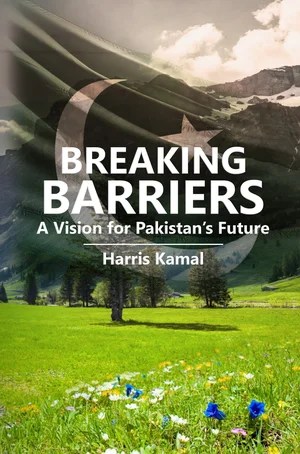

Breaking Barriers: A Bold Vision for Pakistan’s Future is part memoir, part diagnosis, part blueprint. Harris Kamal starts in Karachi and uses his own story as a doorway into Pakistan’s wider journey. He traces the rise from early “Asian Tiger” optimism to a present filled with corruption, broken institutions, and deep inequality. He then moves through the big systems that shape daily life: bureaucracy, police, courts, politics, education, gender relations, and the economy. Finally, he lays out a future agenda that leans on youth, better governance, and social inclusion, with long chapters on schools, women’s empowerment, and structural reforms in everything from taxation to resource use.
I enjoyed the way he mixes hard facts with personal feeling. The Karachi passages have texture and warmth, and the opening section on Pakistan’s “promise and peril” feels tight and focused. The writing is clear and direct. At times, it sounds like a long op-ed. At other time,s it sounds like a friend talking late at night about home. I liked the concrete cases he uses when he talks about law, such as famous murder trials, the Panama Papers, and the battles around Justice Qazi Faez Isa, and his comparison with Kenya’s judicial reforms gives the book a more global feel. The message stays strong, yet I felt that some sections could have been leaner, with fewer long lists of problems and more storytelling on how change actually happens on the ground.
The book moved me more than I expected. The anger at feudal politics, bloated bureaucracy, and daily injustice is clear, but it is grounded in love for the country rather than simple ranting. I found the chapters on women, education, and the digital divide especially powerful, because they show how big structures hit real people in homes, schools, and workplaces. His call for coeducation, broader career paths for girls, and real financial independence for women feels both practical and values-driven. I also liked his focus on tax justice and agricultural income, which many authors avoid. The vision is bold and hopeful, but I sometimes wanted more nuance.
The book does not hide how deep the problems go, yet it refuses to give up on the idea of a fair, modern, confident Pakistan. I would recommend Breaking Barriers to readers in the Pakistani diaspora, to students in Pakistan who are trying to make sense of their own country, and to policy folks or diplomats who want an insider’s passionate brief on what is broken and what could be rebuilt. It reads more like a long, heartfelt briefing from someone who has seen both Karachi’s flooded streets and America’s functioning institutions and still believes Pakistan can rise if enough people decide to push in the same direction.
Pages: 702 | ISBN: 9783127323207
A Quiet, Universal Fear
The Moments Between Choices centers around a man who is allowed to see both the consequences of his life choices and glimpse of the man who could have been. What was the inspiration for the setup of your story?
The story began with a dream I had a few years ago. It wasn’t one of those scattered, surreal dreams — it felt frighteningly clear, like being allowed to watch pieces of my life from the outside. Not the big, obvious turning points, but the tiny moments I’d brushed off. The ones you only recognize as important when you see what they added up to.
That experience sat with me for a long time. At first, I wrote the story with myself as the center because that’s where the emotional spark came from. But as the manuscript grew, I realized I needed to protect the privacy of the people who shaped my life — family, friends, even casual figures from childhood. So I created Omar. He became a way to keep the emotional truth while allowing the details to shift into fiction.
The structure came from trying to recreate the feeling of that dream. We don’t remember our lives chronologically; we remember them through sensation — what we touched, ignored, hurt, loved, or failed to see. I wanted each stage of Omar’s journey to feel like a sense dimming out as he comes closer to understanding himself.
More than anything, the novella came from a quiet, universal fear:
If we were suddenly forced to face our choices all at once…would we be proud of what we see?
That was the seed. Omar grew out of that question.
Where did you get the inspiration for Omar’s traits and dialogue?
Omar didn’t come from one person. He grew out of the parts of ourselves we usually ignore — the moments we move too fast, the people we take for granted, the habits we justify because we think there’s always more time. When I first started writing, I pulled from my own blind spots. But as the story grew, Omar stopped being “me.” He became a reflection instead of a replica.
His traits aren’t meant to point to a specific individual. They’re meant to feel uncomfortably familiar. Anybody who reads this novella is, in some way, Omar. Not because they’ve lived his exact life, but because everyone has those small, forgettable choices that slowly shape who they become.
His dialogue came from trying to capture that everyday tone — the half-distracted conversations, the rushed apologies, the small dismissals we don’t even notice. I didn’t want him to sound poetic or polished. I wanted him to sound real…sometimes painfully real. Because in those ordinary moments, you see the entire arc of his life.
Omar is fictional, but the habits that made him are human. That’s why readers recognize him — not as someone they know, but as someone they might be without realizing it.
What are some things that you find interesting about the human condition that you think make for great fiction?
I’ve always been fascinated by the small, almost invisible moments that end up shaping a person’s entire life. Not the dramatic events we expect to remember, but the tiny decisions we barely register — the things we say out of habit, the people we overlook, the apologies we delay because we assume there’s endless time. Those small choices become the architecture of who we are, and most of us don’t realize it until much later.
Another thing that interests me is how people carry two versions of themselves at the same time: who they are, and who they believe they could be “if things were different.” That gap is where a lot of pain — and a lot of hope — lives. It’s also where great fiction usually hides.
And then there’s memory. We don’t remember our lives in clean timelines — we remember through sensation. A smell, a sound, a sudden feeling in your chest. Emotions come back to us through the senses, not the calendar. That idea shaped the way I wrote this story.
One of the things I love about fiction is the freedom it gives you. You can reach heights you didn’t even know you were capable of. You can follow imagination to places that feel unbelievable — and still land on something emotionally true. Who would’ve thought I’d end up writing a novella based on a dream I had? That’s the power of fiction. It lets you take something fragile, something fleeting, and turn it into a story that might touch someone else.
What makes great fiction, to me, is honesty. Not in a factual sense, but in the way it forces us to sit with something we’ve been avoiding. When a story captures those small, uncomfortable truths about how we love, how we fail, how we change, or how we refuse to — that’s when the human condition feels most alive on the page.
Can we look forward to more work from you soon? What are you currently working on?
Yes, there will definitely be more. Writing this novella opened up a creative side of me I honestly didn’t expect, and I’m already shaping the next project. But right now, I want to give this book the space it deserves. It’s my debut, and I’d like to see how it finds its readers, how people react to it, and hopefully enjoy whatever success it earns.
I’m taking this moment to connect with readers, learn from their responses, and appreciate the journey of having my first story out in the world. After that, I’ll be ready to step fully into the next one — and I’m excited for where that will lead.
The Moments Between Choices
The Moments Between Choices tells the story of Omar Rashid, a man who drifts through life on autopilot until a sudden accident tears open the hidden cost of his choices. The book jumps between the present and his past. It shows the small moments where he hurt the people who loved him. It also shows the glimpses of kindness that hinted at the man he could have been. The final pages follow his quiet reckoning as his life slips out of his hands and into something stranger. The whole thing feels like watching a life replay in fast flashes that hit harder each time.
The language is simple, almost disarmingly so, and then a scene hits like a falling brick. Moments that seem harmless at first crack open into something sad. I kept thinking about the gap between intention and impact. The author doesn’t scream the message. He lets it sit there. The scenes with Omar ignoring his daughter or brushing off his wife felt too real. I felt annoyed with him at first. Then I felt uneasy. Then I felt guilty for how easy it is to slip into the same habits. The emotional rhythm jumps between warmth, frustration, and dread, and the shifts kept me on edge in a good way.
I also liked how the book handles memory. The childhood chapters were surprisingly vivid. The prank with the glue made me laugh. The pepper incident made me wince. The moment with the old janitor honestly touched me. These scenes felt like tiny snapshots that carried more weight than I expected. The book moves fast. I wanted more breathing room in a few spots, but the pace gave the story a kind of heartbeat. I never felt bored. I just sometimes felt shaken. And maybe that was the point. The structure carries this idea that life is stitched together through small choices. And those choices keep echoing, whether we like it or not.
By the time I reached the final chapter, I felt a mix of anger, pity, and something like hope. The ending left me quiet for a minute. It didn’t try to fix everything. It offered clarity. And I appreciated that. It made the story feel honest rather than preachy.
I’d recommend The Moments Between Choices to readers who enjoy emotional stories that keep you thinking about them. People who like character-driven arcs. People who reflect on their own habits and relationships. Anyone who wants a book that nudges them to sit and think about the tiny decisions they make every day. It’s not a light read, but it’s a meaningful one.
Pages: 116



 LITERARY TITAN