Blog Archives
How Not to Up and Die from Lack of Sleep: A Doctor’s Guide to Better Sleep That Boosts Your Energy, Reverses Exhaustion & Restores Your Health


How Not to Up and Die from Lack of Sleep is a broad and practical guide to sleep that blends memoir, popular science, and self-help in a way that feels authentic. Author Jerome Puryear structures it in four parts, moving from the biology of sleep and the mechanics of common disorders into the punishing realities of shift work, then out toward treatment options, wind-down practices, supplements, sleep tech, and even AI-assisted care. The central argument is simple but forceful: sleep isn’t a decorative wellness habit, it’s foundational, and modern life has made casualties of far more people than we like to admit. That idea lands because he keeps returning to concrete human scenes, from his own season of new-parent exhaustion and predawn drives while fighting microsleeps, to later discussions of insomnia, apnea, caffeine, burnout, and the stubborn fantasy that we can “catch up later.”
Puryear writes like someone who has both treated exhaustion and been humiliated by it, and that gives the book a warmth a more clinical manual might never earn. I especially liked the way he threads a humane idea through the whole thing: that many of us are, in effect, “circadian shift workers” now, even if we don’t clock in at midnight. That reframing is smart, and it opens the book up beyond nurses, residents, and first responders to the ordinary overextended reader staring into a phone at 12:47 a.m. Some of his best passages arrive when he steps back from raw advice and notices the culture around sleep, like the historical section on segmented sleep and the sharp observations about hustle culture teaching people to wear deprivation like a medal. Those moments give the book texture and keep it from becoming just another optimization handbook.
Its great strength is range. That range makes it read more like an all-in compendium. The transitions from deeply personal material to reference-style sections on medications, cannabis compounds, supplements, devices, and AI can be quick. Still, I liked that he doesn’t romanticize “natural” solutions or demonize technology outright. A body scan, progressive muscle relaxation, and a quieter bedroom sit beside CPAP data, virtual assessments, and AI tools such as predictive sleep-stage models, which gives the book a welcome intellectual balance. I appreciated that the governing instinct is practical rather than trendy. He wants readers to build a durable life around sleep, not chase one magical fix.
I found this an earnest, useful, and surprisingly friendly book, one that is at its best when its science is lit from within by fatigue, humility, and hard-earned conviction. I’d recommend it especially to people who are exhausted enough to feel slightly estranged from themselves, along with shift workers, new parents, busy professionals, and readers who want a sleep book that acknowledges both physiology and the emotional loneliness of being worn thin. This is a book for people who don’t need sleep romanticized. They need it restored to its rightful dignity.
Pages: 350
The Art of Thinking Critically with Clarity for Optimal Health: Your Longevity is Determined By How You Think!

I found The Art of Thinking Critically with Clarity for Optimal Health: Your Longevity is Determined By How You Think! both insightful and practical. The author has crafted a guide that speaks directly to the challenges my patients and I face every day. He emphasizes the importance of critical thinking in health decisions, showing how structured reasoning, awareness of bias, and emotional intelligence can lead to better choices. The framework he presents is comprehensive yet approachable, and the integration of real-world examples makes the material highly relevant.
What I appreciated most was the balance between clinical precision and accessibility. Too often, health-related texts are either oversimplified or weighed down by technical language. Here, the writing is clear without being shallow, and the concepts are explained in ways that anyone can apply. I also valued the emphasis on metacognition, encouraging readers not just to think critically, but to reflect on how they think.
From a professional standpoint, this book reinforced my own commitment to fostering critical thinking in the exam room. It reminded me that patient education is not only about transmitting information, but also about guiding individuals to ask better questions, weigh options thoughtfully, and consider both medical and personal values in their decisions.
I would recommend this book to health professionals who want a resource to share with patients, as well as to individuals eager to take a more active role in their healthcare. It’s a timely and much-needed contribution to the conversation about how we make decisions that affect our well-being.
Pages: 220
Knowledge Is Power

The Power of Your Spine: How Back Strength and Posture Pilots the Entire Body explains to readers the vital function of back muscles and the spine and how to care for this important area of the body. Why was this an important book for you to write?
One reason this book was important for me to write, which is the core of all my books, is to help educate people to help them heal, support, maintain, and exercise their bodies safely. I often say, “Knowledge is power.” I wanted to teach the power of this spine.
What were some ideas that were important for you to share in this book?
In this book I share illustrations of muscles that we all have. In order for me to teach the “Power” of the spine, readers need the visuals in these illustrations for better learning and understanding.
What is a common misconception you feel people have about back pain?
I find a big misconception about back care and muscles is the “cliche” of what the core muscles are. In social media we often see posts and videos with strong titles like “3 best exercises for your core” or “number one exercise everyone should do for their core” etc. The “core” also includes the many deep muscles in the spine.
These deeper muscles play essential roles in walking, standing, posture, balance, stabilization, and movement. If they are weak and/or ignored the larger muscles try to do the smaller muscles jobs and this causes malfunction, injury, and pain.
What is one thing you hope readers take away from your book?
A gain of knowledge. Once the knowledge shared in this book is known, this can help the reader find a knowledgeable trainer, chiropractor, physical therapist, and more. If professionals helping me heal or in therapy do not know the purpose of all the muscles and how they work together as a team, they cannot help to the extent most people need. For example, if someone is going to a personal trainer, physical therapist, or massage therapist for back care (posture, pain, strengthening, etc.), these professionals should know all the muscles in this book.
Also, many professionals hand a patient/client a piece of paper with exercises to go home and do. Well, the paper is usually the same for every person with back pain. Its usually not based on the individual’s personal situation. This leaves people unable to heal or get more injured.
Author Links: GoodReads | Twitter | Facebook | Website | Instagram
Tracy L. Markley details the vital function of back muscles and bones as key powerhouses to your physical wellness. While back pain is a common complaint among people for various reasons, you don’t need to suffer chronic distress.
Learn how different body parts work together and, if not cared for, work against each other to nourish or diminish your quality of life. You’ll also discover the importance of taking care of your core—how to do it effectively—and discover comprehensive ways to better your posture and promote spinal stabilization so that issues like sciatica are controlled for good.
Whether you’re healthy, suffering from an injury, or seeking to ease the impacts of aging and lifestyle on your body, this dual anatomy and reference resource literally has your back.
The Power of Your Spine book is available it two paperback editions. One is in a colored edition and one is a black and white edition. The kindle edition is always in color.
The Power of Your Spine: How Back Strength and Posture Pilots the Entire Body
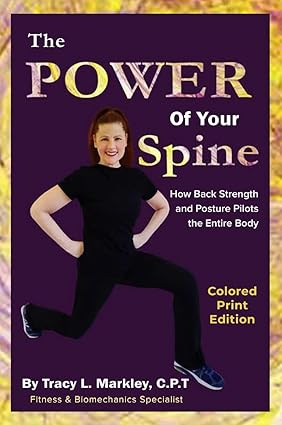
The Power of Your Spine: How Back Strength and Posture Pilots the Entire Body by Tracy L. Markley is an exceptionally enlightening and valuable book that takes readers on a profound exploration of our physical beings. Tracy’s motivation to write this book stems from her interactions with individuals, aiming to foster an understanding of our bodies’ fundamental composition: bones and muscles. She emphasizes that comprehending the intricate workings of each muscle, both independently and in synergy with others, holds the key to cultivating a healthy and pain-free physique. By prioritizing good posture, exercise, and providing our bodies with proper care, we can significantly enhance our physical well-being, thus elevating our overall quality of life.
The book’s composition showcases Tracy’s masterful craftsmanship, characterized by an amiable yet highly informative tone that resonates with readers of all backgrounds. One notable example is Tracy’s inclusion of anatomical terms. The author thoughtfully incorporates illustrations throughout the book, facilitating clear comprehension of muscle identification and function. Consequently, readers can grasp the knowledge imparted by the book and overcome the challenges associated with anatomical terminology.
While the author acknowledges the relevance of the book to individuals in recovery or older age groups, I firmly believe that its usefulness extends to people of all demographics. In our contemporary society, where rapid-paced living and technological advancements dominate, many of us find ourselves bound to chairs or computer screens for prolonged periods. Moreover, poor posture, although an individual concern, affects a substantial portion of the population. Understanding the root causes of bodily discomfort and equipping ourselves with the knowledge to alleviate such pain becomes imperative for leading a pain-free existence.
The Power of Your Spine: How Back Strength and Posture Pilots the Entire Body by Tracy L. Markley is a book that should be embraced by everyone, as it empowers individuals to alleviate existing pain and prevent future discomfort. Personally, I intend to return to this invaluable resource repeatedly, employing it as an essential tool to guide my exercise routines and self-care practices.
Pages: 114 | ASIN : B07XDC3FMR



