Blog Archives
A Meditation On Greatness

Alexander, Pharaoh of Egypt (Ancient Egypt), follows Alexander the Great from his early years, where his education and family shaped him into the man he would become, and the path he took in his quest for godhood. Where did the idea for this novel come from, and how did it develop over time?
The idea for Alexander, Pharaoh of Egypt began in childhood. I first encountered Alexander the Great not as a conqueror, but as a boy—curious, brilliant, and shaped by the towering figures around him: his mother Olympias, his tutor Aristotle, and his father Philip II. That early impression stayed with me, and over time, I became fascinated by the tension between his human vulnerabilities and his relentless pursuit of divinity.
The novel developed over several decades of research, reflection, and writing. My academic background in Egyptology helped me reconstruct the coronation scene with historical precision, but the heart of the story lies in the relationships. I wanted to explore not just Alexander’s military campaigns, but the quieter, more intimate dynamics—his bond with Hephaestion, the resistance of Cassander, and the emergence of figures like Ptolemy and Seleucus who would inherit and fracture his empire.
What shaped the novel most, however, was the experience of physically following in Alexander’s footsteps. I was in Egypt during the Revolution of 2011, a time of immense upheaval and uncertainty. Despite the danger, I travelled out to Siwa—the site of Alexander’s legendary visit to the Oracle of Amun—under armed escort. That journey was transformative. Standing in the desert where he once stood, surrounded by echoes of ancient ritual and modern unrest, gave me a visceral sense of the stakes he faced and the myth he was becoming.
Ultimately, Alexander, Pharaoh of Egypt became a meditation on greatness—how it’s defined, who pays for it, and whether it can coexist with compassion. It’s a story of fractured ideals and enduring friendships, told through the lens of history but driven by timeless human emotion.
What intrigues you about the time period of Ancient Egypt and its history that led you to write this thrilling and insightful period piece?
What intrigues me most about Ancient Egypt is its duality—how it balanced the mystical with the administrative, the divine with the deeply human. It was a civilization obsessed with eternity, yet governed by people whose ambitions, flaws, and relationships were strikingly familiar. That tension between timeless ritual and personal drama is what drew me in.
As someone who studied Egyptology formally, I was intrigued by how much of Egypt’s history is preserved in fragments—temples, tombs, inscriptions—and how much is still open to interpretation. Writing historical fiction allows me to bridge those gaps, to imagine the emotional lives behind the monuments. In Alexander, Pharaoh of Egypt, I wanted to explore what it meant for a foreign conqueror to step into that sacred landscape and claim divinity. What did it cost him? What did it mean to the people who witnessed it?
Egypt’s coronation rituals, its symbolism, its obsession with legacy—all of it offered a rich canvas for storytelling. But ultimately, it was the human element that pulled me in — the friendships, betrayals, and moral choices that echo across centuries. Ancient Egypt wasn’t just a backdrop—it was a character in its own right.
What experience in your life has had the most significant impact on your writing?
It’s hard to pinpoint just one experience that shaped my writing—my early life was full of extremes. My family travelled constantly, which opened my eyes to diverse cultures, landscapes, and histories. But alongside that adventure came profound loss. We lived through the worst weather event ever recorded and later lost everything in a war. At one point, we spent two years living on a ship with no money, no school, no internet, and no music. My father controlled the radio, and as a girl, I wasn’t allowed to mix with the crew. Apart from a few kind cadets who were vetted to speak with me, I spent most of my time alone in a cabin studying. My mother was a trained teacher and set a relentless pace!
That isolation became a crucible for imagination. With no distractions, no peers, and nothing but silence, I turned inward—and that’s when ancient Egypt, art, storytelling, and Alexander the Great found me. I was captivated by the grandeur of lost civilizations, but even more by the emotional complexity of their leaders. Alexander, especially, fascinated me: a boy forged by myth and ambition, driven by a sense of destiny that reached beyond the mortal. He lived with one eye on the present and the other fixed on eternity. That dual gaze—earthbound and divine—is part of why we still remember him.
Writing became a way to make sense of the world—its beauty, its brutality, and the fragile threads of connection that hold people together. That ship, that silence, that solitude—they weren’t just hardships. They were the beginning of everything I write now.
Do you have plans to continue the Ancient Egypt series, or are you working on something new?
Yes, I do plan to continue the Ancient Egypt series—but Cleopatra, the Greek Pharaoh will be the final installment. I’m currently in the early stages of writing it, and it feels like a natural culmination. Cleopatra has always fascinated me—not just as a political strategist and intellectual, but as a woman navigating power, identity, and survival in a collapsing world.
This book will explore the final chapter of Egypt’s dynastic history through her eyes, blending historical rigour with emotional depth. While Alexander, Pharaoh of Egypt examined the cost of greatness through conquest, Cleopatra, the Greek Pharaoh will interrogate legacy and resilience in the face of cultural erasure. It’s a story I’ve wanted to tell for a long time, and I’m excited to bring her world—and her voice—to life.
Ending the series with Cleopatra feels right. She represents both the brilliance and the fragility of empire, and her story closes the arc I began years ago with Moses and Akhenaten.
Author Links: GoodReads | X | Facebook – author | Facebook – book | Website
Alexander III of Macedonia believes in his divine destiny. A golden child tutored by Aristotle while demonstrating qualities of leadership and brilliance, the sixteen-year-old heir rises quickly to prominence with a crushing victory over the Greeks. But when his father is assassinated, Alexander ascends the throne and sets his eye on conquest and godhood.
Surrounding himself with his band of childhood friends and allies, the young king swiftly blazes a vicious path through the East. And though walking in the footsteps of his idol Achilles, Alexander struggles to balance his surging ambition with grace for those beneath him.
Will the self-proclaimed Son of Zeus bring the world to its knees?
With careful research and well-crafted prose, Sharon Janet Hague brings the fourth-century Mediterranean and Asia to vivid life. Exploring the exploits of one of history’s greatest generals and his rival and companion, Cassander, she paints an insightful and unique view of these two fascinating figures.
Alexander, Pharaoh of Egypt is the thought-provoking fourth book in the Ancient Egypt historical literary fiction series. If you like fresh looks at well-known topics, understated humor, and drama of the past, then you’ll love Sharon Janet Hague’s epic tale.
Alexander, Pharaoh of Egypt (Ancient Egypt)


Alexander, Pharaoh of Egypt tells the story of Alexander the Great from a fresh angle. Instead of focusing only on his well-known conquests, it dives into his time in Egypt and casts him in the role of Pharaoh. The narrative begins with his grand entry into Egypt, surrounded by his generals and loyal soldiers, and then it shifts back and forth between his youth, his education, his family, and the forces shaping him. It gives us a sweeping view, filled with politics, myth, childhood dreams, and the powerful personalities around him. There is plenty of detail, from battlefield strategy to palace intrigue, and even moments of tenderness between Alexander and his closest companions.
The writing pulled me in right away. It feels alive and full of movement. Scenes like the taming of Bucephalus or Alexander’s first steps into Memphis come off the page with energy. At the same time, the prose is straightforward and easy to follow. I never felt buried under heavy language or stiff history. Instead, it has the flow of a story told aloud, which makes even the big historical debates feel personal. I liked how the author wove in myths, oracles, and gods alongside the political plotting, since that was very much the mindset of the time. It made Alexander’s ambition feel larger than life, but also relatable, like a boy chasing after Achilles’ shadow.
There were places where I found myself wanting the pace to tighten up. The sheer number of characters and titles sometimes slowed me down. I had to flip back to the glossary often. But in another sense, that richness is part of the book’s charm. It shows how tangled Alexander’s world really was, and it reminded me that his victories were not just about one man but about an entire network of generals, rivals, and allies. And emotionally, I found myself connecting most when the story returned to Alexander’s personal moments, his bond with Hephaestion, his complicated relationship with Olympias, and his hunger for recognition from Philip. Those glimpses made the legendary conqueror feel vulnerable and real.
I enjoyed the book a great deal. I’d recommend it to readers who like history that leans into character as much as event. If you’ve ever been fascinated by Alexander the Great but felt intimidated by dense history books, this story is a welcoming entry point. It’s also perfect for anyone who likes their history with a dose of myth and drama. For me, it struck a nice balance between accuracy and imagination, and it left me thinking about how legends are built, not only by what people achieve but also by how their stories are told.
Pages: 559 | ASIN : B0DXQGBM4R

Lost in Prosperity

Judy Hannigan’s Lost in Prosperity is a gripping tale that masterfully blends romance, suspense, and the rugged charm of the Wyoming Territory. The story begins with a harrowing stagecoach crash that leaves Sam Hillard Stone—a fiercely independent woman—struggling to piece together her shattered memory. A mysterious, strikingly handsome stranger rescues her, but her confusion only deepens when he kisses her with an intimacy she cannot place. Surrounded by friends and family, Sam discovers she is a wealthy saloon owner with a reputation as sharp as her quick draw. Yet, even as fragments of her identity resurface, trust becomes a precarious commodity—especially when the face in the mirror feels like that of a stranger. Jackson, the enigmatic hero, is heartbroken. The woman he loves no longer recognizes him or the life they shared. Her condition worsens with each passing day, and his grief is compounded by the realization that the crash may have been no accident. Determined to protect Sam and uncover the truth, Jackson vows to bring those responsible to justice, even as the stakes rise and secrets surface.
Hannigan quickly swept me into a narrative that balances lighthearted moments with gripping drama. The story alternates seamlessly between tender, blush-worthy interactions and intense, suspenseful twists. While there were occasional moments where I felt the pacing slowed somewhat, these lulls were minor compared to the overall momentum of the plot. The diverse and vividly rendered cast of characters adds depth and richness to the story. Their passions, conflicts, and heartbreaks are palpable, creating a world that feels both authentic and emotionally resonant.
For me, the most compelling aspect of Lost in Prosperity was its exploration of family—how it is built, nurtured, and often defined by bonds far deeper than blood. This heartwarming and thrilling tale is packed with unexpected turns, keeping readers guessing until the final pages.
Lost in Prosperity, by Judy Hannigan, is a captivating Western romance that weaves together themes of love, resilience, and the enduring bonds of a chosen family. If you enjoy stories that combine emotional depth with thrilling intrigue, this book is a must-read. I eagerly anticipate the next chapter in this exciting series!
Pages: 393 | ASIN: B0DFMMPGTP
Janszoon


Mark Kraver’s Janszoon offers a compelling and meticulously crafted exploration of Hollywood icon Humphrey Bogart’s life, set against the tumultuous backdrop of World War II. While Bogart is widely celebrated for his on-screen charisma, this book delves deeper, revealing the complexities of his personal life—his fraught relationship with his studio, the marital discord with his wife Mayo, and his yearning for a lasting legacy and a sense of family. These personal struggles are intriguingly intertwined with Bogart’s fascination with his ancestor, the pirate Jan Janszoon van Salee, whose adventurous spirit and rebellious nature seem to resonate deeply with him. This connection propels Bogart to seek out his own form of adventure and to leave a meaningful mark on the world.
Kraver’s narrative skillfully weaves together Bogart’s personal history with the broader historical context of the 1940s Hollywood scene. His extensive research is evident throughout the book, as he vividly brings to life the golden age of cinema. The author’s ability to humanize Bogart, highlighting his cinematic achievements and his personal trials, makes this fictional biography both engaging and insightful. Through detailed accounts from Bogart’s contemporaries, studio archives, and historical records, Kraver offers readers a nuanced portrayal of a man driven by both his personal demons and his desire for significance. One of the book’s strongest elements is its exploration of Bogart’s internal conflict. The juxtaposition of his tough-guy image with his more vulnerable moments is compelling and offers a nuanced portrayal of a Hollywood legend. The conversations with his aunt and cousin about his family’s pirate ancestry add a unique layer to his character, linking his rebellious spirit to a storied past. These moments of introspection are where the book truly shines, offering insights into Bogart’s motivations and the pressures he faced in both his personal and professional life.
Janszoon stands out as a richly informative and captivating work of biographical fiction, offering a fresh perspective on a legendary figure. Kraver’s expert storytelling invites readers to journey alongside Bogart, experiencing the highs and lows of his life both on and off the screen. This book is highly recommended for those who appreciate historical fiction, drama, and a deep dive into the life of one of Hollywood’s most enduring legends.
Pages: 465 | ASIN : B0CZ7MCXPP
A Conflict Between Love and Tradition

Beyond the Bukubuk Tree follows a young Jewish doctor and a Catholic WWI veteran who are assigned to the same battalion and form an unlikely bond. What inspired the setup of your story?
I wanted to convey two emotional truths in the novel: the beauty of Rabaul, which has a quality of enchantment as it nestles between active volcanoes and lush green flora; and the conflict between love and tradition during wartime. An uncle I never met served in that battalion, Lark Force, and his service inspired me to write Beyond. Family anecdotes suggest that he was conflicted about his sexuality although we don’t actually know. I felt a deep connection to an unspoken pain I saw in photographs of hm. Sharing this truth in a fictionalized character allows readers to connect with characters on a deeper level. I knew that in mainland New Guinea at this time, many incidents of male-male intimacy between soldiers were investigated by the Army. Like Alan Turing, gay soldiers gave their all to their country. It’s time to honor them.
Jake and Alex both have secrets they keep hidden and struggle with their emotions while remaining strong as the battles continue. There was a lot of time spent crafting the character traits in this novel. What was the most important factor for you to get right in your characters?
That they started from one way of functioning in society that repressed vital parts of themselves. With Jake, the orthodox Jewish doctor, it was his desires. With Whipple, his childhood and war traumas gave him a nihilistic view of humanity, stifling his capacity for hope and generosity. Their deepening bond in the crucible of war transformed them.
What were some themes that were important for you to explore in this book?
First, Lark Force, the lone battalion of volunteers defending Rabaul, was under-resourced and abandoned by the Australian Government. Documents revealing that the government never had a plan to reinforce or extract them were concealed for 50 years. But the soldiers gradually realized their plight as peril approached. I wanted to bring to life those moments of revelation. Fiction seemed like a better genre for me than non-fiction.
Second, to convey the diverse population of Rabaul in 1941-2: Australian administrators and soldiers; a solid community of Chinese merchants; and the majority indigenous Tolai inhabitants. These communities’ cultures were opaque to each other but they were interdependent. I wanted characters from the different communities to have a voice in this war between white and Japanese colonists that upended all their lives. It was a risk to do this, but I felt compelled. I love Rabaul!
What is the next book that you are working on, and when will it be available?
I have a sequel to The Reversible Mask: An Elizabethan Spy Novel in rough shape but no scheduled release. Believe me, Literary Titan will be the first to know. My shorter articles on a variety of topics are likely to come out first. But thank you and readers can stay in touch with me via my website.
Author Links: GoodReads | Facebook | Website
New Guinea, 1941. Heroism, sacrifice and ultimately, hope, transcend the terrifying war.
Two men preparing for war, both with secrets they are determined to keep. Jake Friedman, an idealistic young Jewish doctor from Melbourne, is haunted by the death of a colleague he thinks he caused. Alex Whipple, a Catholic known as Wip, is a soul-scarred veteran of the First World War. Wip is an enigma who fights bullies on behalf of their victims yet has a chequered past in the wild side of post-war Paris that he is determined to forget.
Both are posted to Lark Force, a lone and under-resourced battalion defending the port town of Rabaul. It’s not long before Jake and Wip feel a deep pull of attraction. When the Japanese invade Rabaul, their battalion is abandoned by its government. Improvising a desperate jungle retreat, fighting rain, insects, disease, and vengeful Japanese pursuers, Jake will face the ultimate trials of his courage as Wip struggles to find the will to live.
***
This meticulously researched and richly textured novel is set in a lesser-known battle of the Pacific War. The strength of the human spirit, the bonds of love, and the resilience of diverse communities are tested against the backdrop of these battles. “Beyond the Bukubuk Tree” is a gripping saga of courage, love, and survival in the face of overwhelming adversity.
PRAISE FOR BEYOND THE BUKUBUK TREE
This is a war novel like no other, an aching love-story of two people trying to do right when everything around them has gone wrong. With incredibly rich detail in her characters and their struggles, treating childhood polio, indigenous Tolai beliefs, the Aussie army during World War II and much more. Central to the story is a Jewish physician fighting his affection for a fellow officer, and a captivating, widely diverse supporting cast. With lyrical descriptions, the reader is absorbed into a time and place that history has forgotten, the tropical paradise of Rabaul on the deadly Pacific front line.
Nev March, author of award-winning Murder in Old Bombay
“Exquisite battle sequences of utter chaos. Readers can taste the feel of being outnumbered with antique WWI ordnance, all communications cut off, and no place to go. Homage to James Michener, Herman Wouk, and James Jones.”
Roger Crossland, retired U.S. Navy SEAL officer and author of The Abalone Ukulele
“You convey so well in your writing that Tolia people while very respectful are also a very proud lot.”
Tolai researcher Angelique Giranah, Director, Niugini Singaut Ltd.
“Gripping and sensual love story between two Australian officers during World War Two New Guinea, one a doctor driven to heal, the other an officer with a past he is determined to forget. Amid the worlds of army camp and hospital, the native Tolai, and the fight against fungus sores, malaria, and polio, Jake falls in love with the enigmatic Wip, love which was then against the law. The two men’s spiritual and physical bond will face even dire challenges as the first enemy bombs fall. BEYOND is an utterly fascinating nove. lMagically done. Very hard to put down, impossible to forget.”
Stephanie Cowell, author of Claude & Camille and The Boy in the Rain, American Book Award
Beyond the Bukubuk Tree: A World War II Novel of Love and Loss

Set against the tumultuous backdrop of New Guinea in 1941, Beyond the Bukubuk Tree, by Loretta Goldberg, is a masterfully crafted tale of heroism, sacrifice, and hope amidst the terrors of war. The story centers on two compelling characters: Jake Friedman, an idealistic young Jewish doctor from Melbourne, and Alex Whipple, a Catholic veteran of the First World War with a troubled past. Both men are posted to Lark Force, an under-resourced battalion defending the port town of Rabaul, and both carry secrets that haunt them. Jake is tormented by guilt over the death of a colleague he believes he caused, while Whipple struggles with memories of his chequered past in post-war Paris. Their relationship deepens as they face the impending Japanese invasion, leading to a desperate retreat through the jungle. This harrowing journey tests their courage and will to survive, with Jake facing the ultimate trials of bravery and Whipple battling his desire to live.
Author Loretta Goldberg’s meticulous research and rich narrative bring to life a lesser-known battle of the Pacific War. The novel explores themes of love, resilience, and the strength of the human spirit against overwhelming adversity. The characters are deeply complex and vividly portrayed, making their struggles and growth profoundly affecting. Beyond the Bukubuk Tree stands out not only as a gripping war novel but also as a poignant love story. The relationship between Jake and Whipple is sensitively and beautifully developed, set against the chaotic and dangerous backdrop of war.
Goldberg’s lyrical prose immerses readers in the tropical paradise of Rabaul, capturing both its beauty and its peril. The novel’s authentic portrayal of historical events, emotional depth, and character-driven narrative make it an unforgettable read. Readers will be captivated by the detailed descriptions, the intense battle sequences, and the touching moments of tenderness and connection. It’s a book that not only entertains but also offers a profound reflection on the resilience of the human spirit in the face of war’s horrors.
Beyond the Bukubuk Tree is an absorbing and satisfying read that will leave a lasting impression on anyone who picks it up. Loretta Goldberg has crafted a remarkable novel that combines the best elements of historical fiction and romance, making it a must-read for fans of both genres.
Pages: 395 | ASIN : B0D4MH8D63
P is for Pickelhaube

Ryan Weston’s P is for Pickelhaube narratively weaves through the complexities of broken trust and unkept promises during the First World War. The protagonist, Kurt, a soldier entrenched on the Western Front, navigates not only the external brutalities of war but also internal struggles with love, hatred, addiction, and abuse. The story transforms into a stark landscape, eschewing traditional heroics, as Kurt embarks on a battle against his own humanity. The novel poignantly poses the question: in such relentless conflict, who is the real victim, already scarred even before the battle commences?
The book opens on a high note, presenting a thought-provoking query about mortality that instantly grips the reader’s attention. This engaging beginning is one of the book’s strengths. Weston’s writing style is laudable, effectively evoking the era’s atmosphere through vivid descriptions. The varied lengths of the chapters contribute to a pleasing rhythm, with shorter chapters offering a refreshing pace amidst longer ones. The book’s rich descriptive language often adds depth and texture to the narrative, though its detailed nature might cater to specific reader preferences. As an enthusiast of war literature, I found the depth of details quite engaging, even if it occasionally prompted reflective pauses. I felt that, at times, the book jumps around without a strong connection from one chapter to the next. A more streamlined structure might enhance the narrative’s flow, further captivating the reader’s interest.
The book’s conclusion is notably satisfying, leaving readers curious about future developments. It certainly makes one look forward to Weston’s future works. P is for Pickelhaube is a captivating journey into war narratives and historical fiction, with its rich storytelling holding strong appeal even amidst moments of varied pacing.
Pages: 209 | ASIN : B0CL52FVZ1

Empire in Apocalypse
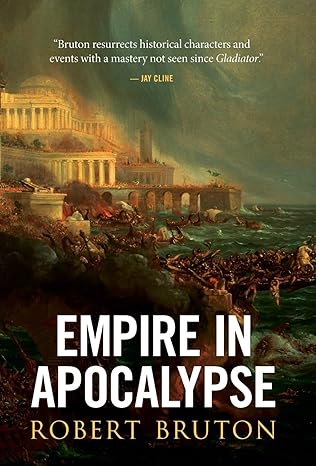
Empire in Apocalypse, by Robert Bruton, delves into a fictionalized depiction of the Eastern Roman Empire’s decline, portraying the tumultuous events that enveloped Constantinople during its final chapters. Through the life of Belisarius, a standout Roman general tasked with reclaiming Roman provinces in Italy, readers gain an intimate understanding of how warfare played a pivotal role in the Empire’s downfall.
The narrative doesn’t shy away from the other monumental challenges that besieged the empire: famine, pestilence, and widespread death. Included is the Hibernian monk, Brendan, who perceives these calamities as manifestations of the apocalyptic four horsemen, suggesting an impending end of days. One particularly gripping segment allows readers a front-row seat to the harrowing effects of the bubonic plague on the Empire.
One of the book’s strengths lies in its exploration of human responses to cataclysmic events. Characters from the commanding Emperor Justinian and the astute Theodora to the remorseful Antonina and the beleaguered Roman citizens reveal a spectrum of reactions to imminent doom. As events unfold, the narrative showcases how the pursuits, once deemed significant, lose their essence in the grand tapestry of survival and legacy.
Bruton’s meticulous research and adept writing prowess could easily make this story a standalone historical account. His deep understanding of Roman history is evident, and his talent in weaving together elements of politics, espionage, religion, romance, and military strategy makes for an engrossing tale.
While the book offers a rich tapestry of events, I feel that a more defined sense of consequence for certain characters might have made it even more immersive. Though the blending of fantasy, like Monk Brendan’s journey to the netherworld, offers a unique twist, I think the story might benefit from more integration to maintain the story’s gravitas.
While the narrative does lean heavily on religious themes, which may not resonate with every reader, those with an affinity for historical fiction or keen insights into history will find Empire in Apocalypse, by Robert Bruton, a rewarding read.
Pages: 540 | ASIN : B0CDJQ4HKV


