Blog Archives
Remembering the Bad with the Good

Frostbend follows a woman who returns to her hometown after the death of the man who terrorized her childhood, only to find herself drawn into a chilling supernatural mystery. Where did the idea behind this novel come from?
I’ve always been fascinated by old, formerly beautiful buildings and the secrets they hold. I knew for a long time that I wanted to write a haunted house story, but it took me many years to realize that my experience living in the Ozarks was something truly valuable that I could bring into the horror space. After deciding that I wanted to set it in the Ozarks, the idea of two sisters battling it out over the fate of a haunted house came to me next, and then the ideas continued to build until I finally had what today is Frostbend.
The Desmond mansion feels like a character in its own right, with its history, secrets, and unsettling presence. How did you go about creating such a vivid haunted house?
This is a wonderful compliment, as this was exactly the impression I hoped to leave with readers. Building the mansion at Frostbend was a culmination of all the gothic novels I’ve ever read and loved, all the sumptuous gothic horror movies I couldn’t stop watching, and a dash of research. I looked at many photos online of real buildings, picking and choosing elements that I thought most fit my novel and researching architectural terms. I love the feeling of wandering an old place alone, wondering what stories it would tell and making up fictional histories in my head. Frostbend is a natural extension of those interests.
Something else that I find fascinating is the way in which different spaces and buildings affect the psyche. For example, old gothic cathedrals that are impressive to behold. It’s hard not to feel small and a bit intimidated by spaces with such a presence. For Frostbend, I also wanted to feature a larger-than-life space that elicits a strong feeling. But I also felt it was important to include some beauty in the midst of the house’s horrible history, which is where touches like the mother’s stained-glass window come in. There are shafts of light and glimmers of beauty, even in the most horrible places. That feeling is an important thematic thread in Frostbend.
Isla is fiercely independent, sarcastic, and emotionally guarded. What drew you to writing a heroine whose greatest challenge is confronting the past she’s spent years avoiding?
I think most people can relate to the feeling of avoidance. There’s a temptation when you have a difficult past to try to leave it all behind, but the danger there is never processing the trauma in a healthy way. I think we all have things we would rather forget, and there’s a temptation to “demolish it.” Isla is redeemable and relatable for precisely that reason—who hasn’t wanted to leave all the unpleasantness of the past behind?
But the hopeful thing about Isla is that when she returns to her past, she discovers she’s not the same person she used to be. She is more capable. She has more people on her side. The scales have shifted, not because the horrors are less vivid, but because she has more resources and power.
The story asks whether escaping the past is ever truly possible. Was that question one of the driving themes you wanted readers to consider?
I think Isla could have escaped her past. She could have hung up the phone and never gone back to Frostbend, but she chose love for her sister instead. Even if she was kicking and screaming and cussing her way through it, she chose not to fully flee her past because of her love for Willa. And I think that is one of the themes I wanted readers to consider. That perhaps even a dark and terrible past is worth remembering, because you can’t always fully untangle the good memories from the bad ones. There is space in the heart to keep the good while putting the bad in its proper place. One question both sisters grapple with is whether they will allow their pasts to rob them of love, and this is a choice I think we all have to make at some point.
Author Links: GoodReads | Facebook | Instagram | Substack | Website
But when Isla returns home to rural Missouri after building a life in Chicago, the presence she encounters is much more personal and powerful than she or her estranged sister, Willa, could ever imagine.
As Isla and Willa’s relationship evolves from mistrust to a sisterly bond, they delve into their shared history, illuminating the darkest corners of their pasts. What they discover in the mansion is sure to change their lives and the future of Frostbend forever, if they manage to survive it.
Welcome to a town where you can’t escape your past. Welcome to a mansion where the dead are just as sentient as the living. Welcome to Frostbend.
Built on Unconditional Love

The Devil Inside follows a father and daughter pulled into a haunting tied to H.H. Holmes, where ledgers, mirrors, and breathing pages reveal that evil survives through memory and the stories that keep rewriting it. What inspired you to reimagine H.H. Holmes?
H.H. Holmes has always fascinated me because he’s one of history’s most infamous serial killers, but most books about him simply retell the crimes we already know. I wanted to explore something different. I started asking myself, What if Holmes never really disappeared? What if death wasn’t the end for him? What if he found a way to rebuild his Murder Castle and continue his work through memory, obsession, and the people drawn to him? That “what if” became the foundation of the novel. Rather than writing another historical thriller, I wanted to blend real history with supernatural horror and create a story where Holmes becomes something far more terrifying than a man. You could say I wanted to bring him back to life.
The novel uses recurring images of ink, ledgers, gold script, ash, and breathing architecture. How did those motifs develop as you wrote the story?
Those images grew naturally as I explored the idea that evil leaves traces behind. Holmes wasn’t just collecting victims in my version of the story. He was preserving them. The ledgers became a way of recording souls, the ink represented memory refusing to fade, and the gold script symbolized temptation because it always appeared beautiful before revealing something horrific. Even the house itself became a living participant in the story. I wanted the building to feel as though it remembered every victim and every secret, almost as if the walls were breathing alongside the people trapped inside. Those recurring images helped tie the supernatural elements together while reinforcing the idea that some horrors never truly disappear because they simply wait to be remembered. As I continued writing, those motifs took on a life of their own and became another way of showing that the past is never truly gone. It lingers, waiting for someone to uncover it.
Julie and Frank’s relationship gives the horror a strong emotional center. How important was that father-daughter bond to the novel’s structure?
For me, it was the heart of the novel. Horror is always more powerful when readers genuinely care about the people facing it. Frank approaches everything as a scientist who believes there must be a logical explanation, while Julie is forced to experience things that defy reason. Their relationship creates a balance between skepticism and belief, but more importantly, it’s built on unconditional love. No matter how frightening the haunting becomes, Frank never stops trying to protect his daughter. That emotional bond gives the story its humanity and raises the stakes because the battle isn’t just about surviving evil. It’s about a father refusing to lose his child to it.
What do you hope readers are still thinking about after they turn the final page of The Devil Inside?
I hope readers walk away wondering where evil really comes from. Is it something we create, something we inherit, or something that survives because we continue telling its story? The Devil Inside asks whether monsters die with their bodies or whether they continue to exist through memory, fear, and obsession. More than anything, I hope readers are left questioning the things we choose to remember and the things we desperately try to forget because sometimes those are the stories that refuse to stay buried.
Author Links: GoodReads | Facebook | Website | Amazon
What begins as a haunting becomes something far more disturbing: a legacy of obsession born in the shadow of Chicago’s Murder Castle, where a killer learned to turn flesh into data and memory into machinery. As the past reasserts itself through hidden ledgers, buried tunnels, and recorded breaths, Julie is drawn into a design that refuses to end.
To break the cycle, she must descend into places where light cannot reach, where history does not stay buried and the Devil is no longer a man, but an idea that survives through memory, ritual, and inheritance.
The Devil Inside Me is a gothic, slow-burn psychological horror novel that blends possession, historical evil, and emotional dread. Elegant, unsettling, and relentless, it explores temptation, redemption, and the terrifying cost of remembering what was never meant to survive.
Frostbend


K.M. Bennett’s Frostbend is a haunted house novel with its feet planted firmly in family trauma, small-town memory, and the messy bond between sisters. Isla Desmond returns to Frostbend after the death of Lionel, the man who terrorized her childhood, and what should be a grim but practical trip becomes something much stranger. The old Desmond mansion isn’t just a setting here. It feels active, hungry, and deeply tied to everything Isla has tried to leave behind.
The book works best when it lets the house speak through sensory details. The mansion is full of rot, dust, old polish, ruined rooms, and memories that don’t stay politely in the past. One of the strongest lines captures that mix of tenderness and horror: “It was the prosaic smell of their mother’s sweetness covering their father’s sins.” That’s really the heart of the novel. Every room holds two stories at once: the life Isla and Willa once had and the violence that warped it.
Isla is a compelling lead because she’s sharp, guarded, and often difficult in a very believable way. She’s not written as someone who has neatly processed what happened to her. She’s someone who has built a life out of control, distance, and sarcasm, then gets dragged back to the one place where none of those defenses work. Willa gives the story much of its warmth. Their relationship is prickly, funny, painful, and gradually healing, with moments like “But you’re my crazy bitch” showing how Bennett lets affection come through in imperfect, authentic language.
There’s plenty of supernatural horror in Frostbend, especially as the mansion, Lionel’s presence, and Isla’s strange ability become more intense. Still, the emotional story is just as important as the ghost story. The book is about what abuse leaves behind, how secrets calcify inside families, and how survival can look cold from the outside. Bennett also gives Frostbend itself a strong identity, from diners and funeral food to local history and buried art, so the town feels like more than a backdrop.
Frostbend is a dark, heartfelt gothic horror novel about confronting the place that made you and deciding what parts of yourself you still want to keep. It has creepy imagery, a bruised but stubborn heroine, and a sister relationship that gives the story its pulse. Readers who enjoy haunted houses with emotional weight, family secrets, and a strong thread of supernatural revenge will find a lot to settle into here.
Pages: 251 | ASIN : B0H1QM8V36

Viscera Varnish: A Novella

Viscera Varnish, by Jason Garman, is a horror novella about Daniel Virek, a celebrated Chicago artist whose talent has begun to curdle into repetition, panic, and desperation. After a humiliating gallery opening confirms that the art world is losing faith in him, Daniel returns to the grisly private ritual that once made his work feel alive: murder as medium, the body as pigment, suffering as process. What begins as a portrait of artistic decay soon slips into stranger territory, where guilt, ambition, and something occultly bureaucratic gather around him like wet paint refusing to dry.
I liked how confidently the novella marries the grotesque with the mundane. Garman does not treat Daniel like a mythic monster at first; he lets him move through apartments, galleries, fast food bags, traffic, bad parking, and petty professional humiliations. That ordinariness makes the horror feel less theatrical and more contaminating. The violence is extreme, but the more unsettling element is Daniel’s almost clerical calm. He has turned atrocity into workflow, and the book keeps asking whether the world around him is horrified by that or merely waiting to see if the result sells.
What I appreciated most was the way the book skewers the appetite of the art scene without flattening it into parody. The gallery patrons, managers, and critics are ridiculous, but they are not harmless; their hunger for genius gives Daniel’s monstrosity a market. The prose has a slick, nasty elegance when it wants to, especially in the descriptions of canvases that seem less painted than coagulated. I also liked the late turn toward the uncanny, where the story stops being only about a killer artist and becomes something more metaphysical: a grim little fable about inspiration, extraction, and the cost of being “special.”
Readers drawn to horror novellas, psychological horror, body horror, supernatural horror, occult and dark art thrillers will find plenty to admire here, especially if they like their nightmares intimate, bloody, and morally rancid. Fans of Clive Barker’s The Hellbound Heart may recognize a similar fascination with the border between ecstasy, creation, and mutilation, though Garman’s voice is grimier, more contemporary, and sharpened by satire of artistic prestige. Viscera Varnish is a savage little gallery of ambition and appetite, where the masterpiece is never as frightening as the price paid to make it.
Pages: 131 | ASIN : B0H1DSB67X
Nero’s Nile
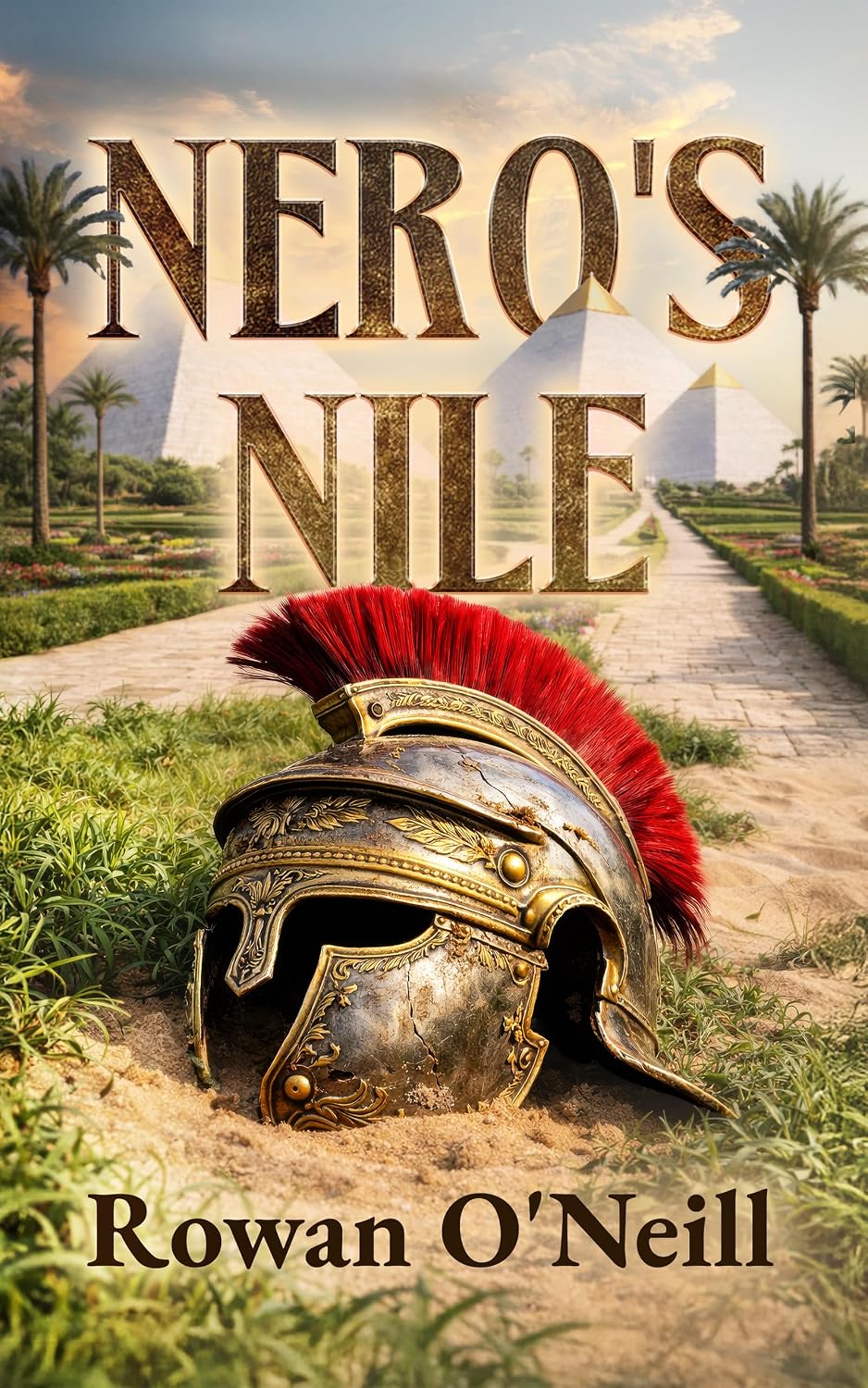

Nero’s Nile, by Rowan O’Neill, is a historical fiction adventure that follows Emperor Nero’s obsession with discovering the source of the Nile. To carry out that ambition, he draws Titus Statilius Taurus back from the quiet life he has earned and sends him into Egypt and beyond, while Rome itself rots under ambition, violence, grief, and spectacle. The novel moves between imperial politics and expeditionary danger, mixing Roman history, Egyptian myth, and supernatural menace into a fast, dramatic story about power and the price of being useful to people who see the world as something to own.
What stood out to me first was the pace. This book doesn’t linger at the doorway. It kicks it open. O’Neill writes in bold strokes, and the result is a novel that often feels closer to a sword-and-sandals epic than a restrained historical drama. Battles, assassinations, betrayals, crocodile attacks, ancient temples, and political murders arrive with steady force. I liked that confidence. The writing sometimes favors impact over subtlety, especially in the dialogue, where characters often say exactly what they mean and say it loudly. That can make some scenes feel theatrical rather than natural. But honestly, that theatrical quality also fits Nero. His world is all performance, blood, gold, and applause, so the heightened style makes a strange kind of sense.
I was most interested in the author’s choice to make the Nile expedition more than a geographic mystery. The book treats the river almost like a living border between history and myth. Titus becomes the steadier center of the novel, a soldier who wants peace but keeps getting pulled toward other men’s dreams of glory. Nero, meanwhile, is written as both ridiculous and dangerous, which can, at times, be a hard balance to hold. He is vain, childish, cruel, and sometimes oddly sad. I found that mix compelling, even when the character work leans broad. The historical fiction genre gives the novel its bones, but the adventure and supernatural elements give it its pulse. By the time the darker mythic material moves closer to the surface, the book has shifted from Roman intrigue into something stranger and more feverish.
I would recommend Nero’s Nile to readers who enjoy historical fiction that is energetic, dramatic, and unafraid to bend history for the sake of the story. If you like ancient Rome, dangerous quests, myth-soaked adventure, and a plot that keeps throwing new hazards into the river, they will probably have a good time with it. I did. The book is a torchlit march into empire, obsession, and chaos, and it knows exactly the kind of spectacle it wants to be.
Pages: 269 | ASIN : B0GY27MQ2B
Witness to Tribulation

Liz Finnegan’s Witness to Tribulation is a reflective historical novel about inheritance, grief, and the strange pull of Gettysburg. The story follows Emily Tomaso, a young woman who leaves a tense home life behind after inheriting her grandmother’s family house in Gettysburg, Pennsylvania. What begins as a fresh start becomes something deeper when Emily finds an old Civil War diary and starts sensing that the past in this town is still very much alive.
The book blends family drama, romance, history, and ghost story in a way that feels personal rather than flashy. Emily’s connection with Peter Sanders gives the story warmth, but the heart of the novel is really her growing relationship with the people who came before her. The Civil War material is woven into the plot through Gettysburg itself, through the diary, and through the emotional residue left behind by ordinary people who had to survive extraordinary suffering.
Finnegan’s strongest idea is that history doesn’t stay sealed away in textbooks. It moves through families, houses, memories, and even silence. That idea comes through beautifully in the repeated use of candles, bells, old rooms, and remembered voices. One line captures the spirit of the town especially well: “If you were to put a candle in every window in this town, it still wouldn’t be enough to acknowledge all of the suffering.” That sense of reverence gives the novel much of its emotional weight.
Emily’s journey also works because it’s grounded in everyday hurt. Her strained relationship with her mother, Mandy, gives the story an intimate tension that balances the larger Civil War history. As Emily uncovers the pain carried by her ancestors, she also begins to understand her own family with more tenderness.
Witness to Tribulation is a heartfelt novel about memory, forgiveness, and the ways a place can shape the people who live there. Finnegan writes Gettysburg as more than a historic site; it becomes a living space where sorrow, faith, love, and reconciliation meet. Readers who enjoy family-centered historical fiction with a spiritual atmosphere will find this book thoughtful, sincere, and easy to settle into.
Pages: 324 | ISBN : 978-1637777749
An Imprint of Evil and Other Hauntings

Stephen Tallevi’s An Imprint of Evil and Other Hauntings is a compact collection of ten horror stories built around cursed objects, old sins, hungry gods, occult bargains, and people who make one terrible choice too many. The book has the feel of classic ghost and weird fiction, with each story rooted in a specific time and place, from Manchester in 1831 to the Florida Keys in 1964, Chicago in 1905, and Muskoka Lakes in 1929. That historical spread gives the collection a pleasing variety, while the tone stays consistent: polished, eerie, and quietly wicked.
I enjoyed how often the horror grows out of desire. Mary’s longing in “Love is Blind,” George’s greed in “Pearly Whites,” Cathers’s ambition in “The Death God,” and the community’s bargain in “The Barn” all lead characters into darkness with their eyes wide open. These aren’t random hauntings so much as moral traps. Tallevi has a knack for letting people talk themselves into the unforgivable, then watching the supernatural world meet them halfway.
The stories also move at a brisk, readable pace. Most begin with a familiar situation, such as a reunion, an expedition, a country visit, a carnival, or a marriage under strain, and then tighten the screws until the final turn lands. “Idol of the Deep” is especially effective as an adventure story that slowly becomes something stranger and more fatal, while “Hands of Fate” adds a detective-story rhythm to the collection. The line “There is no death god in this cave, only death” captures the book’s taste for irony, where the supernatural and human cruelty often blur into one another.
Tallevi’s best moments come when he lets a simple image do the work: a wax doll, a black idol, stained hands, a scarecrow in a storm, a barn door that won’t open. The prose is clear and atmospheric without getting bogged down, and the collection has a campfire-story quality that makes it easy to keep turning pages. Even the brief “Summer Blood” has a playful bite. That story’s mix of menace and dark humor showcases the author’s personality.
An Imprint of Evil and Other Hauntings is an entertaining horror collection with a strong affection for old-school supernatural storytelling. It’s full of cursed inheritances, cruel bargains, and endings that snap shut like a trap. Readers who enjoy concise, atmospheric tales with a macabre sense of justice will find a lot to enjoy here, especially in the way Tallevi turns ordinary human weakness into something ghostly, grotesque, and strangely satisfying.
Pages: 132 | ASIN : B0G5LVNKF6
Skepticism and Belief

Reflections in the Dark follows a haunted academic and a Chicago homicide detective as they investigate ritualistic murders tied to mirrors, fractured identity, and a terrifying reality pressing in from beyond the known world. What was the inspiration for the setup of your story?
The inspiration really came from wanting to merge two types of stories I’ve always loved: surreal, cosmic horror in the vein of Twin Peaks or The X-Files, and grounded noir detective fiction like the work of Raymond Chandler.
Early on, I had a very clear image in my head: it was essentially Fox Mulder paired with Philip Marlowe. I wanted that contrast: a straight-laced, reality-driven investigator encountering cases that gradually become stranger and more unexplainable, eventually drawing in someone who’s open to the paranormal, other dimensions, and the unknown.
That push and pull between skepticism and belief became the foundation of the story. It’s something The X-Files did so well, and it creates a natural tension that lets the mystery evolve from grounded crime into something much more unsettling and cosmic.
As the story developed, that dynamic evolved into Reed and Maria. I shifted the noir detective role into Maria partly because I wanted a male-female pairing, but also because it strengthened that contrast—two people approaching the same reality from completely different perspectives, forced to confront something neither of them can fully explain.
Reed Ashland and Detective Maria Voss bring different kinds of damage to the story. Which character came to you first?
That’s a tough one, because they really arrived together conceptually. From the beginning, I knew the story needed two leads, two perspectives colliding.
That said, I actually started writing Reed first. The opening chapters came from his point of view, and right away, his voice was very disjointed, surreal, and intentionally unstructured. That was always the goal with him; his experience of reality is fractured, but as I was writing, I realized pretty quickly that if the entire novel lived in that space, it would be difficult to anchor.
That’s when Maria really came into focus.
Her storyline became the grounding force of the book. While Reed drifts further into the strange and otherworldly, Maria operates in a much more linear, procedural way—investigating bodies, following evidence, moving step by step through a case. That structure gave the story a necessary through line and allowed Reed’s more abstract descent to have contrast and context.
So while Reed was technically first on the page, Maria’s side of the story became complete first. She’s the lens that holds everything together, and the balance between the two is what gives the story its shape.
What were some themes that were important for you to explore in this book?
At the beginning, I honestly just wanted to write a compelling horror-mystery, something that captured the feeling I got personally from works like House of Leaves, The X-Files, and Twin Peaks. That sense of unease, mystery, and something just beyond comprehension.
But as I wrote the book, the thematic core shifted more toward the characters themselves.
What really interested me was exploring how people carry damage: grief, trauma, unresolved questions, and how that shapes who they are. Reed and Maria, on the surface, can feel like familiar archetypes, but I wanted to push beyond that and show that there’s always something deeper underneath. People aren’t as simple as they first appear.
That idea: that we often misjudge others based on surface-level impressions, became really important to me. You meet someone and think you understand them, but the more you learn, the more complicated they become. I wanted the characters to reflect that reality.
So at its core, the book is less about solving a mystery and more about how these characters navigate their own internal fractures. It’s about how we carry our past with us, how it influences our decisions, and how it quietly shapes the paths our lives take.
What is the next book that you are working on, and when will it be available?
Right now, I have a few projects in motion. The closest to release is a novella titled Viscera Varnish, which is essentially finished and just going through final cleanup. It’s a transgressive, art-driven horror story, and the plan is to release it in early summer.
I’m also in the middle of writing another novella, currently titled Panspermia. That’s just a working title and will most likely change, but that one leans more into sci-fi horror, drawing inspiration from shows like The X-Files and the broader ancient-aliens mythology. If everything stays on track, I’m aiming for a late summer or early fall release.
Beyond that, my next major focus will be the sequel to Reflections in the Dark. It’s still early, but my goal is to have Book Two out within about a year, tentatively targeting early 2027.
I also have several short stories appearing in upcoming anthologies this year. One is a suburban horror piece titled Night Whispers, another is a folk horror story called The Keepers, and a third, Ascended Infinity, explores the idea of uncovering hidden truths. Final anthology titles and release dates are still to be announced.
Overall, the goal is to keep a steady stream of work coming and continuing to build out this world while also exploring different corners of horror along the way.
Author Links: GoodReads | X (Twitter) | Facebook | Website | Amazon
Across town, Dr. Reed Ashland wakes to fractured memories and impossible visions staring back at him from every mirror he passes. Once a respected philosophy professor, Reed is now a disgraced academic spiraling through grief, alcoholism, and the growing certainty that something is watching from the other side of the glass.
When Voss and Ashland are drawn into an uneasy partnership, their investigation quickly slips beyond logic. Victims appear who should not exist. Reflections behave independently. Messages surface where no human hand could have written them. And the killer they are hunting does not seem bound by the rules of a single reality.
All paths lead to a phenomenon Reed knows too well but fears to name: the Elsewhere Fold, a place that exists between worlds where memory, identity, and consciousness bleed into one another. A place that remembers everyone who enters it and does not always let them leave.
As the boundary between the Fold and the waking world begins to erode, Voss and Ashland must confront the versions of themselves reflected in the dark. Some familiar. Some monstrous. Some terrifyingly true. Because the killer they seek may not be entirely human, and if they fail, the Fold will not remain on the other side of the mirror.
Reflections in the Dark is a gripping blend of crime thriller, psychological horror, and surreal mystery that explores fractured identity, existential dread, and the darkness waiting behind every reflection. Fans of Night Film, True Detective, and the dreamlike terror of David Lynch will feel right at home.


