Blog Archives
Izzy Can’t Talk But He Can Make Friends


Izzy Can’t Talk But He Can Make Friends! is a warm children’s book about autism, friendship, and communication. The story follows Izzy, a nonspeaking autistic boy who feels nervous around his new neighbor, Jimmy. As the boys spend time together, Izzy learns that friendship can grow through shared interests, laughter, patience, and simply enjoying another person’s company. The book presents Izzy’s speech device, service dog, safe space, routines, and stimming as natural parts of his everyday life.
The story works especially well as a social-emotional learning book for children because the friendship develops through believable little moments. Jimmy accidentally sits in Izzy’s special spot, visits his treehouse, watches Izzy’s favorite cartoon, and discovers that they both love chicken nuggets. Aunt Bee helps Jimmy understand Izzy without speaking for every feeling he has, while Jimmy shows a willingness to listen, apologize, and adjust. That gives young readers a practical picture of empathy and inclusive friendship.
The bright cartoon illustrations make this inclusive children’s book lively and easy to follow. Izzy’s emotions are shown clearly through his face, body language, and changes in color and lighting, including a striking scene where he appears frozen inside a blue block when meeting Jimmy. The pictures also add playful details, such as superhero costumes, toy dinosaurs, Uncle Gus getting stuck in the treehouse window, and Lucky the service dog joining the action. These visual touches keep the book energetic while helping children understand experiences that Izzy doesn’t express through spoken words.
As an autism awareness picture book and friendship story for kids, the book has a clear, encouraging message: communication can take many forms, and connection doesn’t depend on speech. Its straightforward explanations make it useful for families, classrooms, and conversations about neurodiversity, while the humor and familiar childhood activities keep the story approachable. Izzy and Jimmy’s friendship feels satisfying because it grows from curiosity, shared joy, and time spent together.
Pages: 34 | ISBN : 978-1962636087

Izzy Can’t Talk
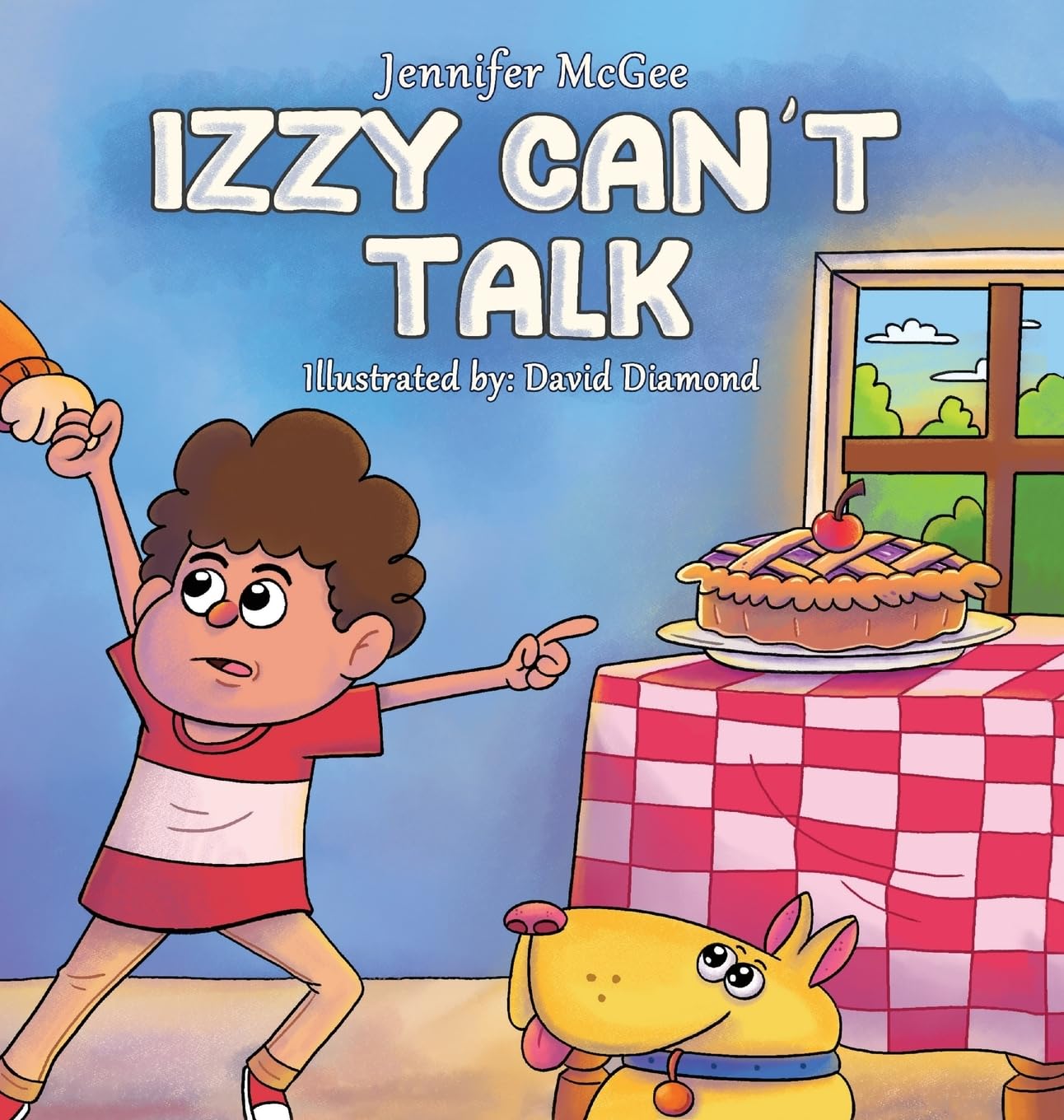
Izzy Can’t Talk, by Jennifer McGee and David Diamond, is a warm and brightly illustrated picture book about a young autistic boy who communicates without spoken words. Izzy lives on a farm with Aunt Bee, Uncle Gus, and his service dog, Lucky. When he becomes excited about Aunt Bee’s razzleberry pie, his family tries to understand what he wants by offering water, a pillow fort, and time on the trampoline. The simple setup gives young readers an easy way to follow Izzy’s growing frustration while recognizing that he has clear thoughts, feelings, and preferences.
The story’s strongest idea is that communication can take many forms. Izzy rocks, jumps, flips a light switch, uses facial expressions, and responds to pictures, but the people around him don’t immediately understand those signals. The book treats this confusion with patience and gentle humor, especially through Uncle Gus’s enthusiastic mistakes and physical comedy. That playful tone keeps the story light while still showing how exhausting it can be when someone knows exactly what they want but can’t make others understand.
David Diamond’s cartoon illustrations give the book much of its personality. The pages use bold colors, exaggerated expressions, and clear visual action, making the emotions readable even before the text is spoken aloud. The pictures also help explain tools such as sign language, picture cards, a service dog, and a speech pad. When Lucky brings the device and Izzy presses the “Eat” button, the moment feels satisfying because the solution gives Izzy direct control over his message rather than asking his family to keep guessing.
This children’s book will be especially appreciated by families, preschool and early elementary teachers, speech-language professionals, and children who are learning about autism or augmentative communication. It could also be meaningful for nonspeaking children who’d enjoy seeing a character whose inner life is active, joyful, and understood. The ending delivers the book’s central point clearly: Izzy can’t talk, but he can communicate. That makes Izzy Can’t Talk a useful and affectionate read-aloud for starting conversations about listening, patience, and giving every child a dependable way to be heard.
Pages: 34 | ISBN : 978-1962636001
Double Jeopardy

How to Organise Inclusive Conferences and Workshops is not a conventional handbook on conference planning; rather, it is a serious, humane argument about what professional gatherings reveal about power, access, and belonging. Why was it important to state upfront that no conference can ever be fully inclusive?
I open the book with a statement that I felt had to come first: no conference or workshop can ever be fully inclusive. I chose to say this immediately, before anything else, because I wanted readers to understand that what follows is not a promise of perfection but an invitation to honest, sustained effort.
The reason I state this so plainly is that human needs are varied, complex, and dynamic. Some needs align, others conflict, and many shift over time. No amount of careful planning resolves all of these tensions, and I think it would be dishonest to suggest otherwise. I draw on Silverman’s concept of access friction to name what I had observed repeatedly in practice: that decisions made to improve inclusivity for one person or group can simultaneously create new barriers for others. Placing posters close together at a poster session reduces the distance some attendees must travel, yet risks sensory overload for others. Offering a hybrid format widens participation for people who cannot attend in person. However, this approach can unintentionally make the online participants feel quietly marginalised by the people able to physically attend. These are not failures of imagination or care. They are structural realities of human diversity, and pretending otherwise would undermine the very honesty this book depends on.
I also wanted to reframe what I was asking of organisers from the outset. Inclusivity, as I understand it, is not a destination. It is a continuous practice of asking, listening, adapting, and responding. That is why I deliberately chose not to offer checklists or quick fixes. I wanted readers to sit with the discomfort that inclusive practice can never be completed, and to commit to the work anyway.
Underlying all of this is something I feel strongly: the barriers people face, whether disability, caregiving, visa restrictions, or financial hardship, are not incidental. They are rooted in systemic inequality. Naming the impossibility of full inclusion is my way of insisting on moral seriousness rather than goodwill alone.
Which “invisible” barriers do organisers most often overlook?
There is often a particular kind of exclusion that happens in events that consider themselves inclusive. It is quieter than a missing ramp or a broken lift, and it is far more common.
The first is the hidden curriculum of professional gatherings. McCalmon, Ugiagbe-Green, and Mohammed-Chapman in Chapter 7 show how conferences reflect unwritten rules about tone, language, and behaviour that quietly privilege those already at home in institutional settings. People who are unfamiliar with these norms are not excluded loudly; they simply fade into the background, their contributions going unrecognised within spaces that claim to be open. They frame their chapter around three questions that sit at the heart of inclusion: who decides, who gets to rest, and what changes as a result.
Closely related is the invisible burden of advocacy. Clarke and Gagné in Chapter 2 show how the responsibility for arranging accommodations almost always falls on the person who needs them, consuming time, energy, and emotional resources in ways that function as a hidden form of exclusion others in the room rarely see. They argue that this begins earlier than most organisers realise, pointing to calls for papers and registration systems as gatekeeping mechanisms that routinely create accessibility barriers before a disabled scholar has even decided whether to attend.
There is also the question of time. Chapter 9, by Donald, Yarovaya, and Georgiadou, draws on research into timeism to show how rigid conference timelines marginalise people who need different rhythms of engagement, creating hidden hierarchies that go largely unacknowledged. People who need flexible arrangements often invest the most time simply to secure basic access, a form of double jeopardy that proactive design could dismantle.
Finally, there is the exclusion embedded in financial structures. Castelle and Ho in Chapter 6 are direct about this: affordability is rarely treated as an accessibility issue, yet cost is one of the most consistent barriers to participation. Tiered pricing, bursaries, and scholarship access, as modelled through the Cannexus conference, are not peripheral gestures but structural responses to a barrier most organisers leave unexamined.
What does it mean to design with disabled participants rather than for them?
For me, designing with disabled participants rather than for them is, at its heart, a question of power and not just practice.
The disability movement’s foundational principle, nothing about us, without us, runs as an ethical thread through the book. Clarke and Gagné in Chapter 2 establish this from the outset, arguing that accessibility must be built into every stage of conference planning rather than retrofitted in response to individual requests. They are clear that when diverse voices are not centred in planning and governance, professional development spaces risk reinforcing the very exclusionary norms they claim to challenge. Cook, Brown, and Beaumont-Bilsby in Chapter 3 extend this through their own lived experience as a wheelchair user, a neurodivergent pracademic, and an inclusive service design specialist. They argue that disability representation on organising committees is not a nicety but a structural necessity, and that systems which appear neutral, such as standard venue designs and funding structures, often reinforce exclusion precisely because they were not designed with diverse ways of moving, thinking, and participating in mind. Decisions made without disabled voices embedded in the planning process tend to produce accommodations that are reactive, inconsistent, and poorly communicated, turning participation into what they describe as a negotiation for survival rather than an opportunity for genuine engagement.
Paul Vincent, Soltani, and McAteer in Chapter 4 are direct about the limits of well- intentioned innovation: live captioning and hybrid formats have improved access in measurable ways, but without sustained investment and disabled input at the design stage, these solutions lack consistency. Crucially, they challenge the assumption that offering a remote option excuses an inaccessible venue. Face-to-face interaction matters, and disabled participants deserve access to it.
McCalmon, Ugiagbe-Green, and Mohammed-Chapman in Chapter 7 reframe the question entirely, asking who gets to decide what inclusion looks like in the first place. They argue that true inclusion must be grounded in justice and the redistribution of power, not merely representation or legal compliance. This means examining whose voices are prioritised in programme design, who carries the emotional and physical labour of making an event run, and who is asked to advocate for their own access while others simply participate. Designing with rather than for, in their framing, is ultimately about shifting that burden from individuals to institutions.
Lin-Stephens, Maze, Lau, and Chen, in Chapter 8, bring a different dimension through their Sustainable Professional Development model, which insists on co-creation with local partners rather than importing solutions from outside. Their experience organising the APCDA conference across Asia shows how cultural contexts shape what inclusion requires, and how assumptions embedded in Western-centric design can themselves become barriers.
Chapter 9 by Donald, Yarovaya, and Georgiadou synthesises this by framing inclusion as a shared responsibility rather than a service delivered to people who need it. The call is clear: when disabled scholars, international participants, caregivers, and others from underrepresented groups are genuinely welcomed and recognised rather than accommodated at the margins, it strengthens a shared sense of belonging for everyone in the room.
Which practical changes tend to have the most immediate impact on inclusion?
The question of which practical changes have the most immediate impact is answered most compellingly through the practitioner voices running through the middle and later sections of the book.
Foote, in Chapter 5, makes the strongest case for proactive communication as the single highest-impact step. Her accessibility package, a detailed, screen-reader-compatible document sent to attendees before the event, covers everything from parking routes and flooring types to lighting conditions and session engagement expectations. The insight behind it is simple: people cannot request accommodations they do not know are available, and they should not have to disclose a disability to access a well-designed event. Placing fidget toys on all tables rather than just in sensory kits, and reserving easy-access seating for anyone who wants it without requiring justification, are low-cost changes that normalise inclusion rather than marking it as exceptional. Foote also recommends providing later start times, earlier end times, and sufficient transition time between sessions, noting that this benefits not only attendees with mobility requirements but anyone who needs time to process information or prioritise self-care.
Castelle and Ho, in Chapter 6, demonstrate what this looks like at scale. The Cannexus conference treats financial access as an inclusion issue, not an afterthought, using tiered pricing, bursaries, and targeted scholarships to widen the pool of who can realistically attend. Their hybrid model, offering nearly full access to keynotes, workshops, and networking online, has proved especially beneficial for caregivers, people managing health conditions, and rural or international participants.
Lin-Stephens, Maze, Lau, and Chen, in Chapter 8, drawing on their experience organising the Asia Pacific Career Development Association conference, add that feedback mechanisms are themselves a practical inclusion tool and one that is frequently overlooked. Seeking input from people who did not attend, not just people who did, is how organisers begin to understand the barriers that prevented participation in the first place.
Donald, Yarovaya, and Georgiadou in Chapter 9 offer a useful frame for all of this: small, intentional actions matter. Inclusion does not require waiting for institutional policy or a new budget cycle. It begins with what an organiser chooses to do next, and those choices, made consistently and with the people most affected in mind, are how larger structural change builds momentum.
Anything else?
I’d just like to take the opportunity to thank everyone who contributed to the book. When I was first approached, the publisher asked if I would be the sole author. I am genuinely pleased and grateful that they agreed to my leading an edited collection instead, because it brought together far richer insights from a wider range of lived experience.
Finally, I’d like to thank the entire team at Literary Titan for the opportunity to share these additional reflections. I hope How to Organise Inclusive Conferences and Workshops will have a meaningful impact as we work together to build a more inclusive and sustainable ecosystem. Thank you.
Author Links: GoodReads | Website | LinkedIn | Amazon
With strong relevance to ongoing global conversations surrounding diversity, equity and inclusion, the book encourages constructive dialogue and provides innovative advice. Situated within contemporary career discourse, it is grounded in sustainable career ecosystem theory and aligned with the UN Sustainable Development Goals. Chapters cover a diverse range of inclusion-related experiences, prioritising respectful representation of individual narratives and affirming the importance of linguistic and cultural sensitivity. By offering strategies for inclusive event planning, it underscores the importance of proactive allyship, co-creation, and advocacy in dismantling systemic barriers to promote an inclusive and sustainable ecosystem for all.
How to Organise Inclusive Conferences and Workshops is a justice-oriented guide for those committed to cultivating genuinely inclusive environments, including academics and other professionals involved in planning and delivering these events. It is also an essential resource for students and scholars in education and business and management.
Everyday Moments

Yoey Does It Her Way follows a determined little girl who learns at her own pace and has her family’s support as they cheer her on every step of the way. Why was it important to focus on joy and everyday moments rather than challenges?
Focusing on joy and everyday moments in Yoey Does It Her Way was important because it shifts the lens from limitation to celebration.
Children who live with differences — including those born with Wolf-Hirschhorn Syndrome — so often have their stories told through the framework of challenge. Appointments. Diagnoses. Milestones measured against charts. While those realities exist, they are not the whole story. Joy is.
By centering the book on everyday moments — trying something independently, laughing, discovering, persisting — the message becomes empowering rather than sympathetic. Yoey is not defined by what is hard. She is defined by who she is.
This approach:
- Normalizes inclusion instead of spotlighting differences
- Shows capability before difficulty
- Allows children to see similarity first
- Models confidence rather than struggle
It also invites all children — not just those with disabilities — to recognize that doing something “your way” is a strength. Independence looks different for everyone. Progress looks different for everyone. Success looks different for everyone.
Joy makes the story accessible. It allows readers to connect with Yoey as a child first — playful, determined, unique — rather than as a diagnosis.
And ultimately, joy tells a child reading the book:
“You are not a problem to solve. You are a person to celebrate.”
Yoey is curious, busy, and proud of herself. How did you shape her personality on the page?
From the beginning, Yoey has her own personality and will. She is non-verbal but still manages to express her opinions! Yoey Does It Her Way was built around her voice: determined, joyful, observant, and quietly confident. Rather than writing about what others expected of her, I tried to follow what she chooses to try, how she approaches a task, and how she defines success.
Her personality shows up in several intentional ways:
- Determination in Small Moments
The story focuses on everyday actions — making friends at the park, swimming, riding a scooter, trying again and again — because that’s where her resilience shines. The language mirrors her steady persistence rather than dramatic struggle. - Joy as a Default Setting
Yoey isn’t written as fragile or overwhelmed. She is curious, playful, and proud. Her reactions emphasize delight and discovery, shaping a tone that feels uplifting instead of heavy. - Independence with Confidence
The phrase “her way” is central. It reinforces that independence doesn’t mean doing something like everyone else — it means doing it in a way that works for you. That belief guided the pacing and phrasing of each scene. - Strength Without Spotlighting Difficulty
Instead of centering the diagnosis, I wanted the readers to experience Yoey through her personality traits — spirited, brave, thoughtful — rather than through medical language and understand the support she gets from her family to find success. - Gentle Repetition and Rhythm
The structure likely echoes her steady, determined energy. Repetition reinforces her persistence and builds a celebratory cadence as she succeeds in her own time.
What conversations do you hope this book sparks between children and adults?
Yoey Does It Her Way can open the door to some of the most meaningful, gentle conversations between children and adults — because it centers on everyday life, not lectures.
Here are powerful conversations it can spark:
- “What does doing it your way mean?”
- Children can reflect on:
- What feels easy for me?
- What feels hard?
- How do I solve problems differently?
- Adults can reinforce:
- There is more than one right way to do something.
- Everyone’s timeline looks different.
- Children can reflect on:
- “What makes you proud of yourself?
- The book invites children to notice small victories:
- Trying again
- Speaking up
- Being patient
- Finishing something independently. This builds internal confidence instead of comparison.
- The book invites children to notice small victories:
- “How can we be a good friend?”
- Children may naturally ask:
- How can I help someone without taking over?
- How do I include someone who does things differently?
- Adults can model:
- Support without rescuing
- Encouragement without pity
- Respect for independence
- Children may naturally ask:
- “What makes each person unique?”
- The story allows space to talk about:
- Different abilities
- Different learning styles
- Different personalities. It shifts the focus from “Why is someone different?” to “What makes them special?”
- The story allows space to talk about:
- “What feels big or new right now?”
- Because Yoey celebrates everyday milestones, children may open up about:
- Trying something new
- Feeling nervous but brave. The book becomes a bridge for emotional honesty.
- Because Yoey celebrates everyday milestones, children may open up about:
- “How do we celebrate effort?”
- Rather than only praising outcomes, adults can ask:
- Did you try?
- Did you keep going?
- What did you learn? This fosters a growth mindset naturally.
- Rather than only praising outcomes, adults can ask:
- “What is something you do your own way?”
- This question empowers all children — not just those who relate to Yoey’s experiences. It reinforces autonomy and self-worth.
- The book doesn’t spotlight diagnosis or difficulty — so conversations stay rooted in:
- Capability
- Joy
- Respect
- Inclusion
- Confidence
It allows children to see: “I’m not behind. I’m not different in a bad way. I’m growing in my own way.”
And for adults, it offers language that feels celebratory instead of corrective.
Author Links: GoodReads | Website | Amazon
From playground fun and family swings to swimming, frozen yogurt, and learning new skills, Yoey embraces life with a bright smile and a big spirit. Some things take her longer to learn, but with hard work, loving support from her brother Royce and her parents, and her own fierce determination, Yoey keeps growing and shining. Yoey is many wonderful things—curious, sweet, busy, brave—and most of all, she wants to be your friend.
This story gently invites young readers to understand and appreciate differences through Yoey’s experiences, while the final page offers helpful information for adults about Wolf-Hirschhorn Syndrome.
Loveable Uniqueness

THE UN-EXTRAORDINARY LIFE OF SOPHIE SIMPLETON captures the beauty of daily life through the eyes of an imaginative and optimistic young girl who loves nature and storytelling. What was the inspiration for the setup of your story?
I live on a mountain that overlooks the ocean. For some years I have been making written observations of my beautiful and yet dangerous surroundings. The only missing element was a young girl called Sophie Simpleton who came to me in an instant of pure inspiration.
Were you able to relate to Sophie while shaping her character?
Absolutely. She naturally flowed out of my observation of members in my own family and others whom I have admired throughout the history of literature I’ve read. Ultimately she developed into her own loveable uniqueness. Every time I would sit down and write I would ask, “So what are we going to get up to today Sophie?” She never disappointed.
What were some educational aspects that were important for you to include in this children’s book?
Sophie is a misfit when it comes to traditional education. Yet in the midst of that, though misunderstood by many, she shines bright.
Can readers look forward to more books featuring Sophie? What are you currently working on?
Certainly. I have published the second in the series titled: SIMPLY SOPHIE SIMPLETON. Also available on Amazon worldwide. The third in the series is currently being written: SAVING SOPHIE SIMPLETON
Author Links: GoodReads | X (Twitter) | Facebook | Website | Amazon
FORTY YEARS to LIFE

In Forty Years to Life, Brenda Bradford Ward offers a profound exploration of the challenges and triumphs of her journey as a transgender person. With compelling honesty, Ward recounts her struggle with identity, shedding light on the complexities of transitioning and its impact on relationships with family and society. The narrative serves as a poignant reminder of the importance of approaching transgender experiences with empathy and understanding.
Ward takes readers through her recurring struggles with identity, from childhood confusion to adult self-realization. She vividly describes her therapy experiences, suicidal thoughts, and the initial trials of wearing women’s clothing amidst societal rejection. Her journey is not just a personal memoir but also a reflective analysis of broader themes, including history, religion, philosophy, politics, and human nature.
The book’s strength lies in its raw and candid prose, revealing Ward’s deepest thoughts, doubts, fears, and questions. Her writing invites readers to understand that being transgender is not a whimsical choice but often a lifelong struggle against one’s assigned gender. This perspective challenges preconceived notions and emphasizes the persistence and courage required to live authentically as a transgender individual.
Beyond personal narrative, Ward engages in analytical discussions on diverse topics such as governmental laws, societal norms, and family dynamics related to gender. This blend of memoir and critical analysis enriches the reading experience, providing new insights into how various societal structures influence the transgender experience. The story also encompasses a variety of themes, including music, friendship, the process of coming out, high school challenges, and medical issues associated with transitioning. These elements combine to create a multifaceted portrayal of Ward’s life, making the book relatable and engaging for a broad audience.
For readers unfamiliar with transgender experiences, Forty Years to Life offers a detailed and educational perspective on what it means to live as a transgender person. Those who have lived through similar experiences will find resonance and relatability in Ward’s story. Ward’s enlightening narrative in Forty Years to Life is a powerful call to challenge biases and embrace the experiences of transgender individuals.
Pages: 759 | ASIN : B0CW1FWKVV
Promote Empathy and Inclusion

May I Sit at Your Table? follows a second-grade girl who is deaf and experiences a transformative moment when her teacher introduces American Sign Language, sparking her goal to connect with her peers. Why was this an important book for you to write?
At one of my brother’s neurodiverse basketball games, I experienced a pivotal moment. While signing “hello” and “good job” to a Deaf teammate on my brother’s team, his father, moved to tears, approached me and shared how meaningful it was to see someone communicate with his son. This encounter inspired me to become fluent in American Sign Language (ASL) and the culture. I’ve always been concerned about bullying and exclusion, and my research disclosed that Deaf children are often victims. I wanted a book that would promote empathy and inclusion of this ostracized community.
The art in the book is fantastic. What was the art collaboration process like with illustrator Samuel Gross?
Thank you for your kind comment! It was truly a work of love. Sam is my brother. He is 14 years older than me, and he suffers from autism. I worked with him in creating the sketches for the book by reading the book to him over and over and then explaining the specific storyline on each page. He then would interpret those events and draw the scene in pencil. It’s fascinating to watch him draw because he holds the pencil in his fist and never picks the pencil off the page when drawing. It’s also amazing to see the world through his eyes. I then traced the drawings in pen and added color and shading.
Doing the illustrations was one of the highlights of Sam’s life. It has bolstered his self-esteem and brought him great happiness. It has also brought us closer together.
What were some themes that were important for you to explore in this book?
My book is more than a children’s book; it’s a social story about how to accept people who are different. Here, a young Deaf girl is ostracized by her peers because she is seen as “different.” It’s my belief that these actions are simply a result of a lack of knowledge. I wanted to show that educating grade school children about diverse communication styles fosters empathy and teaches inclusiveness.
Another key theme is that exclusion often occurs in less supervised settings like school lunchrooms.
Finally, I wanted to explore the often-private nature of the pain caused by exclusion. Children, like the character Abby in my book, may feel reluctant to express their hurt and only confide in their families. Abby’s experience highlights the importance of attentive and caring teachers who can recognize and address such issues, offering support where it’s needed most.
What is the next book you are working on, and when will it be available?
My next book has already been published. It is titled, May I Come to Your Party? and is about a young boy who suffers from autism and is never invited to parties, and he invites everyone to his birthday parties, but no one ever comes. Here is an Amazon link: May I Come to Your Party? I also have a website with more information: Grace Wolf Books
Author Links: GoodReads | Website | Amazon
The story beautifully captures the transformation that comes with understanding and acceptance, underscoring the importance of empathy, inclusivity, and embracing our unique attributes. May I Sit at Your Table? leaves readers with the important message that everyone, no matter how they communicate, deserves to be heard, seen, and accepted.
Let’s Talk! Celebrating the Holidays

Let’s Talk! Celebrating the Holidays, by Lisa Jacovsky, is an engaging narrative that thoughtfully highlights the value of embracing cultural diversity through festive traditions. The book centers around Harper, who celebrates Christmas, and her friends Emma and Jerry, who observe Diwali and Hanukkah respectively. Their curiosity about each other’s traditions leads to a collaborative effort to learn and celebrate together, culminating in a party that integrates elements from all three festivals.
Jacovsky skillfully portrays the characters’ diverse backgrounds and personalities, weaving them into the fabric of the story. The author underscores the theme of inclusivity with the addition of Emma, an autistic character, who communicates using special cards. The characters’ interactions embody mutual learning, emphasizing the significance of understanding and valuing different cultures. This is particularly evident as the children work together to blend their traditions into a harmonious celebration.
The narrative, while straightforward and without a central conflict, succeeds in being both educational and enjoyable. It effectively imparts universal values such as empathy and friendship, alongside fostering creativity in problem-solving and event planning. Jacovsky’s writing style is clear and accessible, making the book suitable for young readers. The story’s vibrant illustrations further enrich the experience, vividly portraying moments of joy and cultural sharing.
Let’s Talk! Celebrating the Holidays emerges as an effective resource for initiating conversations about inclusivity, tradition, and respect among children. It not only entertains but also educates, making it a valuable addition to any young reader’s collection. Jacovsky’s balanced representation of the three holidays reinforces the book’s message of equality and mutual appreciation among different cultures.
ASIN : B0CKTY4TSS


