Blog Archives
An Effective Education System

Just Me: Now That I’m in School? introduces young readers to the idea that the classroom is a shared community, teaching them lessons in cooperation, listening, kindness, and responsibility. Where did the idea behind this book come from?
When I began teaching at age 21, I realized I needed a way to manage a classroom, so I went to the library and found a book titled Just Me, which ended up working perfectly. I used it while teaching second grade and applied the same principles when I went on to teach intermediate grades. I referred to this book in my memoir that I wrote to teach the world what’s really going on in our schools — A Graver Danger: White Chalk Crime, The Stunning First-Ever Explanation for School Shootings & How We End Them. In it, I told a story about how I had my first class so motivated that when a student vomited on her writing paper, she kept working around the vomit and the rest of the class didn’t stop either. I really had my students wanting to learn. I attributed my success to that book.
I tried to find the book, but had no luck. I then asked a couple of children’s book authors to recreate it. But one day I realized I needed to take that job on, since that book—with versions for each grade level—is precisely what an effective education system would have for its teachers. So I recreated it as closely as I remembered, adding a couple of concepts, like the boat idea, which I included verbally when I explained school to my students each year.
My initial thought in creating Just Me was to show a tangible solution for education reform. The central theme of my memoir is that we must empower called-to-teach teachers if we want children to learn. Instead, we have fascist-like administrators pushing those types out of education. In my book, I described what they did to me as one example.
So I decided to recreate that book to help other teachers implement a successful plan in our schools, while I tried to teach education reform with my other book. (The latter is much harder!) I know teachers will love this book since classroom management is a challenge for most. In it, I also offer readers my effective behavior-modification plan, which worked so well alongside this book. I see this book as an opportunity to help our schools from the outside and am excited about what it can do,
To be honest, at first I thought I should just use Just Me as a teaching tool when on podcasts or during interviews discussing my other book. I had one copy made, figuring I wouldn’t bother to publish it. I’m fully aware that I am not welcome in our schools as one who’s made my life’s work exposing them; thus, my book won’t be either. Then I realized, let the administrators try to ban a book that teachers and parents will love. It will help empower other teachers to speak out.
The process I went through with this book illustrates what I have been trying to say: the fascist-like administrators running our schools have disempowered our best teachers, and that is what has unraveled our nation since teachers are the ones who know how learning happens. My very own thinking about this book illustrates how disempowered I felt. So publishing this book is a significant step in my personal growth.
As I work to market my other book, I’ve come to see that one of the main points of my mission is to empower called-to-teach teachers, male and female, and it is a bit like Betty Friedan’s mission when she wrote her book, The Feminine Mystique, to empower women, a book instrumental in allowing women to use their talents. I remember reading her book when I was young and how it helped liberate me. I hope to help free teachers the way she helped free women.
My own process with Just Me proves my point that teachers are not free to use their power. For a long time, it did not occur to me to publish this book or any of my other successful ideas, figuring I’m powerless in the education world. Teachers like me are too other-centered to care or even think about power. How could we not be that way and want to devote our lives to helping children? We need our schools set up in a way that protects us, so we can do our magic with children, being who we were created to be. Instead, we have thieves running far too many of our schools, and it’s close to impossible to get this known given the nature of teachers. It’s truly a catch-22 I am trying to break open.
Now my plan is to help Just Me become a bestseller and empower teachers, which will help A Graver Danger; White Chalk Crime get into the hands of our future leaders, my objective for writing that book. I thank you for the opportunity to tell you how this book came to be as a step in that direction. I do appreciate your organization, as books are so very important.
So that’s the idea behind my recreation of Just Me. I do not think the original author shared his idea for writing it, but I bet he wrote it for parents and teachers like me, aware that managing a classroom takes insightful strategies, aware that teachers need books like this. I certainly appreciated finding it!
Why do you believe learning how to belong is just as important as learning to read or write?
Learning to be part of a community is learning to be part of a democracy. It is clear that schools stopped teaching what this book teaches, or our country wouldn’t be in chaos as it is. Even at a young age, I realized my job as a teacher was to produce educated citizens. To be citizens, children need to learn how to behave in community, and nothing works better than explaining why. So to me, school was always a combination of both. In 2008, well before our democracy fell apart, I warned that our schools would destroy democracy in a book I published then, White Chalk Crime: The REAL Reason Schools Fail: Untold story of crime that has destroyed our schools and how teacher abuse and teacher cleansing have kept this from you, and when speaking at the DC Mall. Here’s me there saying that:
When I returned to teaching in 1992, I was actually a Certified Reading Specialist, so you’d think I’d be more focused on teaching reading, but I loved the balance of the classroom; teaching democracy has always called me. One has only to study our forefathers’ warnings about education to know that education is the foundation of democracy. Democracy must be woven throughout one’s education for our Constitution’s promise of democracy to remain our way of life. It’s as important as reading and writing. When I found that our schools were not operating as democracies or teaching democracy, I began my new career teaching the public.
Why is it important to begin talking about citizenship at such an early age?
\It is important to talk about citizenship the minute a child is part of a classroom in order to gain their cooperation and respect for the classroom and teacher. At that point, we’re talking about citizenship within the classroom or the school. At a higher grade level, it is appropriate to transition to the concept of citizenship in a democracy. I used the word democracy in this book because it is so lost at this time in history that I thought, why not mention it early on? My classrooms were always democracies. That is why the children did so well. They felt a sense of purpose in my classroom, along with a teacher/leader who really cared about them. I decided to include that word given our times. I know that we lost our democracy due to our schools, something that in time others will learn, so our schools need to go the extra mile to bring it back, and in my solutions for education reform I include a democracy curriculum. Whereas I happened upon the Just Me book because I thought it was a good idea, we must have this kind of thinking coming from leadership. We can no longer leave the teaching of democracy up to teachers who think like me, particularly since most of us no longer teach. It has to be part of the curriculum. We don’t need every teacher to be deeply called to teach. What we need is insightful leadership that teaches all teachers to do their job with insight. And citizenship in the classroom has to be the mantra of our schools, so it must start the minute children start school. Learning cannot happen when a classroom is in chaos.
What kinds of discussions do you hope parents and teachers have after reading the book?
I hope parents will appreciate the role of teachers more, and teachers will embrace the idea that they must model democracy in their classrooms both for effective learning and for society at large. The ideas are simple enough to spark the discussions this nation so desperately needs. My best hope is that it leads parents to understand that teachers care about them but have had to follow orders that suggest they don’t. That way, more parents will help me get A Graver Danger: White Chalk Crime to our future leaders, since it is clear that both political parties have no idea what to do about education, while teachers like me know exactly what to do.
Author Links: Facebook | Website | LinkedIn | Substack | TikTok
Just Me: Now That I’m in School?


Just Me: Now That I’m in School! introduces children to the idea that school is a shared community rather than a place where everyone can simply do as they please. Using the image of a classroom as a boat, the book explains that “smooth sailing” depends on cooperation, listening, honesty, kindness, responsibility, and respect. It gradually connects these everyday behaviors to the larger idea of democracy, showing young readers that citizenship begins with small choices such as taking turns, helping others, following rules, and using words instead of anger.
I appreciated the book’s clear sense of purpose. It doesn’t tiptoe around expectations, and there’s something reassuring about that. The writing is simple, direct, and built for repetition, which makes the ideas easy for young children to absorb. I especially liked the comparison between parents having jobs and children having school as their job. That line gives learning and classroom behavior a sense of dignity. The message is more instructional than story-driven. The plainspoken approach feels intentional, and it gives parents and teachers plenty of natural openings for conversation.
The book’s most interesting choice is its use of the word “democracy.” That’s a large and potentially abstract idea for a picture book, yet the author brings it down to a child’s level without stripping it of meaning. Democracy here isn’t presented as a distant lesson about government. It’s presented as the daily work of living alongside other people. I found that thoughtful and quietly ambitious. The artwork supports that approach with uncluttered pages, expressive stick figures, and familiar school situations. The illustrations’ stick-figure simplicity keeps the focus on behavior and emotion. A worried face, a high five, two children sharing a book, or a group gathered on a boat communicates the point immediately.
I found Just Me: Now That I’m in School! to be a sincere and practical book with an unusually thoughtful message about community. It works best when read aloud slowly, with pauses for children to talk about fairness, truthfulness, cooperation, and what they owe to the people around them. I’d recommend it for families with children entering elementary school, as well as teachers, counselors, and homeschoolers looking for a gentle way to begin conversations about classroom citizenship. It’s a useful reminder that learning how to belong is every bit as important as learning how to read.
Pages: 36
It Proves We Needed My Book

A Graver Danger is part memoir, part exposé, and part call to arms that argues that corruption and abuse within America’s schools is the hidden engine behind many of our deepest social fractures, from the rise of authoritarian politics to the epidemic of school shootings. Why was this an important book for you to write?
I was aware that what’s going on in our schools is the best-kept secret ever because people are terrorized within the system and are not going to talk about it. Proof of that is Randi Weingarten, President of the AFT Teachers’ Union, who has just published a book touting the fact that teachers are called to uphold democracy, just as my book did, left out the fact that the fascist-like dictators running way too many of our schools don’t let teachers do what they were called to do. Only my book explains why no one talks about that. It proves we needed my book.
Her book is on the New York Times Best Selling Books List, and she is all over TV, so someone had to get what’s really going on out, or democracy stands little chance of being restored. Thus, it was an important book for someone to write.
That someone had to be from the set of teachers who could afford to lose their jobs and spend thirty years collecting evidence, writing books, spending money to do so, and who would also care enough to do this work. This is not a large set.
I felt I could not leave this earth without exposing this, and although I might not get past the cover up in my lifetime, one day my book will be an intellectual time capsule that explains what happened to America, the way World War One explains what happened to Germany, which is the other nation that fell for a strongman due to despair.
The political right is correct that there’s a deep state of corruption, but has yet to identify that it’s our schools. The political left is also correct that we need to restore democracy, but has no clue what unraveled it. If my book goes viral, since most people want authentic and safe schools, we can work together to take our schools back and end the toxic divisiveness that has replaced democracy.
Can you explain how you came up with the term “White Chalk Crime” and how it has contributed to the current state of the educational system?
I thought of white collar crime, but with a twist, so I used chalk to identify corruption unique to our schools. The self-serving power mongers who break laws at their pleasure are parallel aspects. While business leaders must ensure that workers succeed or they’ll go out of business, in the tax-supported education world, they can and do replace competent teachers, who’d report their wrongdoing, with loyal puppets. Schools can continue to fail and remain in business until someone figures this out, which is not likely to happen without a book like this.
White Chalk Crime™ has ended schools that produce citizens and replaced them with schools that are treasure chests for those running them. All but the White Chalk Criminals are sickened by what they’re doing, but are too afraid to speak out. This never-before-identified corruption needs a strong name, since it works hand in hand with teacher abuse, an act few would understand without knowing the depth of corruption in our schools.
What advice do you have for parents who want to help fix this broken system, specifically at the local level in their school districts, to support teachers fighting for democracy?
Although they need to check laws that vary from state to state, in many districts, the school board members hold all the power. Superintendents have been grooming their boards because, as a society, we trust our schools, since, to most, our schools are closer to motherhood and apple pie than to the mafia, a more fitting descriptor for many of them.
I appeared before my board with a binder of issues that included my principal’s law-breaking acts, and the board responded with “investigation is not what we do” when they are the only watchdog that exists for our schools. That’s what must change.
My superintendent was able to send me to a biased psychiatrist for “imagining harassment,” a psychiatrist who violated my agreement with him despite the law saying he must be an unbiased psychiatrist, because four board members rubber-stamped my superintendent’s wishes.
So, first, parents must learn to be watchdogs, not lapdogs, for our schools.
I recommend they run for a school board on a democracy platform in groups of four—or a number that holds power on that board—so they can control in favor of democracy. They can then insist on hiring quality teachers and replace administrators incapable of working with quality teachers.
I also warn parents that if their administrators are fanning the flames of an extreme right or extreme left political issue, it is to divide people, not because they care about that issue. They use controversial issues to distract from their wrongdoing. Those leaders need to be voted out. Our boards are to make sure our schools do their job as the foundation of democracy. They must be run as the democracy they’re trying to uphold.
What is one thing that you hope readers take away from A Graver Danger?
I hope readers take away the fact that teachers are the spiritual force given to us so people can live in harmony; they make our schools the soul of our nation. Plus, they must understand that school shootings are the universe’s red flags, saying, “Look inside your schools.”
Since 2002, at WhiteChalkCrime.com and at EndTeacherAbuse.org, whistleblowing teachers have been trying to expose that those in power have eliminated this spiritual force, yet this entire nation—media and politicians alike–ignored them because those running our schools forced teachers to behave in ways that turned parents, the media, politicians, and the courts against our teachers.
Our schools weren’t perfect before they became corrupt, and our universities let us down when it comes to education, but people must take away that our schools are our soul, and we must empower our called-to-teach teachers to lead our schools, not self-serving or overly business-minded administrators. Education is not a business. It is the spirit of this nation, and because we trampled our spirit, we’re living in dark times.
Author Links: GoodReads | Substack | Facebook | Website
These are not ordinary times; this is no ordinary book. This book is essential to understand how fascism infiltrated the US and learn what actionable steps can be taken to combat it.
In 1995, a teacher discovered and began exposing that our schools are plagued by what she terms the Harvey Weinstein syndrome—a culture of abuse and exploitation where the powerful get their way — unchecked until someone musters the courage to bring the truth to light. She wrote this book with a singular purpose: to do what the brave actress who testified against Weinstein did — end wrongdoing.
She invested her heart and soul into this book as a contribution to save our country from the clutches of fascism. In light of our nation’s deep divisions, it is imperative to recognize that she believes the selection of a dishonest individual as president—one who is both a criminal and a sexual predator—demonstrates our educational system’s complete failure. Brace yourself for the inevitable wave of negative reviews from MAGA supporters.
Within these pages, she leads those who treasure democracy on an unprecedented examination of our schools. She calls out the pervasive corruption that has transformed our educational institutions from esteemed pillars of society into hollow shells. Introducing the term “White Chalk Crime,” she describes the systemic, mafia-like corruption that is intrinsic to the education system. This fraud, coupled with the teacher abuse used to cover it up, dismantled democracy.
Abraham Lincoln: “The philosophy of the schoolroom in one generation will be the philosophy of government in the next.” We are witnessing this prophecy unfold before our eyes.
She exposes administrators’ active sabotaging of school reform and unveils a bold plan to revolutionize education parallel to the shifts Jeff Bezos brought to marketing and Steve Jobs to technology. Her solution focuses on empowering and revitalizing passionate educators, the very people the crooks who hijacked education wanted out! Her book is the first to include whistleblowers’ voices!
The lack of exceptional teachers to guide troubled students is directly linked to school shootings. In 2002, a dedicated Florida Teacher of the Year attempted to prevent a Columbine by reporting a student who had brought guns to school. Rather than support this teacher,the districtcriminally indicted him, accusing him of complicity. He eventually proved his innocence, but who would willingly face such a fate? Most teachers have stopped noticing the needs or acts of disturbed students.
Furthermore, the unions perpetuate this alarming trend, assisting in ending the careers of exceptional teachers nationwide, while pretending that our teachers have power. Called-to-teach teachers were the government’s only spiritual force. We now live with the chaos their absence caused.
Her plan: teach citizens to vote for members who’ll maintain democracy and/or run for school boards. She provides a clear understanding of our schools, exposes school boards’ contributions to the downfall of democracy, and details how you can make a difference.
This democracy-loving teacher takes you on a journey of repair, not revenge, through the bowels of democracy – our schools, showing how our schools’ gatekeepers have failed us. You will end up hopeful about both our schools and our democracy. In contrast to the school board, which shamefully claimed, “Investigation is not what we do,” this book empowers you to create and support school boards that will actively restore democracy.
A Graver Danger: White Chalk Crime, The Stunning First-Ever Explanation for School Shootings & How We End Them
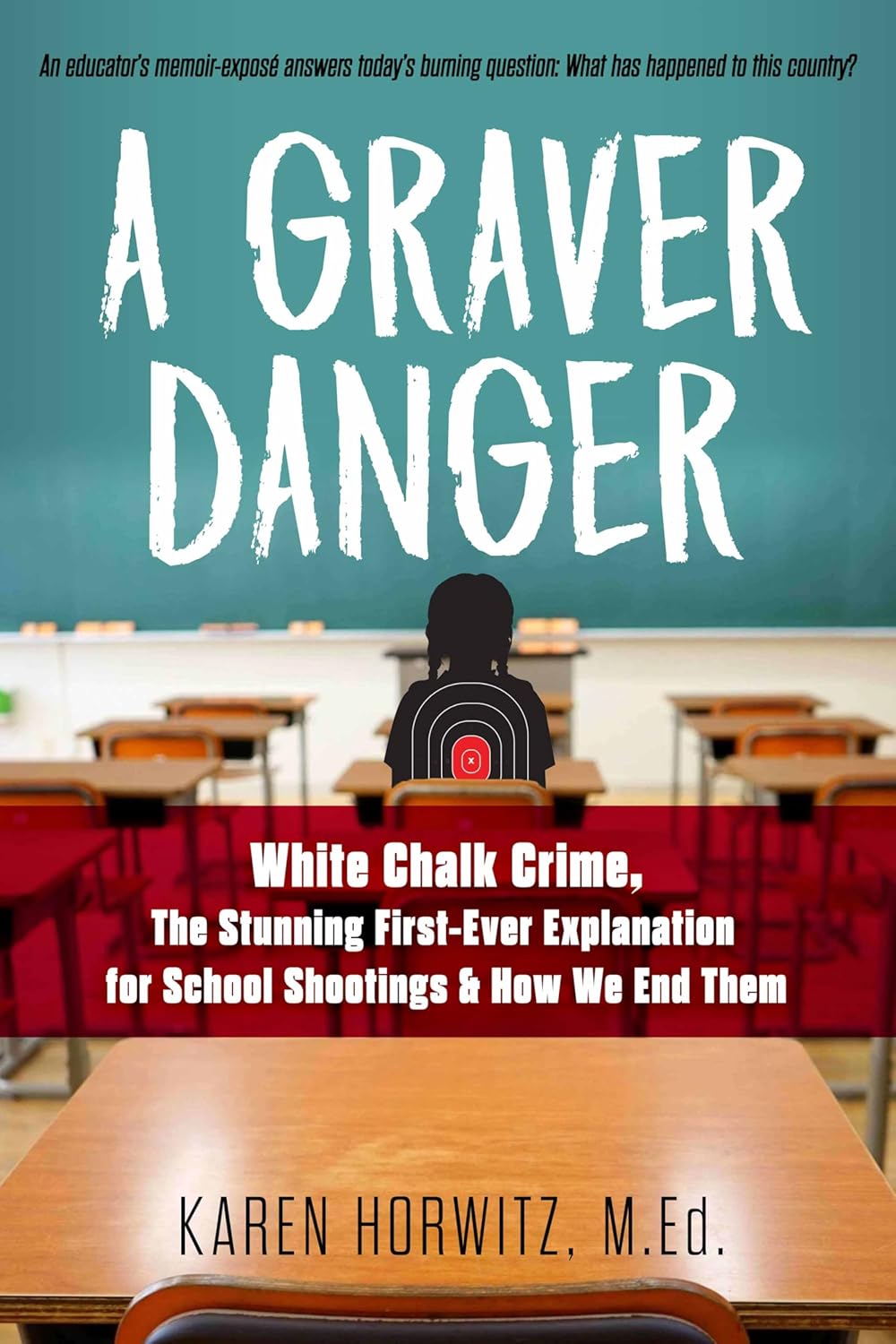
When I picked up A Graver Danger, I didn’t expect to be dragged so quickly into a whirlwind of ideas that felt both raw and unsettling. The book is part memoir, part exposé, and part call to arms. At its heart, it argues that corruption and abuse within America’s schools, what Horwitz calls “White Chalk Crime,” is the hidden engine behind many of our deepest social fractures, from the rise of authoritarian politics to the epidemic of school shootings. Horwitz stitches her own story of being pushed out of teaching into a broader narrative about how education has been hollowed out and how that void has rippled across society. It’s heavy, sometimes overwhelming, but undeniably urgent.
Reading her words, I felt a mix of frustration and admiration. The writing is blunt, even fiery, with no attempt to soften edges or hide her anger. At times, the writing felt especially intense, but then I’d pause and realize that intensity might be the most honest way to tell a story like this. She’s lived through years of being ignored, gaslit, and punished for speaking out, and that bruised persistence bleeds through every chapter. The book isn’t polished in a literary sense, but it’s alive. It jolts you. I found myself underlining sentences, not because they were poetic, but because they resonated with me.
What stuck with me most was her refusal to back down. There’s a loneliness to her fight, and it seeps through the pages. Sometimes I felt exhausted keeping up with the intensity, but then I thought about how exhausted she must be after decades of pushing this rock uphill. That gave me a deeper respect for the work. There were moments when the book revisited similar points from different angles. It’s a way of pressing important truths that have often been ignored.
By the time I finished, I wasn’t left with neat answers. I was left with unease, but also a spark of responsibility. I’d recommend this book to anyone who cares about schools, democracy, or just understanding why our culture feels so broken. It’s for people willing to consider that the roots of our national crises may be closer to home than we think. Teachers, parents, and citizens who still believe democracy is worth saving, this is for you.
Pages: 420 | ASIN : B0DHWJ944H



