Blog Archives
One Size Doesn’t Fit All

Entrepreneur Secrets is a collection of stories from real-world entrepreneurs that reveals how purpose, profit, and power are forged not in theory but in lived experience. What made you choose a multi-author format instead of writing a single, unified business narrative?
Honestly, the question itself surprises me a little, because the word “entrepreneur” covers such an enormous range of people. An entrepreneur can be anyone: the hot dog vendor who starts with a single cart and grows it into a fleet of a hundred, a charter boat operator, a retailer, a tech founder, or a service provider. The paths look nothing alike on the surface.
That’s exactly why I chose a multi-author format. I wanted readers to step inside the journeys of very different kinds of entrepreneurs and see the world through each of their eyes. A single, unified narrative would have flattened that diversity into one voice, one industry, one perspective, and the truth is, one size doesn’t fit all in this world.
What unites these stories isn’t the how; it’s the outcome. No matter how varied the starting point or the path, the end result is the same: someone who took an idea, committed to it, and built something real. By bringing twenty of Houston’s elite entrepreneurs together in one book, readers get twenty different doorways into that same truth, and they’re far more likely to find a story that mirrors their own ambitions.
The book revisits ideas like resilience, mindset, and “knowing your why.” Why do you think these lessons keep resurfacing?
Knowing your why is absolutely critical to success, and I think these lessons keep resurfacing because they’re the foundation on which everything else is built. Strategy, capital, marketing, talent; none of it holds up without a clear sense of purpose underneath.
When you truly understand your why, you develop what I’d call an irrational passion for achieving it. And that’s the keyword: irrational. Because rational people quit when the first real obstacle appears, and obstacles always appear. Cash flow tightens. A key employee walks away. A deal falls through at the last minute. The market shifts overnight.
In those moments, logic tells you to stop. Your why is what tells you to keep going.
That’s why resilience and mindset come up in story after story in this book. They aren’t separate lessons; they’re the natural byproduct of an entrepreneur who knows exactly why they started and refuses to let circumstances rewrite that answer. You can teach someone tactics, but you can’t teach them purpose. They have to find that for themselves, and once they do, it becomes the engine that carries them through everything else.
Many chapters sit inside failure, uncertainty, and reinvention. Why was it important to include those moments, and do you think the culture around entrepreneurship is still too focused on polish over reality?
There is no Plan B. There is only Plan A, which is to manifest your dream. That doesn’t mean you can’t switch course or attack Plan A from a different angle when something isn’t working. It means you don’t abandon the dream itself.
Think about it this way: as a child learning to walk, you didn’t give up every time you fell on your bottom. You didn’t sit there and decide, “That’s it, I’m going to be a crawler for the rest of my life.” No, you tried again, and again, and again, in different ways, until you finally walked. That’s the entrepreneurial spirit in its purest form, and most of us had it before we could even speak.
That’s exactly why it was important to include the failures, the uncertainty, and the reinventions in this book. Those moments aren’t detours from the entrepreneurial journey; they are the journey. And yes, I do think the culture around entrepreneurship has become far too focused on polish over reality. We see the highlight reels, the magazine covers, the funding announcements, but we rarely see what it actually took to get there.
One of the most important lessons in the book is this: you don’t have to be perfect to launch. A friend of mine waited two full years to release his product because he wanted it to be flawless. During those two years, six other companies launched similar concepts. They weren’t perfect either, but they were in the market. They were learning, adjusting, building customers, and generating revenue while my friend was still polishing.
Done is almost always better than perfect. The entrepreneurs in this book understand that, and their stories prove it again and again.
The book challenges the idea that success is purely financial. How do you personally define it now?
Financial windfalls are great, there’s no question about that. But success, the kind that actually lasts, is bigger than the bank account. Lifting people up and giving back to the community matters just as much, if not more.
Money is a good thing to have, because it enables you to provide, not just for yourself and your family, but for the people and the place around you. I think of money as an umbrella. When it’s used well, it doesn’t just cover you; it extends out and shelters the community you live in, the employees who depend on you, the causes you care about, and the next generation of entrepreneurs coming up behind you.
That’s how I define success now. It’s not the number on the page, it’s the reach of the umbrella. If you’re winning financially but no one else around you is better off because of it, you haven’t really won. The entrepreneurs in this book understand that, and you’ll see it woven through every story. Their financial success is the engine, but the impact they have on their community is the real measure.
Author Links: GoodReads | Facebook | Instagram
25 Business Leaders. One Book. Countless Lessons.
What if the secrets to entrepreneurial success weren’t found in textbooks—but in real-life stories from those who’ve built, stumbled, and succeeded?
“Entrepreneur Secrets: Real Stories of Purpose, Profit, and Power” brings together 25 of Houston’s most dynamic business leaders. These are the voices behind thriving companies and influential brands, each one offering unfiltered insights into the strategies, setbacks, and breakthroughs that shaped their success.
This is more than an anthology. It’s a front-row seat to the decisions, pivots, and defining moments that built careers and legacies.
Inside this powerful collection, you’ll discover:
Candid stories from founders, CEOs, creatives, and service-based leaders
Lessons in leadership, branding, team building, and mindset
Practical insights from entrepreneurs who’ve faced failure and rebuilt stronger
Diverse perspectives from Houston’s top business innovators
Strategies and reflections that connect purpose to sustainable profit
Who is this book for:
Business owners ready to scale with clarity and confidence
Aspiring entrepreneurs seeking real-world mentorship
Leaders looking to align purpose with long-term profitability
Professionals hungry for inspiration rooted in truth, not theory
Motivational. Practical. Professional.
“Entrepreneur Secrets” is not about hype. It’s about what really works. Each chapter is a guidepost for navigating the entrepreneurial journey with heart, purpose, and relentless commitment.
All proceeds benefit Kids’ Meals, a Houston-based nonprofit feeding over 10,000 preschool-aged children daily.
Take the guesswork out of growth. Learn from those who’ve walked the path.
Order your copy of Entrepreneur Secrets today.
Authors include:
Bill Baldwin, Dr. Jacquie Baly, Steven Lawrence Biegel, Lary Barton, Matt Brice, Charles Clark, Kimberly Sherer Cutchall, Karen DeGeurin, Adrian Dueñas, Tod Eason, Gretchen Gilliam, Beth Braniff Harp, Alicia Jansen, Romain Kapadia, Joe Machol, Taft McWhorter, Dawn Nelson, Gerard A. OBrien, Mickey O’Neal, Helen Perry, Theresa Roemer, Edward Sanchez, Trace J. Sherer, Saba Syed, and Peter C. Remington
Entrepreneur Secrets: Real Stories of Purpose, Profit, and Power


Entrepreneur Secrets: Real Stories of Purpose, Profit, and Power is a many-voiced collection about entrepreneurship as lived experience, not glossy myth. Across its chapters, author Peter Remington gathers business leaders who treat success as something more textured than revenue: Bill Baldwin grounds real estate in trust, neighborhood knowledge, and showing up; Dr. Jacquie Baly frames leadership through education, policy, immigrant resilience, and legacy; Matt Brice turns the sudden shock of opening a restaurant just before pandemic shutdowns into a lesson in improvisation; Gretchen Gilliam builds The Hive around the humble, communal metaphor of bees; Beth Harp’s Kids’ Meals story reminds the reader that scale can still be tender, human, and mission-led. The book’s central argument is simple but deeply felt: entrepreneurship is not just building a business, it’s building a life with purpose braided through the hard parts.
What I appreciated most was the book’s emotional generosity. Its strongest chapters don’t pretend that entrepreneurship is sleek or painless. They linger in the uncomfortable rooms: the empty restaurant dining room after COVID closures, the early office where the phone doesn’t ring, the private ache of reinvention later in life, the quiet pressure of leading people who are looking to you for courage. I found those moments moving because they made the advice feel earned. Baldwin’s insistence on one phone number and one email for decades could have sounded like a small business tip, but in context it becomes almost moral, a commitment to steadiness. Baly’s reflections on education and representation carry the warmth of someone who knows that access isn’t abstract. Saba Syed’s spa story, with its emphasis on faith, women’s care, and starting again, adds a softer and more intimate register.
Some chapters read like polished keynote speeches, some like memoir, some like mentoring notes written from across a kitchen table. The book leans into motivational language, and a few passages repeat familiar success principles about mindset, gratitude, resilience, and finding your “why.” Still, I found myself forgiving the repetition because the voices keep shifting the light. Charles Clark’s food-centered origin story has a satisfying sensory pull, while Kimberly Sherer Cutchall’s “You. Only Better.” chapter brings a sharper leadership lens, asking not only what leaders achieve but how they make people feel. The best writing here has a plainspoken sincerity that lands because it refuses cynicism.
I came away from Entrepreneur Secrets with respect for its sincerity and its insistence that profit, power, and purpose don’t have to live in separate rooms. The book works best when read slowly, one story at a time, rather than as a conventional business manual. Its conclusion, for me, is that entrepreneurship is less about certainty than devotion: to people, to craft, to community, to the stubborn little flame that keeps asking to be protected. I’d recommend it to aspiring entrepreneurs, small business owners, nonprofit leaders, career changers, and anyone who wants business wisdom with a distinctly human pulse.
Pages: 277 | ASIN : B0GMTLB6KR

The Art of Managing Humans
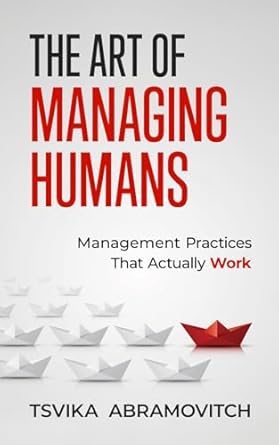

Managing human relationships is an essential skill that permeates daily life, from casual interactions like getting coffee to the complex responsibilities of leadership at work. Tsvika Abramovitch’s book, The Art of Managing Humans, is a comprehensive resource designed to be within arm’s reach, ready to offer practical insights at a moment’s notice. Abramovitch’s central aim is for managers to regularly consult this book and apply its principles in real-world situations. The book’s success lies in its ability to improve a manager’s approach by either clarifying existing knowledge or introducing new, actionable strategies that lead to tangible results. By the end of the book, readers will likely appreciate how seamlessly it achieves this objective.
One of the book’s most compelling elements is its exploration of the evolving workplace landscape, contrasting the rigid, hierarchical norms of the past with today’s dynamic, employee-centric environments. Abramovitch uses vivid examples, such as a scene from Revolutionary Road, to illustrate this shift from monotonous subordination to a work culture where employees seek meaningful engagement, career development, and a sense of purpose.
A particularly noteworthy feature of the book is the introduction of the “Seesaw Model,” which offers a fresh perspective on the shifting balance of power between employers and employees. Abramovitch effectively argues that modern managers must navigate a landscape where authority is no longer absolute, and employee input and satisfaction are critical to organizational success. The value of this book is further underscored by its historical perspective on the evolution of Human Resources (HR). Abramovitch traces HR’s journey from a clerical function to a vital business partner, providing readers with a deeper understanding of the complexities involved in managing human capital today. This historical context highlights the crucial role HR plays in driving organizational success.
Abramovitch’s writing is both insightful and practical, making The Art of Managing Humans an invaluable resource for managers at all levels. His ability to distill complex concepts into actionable advice is one of the book’s key strengths. The text is peppered with quips that not only add depth to the discussion but also engage the reader, prompting them to reflect on the various dimensions of leadership.
The Art of Managing Humans serves as a manual for navigating the challenges of modern management and excelling as a leader in today’s workforce. Abramovitch set out to create a tool that managers can refer to whenever and wherever needed. This book is like a guru imparting wisdom and a wise mentor offering encouragement and knowledge as you step into the world of management.
Pages: 195 | ASIN : B0CPX43KX3

Be Human, Lead Human: How to Connect People and Performance

In her book, Be Human, Lead Human: How to Connect People and Performance, Jennifer Nash, Ph.D., brings a distinctive and deeply personal perspective to the topic of leadership. Drawing on her own experiences and contemplations, Nash takes the reader on a journey to explore what it truly means to lead with a sense of humanity in an era where traditional leadership methodologies often seem inadequate.
Nash’s narrative is not just a recount of her own journey; it serves as a catalyst for delving into the ethos and practices of Human Leadership. The book is peppered with engaging anecdotes and reflective insights that highlight the importance of empathy, authenticity, and connection in leadership roles. One of the book’s strengths lies in its emphasis on actionable advice. Nash opts for providing a constructive roadmap for evolving leadership practices, steering clear of merely critiquing conventional methods.
The inclusion of self-assessment exercises and “Pro Tips” throughout the book actively engages the reader, offering them tangible steps to enhance their leadership skills with compassion and effectiveness. Nash’s writing style is approachable and relatable, successfully weaving personal stories with professional insights. Her vivid descriptions, such as the image of a paper plate decorated with Superman stickers or the emotional resonance of receiving a handwritten note from a CEO, effectively draw the reader into the narrative. This approach not only engages the reader but also makes the material relevant and thought-provoking. The book does an excellent job of illustrating the significant impact that a human-centered approach to leadership can have in the workplace. It addresses common professional challenges, such as the silencing of diverse voices and adhering to the status quo, which will resonate with many readers.
Be Human, Lead Human: How to Connect People and Performance stands out as a thoughtful and insightful exploration of leadership. Nash offers practical advice for leaders looking to improve their approach to people management. The book is a valuable resource for leaders aiming to enhance their effectiveness and create a more engaging and fulfilling workplace in today’s dynamic work environment.
Pages: 346 | ASIN : B0BYKWRGH9


