Blog Archives
Simmering Emotions


Simmering Emotions is a tapestry of memory, heritage, and human feeling stitched together with poetic elegance. The book blends verse, prose, and reflection, moving fluidly from personal stories of mothers and migration to philosophical musings and historical essays. Each piece feels like an offering from the author’s heart. He writes of love and loss, of the soul of Punjab, of the ache of displacement, and of simple kindness that survives every storm. It’s not a single story but a chorus of voices. Sometimes the rhythm is that of a lullaby, other times a lament, but it always feels alive.
Reading it stirred something deep in me. The writing is both grounded and lyrical. Author Manmohan Sadana writes like someone who has seen both light and shadow and refuses to let either define him. His language feels sincere, not polished for show. The poems about Partition and motherhood nearly broke me. There’s pain, but there’s also grace. The imagery, trains, rivers, gold temples, and quiet rooms, made me feel like I was walking beside him through decades of Indian history and human emotion. I could sense his reverence for women, his tenderness toward the past, and his restlessness in a changing world. Yet at times the tone shifts sharply from poetic to academic, which can feel jarring. It’s as if the writer’s mind and heart take turns speaking. Still, that rawness makes the book honest.
What stayed with me most is the quiet dignity of his characters. The old mother who rebuilds her life from ashes. The lovers separated by Partition who never stop whispering each other’s names. Even in the essays about cities and traditions, there’s an undercurrent of yearning, a belief that goodness survives. The writing reminded me that culture isn’t just monuments or food, it’s the way people love and forgive. There were moments when I had to stop reading, just to breathe and absorb the weight of his compassion.
I’d recommend this book to anyone who loves poetry that tells stories and stories that feel like prayers. It’s for readers who want to feel rather than analyze, who find beauty in nostalgia and redemption in remembrance. If you’ve ever sat with old memories that refuse to fade, Simmering Emotions will speak to you gently, as a friend who has also lived, lost, and learned to forgive.
Pages: 206 | ASIN : B0FS46N1S1

Fleeting Moments, Eternal Memories

Manmohan Sadana’s book Fleeting Moments, Eternal Memories is a beautiful collection of short stories, poems, and reflections that move between memory and imagination, history and myth, the everyday and the extraordinary. Sadana weaves together tales of love, loss, tradition, rebellion, and hope, set across a backdrop of Indian culture, history, and modern realities. The book dances between genres—historical fiction, mythology retellings, social commentary, and deeply personal narratives—yet it all comes together under a central theme: that life’s fleeting moments leave behind powerful, eternal memories.
The opening story An Eternity of Love hit me right in the heart. It’s the kind of love story that just melts you. Arjun, who struggles with dyslexia, and Aisha, who is blind, connect over literature, tea, and subtle gestures that speak louder than words. Their story unfolds with a soft kind of intensity. It’s so tender, so warm. That one line—“I may not see them, Arjun, but I can feel their magic”—when Aisha talks about the stars, gave me chills. This story made me believe in the kind of love that transcends sight, time, and distance.
But the book doesn’t just swim in sweetness. It dives deep into heavy, uncomfortable waters too. Take Babloo, for instance. It starts off lighthearted—Babloo is this vibrant, quirky garbage collector who radiates joy and love for his family. But then it takes a shocking, tragic turn at the end, and suddenly you’re slapped with the reality of exploitation, disability, and systemic silence. It’s not an easy read, and it’s not supposed to be. The way Sadana leaves that last scene hanging, without resolution, is haunting. That’s what made it powerful.
The chapter Love Rekindled is a quiet, emotionally rich tale about second chances and rediscovering love later in life. It follows Nisha and Arvind, once college sweethearts, now in their 60s, who reconnect after decades of separation. What makes this story special is its simplicity—there’s no dramatic twist, just two people finding warmth in shared memories, rekindling a bond that time never fully erased. Sadana writes their reunion with tenderness, capturing the awkwardness, nostalgia, and quiet excitement that comes with revisiting a past left unfinished. It’s heartwarming to see how love, even when buried under years of silence and different lives, can still bloom again with a single conversation.
This book isn’t just a light stroll through nostalgia. It’s layered and thoughtful. Some stories are sugar-sweet and soothing, others are raw and painful. The writing isn’t always polished—there are a few places where dialogue feels a little staged or too descriptive—but the heart behind it is undeniable. Sadana writes like someone who’s lived through many lives and still carries pieces of them in his pocket.
If you’re someone who enjoys emotionally rich storytelling, who loves a mix of folklore and reality, or who’s looking for a book that can make you smile and cry in the same chapter, this is it. Fleeting Moments, Eternal Memories is perfect for reflective readers, for romantics, for lovers of Indian culture, and for anyone who’s ever wanted to pause life just to remember a moment a little longer.
Pages: 202 | ISBN : 9789370093713
They Paved The Path On Which I Tread
Healing Strings follows an ex-pat from India who is forced to take shelter after Tokyo is rocked by two major natural disasters. What was the inspiration for the setup to your story?
“Healing Strings” is a work of fiction with some autobiographical elements. I was living in Tokyo, when an earthquake of 9 Richter struck the Tohoku region in Japan on March 11, 2011, followed by a Tsunami at 14.46 JST. These two major disasters occurred at a time when I was diagnosed with “Takayasu Arteritis” – a fatal autoimmune disease. The Japanese doctors did an exceedingly good job of saving me. These major events after a few years triggered my imagination to write a novel. As this would be my first attempt at novel writing, I took admission in an online Novel Writing Course in the Faber Academy, UK. This novel my project in Faber Academy developed into the present stage with the guidance received from my Professors and Authors in Faber Academy, i.e Emily Barr and Mark Jervis. They paved the path on which I tread and expressed my imagination, experiences and dreams into words.
I must admit that what follows the earthquake in the novel is fiction, though I am a keen lover of the mandolin and music therapy is a major theme of this work. The location of the novel as well as description of Japanese culture in Tokyo and Kyoto as well that of Bekal in Kerala is what I have experienced first-hand and so is the medical treatment imparted to the protagonist for “Takayasu Arteritis” by the Japanese doctors.
Raj is an interesting character. What were some driving ideals behind your character’s development?
Raj is a character which developed through me as we both suffer from the same physical ailment. However, our lives may have taken different trajectories as Raj is a figment of my imagination. His value system which he has imbibed is what I cherish. He is a ‘family man’ with immense love and affection for his wife, son, and daughter. Though he is a marketing professional in a corporate firm in Tokyo, his roots and magnetic pull is towards his family in New Delhi in India.
Another trait of his character is his sense of humour and empathy which is reflected in his relationship with the staff of Trinity Advertising, his friend Bikram, and the nurses in the hospital.
A major theme of the novel is music, and this germinates from Raj’s love for the mandolin. Playing on the mandolin’s strings not only is a source of communication with Ayana but also helps in subsiding the aneurysms in his body. As Music Therapy worked in his case, he tries to replicate the same by opening an institute of Music Therapy in Bekal in Kerala. He wants to share with society, what has worked in his life.
The love he develops for his mandolin teacher and the respect he has for her husband and his own wife depicts his level of maturity in handling such a situation. An attempt has been made to portray him as a good human being, a fine friend, a virtuous life-partner, a platonic lover, and a concerned parent.
The reader on reading the novel may wish to imbibe some of his traits.
What were some themes that were important for you to explore in this book?
There are various themes which run concurrently in “Healing Strings”. One of the major themes in this work is disaster at the personal level and national level and how it effects an individual, society, and the entire nation. To overcome a disaster, requires resilience and expertise and these aspects are delineated in the reactions of Raj, scientists, medical fraternity, as well as the local population of Japan.
The second theme which is predominant is love and that love can bloom even without verbal or written communication. Love has only a beginning…. and that love can rise above the physical. Music can bring the hearts together and convey more to the lovers than any language.
The third theme is Music Therapy, and this is depicted in the blooming feelings of Raj and Ayana as well the cure of Raj’s ailment. It is not surprising that in today’s world modern medical science has accepted the role of Music Therapy and many hospitals world over have a Music Therapy wing. The famous American novelist Jodi Lynn Picoult states, “Music therapy, to me, is music performance without the ego. It’s not about entertainment as much as about empathizing. If you can use music to slip past the pain and gather insight into the workings of someone else’s mind, you can begin to fix a problem.”
What is the next book that you are working on and when will it be available?
I am presently working on two books simultaneously. The first book is a compilation of short stories titled “Thirteen” which will depict various scenes of life which we overlook and consider as natural happenings, but they play a major role in the character’s life. I personally feel that every human being is a compilation of experiences, stories, and anecdotes. We just need to be keen observers and empathise with what another human being undergoes. This book should be ready for release in 2023.
The second book I am working on with a co-author is non-fiction and is tentatively titled “Tourism Marketing in India”. The focus of this book is on the post-pandemic era, the marketing strategies required to revive tourism in India and usage of social media tools to position the destination in the potential tourist’s psyche in various key markets across the globe. The world has undergone a sea change because of the onslaught of Covid 19 and almost all destinations need resuscitation and revival at the grassroot level. Hence, the strategies to promote a destination which will now emerge with the new travel trends are going to be different. I sincerely hope I can complete this work in 2022.
Author Links: Twitter | Facebook
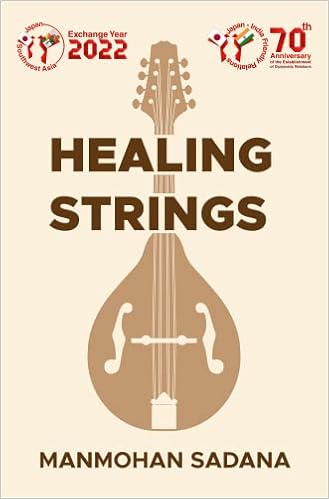
“Healing Strings” 14:46 hrs, 11 March, 2011, Tokyo is hit by a massive earthquake. The city is still reeling with the aftershocks when an unprecedented Tsunami hits its shores. This wake of destruction is reflected in the life of Raj, an expat from India. 50-year-old Raj has been diagnosed with Takayasu Arteritis, an incurable disease in which the blood vessels develop blockages which can burst at any moment. Raj had nine such aneurysms all over his body. The Japanese Doctors are trying their best to prevent them from bursting. Much like scientists in Fukushima trying hard to prevent the nuclear reactors from exploding. Out for a random stroll, an antique Mandolin catches his eye. He ends up buying the instrument, hoping to learn how to play it. This item on his bucket list, takes him to the threshold of an elderly Japanese musician. She hesitantly takes him under her fold. She only speaks Japanese, of which Raj does not understand a word. Transcending language and cultural barriers, a rare friendship develops between the two. In a scenario of disease and disaster, does the will to survive and make new beginnings assert itself, amongst the Japanese and Raj………. Reviews ” A fascinating debut! Love blossoms in an ambience of disaster, Japanese culture and resilience, and ends in the beautiful environs of Bekal in Kerala. Creativity at its best! Truly captivating. – Amitabh Kant, CEO, NITI Aayog, Government of India. ” Music heals – how true and how well this book brings it out. And provides succour to the protagonist, the lovers and the nation. A great read” – Ashwani Lohani CEO, GMR Services Business, Former CMD, Air India & ITDC, Former Chairman, Railway Board. “the story is truly heart-warming and enlightening, definitely an original tale that I have not had the pleasure of hearing anything similar before.” – Literary Titan
Healing Strings

Healing Strings by Manmohan Sadana is an extremely touching tale that follows Raj, an ex-pat from India, who is living away from his family in Tokyo. This is where we find him when a massive earthquake shakes the city, and he is forced to take shelter. But unfortunately, in the wake of one natural disaster comes another in the form of a tsunami, and those living in Japan must also deal with the threat coming from the nuclear reactors. Although, these are just the beginning of the issues that Raj must face, as he soon discovers he is very ill and in need of urgent medical attention.
There is constant mirroring of the two storylines, Japan trying to recover from natural disasters while in constant worry that a nuclear reactor will explode, and Raj’s personal battle with his disease and the concern that his blood vessels may burst at any moment. This is excellently portrayed as we follow Raj, who learns about what is happening everywhere else through news stories and from his friends.
This story is a potent reminder that while all of these things are happening in the larger picture, life still continues as individuals as well. From battling his illness to trying to learn a new skill of playing the mandolin, it is an excellent theme to have filtered through the main text. This book also shows readers how Music Therapy can be used to cure ailments, and that music is truly a powerful part of our lives.
There are so many varying cultural references throughout as well. The reader gets a glimpse into Raj’s culture through references to ‘Shiva-the Hindu God’ or his mantra taught him by his ‘spiritual adept.’ But they also get to see the Japanese culture witnessed by Raj. For example, when he first meets Ayana, the music teacher and Japan’s treasured musician, she is described as wearing a ‘silk kimono with sakura imprints.’ These visual representations of the culture allow the reader to honestly imagine what is happening.
There are a few places I thought metaphor and suggestion rather than telling would have given the story more depth. However, the story is truly heart-warming and enlightening, definitely an original tale that I have not had the pleasure of hearing anything similar before.
Pages: 162 | ISBN: 9356206465



 LITERARY TITAN