Blog Archives
In Vitro


M.J. Kuhar’s In Vitro is a medical drama built around one of the most intimate hopes a couple can carry: the hope of becoming parents. The novel opens with McArthur Fertility Institute already under investigation, then moves back two months to show how the crisis began. That structure gives the story an immediate sense of tension, but the heart of the book is personal. Evie and Leon Coleman’s longing for a baby, Joyce Porter’s devotion to her patients, and the quiet pressure inside a prestigious fertility clinic all come together in a story about trust, ambition, consent, and the emotional weight of reproductive medicine.
Joyce is the character who holds the book together. She’s smart, compassionate, anxious, ambitious, and deeply human in the way she second-guesses herself while still trying to do right by her patients. Her work at McArthur puts her in the middle of ethical questions that grow more serious with every chapter, but Kuhar also makes room for her marriage to Bill, her friendship with Sally, her attraction to Dominique, and her ongoing struggle to be heard in a workplace shaped by hierarchy and ego. The smaller domestic details, like phone calls, coffee, cats, and rushed lunches, make Joyce feel like a real person rather than just the doctor at the center of a scandal.
The strongest parts of the novel are the scenes where medicine and emotion collide. Kuhar clearly understands the procedures, the language, and the rhythms of a fertility clinic, but the book stays grounded in the people whose lives are changed by those procedures. Evie and Leon’s early tenderness gives the story its emotional anchor, especially when Leon tells her, “Evie, I love you. No matter what.” That line captures the couple’s sweetness while also foreshadowing how much their love will be tested once the clinic’s secrets begin to surface.
The darker thread of the book comes through Owen Hicks, whose obsession with reputation and success poisons the culture around him. His command to “Stay the course and keep those pregnancy rates up” says a lot about the world he’s created, one where numbers matter more than people. Kuhar builds the tension steadily as Joyce begins to understand that the problems at McArthur aren’t isolated mistakes. They’re part of a larger pattern of abuse, secrecy, and institutional self-protection. The result is a story that reads like a workplace drama, a medical mystery, and a moral reckoning all at once.
In Vitro is a compassionate and accessible novel about infertility, medical ethics, and the courage it takes to challenge powerful people. It gives readers the emotional reality of IVF from several angles: the couples who want children, the doctors who want to help, and the administrators who want the clinic’s success story to stay intact. Kuhar’s conversational style keeps the story easy to follow even when the stakes get heavy, and the ending gives the characters space to reckon with what happened and imagine a life beyond McArthur. It’s the kind of book that invites readers to care about the science because they already care about the people.
Pages: 332 | ASIN : B0G1BKZQMY

Unseen Adversaries

Fade to Blue follows an Alzheimer’s researcher who is being hunted and manipulated after accidentally creating a drug that can almost instantly wipe out all brain activity. Where did the idea for this novel come from?
In 1998, I was working at a steel mill. One evening during a break, a coworker suggested we write a short story together. While considering ideas, I remembered that an annealing line had crashed because a computer controlling its speed and torque had lost all Random-access memory. I said, “How about this: a scientist creates a drug that can erase a human’s memory.”
How much research went into the neuroscience and Alzheimer’s elements of the story?
My father was suffering from Alzheimer’s disease when I began writing Fade to Blue. That had a huge impact on me and the story.
Regarding the research, neuroscientist Dr. Brian Cummings invited me to his UC Irvine laboratory, where I saw firsthand the experiments and brain research being done by his students. The Memory Research Institute depicted in Fade to Blue is the result of my visit to UC Irvine. And it was Dr. Cummings who explained how a brain-destroying drug like T-3 could be created.
I later went to New York City at the invitation of Dr. Bernardo Rudy, head of the Rudy Lab at NYU Department of Neuroscience, to get a tour of his laboratory and discuss the science in my book.
The novel builds tension through small, everyday moments—driving, showering, simply being alone. Why was it important to show fear in those ordinary situations?
I wanted to infuse fear into normally mundane aspects of Sarah’s life so a reader could identify. We all drive a car and receive phone calls from friends. Those events shouldn’t stoke fear or panic. They do in Fade to Blue because unknown and unseen adversaries are following Sarah’s every move and listening to her every sound. This fear is omnipresent, but she must maintain a happy façade and keep her friends in the dark. At the same time, she channels her fear into courage, cunning, and resolve.
What is the next book you are working on, and when will it be available?
Unfortunately, I’m not planning to write more books at this time. It took me 25 years to write Fade to Blue.
Author Links: GoodReads | Amazon
Sarah Brenalen, a frustrated researcher, secretly tests experimental Alzheimer’s drugs, only to create a brain-destroying compound. Marcel, an international operative, sees its potential.
Fade to Blue plunges you into a high-stakes cat-and-mouse game. Is Sarah a pawn, or can she outwit Marcel and prevent global catastrophe?
Uncover a dark conspiracy
Experience a fast-paced thriller
Explore the ethics of scientific discovery
For fans of Robin Cook and Michael Crichton, this medical thriller blends cutting-edge science with heart-stopping suspense.
Poison Pill

Poison Pill is a medical thriller that follows Dr. Mark Lin, a hospital internist in Southern California, after two young patients land in his care with problems that feel too extreme, too early: a 24-year-old in kidney failure and a severely obese man with worsening breathing issues. When Mark notices a common thread, both men have been using weight-loss products, one an herbal supplement called Motileaf and the other a prescription drug called Naxipil, his curiosity turns into an off-the-clock investigation that pulls him from hospital rounds into supplement shops, corporate hallways, and a much bigger fight over how “help” gets sold, regulated, and sometimes weaponized.
What I liked right away is how the book opens with the body, not the conspiracy. There’s this clear-eyed attention to blood, organs, and the quiet terror of hearing a patient ask if they’re going to die. The medical detail is frequent and confident, but it usually lands in a way that serves the tension instead of showing off. You can almost smell the dialysis unit and feel the fluorescent stillness of a hospital hallway. And the first-person voice works here. Mark can be compassionate with patients, prickly with colleagues, and blunt in his private thoughts, sometimes all in the same scene. That mix made him feel authentic to me, which matters in a genre where the lead can easily turn into a walking lab coat.
Author Anthony Lee also makes a deliberate choice to bring the reader into the systems around medicine, not just the bedside moments. You get a lot about how herbal supplements slide through looser oversight, how pharma messaging moves, and how “evidence” can be both a shield and a sales tool. The plot escalates the way good thrillers do: one unsettling link becomes two, then suddenly Mark is watching the supply chain and realizing how many hands touch a “simple” capsule before it reaches someone’s kitchen counter. The story occasionally pauses to explain processes and terminology, which will work for some readers, but I found it mostly grounded because it’s framed as how a clinician thinks when the pattern won’t let go.
Poison Pill reminds me of author Tess Gerritsen, where the pace comes from a doctor pushing past polite boundaries because the official story does not add up, like in Harvest. And if you like Michael Crichton’s “this could actually happen” vibe, especially the procedural, systems-focused suspense of The Andromeda Strain, Lee’s interest in process, oversight, and unintended consequences will feel familiar, just grounded more in everyday medicine and consumer health than in big sci-fi set pieces.
I’d recommend Poison Pill to readers who like medical thrillers with a strong “how did this happen” spine, especially if you enjoy stories that blend clinical realism with corporate and regulatory pressure. If you’re into slow-burn unease that builds into a wider conspiracy, and you don’t mind learning a little along the way, this one will hit the spot.
Pages: 383 | ASIN : B0GGZG155T
Be Aware, Be Ready

To Slaughter a Camel follows a nurse practitioner whose loyalty is tested when she is suddenly pulled into the shadow world of US Intelligence. What was the inspiration for the setup of your story?
I’ll try to give you the short version.
Erika, my protagonist, was featured in my first novel, Topeka ma’shuge, a dark coming of age story. She survived her journey to adulthood, the novel concludes open-ended, but by that time I think I was a little in love with her; she hung around in the back of my mind, always asking me, “What about the rest of my life?”
I’ve known many military personnel in my life, and a handful from the clandestine services. I was aware of the role of being a medical provider embedded with clandestine operators, and the risks they faced, lacking the necessary warrior training to deal with the casualties when a mission goes terribly wrong.
Erika is isolated and looking for a sense of family; her decision to join the CIA is impulsive after the death of her best friend, but she already has unwittingly qualified for the position. It was only natural at that point, as in may thrillers and mysteries, to plop her in a catastrophe she wasn’t prepared for.
What were some challenges you felt were important to defining your characters in this story?
Wellesley is a bit of a cliché, the paternal supervisor with best intentions for his staff. Or is he? He is a bit insular, with a past we suspect. Why is he single? Who is the young woman in the frame by his desk? He understands the real horrors that can occur in his trade, but he tries to protect his young recruit. Was this the best decision? He isn’t sure and asks himself this as she walks away. Adding depth, ambivalence, vices and virtues to a character make them far more credible, but it does require work to do so.
Defining Erika was far easier, her character developing in the first novel. I knew her like a sister. Even when a crisis appeared that I’d only just created, I already knew how she would react. Until she was raped. As a former ER doc I understood a little bit of this, but some extensive research into the psychology of being a survivor of such an event was required. And her ability to kill, instinctively, prudently, slowly grows as the story progresses. Pacing that progress was a challenge. Pacing her evolution from a transparent medical provider devoted to the truth, to understanding how essential lies and deception are to survival in the clandestine theatre, was also a challenge.
What were some themes that were important for you to explore in this book?
“There are people in the world who will kill you for a pack of cigarettes,” Wellesley tells Erika; the warning intended for the reader as well. Don’t be paranoid, but be aware, be ready.
Perseverance in the face of adversity.
The value of patience, occasionally compassion, when one’s instincts tell you to act boldly.
What is the next book you are working on, and when will it be available?
A love story set in the first few months after 9-11. Jack Welsley, GS-13 at Langley, is 42, recently divorced, depressed, facing alcoholism, when he falls in love with the 23 year-old daughter of his best friend. She is a medic, has finished a year of Linguistics, and is slated to deploy in Afghanistan as a first Lieutenant. I hope to have a rough draft by the end of 2026, but the research is going to be exhausting, to review every day in the first year of that war, and get all of the technicalities and logistics believably correct.
Erika will reappear in the next work after that, another espionage thriller.
Author Links: GoodReads
To Slaughter a Camel masterfully charts the journey of Erika Harder from a routine existence in Oregon to a perilous life filled with uncertainty and trepidation in Madrid. Bereaved and lonely, Erika finds solace in her work as a multi-lingual nurse practitioner. Her normalcy is shattered when her proficiency in Farsi piques the interest of the State Department’s Jack Wellesley, who persuades her to serve as a civilian contractor for the CIA.
Erika’s initial excitement at the prospect of a new chapter in her life quickly morphs into a nightmare when a mission in Madrid goes awry, resulting in the death of seven of her colleagues. The explosion at the CIA station leaves her stranded with Guneet Jodal, a hapless translator whose loyalties are suspect. Erika is caught in a maelstrom of danger, with no way out and no one to trust.
Hutson’s narrative is a riveting exploration of the human spirit’s ability to endure and overcome even the most devastating tragedies. Erika, the novel’s protagonist, is a compelling character. Despite her raw wounds, both emotional and physical, she demonstrates an impressive strength and resourcefulness that will inspire readers.
To Slaughter a Camel is a unique blend of suspense and emotional depth. Hutson skillfully intertwines Erika’s personal journey with the broader narrative of international intrigue, creating a story that is as thought-provoking as it is action-packed. With a plot that keeps readers on the edge of their seats and a heroine whose resilience is nothing short of inspiring, this novel is a must-read for those seeking a thrilling, yet emotionally resonant tale.
To Slaughter a Camel


The book follows Erika Harder, a nurse practitioner in Portland whose already-fractured life is blown open by violence, loss, and an unexpected pull into the shadow world of U.S. intelligence. What begins as a grounded portrait of hospital life and grief slowly widens into a story about recruitment, moral compromise, and what it costs to belong to something larger than yourself. The plot moves from commuter trains and emergency rooms into secret offices, covert stations, and overseas assignments, tracking Erika as she’s tested not just for skill, but for resilience and loyalty.
What struck me first was how tactile the writing feels. The author lingers on details that matter. The rhythm of a train over a bridge. The chaos of a trauma bay. The weight of a shoulder bag that carries memories. These moments give the book a lived-in quality that many thrillers skip over in favor of speed. Here, the pacing is deliberate at the start, and I appreciated that patience. It lets the emotional stakes settle before the story turns sharper and more dangerous. Erika’s grief isn’t rushed or dramatized. It just sits there, heavy and unresolved.
I also found the author’s choices around power and authority compelling, if sometimes unsettling. The intelligence apparatus is not romanticized. Recruiters are intrusive. Procedures are dehumanizing. Even the promise of purpose feels conditional. There’s an ongoing tension between being chosen and being consumed, and the book doesn’t pretend those are different things. The dialogue leans into cynicism, but it fits the world being built. This is an espionage novel that understands control as something exercised quietly, through access to records, language, and fear rather than heroics.
This isn’t a slick, globe-trotting spy fantasy. It’s slower, heavier, and more reflective than that. Readers who enjoy espionage thrillers with strong character work, especially those interested in the psychological cost of service and secrecy, will appreciate this book most. If you like your thrillers grounded in realism, morally gray, and shaped by interior struggle as much as external threat, To Slaughter a Camel is worth your time.
Pages: 360 | ASIN : B0DPLJ73MN
Remaining True to Oneself

Carnage in D Minor follows an RN from her days as a piano prodigy to a military veteran with PTSD, who goes on a quest to discover a new, and ethically questionable, treatment for mental illness. What was the inspiration for the setup of your story?
The story came to me during a time when my brother, an Army war veteran, was dealing with severe depression—intensified by chronic pain from an injury he received in Iraq. His struggle inspired me to write about determination and perseverance in the face of soul-crushing obstacles. The frustration he experienced attempting to get anyone to listen to him about his chronic health issues—the direct result of his service to this country—was excruciating to listen to. The time it took for him to ultimately get treatment was a burning thread for me. During the long waits between phone calls, referrals, and appointments, he resorted to self-medicating with alcohol and prescription drugs. I was worried that he would become a forgotten statistic. But he persevered, and I’m beyond happy he’s still with us today. After a successful surgery, his pain is manageable, and he has quit drinking. Fun fact: his wife is also a career Army veteran. They are both huge inspirations to me.
Leeza’s story is one that readers can relate to or find pieces of themselves in, making it easier to connect to her character and become invested in her story. Were you able to achieve everything you wanted with Leeza’s character in the novel?
Yes. Carnage in D minor is an adaptation of a screenplay. In the original screenplay, the protagonist was a white male. As a writer, I had an urge to change that character to a Black female for the book because, over the years, I have had so many friends from underrepresented minority cultures, genders, sexual orientations, etc. I jumped in with both feet and wrote her character without holding back. I wanted her successes to rise to the level of a superhero. Judging by many of the reviews I’ve read, I think I came quite close.
What were some themes that were important for you to explore in this book?
The core themes I explored were the absolute refusal to give in or give up, and remaining true to oneself even when others have given up on you. Self-doubt is a major roadblock for so many.
What is the next book that you are working on, and when can your fans expect it to be out?
The Last Lily of Savannah – a novel. Late Summer, 2026. The story delves into a successful New York businesswoman’s seemingly perfect life. But beneath the carefully cultivated facade, she is tortured by the fact that she was adopted, and that the truth surrounding her biological family’s past has been hidden from her all her life. This story explores the primal need for adopted individuals to understand their origins. Unfortunately for our protagonist, sometimes it’s best to let sleeping dogs lie.
Incidentally, I am also writing a screenplay for a production company in L.A. It is a horror flick set in a war zone. Fingers crossed—it may be in a theater near you soon.
Author Links: GoodReads | Facebook | Website | Amazon
Leeza followed in her mother’s footsteps as a nurse, relying on Army ROTC for her education. During her early career as an RN and a commissioned officer, she endured a deployment in a war zone that left her with severe PTSD and a battle with addiction.
Twenty years later, Leeza is a married mother of two and a successful neurosurgical nurse practitioner. She is also a passionate activist. Driven by her own mental challenges and a deep desire to help others, she embarks on a desperate, ethically questionable quest to discover a revolutionary treatment for mental illness. Her goal: “mental conflict remission” and a global shift to destigmatize mental illness.
Though the journey is fraught with danger and illegality, Leeza’s passion and strength ultimately carry her though, culminating in a powerful story of global triumph.
Devotion and Duty

Sick is a haunting psychological horror that follows a marriage unraveling into madness as devotion, illness, and manipulation, and blurs into a claustrophobic battle for control and belonging. What was the inspiration for the setup of your story?
This story was born from a nightmare. I dreamt I was a woman whose life was decaying around her as she cared for her sickly husband. By the end of the dream, she discovered the man she loved and trusted was far more ill than she could imagine. Her disorientation and fear pulled at me, and I knew I had to write the story.
How did you balance the ambiguity of John’s illness so the reader constantly questions what’s real and what’s manipulation?
I wanted to put people inside Susan’s mind, in the perspective of your typical person who feels the duty to care for their loved ones, no matter what is required. She has let her husband’s illness take over her life, so much so that she no longer has one. Of course, caregivers think, this person is sick, they need me. But what is the cost to yourself? When does devotion and duty become co-dependency? You can only be manipulated if you allow people to do so. How much of it is your own fault?
The book relies heavily on atmosphere and sensory detail rather than overt scares. How do you approach building tension through subtlety rather than shock?
I think the dark, quiet desires, motivations, and needs of our inner selves are more terrifying than your typical monsters, serial killers, or jump scares. It’s the realization that the frame you put around your life story to keep you safe could be a lie, and that you have been preyed upon by those you love and trust. It’s being slowly bled dry and not knowing until it’s too late. Worst of all is realizing you had a hand in your own demise.
What do you hope readers take away about love, neediness, and the moral gray zones that exist inside unhealthy relationships?
I hope readers will think more deeply about what they’re giving and taking in relationships, to be aware when someone is manipulating and using them, and where they themselves might be abusing a person in their life in a mental or emotional way.
Most victims can’t conceive that someone who claims to love them is silently exploiting them for their own gain. Likewise, abusers often don’t know that what they are doing is toxic. These are survival mechanisms they learned as children.
That is why I showed both Susan’s and John’s sides of the story. Neither of them is innocent.
Unfortunately, once confronted, not all abusers will acknowledge to themselves, much less to others, that they were damaging the people around them. It takes a brave person, a genuinely good-hearted and self-aware person, to be willing to admit their flaws and work to change them. Most narcissists and psychopaths do not have any empathy for others, nor true self-awareness that extends beyond their own self-importance.
I hope this story will wake up victims to possible abuse and tip off abusers that maybe they are the villain, and not the hero, of their own story.
Author Links: GoodReads | Facebook | Instagram | Website | Write Catalyst | Amazon
Charming and enigmatic, but very sick.
Born into wealth and prestige, John lost his family’s fortune to the mysterious illness that has now left him bedridden, and Susan’s life revolves around his care.
Years of devotion have left her exhausted and frustrated, yet she’s determined to scrape together whatever resources she can to keep John comfortable and happy—including stealing Demerol from the doctor’s office where she works to feed his growing dependence on painkillers.
As John’s condition continues to baffle doctors, Susan uncovers a secret from his childhood and the chilling cause of his illness.
Now that she knows the truth, can she put an end to the madness?
Christa Wojciechowski delivers a twisted psychological suspense novel for readers who like their fiction sick, sharp, and unforgettable.
Bad Pharma
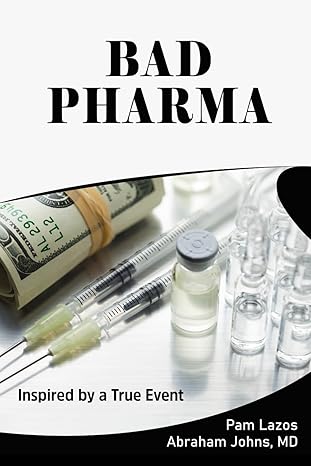
Bad Pharma is a medical thriller that dives into the murky waters of the pharmaceutical industry. It tells the story of Nora O’Connell, a savvy pharmaceutical professional, and Siddhartha Kumar, a meticulous medical monitor, as they navigate the ethical quagmire of Big Pharma’s relentless drive for profit. The story intertwines corporate ambition, personal stakes, and moral dilemmas, shedding light on the sometimes disastrous consequences of prioritizing business over patient safety.
One thing I loved about this book is its rich and complex characters. Nora’s razor-sharp wit and unrelenting ambition make her a captivating protagonist, but it’s her internal struggle with corporate ethics that truly resonates. Take her confrontation with Sid in Chapter 4—her fiery accusations and Sid’s calculated calmness highlight the human element in a soulless corporate environment. Sid, too, is a standout character. Haunted by the ghost of Bonifidia, a past pharmaceutical disaster, he’s the moral compass of the story. His dogged determination to analyze RSVIX data properly, despite mounting pressure, had me rooting for him even when his methods bordered on maddeningly slow.
The writing itself is vivid and engaging, but at times, it teeters on over-explaining. The passages detailing the clinical trial process, while necessary, occasionally bogged down the pace. That said, I appreciated the clarity in these sections, particularly when Sid outlines the risks associated with cutting corners in vaccine trials. The authors don’t just present the science—they make you feel the weight of the decisions being made. For instance, the description of Keturah’s hospitalization in Chapter 6 was gut-wrenching. It made the stakes of the BREATHE trial painfully real.
I also found the tension between Nora and Sid compelling. The workplace banter was a welcome reprieve from the darker themes, providing a balance that kept the narrative from feeling too heavy. The authors’ ability to blend sharp commentary on the pharmaceutical industry with human connection is a testament to their skill.
Bad Pharma is a moral inquiry wrapped in an engaging narrative. I would highly recommend it to anyone intrigued by the intersection of science, ethics, and corporate drama. Whether you’re a healthcare professional, a corporate worker, or simply a fan of thought-provoking conspiracy thrillers, this book will make you question how much we’re willing to compromise in the name of progress.
Pages: 365 | ASIN : B0DPSWQMXK


